

Road force balancing is a tire balancing method that does two jobs at once. It corrects weight imbalance like a standard balance, and it also presses a roller against the spinning tire to measure how stiff and round the tire and wheel are under load. That second measurement finds problems a regular spin balancer can’t see. It is worth considering when a vibration survives a normal balance, when you run low-profile tires, or when you want a new set mounted as smoothly as possible. It is not something every car needs on every tire change.
Below, we explain how the process works, what it typically costs and how long it takes, how to tell whether you need it, and what to ask a shop before you approve it.
TL;DR
- Road force balancing adds a load roller to a normal balance, so it measures how uniformly a tire pushes back, not only where weight sits.
- It is most useful for stubborn vibrations that a standard balance did not fix, and for very low-profile tires (45-series and lower).
- National estimates put it at $80 to $160 for four tires and 45 to 75 minutes. Local pricing varies by shop.
- Vibration can also come from alignment, worn suspension, bent wheels or brakes, so a proper diagnosis comes first.
- Ask your shop what machine and procedure it uses, and whether the price is per tire or for the set.
Table of Contents
- What road force balancing actually is
- How the process works, step by step
- Is road force balancing worth it?
- How much does road force balancing cost, and how long does it take?
- Check these causes before paying for a road force balance
- Our perspective: diagnose first, then pick the method
- What to expect when you bring your car in for a vibration
- Questions to ask any shop before approving road force balancing
- When we would say you don’t need it
- Get your vibration looked at
- FAQ
- Sources
What road force balancing actually is
A standard spin balancer holds your wheel and tire in the air, spins it, and tells the technician where to put small weights. It measures one thing: whether mass is distributed evenly around the assembly.
A road force balancer does that same weight check. Then it brings a heavy roller against the tread, which simulates the load of the vehicle pressing on the road. As the assembly turns, sensors record how much the force changes from one point on the tire to the next. That variation is called radial force variation, or road force.
Think of a commercial kitchen. A home scale tells you how much flour you have, but it doesn’t tell you whether the dough is rising evenly. Weight is only part of what makes a tire run smooth. The shape and internal stiffness of the tire, and the roundness of the wheel, matter just as much once the assembly is rolling under a car’s weight.
What it can find that a spin balance can’t
- Stiff or soft spots in the tire. A tire can be perfectly weight balanced and still have a section that is stiffer than the rest.
- Out-of-round tires or wheels. A slightly bent wheel or a tire that is not perfectly round shows up as force variation under load.
- Poor tire-to-wheel match. Every tire has a high point and every wheel has a low point. Tire manufacturers describe match mounting as lining up the tire’s high point with the wheel’s low point, so the two partly cancel each other out.
That last point is important. Adding lead or adhesive weight can make a tire read as balanced, but weights alone often can’t remove force variation built into the shape of the assembly. The better fix is to rotate the tire on the wheel into its best position, then add only the weight that is still needed.
How the process works, step by step
Procedures vary by machine and by shop, but a road force balance generally follows this order:
- Prepare the assembly. The wheel is cleaned and mounted on the balancer with the correct adapters. Precision work relies on proper collets and flange plates rather than generic centering cones, according to a manufacturer technical service bulletin.
- Measure. The machine spins the assembly, measures weight imbalance, then brings the roller against the tread to measure road force.
- Read the result. The technician sees how much force variation each tire has and where the high and low points sit.
- Match mount if needed. If the numbers are high, the tire is broken down and rotated on the wheel so the high point lines up with the wheel’s low point.
- Re-measure and weight. The assembly is checked again and balancing weights are added to finish the job.
- Replace or swap if the tire is the problem. If a tire still has excessive force variation after match mounting, the number points to a defective or damaged tire, and replacing it is the real fix.
One detail that affects accuracy: tires that have sat in the cold can develop temporary flat spots. The same service bulletin notes that warm tires give a truer reading, and that technicians can drive the vehicle first or measure right after it comes off a hoist. If your car has been parked for days, a short drive before the appointment is reasonable.
Is road force balancing worth it?
It depends on your car, your tires and your symptoms. Here is a plain way to decide.
| Your situation | Is road force balancing worth considering? |
|---|---|
| Vibration at highway speed that stayed after a standard balance | Yes. This is the classic use case. |
| Low-profile tires, 45-series or lower | Often yes. Industry experts note these tires are more sensitive to small uniformity flaws. |
| New set of tires on a vehicle with large, expensive wheels | Reasonable, to get the smoothest result from the start. |
| Everyday sedan or crossover, no vibration, standard sidewall tires | Usually not needed. A standard balance does the job. |
| Steering wheel shake only when braking | Not a balance issue. Look at the rotors and brakes first. |
The trade press frames it the same way. A Hunter Engineering representative told Modern Tire Dealer that a significant share of customers used to come back with vibrations after conventional balancing, and that road force measurement helps shops catch bent wheels and uniformity problems up front. In other words, the method earns its keep on problem assemblies, not on every wheel.
How much does road force balancing cost, and how long does it take?
There is no single national price, and we don’t publish one for this service. For a general picture, one 2026 industry analysis puts road force balancing at roughly $80 to $160 for four tires, compared with $40 to $80 for a standard spin balance. The same analysis estimates 45 to 75 minutes for a set of four, against 30 to 45 minutes for a standard balance, because the load roller step adds about 3 to 5 minutes per tire.
Treat those as ballpark figures, not quotes. Dealerships and performance shops can charge more, and some shops price per tire instead of per set.
If you have seen a dealer quote that makes you wince, that is a fair reason to ask questions, not to refuse automatically. Ask:
- Is the price per tire or for all four?
- Does it include match mounting and any weights?
- What will you do if a tire shows high force variation after match mounting?
- Can I see the measurements before and after?
A shop that can answer those clearly is a shop you can trust with the work.
Check these causes before paying for a road force balance
A vibration is a symptom, and balance is only one possible cause. Before spending money on a specialized procedure, rule out the more common culprits.
- Plain imbalance. If the tires were never balanced, or a weight fell off, a standard balance is the right and cheaper fix. Our guide to mounting and balancing tires walks through what a normal service includes.
- Alignment. Alignment affects wear and pulling more than it causes speed-related shake. Our article on telling alignment from balance helps you describe what you feel.
- Worn suspension or steering parts. Loose or worn components can produce shake, wander and clunks. A steering wheel vibration guide covers these causes in more detail.
- Brake problems. A pulse you feel mainly when slowing down points toward rotors. See warped rotor symptoms for how to tell.
- Wheel bearings. A hum or sway that changes with steering input is a different problem, covered in our wheel bearing noise test.
- Uneven or damaged tires. Cupping, flat spots, bulges and belt separation can all create vibration. Our uneven tire wear guide shows the patterns.
A practical rule: if the vibration is felt at a specific speed range, usually highway speeds, and it comes through the steering wheel or the seat, start with the tires and wheels. If it appears under braking, at idle, or with turning, start somewhere else.
Safety note: a bulge in a sidewall, exposed cords, a sudden new violent shake, or a wheel that looks bent should be inspected by a professional right away, before you keep driving at speed.
Our perspective: diagnose first, then pick the method
We see the same pattern often. A driver feels a shimmy, buys new tires or a quick balance, and the shimmy comes back. The frustration is real, and it usually comes from treating one symptom with one fix without confirming the cause.
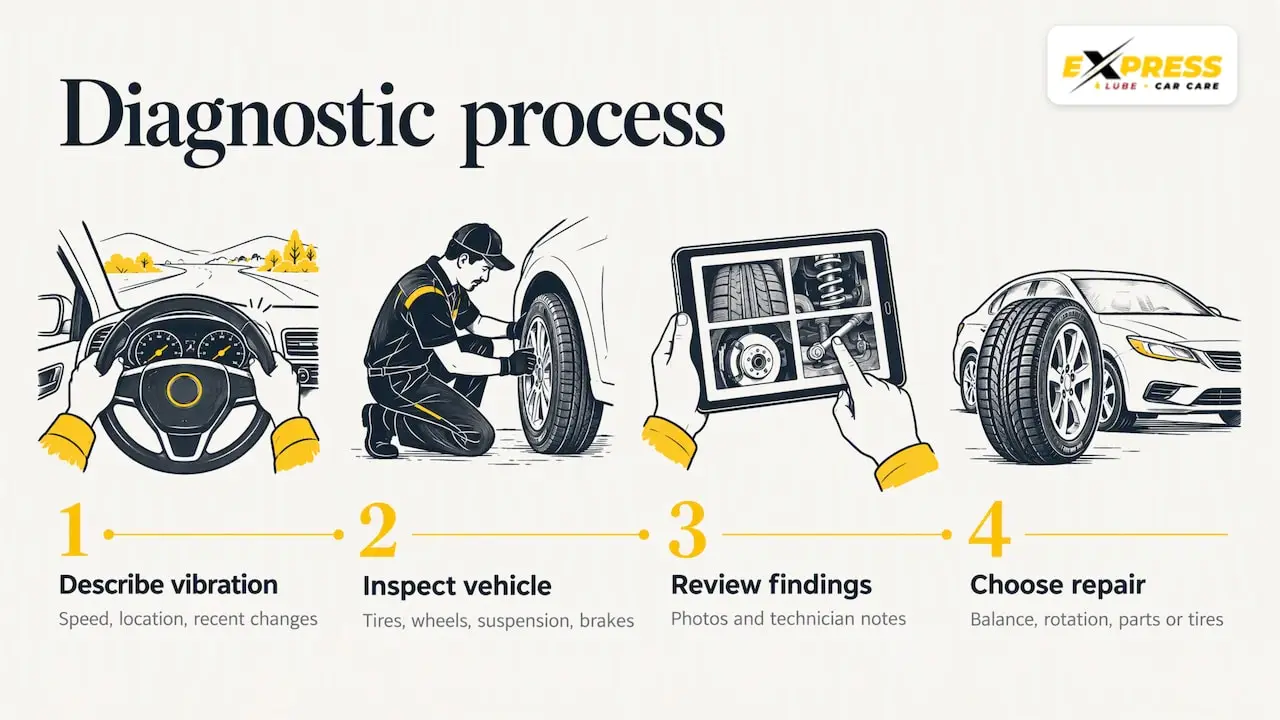
Our approach at Express Lube & Car Care is to start with a conversation and an inspection. We want to know when the vibration happens, at what speed, and whether it changed after any recent tire, brake or suspension work. Our ASE-certified technicians look at the whole system, because a tire that is truly out of round is far less common than a loose part or a simple balance that needs redoing. We also provide digital vehicle inspections with photos and technician notes, so you can see what we see before you approve any repair.
We think road force balancing is a good tool for the right job, and a poor purchase for the wrong one. That is why we would rather explain what your numbers mean than sell you an add-on you don’t need. If you have low-profile tires or a vibration that has survived a standard balance, ask us whether a road force measurement makes sense for your vehicle and what equipment is available for it. We don’t publish a price for this service, so ask for a quote before any work.
No appointment is needed for most visits, and most services are same-day.
— Express Lube & Car Care
What to expect when you bring your car in for a vibration
Here is how a visit about a vibration typically goes with us:
- You describe it. Speed range, where you feel it (steering wheel, seat, floor), and what changed recently.
- We inspect. That includes tire condition, wheels, suspension and steering components, and brakes where relevant.
- We explain the findings. With a digital inspection you get photos and notes, not just a verbal summary.
- You choose the fix. That might be a standard balance, a rotation, a part replacement, or new tires.
If we replace tires, you can read about tire sales and service and, if needed, what to know about alignment with new tires. Our services page lists everything we handle, from brakes to suspension to diagnostics.
One more consideration for Texas drivers: a vibration at highway speed is easy to ignore on short Plano commutes and hard to ignore on a long trip up US-75 or out of town. Catching it early also protects tires and suspension parts from extra wear.
Warranty note
Where repairs qualify, we offer a 24-month/24,000-mile limited warranty, whichever comes first, and a Lifetime Suspension Warranty on qualifying suspension repairs. Eligibility, limitations and exclusions apply, and not every repair or part is covered. Read the details on our auto repair warranty page before you decide.
Questions to ask any shop before approving road force balancing
Use this list whether you come to us or go elsewhere.
- What did you find that makes this necessary? A good answer references a symptom or a measured number, not just a upsell.
- Did you try a standard balance first? Sometimes that is enough.
- What are the readings? Many road force machines display force variation for each tire. Ask to see it.
- What happens if a tire fails? You should know in advance whether a replacement would be recommended and what that would cost.
- Are the wheels clean and mounted correctly? Dirt, corrosion or the wrong adapter can distort the result. Technical literature stresses correct adapters and mounting for accurate readings.
When we would say you don’t need it
It’s worth being direct. If your car drives smoothly, your tires have normal sidewalls, and you simply need new tires mounted, a standard balance is usually what manufacturers and most shops use. Trade publications ask openly whether road force is overkill on ordinary cars, and the honest answer is that it often is.
The cases where it earns its cost are narrower: persistent vibration, low-profile or performance tires, and vehicles with a history of comebacks after normal balancing. European vehicle owners and drivers with larger SUV or truck wheels are among those who ask about it most, and each deserves a conversation about the specific vehicle. Intervals and needs vary by vehicle, so your owner’s manual and a professional inspection are the right starting points.
Get your vibration looked at
If your steering wheel or seat shakes at highway speed, come by Express Lube & Car Care in Plano. We take walk-ins, so you don’t need an appointment, and we’ll tell you plainly whether you need a balance, a repair, or something more specialized. You can see our full list of services on the services page or reach us through our website.
FAQ
What does road force balancing mean?
It means balancing a tire and wheel while also measuring how consistently the tire pushes back against a roller that simulates road load. The machine checks weight distribution and force variation together. That lets a technician find stiff spots, out-of-round tires and poor tire-to-wheel matches.
How long does a road force balance take?
One 2026 industry analysis estimates 45 to 75 minutes for four tires, versus 30 to 45 minutes for a standard balance. Match mounting a problem tire adds time. Actual times depend on the shop and the vehicle.
How much does road force balancing cost?
The same analysis cites about $80 to $160 for four tires, compared with $40 to $80 for a standard balance. Local prices vary and some shops charge per tire. Ask for a written quote that says what is included.
Do new tires need road force balancing?
Not always. Most new tires on ordinary vehicles do fine with a standard balance. It is a stronger option for low-profile tires, large or costly wheels, or when you have had vibration problems before.
Can road force balancing fix every vibration?
No. It addresses problems in the tire and wheel assembly only. Vibration from worn suspension parts, brakes, bearings or alignment needs a different repair, which is why an inspection should come first.
Sources
- Road Force Balancing vs Standard Balancing: The Difference, American Fusion Wheels
- Using the Balancer to Reduce Customer Comebacks, Modern Tire Dealer
- Road Force Balance Tires, Brake & Front End
- Tire-Wheel Match Mounting for Optimum Uniformity, Mickey Thompson
- Wheel/Tire Vibration, Balance and Radial Force Variation Service Procedures, technical service bulletin