

The most common tie rod symptoms are a clunk or knock from the front end when turning at low speeds, loose or wandering steering, a vibrating steering wheel, and tires that wear unevenly on the inner or outer edge. MOOG’s guide to bad tie rods lists these same signs, along with poor handling and a front end that will not hold alignment. Any one of them is a reason to have the steering inspected, because a tie rod is one of the parts that keeps your front wheels pointed where you steer.
Below, we explain what each symptom feels like, how a worn inner tie rod differs from a worn outer tie rod end, what else can mimic the problem, whether you can keep driving, and what a repair typically involves.
TL;DR
- Watch for clunking or knocking when turning, loose or vague steering, steering-wheel vibration, a car that pulls, and uneven tire wear on the front tires.
- Outer tie rod ends usually fail from impact, corrosion or a torn boot. Inner tie rods wear more gradually inside the steering rack. Both need a hands-on inspection to confirm.
- Vibration alone does not prove a tie rod is bad. Tire balance, alignment and other worn parts can cause the same feel.
- A badly worn tie rod can separate and cause a loss of steering control, so do not put off the inspection.
- We inspect steering and suspension same day with no appointment needed at our Plano shop.
Table of Contents
- What a tie rod does
- The main tie rod symptoms
- Inner vs. outer tie rod symptoms
- What causes tie rods to wear out
- What else can feel like a bad tie rod
- How tie rods are checked
- Can you still drive with a bad tie rod?
- Perspective: why we inspect before we replace
- What a tie rod repair involves and costs
- Getting your steering checked in Plano
- FAQ
- Sources
What a tie rod does
When you turn the steering wheel, the steering rack or steering box moves, and the tie rods carry that movement out to the steering knuckle at each front wheel. Each tie rod has two parts:
- The inner tie rod threads into the steering rack and has a ball joint that lets it pivot as the suspension moves.
- The outer tie rod end connects to the steering knuckle at the wheel. It has its own ball-and-socket joint, usually protected by a rubber boot that holds in grease and keeps out dirt.
Because both ends are ball joints, they are built to move. They also wear. Every bump, turn and parking-lot maneuver works them a little, and once the joint develops play, the wheel can shift slightly on its own instead of following the steering wheel exactly.
This is why tie rod trouble is a steering and safety issue, not just a comfort one. If you want to see how the whole system fits together, our steering and suspension repair page covers what we inspect and fix.
The main tie rod symptoms
Clunking or knocking when turning
A knock, clunk, rattle or click from the front end is the symptom drivers notice first. It tends to show up at low speeds: pulling into a driveway, turning in a parking lot, or rolling over a rough patch while the wheels are turned. As the joint loosens, the stud can rattle in its socket. Delphi Technologies lists clicking, rattling or chuckling noises among the signs of worn outer tie rods.
Not every front-end noise is a tie rod. Sway bar links, ball joints, struts and control arm bushings all clunk. Our guide to diagnosing a suspension clunk walks through how a technician sorts them out.
Loose, vague or wandering steering
Worn tie rods add slack between your hands and the tires. You may notice extra play before the car responds, a need for constant small corrections on the highway, or a sense that the front end is floating. Delphi lists loose steering or steering-wheel play among the symptoms of worn outer tie rods.
This is easier to feel on a straight road at moderate speed. If the steering feels different than it did a few months ago, trust that impression and get it checked.
Steering-wheel vibration or shaking
A shaking steering wheel is one of the best-known tie rod symptoms, but it is also one of the least specific. AAA Club Alliance notes that a shaking wheel has several possible causes, including tire or wheel imbalance, alignment problems, and worn suspension parts such as tie rods. So vibration alone does not diagnose a bad tie rod.
A useful clue is timing. Vibration that appears at a certain highway speed often points to tire balance. Vibration paired with play in the steering, a clunk, or uneven wear points more toward worn parts. Our article on steering wheel vibration causes helps you narrow it down.
Uneven tire wear
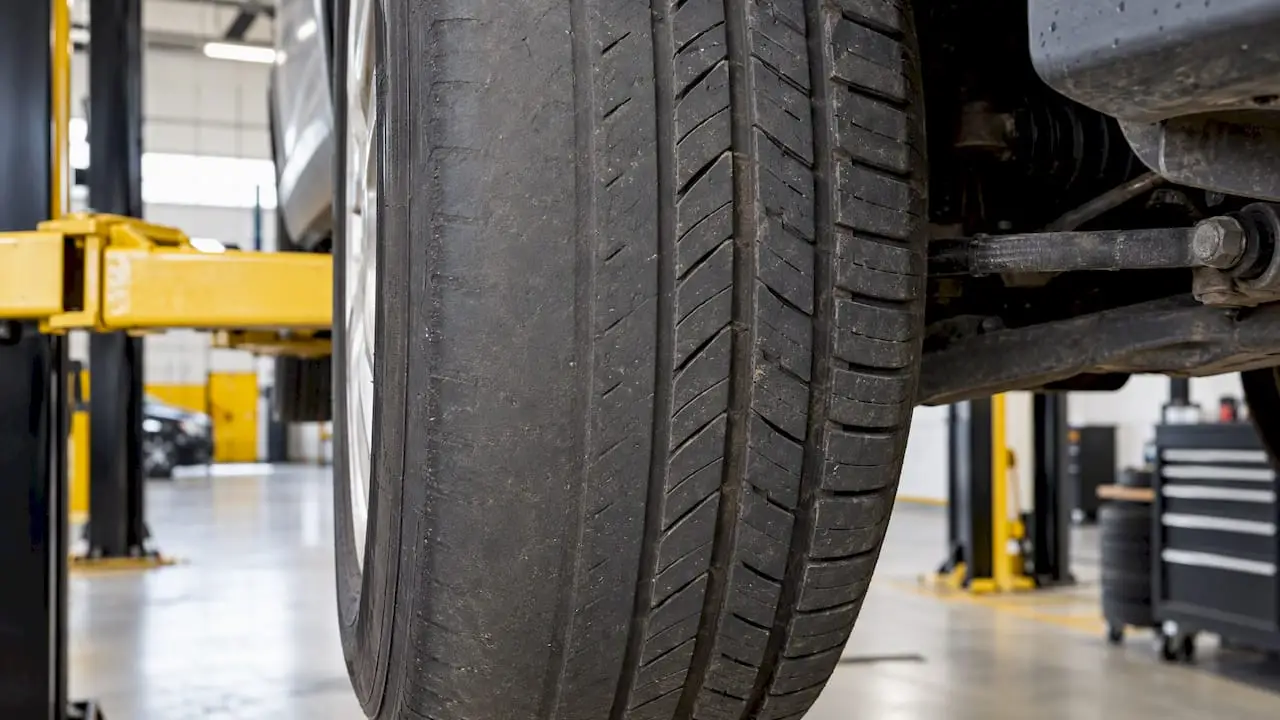
When a tie rod has play, the front wheel can drift out of its set angle, so the tire scrubs on one edge. MOOG states that a damaged tie rod can cause uneven or excessive tire wear. Brake & Front End describes a common progression: inner-edge wear on a front tire first, then a slight knock under braking or acceleration, and finally knocking while turning.
Look at your front tires for a smooth, worn-down inner or outer shoulder while the rest of the tread still looks fine. Our uneven tire wear guide matches each wear pattern to its likely cause, because worn shocks, bad alignment and low pressure also leave marks.
Pulling, an off-center wheel and alignment that will not hold
AAA’s alignment and suspension guide lists heavy pulling, an off-center steering wheel, uneven tire wear, loose or sluggish steering, and tire squeal in ordinary turns as signs to check alignment. Those are also signs that a steering component may be worn, which is why an alignment check without a look at the tie rods first can waste money. If the tie rod has play, the alignment will not stay put.
If your car drifts to one side, see our article on why a car pulls to the right. For a broader checklist, read about the signs your car needs an alignment.
Inner vs. outer tie rod symptoms
The symptoms overlap a great deal, and no one sign tells you for certain which part has failed. What helps is where the play is and when the noise happens. Brake & Front End’s inspection guidance says to check inner tie rods for knocking or clicking as the steering turns, and to check outer tie rod ends for vertical movement or free play at the joint.
| Outer tie rod end | Inner tie rod | |
|---|---|---|
| Where it is | At the steering knuckle, near the wheel | Inside the boot at the steering rack |
| Typical noise | Clunk, knock or rattle in turns, often at low speed | Knocking or clicking as the steering is turned or the rack moves |
| Feel | Play at the wheel when it is rocked by hand | Vague or loose steering, sometimes felt through the boot |
| Common causes of wear | Torn boots, road impact, corrosion | Gradual wear from repeated rack movement |
| How it is found | Free play check at the joint with the wheel off the ground | Checked at the rack, with the steering turned |
The outer end is more exposed, so it often wears out first. The inner joint is hidden under a bellows boot, which makes it easy to miss without a proper inspection. Technicians commonly check both sides and replace worn parts as a pair when wear is significant, since the matching part has seen the same miles.
What causes tie rods to wear out
Age and mileage are part of it, but not the whole story. These are the usual contributors:
- Torn or cracked boots. Brake & Front End identifies damaged boots as a major route to tie rod wear, because dirt and debris get into the joint and strip away grease.
- Potholes and curbs. A hard hit can bend a tie rod or damage a joint right away.
- Corrosion. Moisture and road grime attack exposed joints.
- Lifted or oversized setups. Larger tires and added weight on trucks and SUVs put more load on steering joints.
- Other worn parts. Loose control arm bushings or worn ball joints change the geometry and speed up wear elsewhere.
This also explains why a tie rod can fail sooner than you expect. A car with only two years on it can have a problem if a boot tore early, a wheel took a hard impact, or the joint was damaged during previous work. Mileage alone is a poor predictor, so go by symptoms and inspection results.
What else can feel like a bad tie rod
Before you commit to a repair, a technician should rule out look-alikes. The most common are:
- Wheel bearings. A hum or grinding that changes with speed or when swaying the car side to side. See our wheel bearing noise test.
- Worn shocks and struts. Bouncy ride, nose dive and clunks over bumps. See our list of bad shock and strut symptoms.
- Control arm bushings. Clunks on braking and loose handling. Read about control arm bushings.
- Ball joints. Clunks and wander, often with similar play at the wheel.
- Tire problems. Imbalance, separated belts or flat spots cause vibration without any worn steering parts.
- CV axles or a steering rack. Clicking in tight turns or grinding while steering. See our guide to grinding when turning the wheel.
Because so many parts produce similar symptoms, guessing and replacing parts is the expensive way to fix a steering problem. A hands-on check finds the actual play.
How tie rods are checked
The checks below show how a technician confirms a tie rod problem. They are explained so you know what to expect, not as a replacement for inspection.
- Wheel play check. With the front wheel lifted, the technician grips the tire at 9 and 3 o’clock and tries to move it back and forth. Movement here can point to a worn tie rod end, though a wheel bearing or other part can also be involved.
- Dry park check. Brake & Front End describes the dry park method, where the steering is turned with the vehicle’s weight on the tires so any slack in the steering linkage can be seen and felt. On turn plates, an assistant locks the steering while the technician tries to move the tire to detect play.
- Boot and joint inspection. The technician looks for torn boots, leaking grease and joints that move more than they should.
- Related components. Control arm bushings and ball joint wear can affect what the tie rod test appears to show, so those get checked too.
If you want to check at home, you can look at the front tires for uneven wear and check for torn rubber boots with a flashlight. Skip the lift-and-shake test unless you have jack stands and know how to use them. Do not work under a car held only by a jack. For a vehicle you depend on for the school run or a commute, an inspection is the safer route.
On manufacturer procedure, one NHTSA-posted service bulletin states that its steps are intended for skilled technicians with proper tools, equipment and training, and that the work includes relearning steering angle sensors and an alignment on that vehicle. Many newer vehicles are like that: steering repairs touch electronics, and the car needs an alignment afterward.
Can you still drive with a bad tie rod?
A tie rod with a small amount of wear may let you drive a short distance to a shop, but you should not treat it as a part that can wait. The reason is simple: if a tie rod separates or breaks, the wheel can turn on its own.
NHTSA recall reports show what is at stake. A 2024 safety recall notice describes tie rod separation or breakage that can lead to sudden or partial loss of steering control and increase the risk of a crash. A 2023 NHTSA recall report on certain 2020 to 2022 Nissan Sentras states that a bent tie rod may cause an off-center steering wheel or vibration, and that if it breaks, the result can be partial loss of steering control. Those were specific vehicles and defects, but they show the consequence when the part fails.
Here is a practical way to decide:
- Stop and arrange a tow if the steering suddenly feels disconnected, the wheel will not respond normally, a front wheel looks tilted or out of line, or you hear loud clunking with every turn of the wheel.
- Limit driving to a short, slow trip to a shop if you have mild play, a light clunk at low speed or uneven tire wear. Avoid highways and heavy traffic until it is inspected.
- Schedule an inspection promptly for early signs such as a slightly off-center wheel or new inner-edge tire wear.
We cannot tell you how many miles a given worn tie rod has left, and nobody can reliably say. If you are unsure, treat the steering as unsafe and call us.
Perspective: why we inspect before we replace
In our shop, steering complaints rarely arrive with a clean label. A customer says the wheel shakes, or the truck wanders, or the tires look strange, and the cause might be a tie rod, a bushing, a strut, or a balance problem. That is why we start with an inspection rather than a parts list.
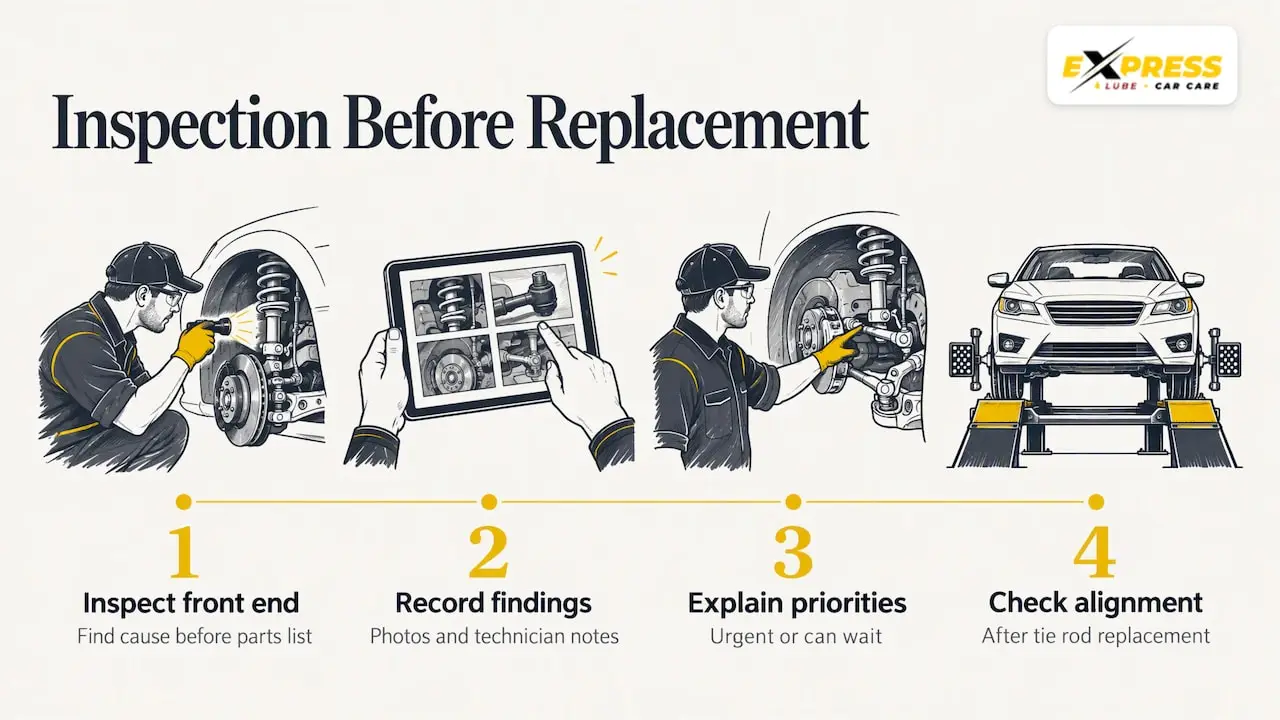
Our approach is to look at the whole front end, show you what we find with a digital vehicle inspection that includes photos and technician notes, and explain which items are urgent and which can wait. We would rather you leave knowing why a part needs replacing than leave with a bigger invoice and no explanation. Our technicians are ASE-certified, and we can usually handle steering and suspension work the same day, with no appointment required.
One more point from experience: a tie rod job should be followed by an alignment check, since changing a tie rod changes the toe setting. Skipping that step wastes the repair and wears new tires.
— Express Lube & Car Care
What a tie rod repair involves and costs
A typical replacement means removing the old tie rod end or inner tie rod, installing the new part, and then setting the alignment. Inner tie rods require more access, since they sit at the steering rack.
For a national benchmark, RepairPal’s estimator reported in 2026 that tie rod replacement averages between $258 and $300, with labor of roughly $88 to $130 and parts around $170. It also notes that costs vary by vehicle and that related repairs may be needed. An alignment, a second side, or other worn components can add to the total, and European vehicles and heavy trucks can fall outside that range.
We do not publish a fixed price for tie rod work because it depends on the vehicle, which part is worn, and what else the inspection finds. We will give you the estimate before work begins.
Warranty on qualifying repairs
Qualifying repairs at our shop carry a 24-month/24,000-mile limited warranty, whichever comes first, and qualifying suspension repairs may be covered by our Lifetime Suspension Warranty. Eligibility, limitations and exclusions apply to both, and not every repair or part is covered. Ask us about the terms for your specific repair before you approve it.
Getting your steering checked in Plano
If your car clunks, drifts, or wears out front tires faster than it should, bring it in. We inspect the steering and suspension at our Plano shop with no appointment needed, and most services are completed the same day. If the problem turns out to be a tire or an alignment, we will say so. If it is a worn tie rod end or another steering part, you will see it in the inspection report before you decide.
Start with our steering and suspension service, or see everything we do on our services page. We also work on fleet vehicles, so if you manage several trucks or vans, steering inspections can be built into your maintenance routine.
FAQ
How do I know if it is the inner or outer tie rod?
You cannot tell reliably from the driver’s seat. Outer tie rod ends tend to produce clunks in turns and visible play at the wheel, while inner tie rods tend to cause knocking at the rack and vague steering. A technician checks both by hand, because the symptoms overlap.
Can bad tie rods cause the steering wheel to shake?
Yes, they can, but they are not the only cause. AAA notes that tire or wheel imbalance and alignment problems can also shake the wheel. Shaking together with loose steering, clunking or uneven tire wear makes worn tie rods more likely.
Is it safe to drive with a loose tie rod?
It is not safe to keep driving on it. A loose tie rod can wear further or separate, and NHTSA recall documents describe loss of steering control when tie rods break. Get it inspected right away, and arrange a tow if the steering feels disconnected.
How much does it cost to replace a tie rod?
RepairPal’s 2026 national estimate is $258 to $300 on average, though it varies by vehicle and by what else is worn. Alignment is typically needed afterward. Contact us with your vehicle and we will inspect it and quote the work.
Should I replace tie rods in pairs?
It is often recommended when one side shows significant wear, because the other side has the same mileage and conditions. Your technician can tell you from the inspection whether the second side needs work now or can wait.
Sources
- Symptoms of Bad Tie Rods, MOOG Parts
- How to replace an outer tie rod end, Delphi Technologies
- Why Your Steering Wheel Shakes, AAA Club Alliance
- Guide to Vehicle Wheel Alignment and Suspension, AAA
- Worn Tie Rod Inspection and Dry Park, Brake & Front End
- NHTSA safety recall notice, 2024
- NHTSA recall report 23V-581, 2023
- NHTSA service bulletin, 2023
- Tie Rod Replacement Cost Estimate, RepairPal