

Your engine's oil pressure is fundamental to its operation and longevity. It can be compared to the circulatory system in the human body. Just as the heart pumps blood through arteries to nourish every organ, your engine's oil pump circulates lubricant through narrow passages, called oil galleries, to protect every moving component.
This constant flow of pressurized oil creates a microscopic, high-strength film between metal surfaces. This hydrodynamic lubrication is the only barrier preventing the intense friction and heat generated by moving parts from causing catastrophic damage. When oil pressure drops, this protective film collapses.
The flashing red oil light on your dashboard is not a suggestion; it is a critical warning demanding immediate action. Continuing to operate the engine, even for a short distance, can escalate a minor issue into a severe engine failure. The damage from direct metal-on-metal contact occurs rapidly and can lead to repairs costing thousands of dollars.
What is Low Oil Pressure? It signifies that the force propelling oil through your engine has fallen below the manufacturer's specified minimum. Without sufficient pressure, the oil film fails, leading to friction and heat buildup that can cause irreversible damage to bearings, camshafts, and other critical internal components.
The Primary Causes of Low Oil Pressure
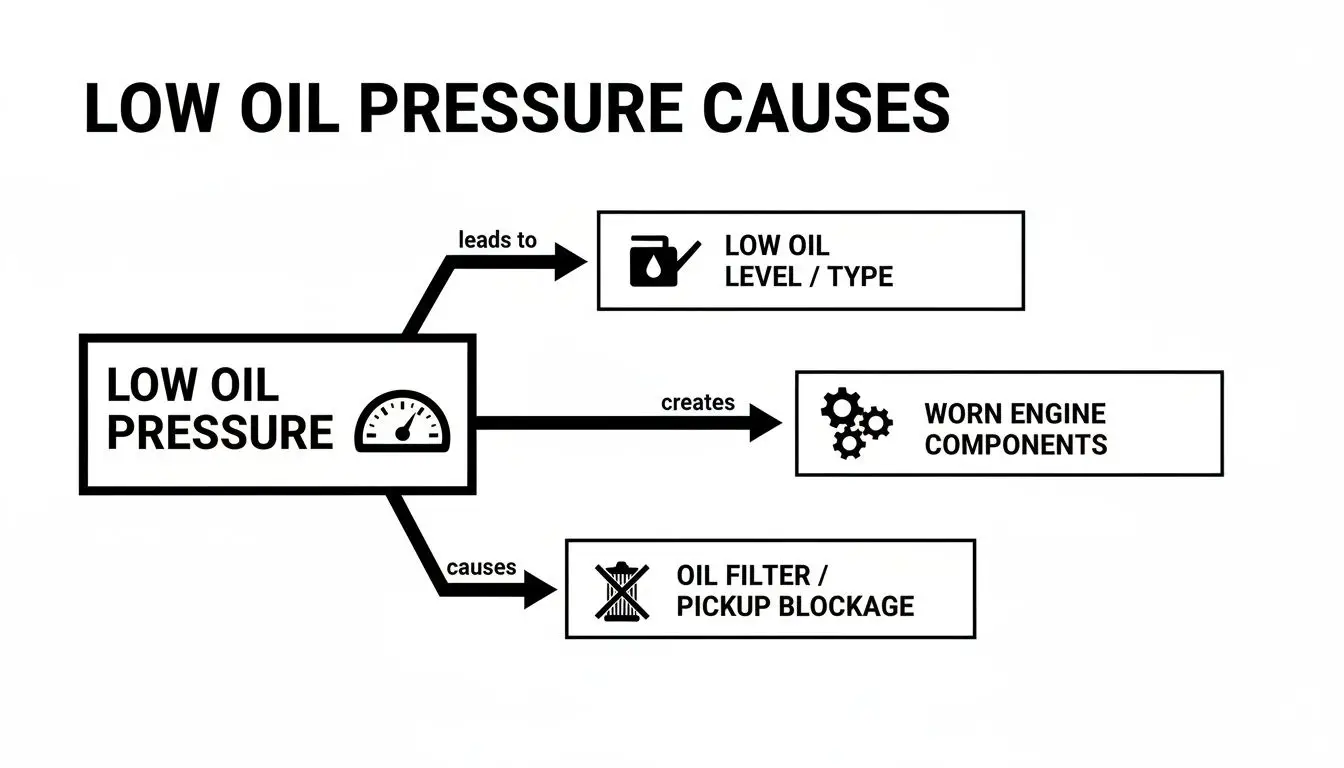
What factors lead to this dangerous drop in pressure? While a professional technician is needed for a definitive diagnosis, the root causes typically fall into three main categories.
- Insufficient Oil Volume: This is the most frequent and preventable cause. If the oil level in the sump (oil pan) is too low, the oil pump will draw in air along with the oil. Since air is compressible and cannot be pressurized like a fluid, the system pressure plummets.
- Worn Mechanical Components: Over many thousands of miles of operation, critical parts like engine main and rod bearings, or the oil pump itself, experience wear. This wear increases the clearance (the gap) between moving parts. The oil pump may no longer be able to supply a sufficient volume of oil to maintain pressure across these larger gaps.
- Flow Restrictions: A severely clogged oil filter or a blocked oil pickup screen can starve the pump of oil. The pump is functioning correctly but cannot draw enough fluid through the obstruction to build and maintain adequate pressure downstream.
This flowchart illustrates the most common sources of low oil pressure, ranging from simple to complex.
To help you understand the potential issues, here is a quick reference guide.
Quick Guide to Low Oil Pressure Causes
| Cause | Common Symptom | Repair Complexity |
|---|---|---|
| Low Oil Level | Oil light on, especially on turns or stops | Low (Top up oil) |
| Faulty Sensor/Gauge | Light is on, but engine sounds normal | Low (Replace sensor) |
| Wrong Oil Viscosity | Light on after oil change, noise at startup | Low (Change to correct oil) |
| Clogged Oil Filter | Light on, engine may sound strained | Moderate (Replace filter) |
| Worn Engine Bearings | Low pressure at idle, knocking/rumbling noise | High (Major engine work) |
| Failing Oil Pump | Whining noise from engine, low pressure | High (Requires engine disassembly) |
As shown, the problem can range from a five-minute correction to a major engine overhaul. Proactive maintenance is the best strategy for prevention. Understanding what's included in a full-service oil change is an excellent starting point, as it represents the first line of defense against most oil-related failures.
The Most Common Cause of Low Engine Oil Pressure
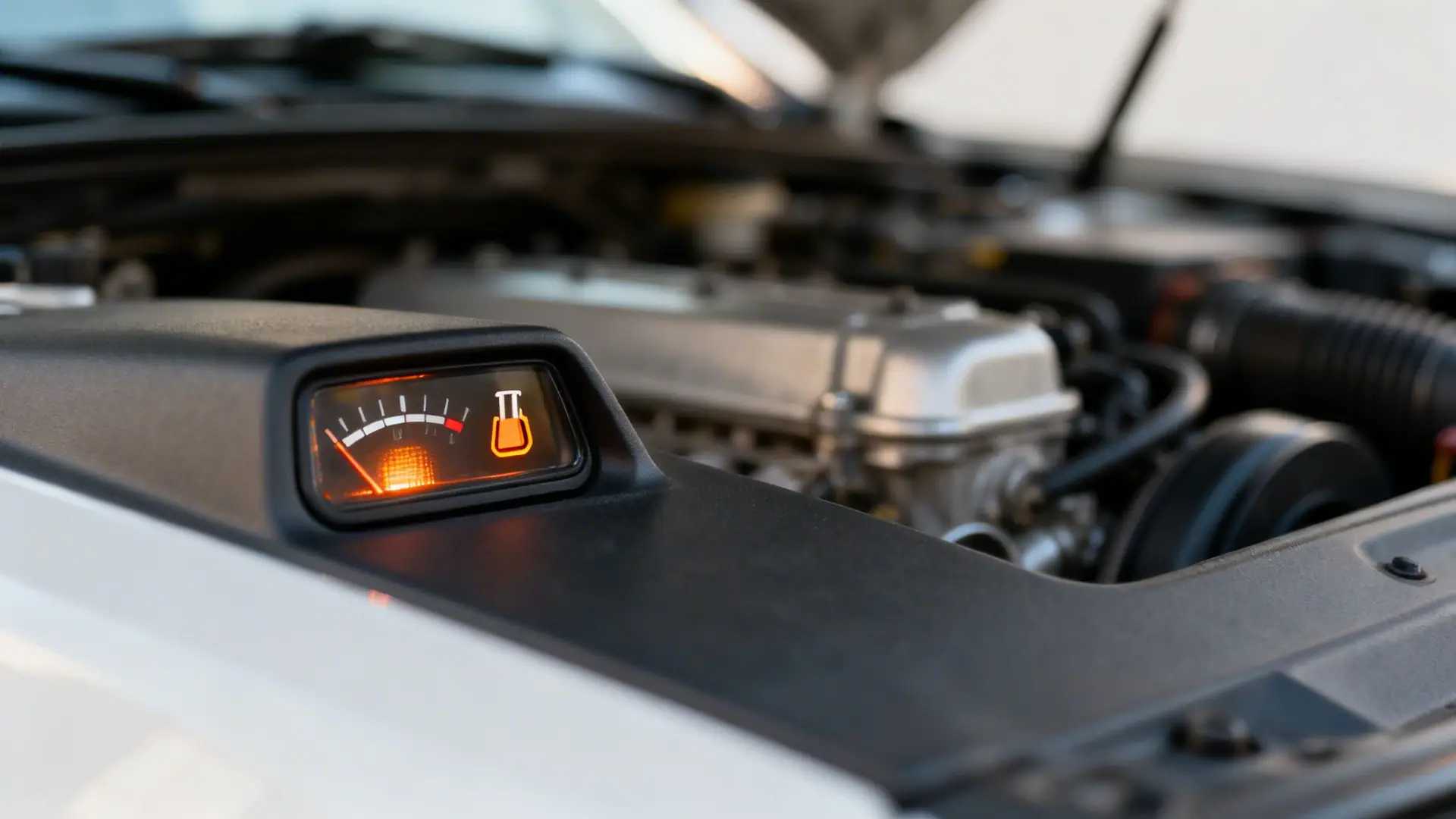
When the oil pressure warning light illuminates, it's natural to anticipate a complex and expensive repair. However, before assuming the worst, it is important to consider the most common cause, which is also the simplest to rectify: the engine is simply low on oil.
The principle is analogous to attempting to drink the last bit of liquid through a straw. Once the fluid level is too low, the straw begins to draw in air. An engine's oil pump functions similarly. It is designed to move a non-compressible fluid (oil), not a gas (air). When the oil level drops below the oil pickup tube's intake, the pump cavitates by drawing in air, pressure is lost, and the vehicle's warning system is triggered.
Reasons for a Low Oil Level
Where does the oil go? Motor oil does not simply disappear. A low oil level is the single most preventable cause of low oil pressure and is typically the result of infrequent dipstick checks or an unaddressed leak.
Industry experts note that engines consuming more than one quart of oil every 1,000 to 2,000 miles may be exhibiting signs of advanced internal wear that requires professional evaluation. You can read more about the critical relationship between oil levels and engine health on Amsoil's blog.
The primary reasons for oil loss are:
- Normal Consumption and Oil Burning: All internal combustion engines consume a small amount of oil. As an engine ages, wear on components like piston rings and valve seals allows more oil to enter the combustion chamber, where it is burned.
- External Oil Leaks: Gaskets and seals degrade over time due to heat and age, becoming hard and brittle. A failing valve cover gasket, oil pan gasket, or main seal will result in visible drips on the ground.
- Extended Oil Change Intervals: Exceeding recommended oil change intervals allows the oil's detergents and viscosity modifiers to break down. This degraded oil can contribute to increased consumption and can accelerate the aging of seals, leading to leaks. If you notice oil spots in your parking space, it's time for an inspection. You can discover more about how to stop an oil leak in our detailed guide.
The Five-Minute Engine-Saving Skill
Understanding what causes low oil pressure in an engine is important, but the practical skill of checking your oil level is the most effective way to prevent catastrophic failure.
Performing a quick dipstick check every other time you refuel is a simple habit that can detect a low oil level long before it becomes a critical, engine-damaging issue.
Follow this procedure for an accurate reading:
- Park on Level Ground: A flat surface ensures that the oil in the pan is level for an accurate measurement.
- Wait for the Engine to Cool: Shut off the engine and wait 5-10 minutes. This allows oil from the upper parts of the engine to drain back into the oil pan.
- Locate and Pull the Dipstick: The dipstick handle is typically a brightly colored ring (yellow or orange). Pull it completely out.
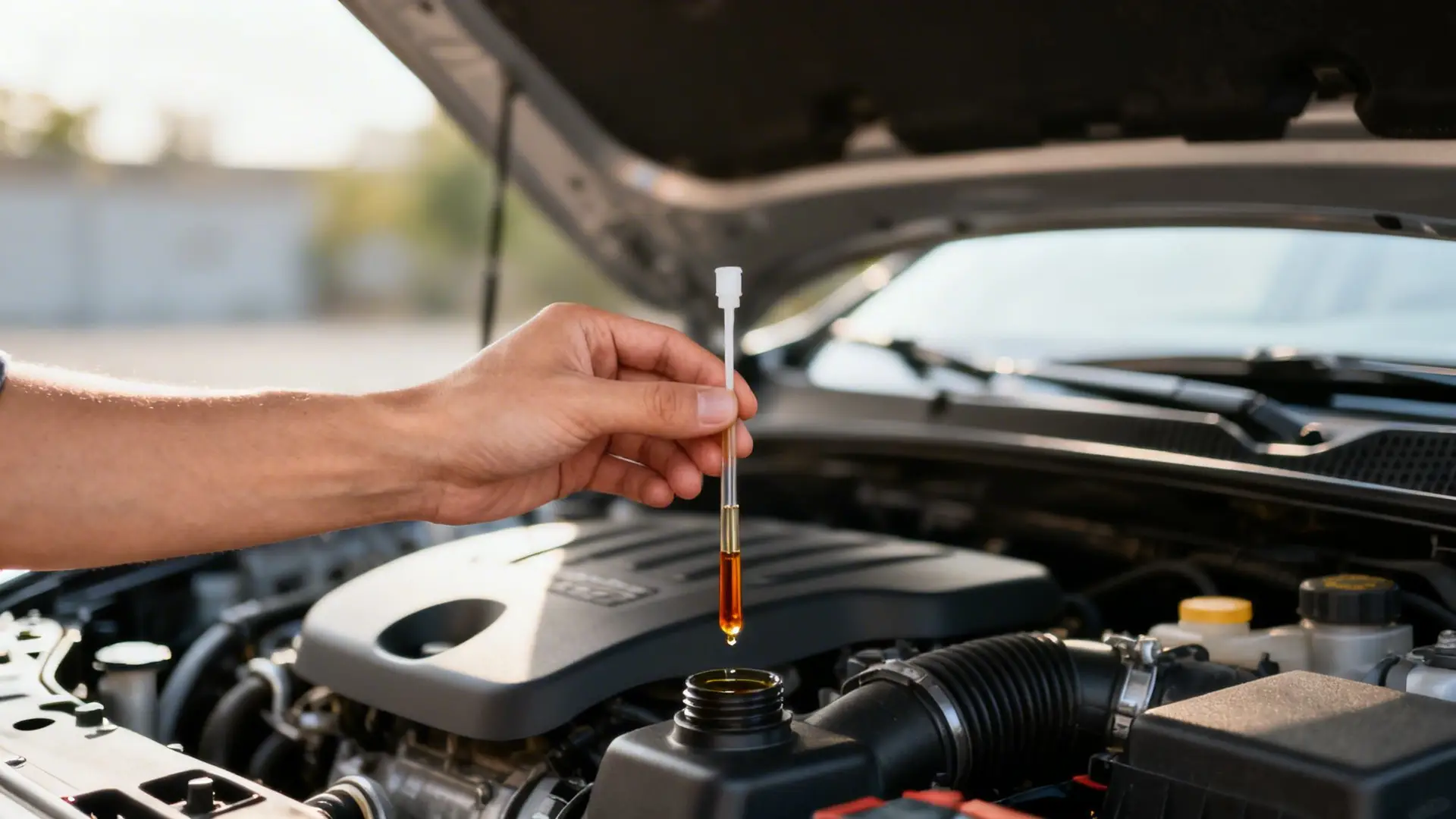
- Wipe and Re-insert: Use a clean, lint-free rag or paper towel to wipe the entire length of the dipstick. Fully re-insert it, wait a moment, and withdraw it again.
- Read the Level: Observe where the oil film ends. The level should be between the "Full" and "Add" markings. If the level is at or below the "Add" mark, you must add the correct type and grade of oil immediately.
Major Mechanical Failures: Worn Bearings and Oil Pump Issues
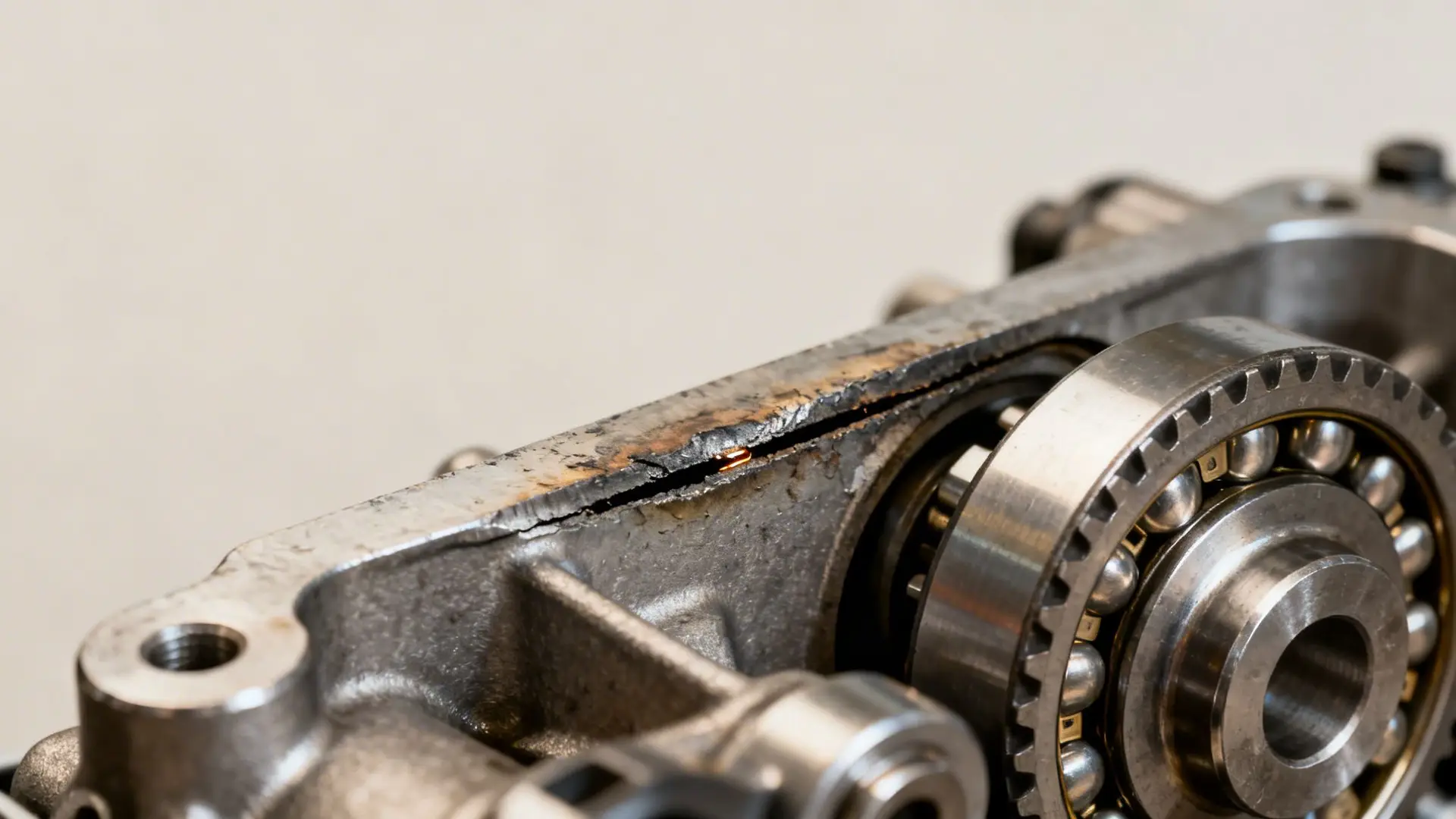
While a low oil level is a straightforward issue to resolve, the low pressure warning can also signal deeper, more severe mechanical problems within the engine. When topping off the oil does not resolve the warning, investigation must turn to major component failure.
These are not minor faults; they are conditions that threaten the engine's integrity and require professional intervention. Two of the most significant mechanical culprits are worn engine bearings and a failing oil pump.
Worn Engine Bearings: The Source of Knocking Noises
Engine bearings are precision-engineered surfaces that support rotating parts, such as the crankshaft and connecting rods. They function much like cartilage in a joint, providing a smooth, low-friction surface. These bearings are designed with extremely tight clearances—typically between 0.001 and 0.003 inches. This microscopic gap is engineered to hold a film of pressurized oil, which prevents metal-on-metal contact.
Through normal wear over many thousands of miles, or accelerated by neglect (such as running on old, contaminated oil), these bearings erode. As they wear, the clearance widens. Oil can then escape from the gap more easily than it is supplied by the pump, causing a system-wide drop in pressure.
A classic symptom of worn bearings is a deep, rhythmic knocking or rumbling sound from the lower part of the engine. This noise is often most pronounced when the engine is warm and at idle, which is when oil pressure is naturally at its lowest.
This creates a destructive feedback loop: the increased clearance lowers oil pressure, which reduces lubrication, which in turn accelerates bearing wear. This is one of the most serious and costly causes of low oil pressure, with repairs often ranging from $3,000 to $5,000 or more, potentially requiring a complete engine rebuild.
Oil Pump Failure: The Heart of the Lubrication System
If bearings are the engine's joints, the oil pump is its heart. Its sole function is to draw oil from the sump and force it under pressure through the engine's oil galleries. As a mechanical component, it is subject to wear and can eventually fail.
An oil pump can fail in several ways:
- Worn Gears or Rotors: The internal moving parts that create pressure wear down, reducing the pump's efficiency.
- Broken Drive Mechanism: The pump is mechanically driven by the engine (e.g., via the crankshaft or camshaft). If this drive link breaks, the pump ceases to operate.
- Stuck Pressure Relief Valve: This valve is a safety feature that prevents excessive oil pressure. If it becomes stuck in the open position, it will continuously bleed off pressure, preventing the system from reaching its required level.
When an oil pump fails, the loss of pressure is typically sudden and total. The oil pressure gauge will drop to zero, and the warning light will illuminate urgently. This is an engine emergency requiring immediate shutdown to prevent seizure and catastrophic internal damage. When addressing major repairs, using high-quality components is essential. A variety of new aftermarket auto parts are available for professional repairs.
Subtle Causes: Contamination and Incorrect Oil Viscosity
Sometimes, the cause of low oil pressure is not a major mechanical failure but a more subtle issue, such as a simple blockage or the use of an incorrect fluid. These problems, while less dramatic initially, can be just as damaging over time and are often overlooked.
Two of the most common hidden culprits are a clogged oil pickup screen and the use of incorrect oil viscosity. Even with a perfectly functioning oil pump, these conditions can starve an engine of the lubrication it requires.
Starvation at the Source: The Clogged Oil Pickup Screen
Located at the bottom of the engine's oil pan is the oil pickup tube. At its inlet is a mesh screen that serves as the first line of defense, filtering out large contaminants before they can be drawn into the oil pump.
This screen can be compared to the drain in a sink. When clear, fluid passes freely. When clogged with debris, flow is restricted. In an engine, the primary contaminant is engine sludge, a thick, tar-like substance that forms from the thermal and oxidative breakdown of old, overworked oil.
If the pickup screen becomes obstructed by sludge, the oil pump is effectively trying to suck fluid through a clogged filter. It cannot draw a sufficient volume of oil to build and maintain proper pressure throughout the engine's lubrication system.
This scenario highlights the critical importance of adhering to regular oil change intervals. Fresh oil contains active detergents that hold contaminants in suspension and prevent the formation of sludge, keeping the pickup screen clear and ensuring the pump has an unrestricted supply of oil.
The Wrong Fluid Thickness: Incorrect Oil Viscosity
Another subtle but critical cause of low oil pressure is using oil with the wrong viscosity. Viscosity is a measure of a fluid's resistance to flow—its thickness. Vehicle manufacturers specify a precise viscosity grade because the engine's internal clearances are engineered to work with oil of that specific thickness.
Using an oil that is either too thin or too thick will disrupt the designed balance of the lubrication system.
- Oil That Is Too Thin (Lower Viscosity): A lower-viscosity oil flows too easily. It can escape through the gaps in the engine bearings so quickly that the pump cannot maintain the necessary pressure to create a robust oil film. This is especially true in a warm, idling engine.
- Oil That Is Too Thick (Higher Viscosity): A higher-viscosity oil creates too much resistance to flow. The oil pump must work significantly harder to circulate the thick fluid, particularly during a cold start. This strain can lead to a low-pressure condition because the oil cannot reach critical components quickly enough.
Adhering to the manufacturer’s recommended oil grade is not merely a suggestion; it is essential for engine health. Using the incorrect oil is an entirely avoidable mistake. To learn more about this topic, you can understand what oil viscosity means in our detailed guide.
Ruling Out a False Alarm: The Role of Sensors and Gauges
While the glowing red oil light rightly commands attention, it's important to consider a less alarming possibility: what if the issue lies not with the engine's oil pressure, but with the system that reports it?
This scenario is like a false fire alarm. In many instances, the warning system itself is the source of the problem.
Your engine's lubrication system includes a small but vital component called the oil pressure sensor (or sending unit). This device's function is to measure the oil pressure within the system and transmit that data to the instrument cluster on your dashboard. However, as an electronic component exposed to extreme heat and vibration, it has a finite lifespan.
Over time, these sensors can fail, become clogged with debris, or develop an internal electrical fault. When this occurs, they can send inaccurate signals to the dashboard.
Differentiating a Real Warning from a System Glitch
A malfunctioning sensor can "cry wolf," triggering the warning light even when the engine's oil pressure is perfectly within the specified range. The dashboard may indicate a critical failure while the engine continues to be properly lubricated and operates normally.
For this reason, a professional technician's diagnostic process begins with verifying the sensor's accuracy.
A faulty oil pressure sensor can create all the anxiety of a major engine problem without any of the actual mechanical danger. It is a classic case where the warning system, not the engine, is the component that needs repair.
So, how is the true condition determined? A skilled mechanic will perform a definitive test to get a clear answer.
- First, the vehicle's electronic oil pressure sensor is carefully disconnected and removed.
- Next, a mechanical pressure gauge is threaded into the same port on the engine block. This calibrated tool provides a direct, physical measurement of the oil pressure, bypassing all electronics.
- The engine is then started, and the reading on the mechanical gauge is observed.
This test provides an unambiguous result. If the mechanical gauge displays a healthy, stable oil pressure while the dashboard light remains illuminated, the problem is confirmed: the sensor is faulty and needs replacement. This diagnostic step distinguishes a genuine crisis from a simple electronic failure, saving you from unnecessary stress and expense.
Your Immediate Action Plan for Low Oil Pressure
The red oil pressure light on your dashboard is your vehicle's most urgent warning. It requires a calm, immediate, and correct response.
Continuing to drive, even for a minute, can transform a manageable problem into catastrophic engine failure. Your actions in the next 60 seconds are absolutely critical.
Emergency Procedure
- Pull Over Safely and Immediately: As soon as you see the light, activate your hazard lights, signal, and find a safe location to pull off the road. Do not attempt to "limp home" or reach the next exit.
- Turn Off the Engine Instantly: Once safely stopped, shut down the engine. This is the single most important action to prevent unlubricated metal components from grinding against each other.
- Allow the Engine to Cool: Wait at least 10-15 minutes before attempting any inspection. This allows the oil to settle in the pan and reduces the risk of burns from hot engine parts.
- Do Not Drive to a Repair Shop: Even if you check the oil, find it low, and add more, the light was triggered for a reason. You may have a severe leak or a failing component. Driving is a gamble with your engine's life.
- Call for a Tow: This is the only safe and responsible course of action. Attempting to save money on a tow service could result in a repair bill for a new engine costing thousands of dollars.
The cardinal rule is simple: stop, shut off the engine, and arrange for a tow. Every second your engine operates without adequate oil pressure, it is sustaining irreversible internal damage.
From Roadside Crisis to Reliable Solution
While a roadside breakdown is stressful, transporting your vehicle to a trusted repair facility transforms the crisis into a solvable issue. Once your vehicle is towed to a professional team like ours at Express Lube & Car Care in Plano, our ASE-certified technicians will begin a methodical diagnostic process.
We will connect a mechanical gauge to confirm the true oil pressure before proceeding. From there, we will inspect for leaks, test the sensor, and perform other necessary checks to provide you with an accurate and honest diagnosis. We are committed to turning your emergency into a manageable, transparent service experience and getting you back on the road safely.
Frequently Asked Questions About Low Oil Pressure
Even after understanding the fundamentals, drivers often have specific questions when faced with a low oil pressure situation. Here are answers to some of the most common inquiries we receive.
Can I Just Add More Oil if the Pressure Light Comes On?
This is a common first reaction, and if the issue is simply a low oil level, adding the correct type of oil will often extinguish the light. However, this should be viewed as a temporary measure, not a permanent solution.
The warning light only illuminates when the oil level is critically low. The fundamental question you must answer is: why is the oil low? The vehicle either has an external leak or is burning oil internally due to wear. A professional diagnosis is essential to identify the root cause and prevent a more severe and costly failure down the road.
A flickering oil light, particularly at idle or during sharp turns, is a severe warning sign. It indicates the oil level is so low that the oil pump pickup is intermittently sucking in air. This symptom must not be ignored.
How Long Can I Drive with the Oil Pressure Light On?
The definitive answer is zero miles. As soon as that red light illuminates, your engine is being starved of the lubrication it needs to operate without damage. Metal is grinding directly against metal.
Driving for even a few more minutes generates immense friction and heat, rapidly escalating what might be a minor issue (like a faulty sensor) into catastrophic engine failure. The only safe and correct response is to pull over immediately, turn off the engine, and call for a tow.
Understanding what causes low oil pressure in an engine is important, but knowing how to react is what will save you from a multi-thousand-dollar repair.
When your oil pressure light comes on, you need a diagnosis from a team you can trust. The ASE-certified technicians at Express Lube & Car Care have the expertise and diagnostic tools to accurately identify the problem and restore your vehicle's safety and reliability. Visit our Plano shop today for fast, reliable service.