
If you’ve ever searched for an express oil change near me and wondered exactly what you’re walking into, you’re not alone. A local express lube shop, known in the industry as a quick lube facility, is a specialized automotive service center built around one core promise: get you in, get you out, and keep your vehicle running. These shops focus on oil changes, fluid maintenance, and basic vehicle checks rather than full repairs. This article breaks down exactly what services they offer, how they compare to dealerships, and what you should watch for before and after every visit.
Table of Contents
- Key takeaways
- What is a local express lube shop
- Advantages and limitations of express lube shops
- What to expect during a typical visit
- Express lube shops vs. dealerships and traditional mechanics
- Tips for getting the best service from a quick lube shop
- My honest take on using express lube shops
- Fast, reliable oil changes at Express Lube & Car Care
- FAQ
Key takeaways
| Point | Details |
|---|---|
| Speed-focused service model | Quick lube shops prioritize fast turnaround on routine maintenance like oil changes and filter replacements. |
| Limited inspection depth | Courtesy checks at express lube facilities are less thorough than the multi-point inspections performed at dealerships. |
| Post-visit checks matter | Always verify your oil cap, fluid levels, and look for leaks after leaving any quick lube shop. |
| Cost and convenience advantages | Promotions and package deals at local lube services regularly reduce the price of routine maintenance. |
| Proactive customers get better results | Asking specific questions about what is included in the inspection directly improves your service outcome. |
What is a local express lube shop
A local express lube shop, or quick lube facility, is a drive-in automotive service center designed specifically for fast, routine vehicle maintenance. The business model is built on volume and speed, not on comprehensive diagnostics or major repairs. You pull in, a technician handles the work quickly, and you leave with fresh oil and a vehicle ready for the road.
These facilities are purpose-built for this work. The bays are configured with overhead equipment, fluid dispensers, and organized workstations so technicians can perform the same procedures efficiently, visit after visit. Think of it less like a full-service garage and more like a commercial kitchen built for lunch service. Everything has its place because repetition is the point.
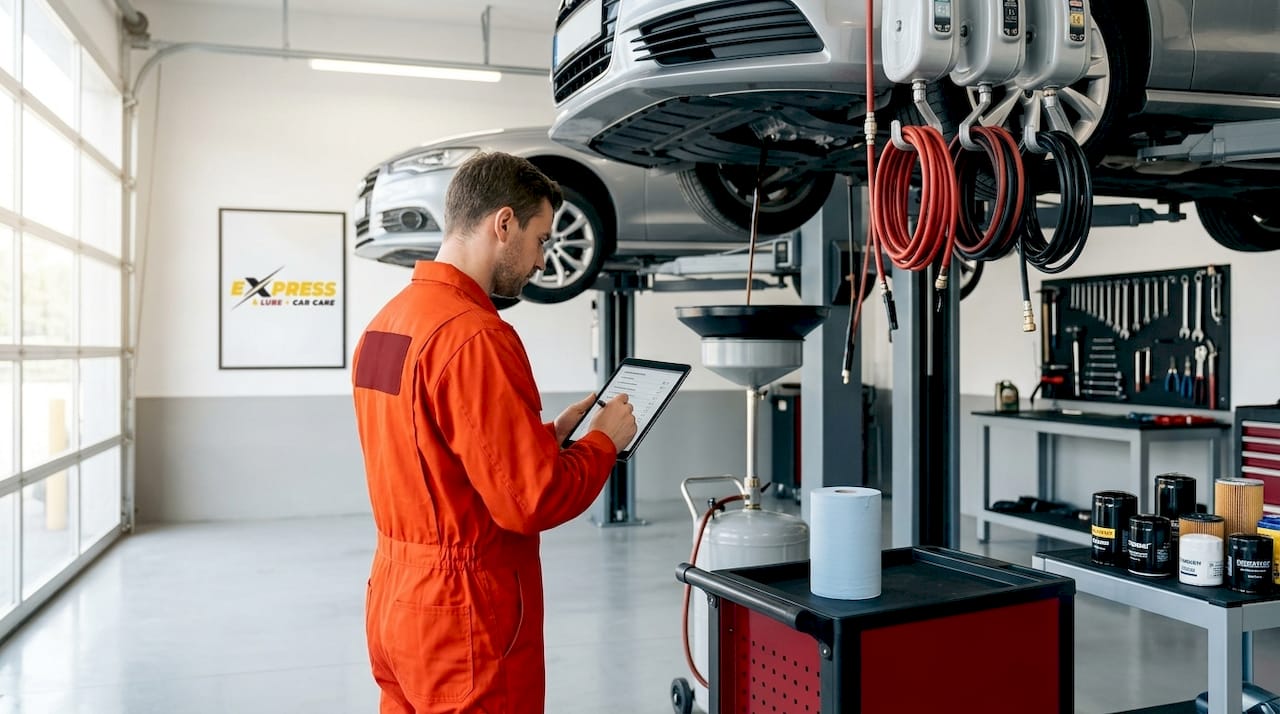
Quick lube shops focus on speed and routine services like oil changes, fluid top-offs, and filter replacements, and most do not offer comprehensive repairs or diagnostic work. That is a feature, not a flaw. It keeps wait times short and pricing accessible.
Here is a breakdown of the services you can typically expect:
- Oil change: Drain the old oil, replace the drain plug and gasket, install a new oil filter, and refill with the correct oil type and grade for your vehicle.
- Fluid top-offs: Windshield washer fluid, power steering fluid, coolant reservoir, and brake fluid checks with top-offs as needed.
- Air filter replacement: Both engine air filters and cabin air filters are commonly offered as add-on services.
- Battery testing: A quick load test to assess battery health and cold cranking amps.
- Wiper blade replacement: Visual check and swap if blades are worn or streaking.
- Tire pressure adjustment: Inflation checked and corrected to manufacturer specifications.
- Courtesy visual inspection: A brief look at belts, hoses, lights, and tires, though coverage varies by location.
What express lube shops generally do not offer includes brake repairs, engine diagnostics, transmission service, suspension work, or any repair that requires significant disassembly. If your vehicle has an active warning light, a grinding noise, or a known mechanical issue, a quick lube visit is not the right stop.
Advantages and limitations of express lube shops
Understanding the real benefits of express lube service means looking honestly at both sides of the equation.
What works well
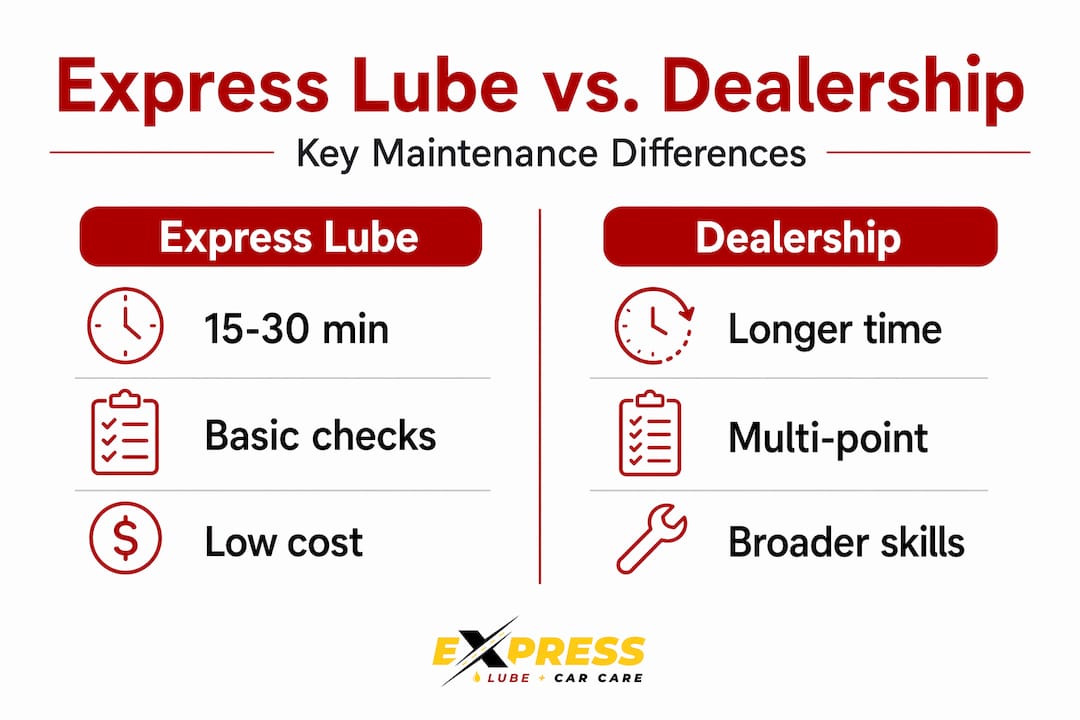
The most obvious benefit is time. A standard oil change at a well-run quick lube shop takes 15 to 30 minutes. You do not need an appointment in most cases. You can pull in during a lunch break or on your way home, which is a meaningful convenience for families and professionals who cannot block out half a day at a dealership service department.
Cost is the second advantage. Promotions and package deals at local lube centers can provide better value for routine oil changes and fluid services compared to dealership pricing on the same work. Many shops offer military and first responder discounts as well.
Accessibility is the third factor. Quick lube shops are often located on high-traffic roads with extended hours, making them practical for routine upkeep that might otherwise get delayed.
Where limitations appear
The tradeoffs are real, and being informed about them protects your vehicle. Technician training and service consistency may vary widely among express lube franchises and individual locations. Customer experiences range significantly, which is why reading reviews before choosing a location matters.
The most common errors are not complicated. Reported incidents of oil leaks or smells shortly after service mostly trace back to sealing mistakes, specifically missing gaskets, forgotten oil caps, or improperly installed filters. These are basic procedural steps that should never be skipped, but they do get missed under pressure in high-volume environments.
The inspection scope is also narrower than many drivers assume. Express lube courtesy inspections may vary widely and are often less detailed than what a dealership provides. You may leave with fresh oil but no awareness of a developing brake issue or a worn belt.
Pro Tip: Before you pull out of the bay, ask the technician to confirm the oil cap is secured and then check it yourself. It takes ten seconds and eliminates one of the most common post-service problems.
What to expect during a typical visit
Knowing the sequence of a standard quick lube visit helps you follow along and catch anything that looks off. Here is what a properly run service should look like from intake to exit:
- Vehicle intake: A service advisor or technician greets you, records your mileage, and confirms the correct oil type and viscosity for your vehicle based on the owner’s manual spec or their database.
- Oil drain: The technician positions under the vehicle, removes the drain plug, and drains the old oil completely. The drain plug washer or gasket should be inspected and replaced if worn.
- Filter replacement: The old oil filter is removed and a new filter is installed. Filter housing threads are inspected for damage before the new filter is hand-tightened, then snugged with a wrench to the correct torque spec.
- Fresh oil fill: The correct grade and volume of oil is added through the fill cap. This is the moment the cap must be properly reinstalled and secured.
- Fluid top-offs: The technician checks reservoir levels for coolant, brake fluid, power steering fluid, and windshield washer fluid, topping off as included in your service package.
- Courtesy inspection: A visual walk-around covering tires, lights, belts, and hoses. The depth of this step varies by location, so ask specifically what is checked and documented.
- Final check and payment: You receive a service sticker, a printed or digital record of work performed, and any recommendations for upcoming maintenance.
After you leave the bay, check for any drips on the ground beneath your vehicle before driving away. Promptly address any oil leaks or odors after an oil change. Waiting until your next scheduled service is not the right call if you smell burning oil or see a puddle forming.
Pro Tip: Ask the service advisor to walk you through what the courtesy inspection includes before the service begins. Explicitly asking what points are covered in the inspection gives you a clearer picture of your vehicle’s overall condition.
Express lube shops vs. dealerships and traditional mechanics
Choosing the right service provider comes down to matching the job to the facility. Here is how the three options compare directly:
| Category | Express lube shop | Dealership service | Traditional mechanic |
|---|---|---|---|
| Service time | 15 to 30 minutes typical | 1 to 3 hours typical | Varies widely |
| Appointment needed | Usually not required | Generally required | Often required |
| Inspection depth | Basic visual checks | 20 to 30+ component multi-point inspection | Depends on request |
| Service scope | Routine maintenance only | Maintenance and complex repairs | Full repair capability |
| Cost for oil change | Lower to mid-range | Mid to higher range | Varies |
| Technician specialization | Routine service focused | Brand-certified technicians | General or specialty |
The speed advantage is not always definitive. Dealerships increasingly offer express lanes that match or beat quick lube times, while also providing thorough inspections. The difference that remains consistent is service scope. If your vehicle needs a multi-point inspection with documentation, brake evaluation, or computerized diagnostics, a dealership or traditional mechanic is the appropriate choice.
Express lube shops are purpose-built for one thing, and that focus is genuinely valuable when the job fits the tool.
Tips for getting the best service from a quick lube shop
Getting the most from any local lube service comes down to preparation, communication, and a short post-service routine.
- Check your oil level and cap after every visit. Pop the hood before you leave the parking lot. Confirm the dipstick reads within range and the oil fill cap is hand-tight and properly seated.
- Ask about inspection specifics. “What does your courtesy inspection cover?” is a question every technician should be able to answer clearly. If they cannot, adjust your expectations accordingly.
- Use the same trusted location when possible. Technicians at a shop you visit regularly will recognize your vehicle’s service history and are more likely to flag developing concerns.
- Return immediately if something seems wrong. Any oil smell, warning light, or visible drip after a quick lube visit warrants a same-day return, not a wait-and-see approach.
- Look for coupons and specials before you go. Oil change specials and promotional packages are common and can significantly reduce your out-of-pocket cost on routine maintenance.
- Check reviews and reputation. A shop with consistent positive reviews for accuracy and communication is a better choice than the nearest option, especially for first-time visits.
Pro Tip: Keep a small notepad or use your phone to log your oil change date, mileage, and oil type after each visit. This record helps you catch if a shop ever uses the wrong grade for your vehicle.
My honest take on using express lube shops
I’ve seen the full range of outcomes at quick lube facilities. When the service is performed carefully and the technician treats every drain plug and filter like it matters, the result is genuinely efficient, quality maintenance at a fair price. The model works.
What I’ve also learned is that most complaints about quick-lube shops center on typical procedure mistakes rather than systemic unreliability. That distinction matters. It means being a proactive customer, one who checks their oil cap before leaving, asks clear questions, and pays attention afterward, can meaningfully reduce your risk.
In my experience, express lube shops are the right choice for routine oil changes and fluid maintenance on vehicles that are running well. They are not the right choice when your vehicle has an unresolved issue, when you need documentation for a warranty claim, or when thorough diagnostics are warranted. Knowing which situation you are in before you pull into the bay is the most useful habit a driver can develop.
The shops that stand out are the ones where the technicians slow down just enough to do the basics correctly. Speed is the value proposition, but precision is what keeps engines healthy. At Express Lube & Car Care, that balance is what we work toward every day.
— Express Lube & Car Care
Fast, reliable oil changes at Express Lube & Car Care
Express Lube & Car Care in Plano offers no-appointment-needed service managed by certified technicians who take the time to do the basics right. Whether you need a routine oil change, brake service, or engine repair, you get quality results without the dealership wait.
Current oil change and service specials make it easy to stay on schedule with your maintenance without stretching your budget. We also offer dedicated discounts for military personnel and healthcare providers as part of our commitment to the Plano community. If your vehicle needs attention beyond routine maintenance, our brake repair and engine diagnostics services are available at the same location. Stop in when it works for your schedule, no appointment needed.
FAQ
What does a local express lube shop actually do?
A local express lube shop, or quick lube facility, handles routine vehicle maintenance like oil changes, filter replacements, fluid top-offs, and basic visual inspections. Most do not perform complex repairs or computerized diagnostics.
How long does a visit to a quick lube shop take?
Most express oil change visits take between 15 and 30 minutes for a standard service. Times can vary based on location volume and any additional services requested.
Are express lube shops less thorough than dealerships?
Yes, in terms of inspection depth. Dealerships typically perform multi-point inspections covering 20 to 30 or more components, while express lube courtesy checks are generally more limited and less formally documented.
What should I check after getting an oil change at a quick lube shop?
Check that your oil cap is properly secured, look under the vehicle for any drips, and monitor for oil smells or warning lights during the first few miles of driving. Return immediately if any of these issues appear.
How do I find a trustworthy express oil change near me?
Read customer reviews specifically for accuracy and communication, ask what the courtesy inspection covers before committing, and look for shops with transparent pricing and certified technicians on staff.