

Dependable car service in healthcare is defined as reliable, on-time, and safety-focused transportation that connects patients to medical appointments without disruption. Understanding why dependable car service matters in healthcare starts with a simple fact: care cannot happen if patients cannot get there. Non-emergency medical transportation (NEMT) is the recognized industry term for this service category. Professional NEMT providers have demonstrated that reliability is measurable, with top operators reporting a 0.2% complaint rate and an average ride rating of 4.78 out of 5. Those numbers reflect what healthcare professionals and caregivers already know from experience. A missed ride equals a missed appointment, and a missed appointment can mean a delayed diagnosis or a disrupted treatment plan.
How does dependable transportation affect patient health outcomes?
Transportation is classified as a social determinant of health, meaning it sits alongside income, housing, and education as a root factor in whether patients receive care. Even the best clinical team cannot help a patient who never arrives. The importance of reliable transportation becomes most visible in chronic disease management, where consistency is the treatment.

Consider patients undergoing dialysis or chemotherapy. These treatments follow rigid schedules. Missing a single session carries serious medical consequences. Approximately two million new cancer cases are diagnosed in the United States each year, and reliable transportation directly affects whether those patients complete their prescribed treatment courses. That scale makes transportation a clinical concern, not just a logistical one.
The benefits of dependable car services for recurring-care patients include:
- Appointment adherence: Patients with scheduled, confirmed rides show up at significantly higher rates than those relying on informal arrangements.
- Treatment continuity: Dialysis patients who miss sessions face fluid overload and electrolyte imbalances. Consistent transport prevents those gaps.
- Reduced emergency utilization: When patients attend routine appointments, preventable complications that drive emergency room visits decrease.
- Mental health stability: Predictable transport reduces patient anxiety before procedures, particularly for elderly or cognitively impaired individuals.
- Equity in access: Patients without personal vehicles or family support depend entirely on NEMT to access specialty care, imaging, and lab services.
Pro Tip: When coordinating transport for chemotherapy patients, schedule return rides at the time of booking the outbound trip. Treatment sessions run long, and a confirmed return ride removes a major source of patient stress.
What operational benefits does reliable transportation give healthcare facilities?
Reliable transportation reduces no-show rates, and lower no-show rates directly improve clinic scheduling efficiency. When a patient fails to appear, that appointment slot is lost revenue and wasted staff time. Facilities that partner with dependable NEMT providers report smoother discharge processes and better appointment flow throughout the day.
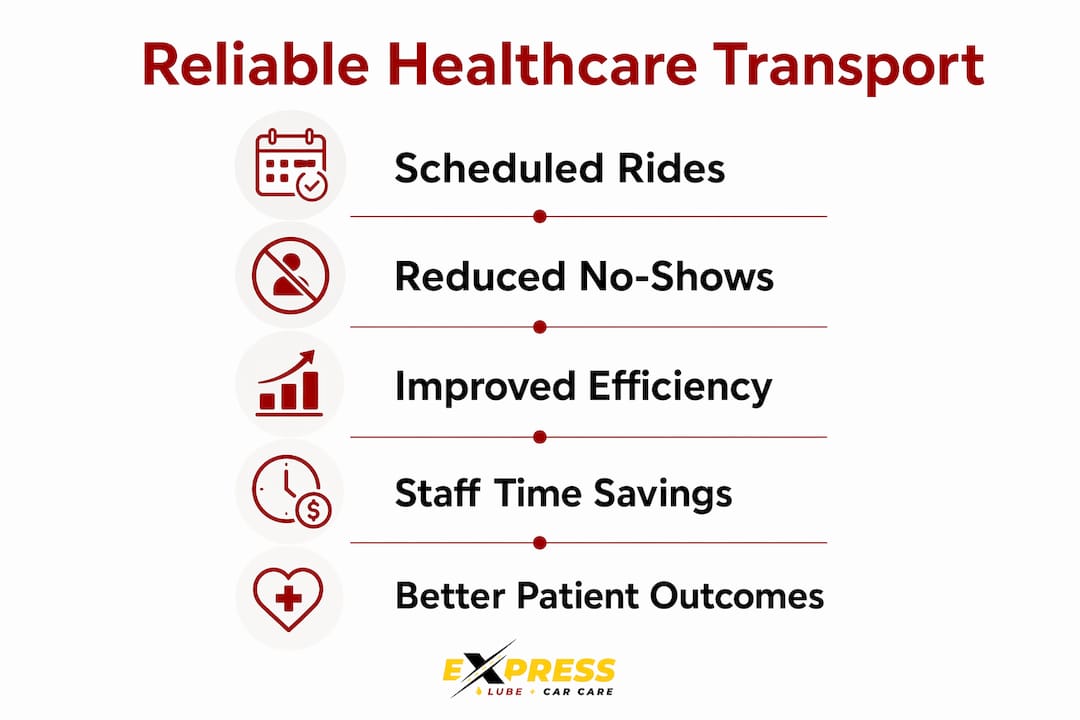
The operational gains extend beyond scheduling. Consider the staff hours consumed by transportation coordination when no reliable system exists. Nurses and medical assistants spend time calling patients about rides, rescheduling appointments, and managing the downstream chaos of no-shows. That time belongs in clinical care, not logistics.
Caregivers benefit equally. Dependable transportation frees caregivers from the logistical burden of arranging rides, allowing them to focus on emotional support and clinical observation. A caregiver who spends two hours arranging transport is a caregiver who is not monitoring a patient’s condition or communicating with the care team.
The operational case for investing in healthcare transportation solutions breaks down into four concrete gains:
- Lower no-show rates: Confirmed transport removes the most common reason patients cite for missing appointments.
- Faster discharge cycles: Patients with confirmed rides leave on schedule, freeing beds and reducing bottlenecks in post-acute units.
- Reduced staff burden: Coordinators spend less time on phone-based transport troubleshooting and more time on clinical tasks.
- Improved patient satisfaction scores: Patients who arrive on time and leave on time report better overall care experiences, which affects facility ratings.
Pro Tip: Track no-show rates by transportation method. If patients using a specific NEMT provider miss appointments at higher rates, that data gives you grounds to renegotiate the contract or switch providers.
How does technology improve transportation reliability in healthcare?
Transportation in healthcare functions like clinical plumbing. When it works, no one notices. When it fails, everything backs up. Technology is what keeps it working at scale.
The most significant development in healthcare transportation solutions is the integration of ride scheduling directly into electronic health record (EHR) platforms. VectorCare’s PACE app, for example, is integrated into Epic’s App Showroom, allowing care coordinators to dispatch transportation from within the same system they use to manage clinical workflows. That integration eliminates the manual handoff between clinical scheduling and transport dispatch, which is where most errors occur.
Batch scheduling is a second major advance. Rather than booking each patient ride individually, batch scheduling algorithms chain multiple pickups into optimized routes. For dialysis centers and oncology clinics where dozens of patients arrive on the same schedule, this approach dramatically increases consistency and reduces per-trip costs.
| Feature | Traditional dispatch | Technology-integrated dispatch |
|---|---|---|
| Scheduling method | Phone-based, manual | EHR-embedded, automated |
| Route optimization | Driver-dependent | Algorithm-driven batch scheduling |
| Error rate | High, due to manual handoffs | Low, due to system integration |
| Coordinator time required | High | Significantly reduced |
| Scalability for recurring trips | Limited | Built for high-volume recurring care |
Federal support reinforces these advances. The Federal Transit Administration has funded pilot projects up to $75,000 that link transportation access directly to healthcare outcomes. Programs that document operational results can use that data to secure ongoing funding and expand their reach.
Pro Tip: When evaluating a transportation vendor, ask specifically whether their platform integrates with your EHR. A vendor that requires a separate scheduling portal adds friction and increases the chance of booking errors.
What should you look for when choosing a car service for medical appointments?
Choosing a car service for medical appointments requires more than checking whether a provider shows up on time. The vehicle, the driver, and the compliance record all matter equally.
The criteria that separate a dependable NEMT provider from an unreliable one include:
- On-time performance data: Ask for documented on-time arrival rates. Reputable providers track this metric and share it willingly.
- Driver credentialing: Trained drivers with background checks, defensive driving certification, and patient assistance training are non-negotiable. Provider credentialing and compliance protocols directly determine patient safety during transport.
- Vehicle condition and maintenance records: A vehicle that breaks down on the way to a dialysis appointment is a medical event. Fleet maintenance best practices require regular inspection of brakes, tires, fluid levels, and safety systems. Ask providers for their maintenance schedule.
- Accessibility equipment: Wheelchair lifts, safety restraints, and climate control are baseline requirements for many patient populations.
- Communication systems: Real-time tracking and driver-to-coordinator communication prevent delays from becoming no-shows.
- Complaint resolution process: A 0.2% complaint rate is achievable. Ask how the provider handles complaints and what their resolution timeline looks like.
The benefits of dependable auto service apply directly here. A provider whose vehicles are maintained to a high standard will deliver consistent performance. One whose fleet is neglected will fail at the worst possible moment.
Key Takeaways
Dependable car service in healthcare is not a support function. It is a direct input to patient outcomes, clinic efficiency, and caregiver effectiveness.
| Point | Details |
|---|---|
| Transportation is a health determinant | Missed rides cause missed appointments, which disrupt treatment continuity for chronic and acute conditions. |
| Technology reduces transport errors | EHR-integrated platforms like VectorCare’s PACE app and batch scheduling cut manual errors and improve consistency. |
| Operational gains are measurable | Lower no-show rates, faster discharges, and reduced staff burden follow directly from reliable NEMT partnerships. |
| Vehicle maintenance is patient safety | Fleet vehicles require regular brake, tire, and fluid checks to prevent breakdowns that become medical incidents. |
| Driver training is non-negotiable | Credentialed, background-checked drivers with patient assistance skills are a baseline requirement, not a premium feature. |
Transportation reliability is the part of patient care most often overlooked
At Express Lube & Car Care, we work with healthcare professionals and caregivers who depend on their vehicles every day. What we see consistently is that transportation reliability gets treated as someone else’s problem until it fails. A nurse who drives patients to follow-up appointments, a caregiver who transports a family member to weekly infusions, a clinic coordinator managing a fleet of transport vehicles: all of them share the same vulnerability. One mechanical failure breaks the chain.
The clinical community has done excellent work integrating NEMT into care planning at the system level. What gets less attention is the individual vehicle layer. A personal car used for patient transport is still a medical transport vehicle. It needs the same discipline applied to fleet vehicles: regular oil changes, brake inspections, tire checks, and fluid monitoring. The routine maintenance checklist that applies to a personal vehicle is the same one that keeps a transport fleet running.
The uncomfortable truth is that transportation breakdowns in healthcare are almost always preventable. They happen because maintenance was deferred, not because the vehicle was fundamentally unreliable. Treating your vehicle with the same seriousness you bring to clinical protocols is the simplest way to protect the patients who depend on you getting there.
— Express Lube & Car Care
Vehicle maintenance that keeps healthcare transport on schedule
Healthcare professionals and caregivers who transport patients cannot afford a breakdown. Express Lube & Car Care provides fast, no-appointment-needed service in Plano, TX, with certified technicians who handle oil changes, brake repairs, and engine diagnostics with the same care you bring to your patients.
Express Lube & Car Care offers service specials designed for busy professionals, including special discounts for healthcare providers. Whether you need a quick oil change between shifts or a brake inspection before a long transport day, the team is ready when you are. Keeping your vehicle maintained is how you keep your patients on schedule.
FAQ
What is NEMT and why does it matter for patient care?
Non-emergency medical transportation (NEMT) is a scheduled transport service that connects patients to medical appointments when they lack personal transportation. It is classified as a social determinant of health because access to care depends directly on the ability to reach care.
How does reliable transportation reduce no-show rates?
Confirmed, scheduled rides remove the most common reason patients miss appointments. Facilities that partner with dependable NEMT providers report lower no-show rates and more consistent appointment flow throughout the day.
What technology improves healthcare transportation scheduling?
EHR-integrated platforms such as VectorCare’s PACE app, available through Epic’s App Showroom, allow coordinators to schedule and dispatch rides from within clinical workflows. Batch scheduling algorithms further improve efficiency by optimizing routes for multiple patients with recurring appointments.
What vehicle maintenance is required for healthcare transport?
Healthcare transport vehicles require regular oil changes, brake inspections, tire checks, and fluid monitoring. A local maintenance checklist helps drivers and caregivers stay current on service intervals and catch issues before they cause breakdowns.
Does Express Lube & Car Care offer discounts for healthcare workers?
Express Lube & Car Care offers special discounts for healthcare providers as part of its community commitment. No appointment is needed, and certified technicians provide fast service that fits around demanding healthcare schedules.