

A slow tire leak is almost always a tread puncture, a bad valve stem, or a bead/rim seal that has lost its grip. Inflate the tire to the pressure listed on your door jamb sticker, check it with a gauge, and avoid long drives until you know why it’s losing air. If you spot sidewall damage or the tire keeps deflating fast even after inflating, stop driving and get it inspected before you go any further.
TL;DR:
- Most slow leaks are caused by a worn valve stem, a tread puncture, or bead and rim seal failures, not by a critical tire defect.
- Performing a pressure check after 24 hours at stable temperatures helps distinguish actual leaks from pressure drops due to temperature changes.
- Fixing a loose valve core or replacing a puncturing object in the tread can often be done DIY, but internal patching, bead resealing, or rim repairs require professional service.
- Avoid driving on a tire with a sidewall bulge, cut, or rapid pressure loss, and seek professional diagnosis if you’re unsure.
- Regular monthly pressure checks with a quality gauge and proper valve maintenance prevent most slow leaks from developing or worsening.
Table of Contents
- How Do You Find a Slow Leak in a Tire?
- What Causes a Tire to Leak Air Slowly?
- Can You Fix a Slow Tire Leak Yourself?
- Is It Safe to Drive on a Tire With a Slow Leak?
- How Do You Prevent a Slow Tire Leak?
- How Express Lube & Car Care Diagnoses and Repairs Slow Leaks
- Our Take: Diagnose Before You Panic, But Don’t Guess Past Your Limits
- Get Your Slow Leak Diagnosed the Same Day
- Sources
- FAQ
How Do You Find a Slow Leak in a Tire?
Finding a slow leak doesn’t require a repair bay. It requires patience and the right order of checks. Skipping steps is how people miss a leak at the valve stem while chasing a phantom puncture in the tread.
Tools you’ll want on hand:
- Tire pressure gauge (dial or digital, not the cheap pencil type)
- Spray bottle with dish soap mixed into water
- Valve core tool (sold for a few dollars at any auto parts counter)
- Marker or chalk to flag the leak once you find it
- A shallow tub of water, if you plan to pull the wheel for a dunk test
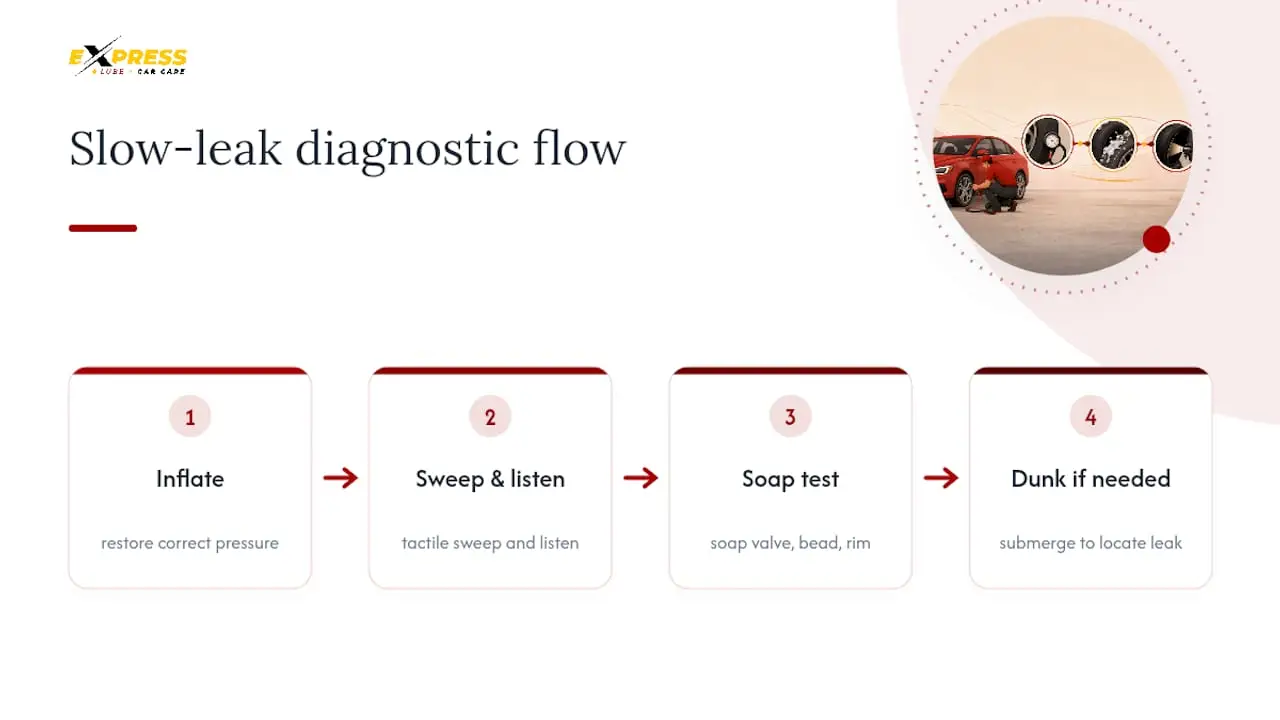
Work through the diagnosis in this order:
- Inflate to the specification on your door jamb, then note the exact PSI and the date. If the tire loses pressure over the next 24 hours while temperatures stay steady, you’re dealing with an actual leak rather than a seasonal fluctuation.
- Run your hand and eyes over the whole tire, tread first, then sidewall. Feel for embedded screws, nails, or glass, and look for bulges, cuts, or anything that doesn’t match the rest of the tire’s surface.
- Listen close to the valve stem and bead line for a faint hiss. It’s easy to miss in a garage with a running fan, so kill any background noise first.
- Remove the valve cap and press on the valve core. A loose or worn core is one of the most common causes of a slow leak, and often the cheapest to fix, since tightening or swapping the core can resolve the problem outright.
- Spray the soap-and-water mix across the tread, the bead where tire meets rim, the valve stem, and the rim itself. Steady, growing bubbles mark the leak. This step alone finds the majority of leaks people bring to a shop.
- If the soap test comes up empty, pull the wheel and submerge it in a tub. Rotating it slowly through the water reveals bubbles a spray bottle can miss, especially on the inner bead surface.
This sequence, moving from the simplest checks to the most involved, mirrors the ordered diagnostic process technicians actually use, and it saves you from pulling a wheel over something a $5 tool could have fixed in the driveway.
Pro Tip: Mark the leak location with your marker the moment you find bubbles. It’s frustratingly easy to lose track of a pinhole leak once you set the wheel down or move the tire.
What Causes a Tire to Leak Air Slowly?
Four culprits account for nearly every slow leak: a tread puncture, a damaged valve stem, a bead or rim seal failure, or rim corrosion. Each leaves a different fingerprint.
- Tread punctures from nails, screws, or road debris typically bleed pressure at a predictable rate, often 2 to 4 PSI per day for a nail lodged in the center tread. You can usually see or feel the object once you know where to look.
- Valve stem and core problems show up as perished rubber around the stem base, visible corrosion on the metal core, or a core that simply never got tightened after a service. These leaks hiss steadily and respond to the valve check in the diagnostic steps above.
- Bead and rim issues, including corrosion on the bead seat or porosity in an older alloy wheel, leak slowly and are notoriously hard to spot without a soap test or a dunk test, since the air is escaping between metal and rubber rather than through either surface alone.
- Sidewall punctures are the one cause you don’t troubleshoot further. They’re structurally different from tread damage and aren’t safe to repair under any circumstance, which is worth knowing before you spend an hour hunting for a patchable hole that isn’t there.
Temperature swings mimic a leak but aren’t one. Tire pressure shifts roughly 1 PSI for every 10 degrees Fahrenheit of ambient temperature change, which explains why your tires read low on a cold morning after reading fine the evening before. The 24-hour stable-temperature test from the diagnostic section is what separates a thermal dip from a genuine leak. If pressure keeps dropping after temperatures level off, something is actually letting air out.
Can You Fix a Slow Tire Leak Yourself?
Some slow leaks are a five-minute driveway fix. Others need a lift and a trained eye, and pretending otherwise just delays the right repair.
What you can reasonably handle yourself:
- Tightening a loose valve core with a valve core tool
- Swapping a worn or corroded valve core for a new one
- Plugging a puncture that sits squarely in the center tread, using a plug kit rated for that use
What belongs at a shop:
- An internal patch combined with a plug, which is the accepted standard for tread punctures because it seals both the inner liner and the puncture channel
- Full valve stem replacement, which requires breaking the bead
- Bead resealing and rim cleaning, where wire-brushing the bead seat and applying bead sealant fixes porosity and light corrosion, while heavier pitting calls for rim resurfacing or, in worse cases, replacement
Aerosol tire sealants deserve a caution here. They can get you off the shoulder of a road in an emergency, but technicians generally treat them as a last resort because the sealant coats the inside of the tire and can complicate a proper patch job afterward. If you’ve used a can of sealant, tell the technician before they start, not after they’ve already broken the bead.
Sidewall damage and severe rim pitting sit outside the repair conversation entirely. Neither one gets patched, plugged, or sealed. Both mean replacement, full stop.
Pro Tip: A quick valve core swap and a professional patch job land in very different cost and time brackets, so if a shop quotes you for a patch when you were expecting a $5 valve fix, ask them to walk you through what they found during the inspection.
Is It Safe to Drive on a Tire With a Slow Leak?
Short answer: only briefly, and only after you’ve inflated to the correct pressure. A tire losing more than 1 to 2 PSI a week at stable temperatures suggests a genuine slow leak worth monitoring closely. Losing 2 to 4 PSI in a single day is a different situation entirely and needs attention now, not next weekend.
Certain signs mean you should not drive at all:
- A visible bulge or cut anywhere on the sidewall
- Rapid pressure loss again within hours of a fresh inflation
- Exposed internal cords or fabric showing through the rubber
If the leak seems to originate from the bead, the rim, or the inner face of the tire, and you’re not confident pinpointing it yourself, a professional inspection or mobile tire service is the safer call than more troubleshooting. When you do drive short distances after inflating to spec, stick to surface streets, skip the highway, and avoid a fully loaded trunk or trailer until the tire’s been properly diagnosed.
How Do You Prevent a Slow Tire Leak?
Most slow leaks are preventable with habits that take five minutes a month. A monthly pressure check with a real gauge, dial or digital, catches problems long before your dashboard warning light does. That’s because a TPMS light typically doesn’t trigger until pressure has dropped around 25 percent, which is far past the point a slow leak was easy to catch and cheap to fix.
- Check pressure monthly, not just when the TPMS light comes on
- Ask your shop to replace valve stems whenever you’re getting new tires mounted
- Keep valve caps tightened; they’re a cheap second barrier against dirt and moisture
- Have bead corrosion addressed early, and skip harsh wheel cleaners that accelerate pitting over time, a concern covered well in guides on protecting alloy wheels with ceramic coatings
- Inspect tires after hitting a pothole or curb, since impact damage doesn’t always show symptoms immediately
- Keep a compact gauge and valve core tool in the glove box for a five-minute roadside check
How Express Lube & Car Care Diagnoses and Repairs Slow Leaks
Our shop workflow starts exactly where your driveway diagnosis would: confirm the leak with a gauge and soap test, then pull the wheel for a full internal inspection. From there, we repair with an internal patch and plug, replace the valve stem, or reseal the bead, depending on what the inspection actually shows.
Our technicians perform every inspection and repair.
No appointment needed. Same-day turnaround is often possible depending on shop volume.
Inspection notes and photos document what was found and why.
Sidewall damage or serious internal cord exposure always gets a replacement recommendation, never a patch.
| What we check | What it tells us |
|---|---|
| Gauge reading over time | Confirms an active leak versus temperature swing |
| Soap test on tread, bead, valve | Pinpoints the exact leak location |
| Internal inspection off the wheel | Confirms whether a puncture is repairable |
| Bead and rim condition | Determines if resealing or rim service is needed |
Inflate your tire to spec before you come in. It makes the diagnosis faster and gives us a cleaner baseline to work from.
Our Take: Diagnose Before You Panic, But Don’t Guess Past Your Limits
The conventional advice on slow leaks tends to swing between two extremes: either “just add air and forget it” or “replace the tire to be safe.” Neither serves the reader well. Most slow leaks have a specific, findable cause, and the ordered diagnostic approach, inflate, sweep, listen, soap test, dunk if needed, solves the majority of cases without a shop visit at all.
Where we think owners get into trouble is treating every slow leak as equally serious. A loose valve core and a corroded bead seat both show up as “the tire’s losing air,” but one is a five-minute fix and the other needs a lift, a wire brush, and sealant applied correctly. The instinct to reach for an aerosol sealant because it’s fast is understandable, but it often makes the eventual professional repair harder, not easier.
Prioritize the tactile checks first. They’re free, they’re fast, and they rule out the easy causes before you spend money on anything else. When the soap test points to the bead, the rim, or the inside of the tire, that’s your signal to stop diagnosing and start scheduling.
— Express Lube & Car Care
Get Your Slow Leak Diagnosed the Same Day
You can walk in with no appointment and technicians will confirm the leak, pinpoint it, and repair or replace as needed, often the same day you arrive.

If your tire keeps losing air and you’ve already tried the driveway checks, bring it in. We’ll inflate it to spec, run the same soap and internal inspection process outlined above, and give you a straight answer on whether it’s a quick patch, a valve stem swap, or something that needs a new tire. Beyond tires, our full services lineup covers everything from brakes to engine diagnostics if your visit uncovers something else worth addressing. Start with our tire and oil change services page, or just drive in. No appointment required.
Sources
- Why Is My Tire Slowly Losing Air? (Causes & Fixes) — Car Care Total
- How to Find a Slow Leak In a Tire – AutoZone
- How to Find and Fix a Slow Leak in Your Tire — RepairPal
- Cars
FAQ
Can You Drive With a Slow Leak in Your Tire?
You can drive short distances if you’ve inflated the tire to the manufacturer’s specified PSI first, but avoid highways and long trips until the leak is diagnosed. Stop driving entirely if you see sidewall bulging, a cut, or exposed cords, since those signs mean the tire isn’t safe at any pressure.
How Do You Fix a Slow Leak in a Tire?
Start with the cheap fixes: tighten or replace the valve core, which resolves many slow leaks in minutes. If the leak comes from a tread puncture, a shop can install an internal patch and plug; bead or rim leaks need cleaning and sealant, or replacement in severe cases.
What Causes a Tire to Leak Slowly?
The most common causes are a tread puncture, a worn or loose valve stem, a bead seal failure, or rim corrosion. A 24-hour pressure test at stable temperatures helps confirm whether you’re dealing with an actual leak or normal temperature-driven pressure changes.
How Much Does It Cost to Fix a Slow Leak in a Tire?
Costs vary widely depending on the cause, since a valve core swap is a minor fix while an internal patch, bead resealing, or a full tire replacement each carry different labor and parts costs. Express Lube & Car Care can give you an exact quote after inspecting the tire; current pricing is available on our services page.