

Uneven tire wear usually points to a fixable issue, most often incorrect inflation, a misalignment, or a worn suspension component, rather than a reason to panic. Your tires become unsafe once tread depth reaches 2/32 of an inch anywhere on the surface, a threshold set by NHTSA. Start with a quick pressure and tread check today, then call a shop if the pattern looks severe or tread is already close to that limit.
TL;DR:
- Compare the inner, center, and outer tread, and seek professional attention if depth differs by more than 2/32 of an inch across one tire.
- Center wear usually signals overinflation, both worn shoulders suggest underinflation, one worn shoulder points to camber misalignment, and feathering typically indicates incorrect toe alignment.
- Check tire pressure cold with a gauge and follow the door jamb sticker; if tires are warm, add 4 psi temporarily, then recheck cold.
- Avoid highway driving and seek inspection if you spot a bulge or exposed cords, feel persistent shaking, or notice the car pulling.
- Follow your owner’s manual for rotation; if it gives no interval, rotate every 5,000 to 8,000 miles, but inspect alignment and suspension first when wear appears.
Table of Contents
- How to spot the common uneven-wear patterns
- What’s likely causing each wear pattern
- What to do now: quick checks before your next drive
- When to see a professional and what they’ll inspect
- Building a maintenance routine that prevents uneven wear
- How uneven wear changes the way your car handles and drinks fuel
- How everyday driving habits shape tire wear patterns
- Why tire type affects how evenly tread wears down
- What you’ll feel and hear inside the car when tires wear unevenly
- How we approach a same-day tire wear check
- Get your tires inspected without waiting for an appointment
- FAQ
- Sources
How to spot the common uneven-wear patterns
Each wear pattern tells a different story, and learning to read it saves time once you’re on the phone with a shop. Center wear shows a strip of balder rubber running down the middle of the tread. Both-shoulder wear looks like the opposite: the edges are thinner than the center. One-sided shoulder wear wears down only the inside or only the outside edge. Cupping (also called scalloping) feels like a washboard when you run your hand across the tread, with dips spaced around the circumference. Feathering, sometimes called heel/toe wear, makes each tread block feel sharp on one side and rounded on the other, almost like a sawtooth under your fingers.
A few simple checks help you confirm what you’re seeing:
- Run your bare hand across the tread in both directions to feel for a sawtooth edge, since feathering is often easier to feel than see.
- Compare the inner, center, and outer thirds of each tire side by side rather than judging one spot alone.
- Use a tread depth gauge or the penny test, inserting Lincoln’s head into the groove, to check how close any area is to the wear bars.
A tread-depth difference of more than 2/32 of an inch across a single tire surface signals that the tire needs professional attention, according to Michelin. If you’re unsure how to read the numbers, our tire tread depth chart walks through the penny test and wear-bar locations in more detail. When you do call a shop, snapping a few photos of each pattern ahead of time helps a technician narrow down the likely cause before your car is even on the lift.
What’s likely causing each wear pattern
Once you know the pattern, the probable cause usually follows a predictable map. Overinflation pushes the center of the tread into greater contact with the road, wearing it faster than the shoulders. Underinflation does the reverse, letting the tire flex so the shoulders bear more load, which wears both edges down evenly. A worn edge on just one shoulder, inside or outside, typically traces back to camber being out of specification. Feathering is almost always a toe misalignment, where the tires are pointed slightly inward or outward instead of straight.
- Center wear usually means the tires are overinflated beyond the manufacturer’s recommended pressure.
- Both-shoulder wear usually points to underinflation relative to that same recommendation.
- One-sided shoulder wear often comes from a camber angle that’s out of alignment specification.
- Feathering is typically a toe-angle problem rather than an inflation issue.
- Cupping or scalloping generally traces back to worn shocks or struts, or an unresolved wheel imbalance.
Bridgestone notes that improper inflation and out-of-spec alignment are two of the most common drivers of early, uneven tread wear, and that toe and caster settings are frequently behind feathering and heel/toe patterns specifically. Heavy towing, carrying consistently heavy loads, aggressive cornering, and repeated pothole impacts can all accelerate any of these patterns once they start. If you’ve noticed pulling to one side along with uneven wear, our guide to signs your car needs alignment covers the symptoms in more depth.
It’s worth repeating one point clearly: rotating tires does not fix a mechanical cause. Michelin explains that rotation simply spreads existing wear to other positions rather than correcting what caused it, so an alignment or suspension problem left unaddressed will keep damaging whichever tires you move into those spots.
What to do now: quick checks before your next drive
Before anything else, confirm your tires are safe to drive on and slow any further damage while you arrange service.
- Check pressure cold, ideally before the car has been driven more than a mile or two, using a reliable gauge rather than guessing by sight.
- Compare the reading against the number on your door-jamb sticker, not the number molded into the tire sidewall.
- If you can only check when tires are warm, add 4 psi above the recommended cold figure as a temporary adjustment, then recheck once the tires have cooled, a method described by Bridgestone.
- Run the penny test on multiple spots around each tire and look closely for bulges, cuts, or exposed cords.
- Avoid long trips or highway speeds if any area is near or below the wear bars, or if you spot a bulge or cord.
Pro Tip: Pull any embedded stones or debris from the tread grooves before a long drive, since trapped debris can mask a slow leak or accelerate wear in that spot.
Our guide to checking tire pressure walks through the cold-check process step by step if you want a visual reference.
When to see a professional and what they’ll inspect
Some findings call for a shop visit rather than a wait-and-see approach. Tread at or below 2/32 of an inch anywhere, a visible bulge, a cut exposing the inner cords, persistent shaking at speed, or the car pulling to one side are all reasons to get the vehicle looked at before your next highway drive.
A typical inspection covers more than just the tires themselves; the process aligns with the role of commercial vehicle inspections in fleet safety, ensuring comprehensive vehicle care.
- A four-wheel alignment check compares camber, caster, and toe against factory specifications.
- A wheel and tire balance check identifies vibration sources, particularly relevant if you’re feeling a rhythmic shake that points toward cupping.
- A suspension inspection looks at shocks, struts, and related components for wear or leaks.
- A wheel runout check rules out a bent rim as the source of vibration.
- A valve stem and TPMS check confirms the sensor system is reading and reporting pressure correctly.
Depending on what’s found, outcomes range from a straightforward alignment adjustment to shock or strut replacement, rebalancing, or, if tread is already at the safety limit, tire replacement. To understand the difference between an alignment issue and a balance issue before you call, our comparison of wheel alignment versus balance breaks down which symptoms point to which problem.
Building a maintenance routine that prevents uneven wear
Prevention is simpler than diagnosis, and a short routine catches most problems early. Rotate tires according to your owner’s manual first; if no interval is listed, every 5,000 to 8,000 miles is the range recommended by the U.S. Tire Manufacturers Association. If uneven wear is already visible, inspect for an alignment or suspension cause before rotating, since rotating a tire with an unresolved mechanical fault only moves the problem to a new position.
- Check pressure monthly with a gauge, since TPMS is a backup warning system, not a monitoring tool for precision.
- Remember that TPMS is designed to warn once a tire is roughly 25% below the recommended cold pressure, a threshold confirmed by NHTSA, which means meaningful underinflation can exist well before the light comes on.
- Add a visual tread inspection to every oil change and at the first scheduled rotation.
- Confirm whether your tires are directional or asymmetrical before a rotation, since those designs limit which positions a tire can move to.
How uneven wear changes the way your car handles and drinks fuel
Tread does more than grip the road: it’s part of how your car communicates stability and efficiency. As wear becomes uneven, the contact patch each tire makes with the pavement changes shape, and the car can start to feel less planted in corners or during quick lane changes. A tire worn unevenly on one shoulder grips less evenly across its surface, which shows up as reduced traction in wet or icy conditions specifically on that corner of the car.
Fuel efficiency takes a hit too, though the mechanism is straightforward rather than dramatic. An underinflated tire, which often produces shoulder wear, creates more rolling resistance because more rubber flexes against the road with every rotation. That added resistance means the engine works harder to maintain speed, which shows up as more frequent fill-ups over time. Overinflated tires, by contrast, can reduce the size of the contact patch enough to affect braking distance and cornering grip, even though they sometimes feel like they’re saving fuel.
None of these effects happen overnight, which is part of why uneven wear is easy to overlook until it’s advanced. A slight pull to one side, a touch more road noise, or tires that seem to need air more often than they used to are often the earliest clues that wear has already started changing how the car handles.
How everyday driving habits shape tire wear patterns
The way you drive has as much influence on tire wear as any mechanical setting. Hard cornering at speed puts extra load on the outer shoulder of the tires on the outside of the turn, and drivers who regularly take corners fast will often see uneven shoulder wear develop faster than drivers who don’t. Frequent hard braking does something similar, concentrating stress on the front tires and accelerating wear there compared to the rear.
Carrying heavy loads or towing regularly adds constant extra weight that inflation alone may not fully compensate for, especially if pressure isn’t adjusted to match the load. Potholes and curb strikes are a less obvious contributor: a single hard impact can knock a wheel slightly out of alignment or damage a strut without any immediate symptom, and the uneven wear that follows may not show up for weeks.
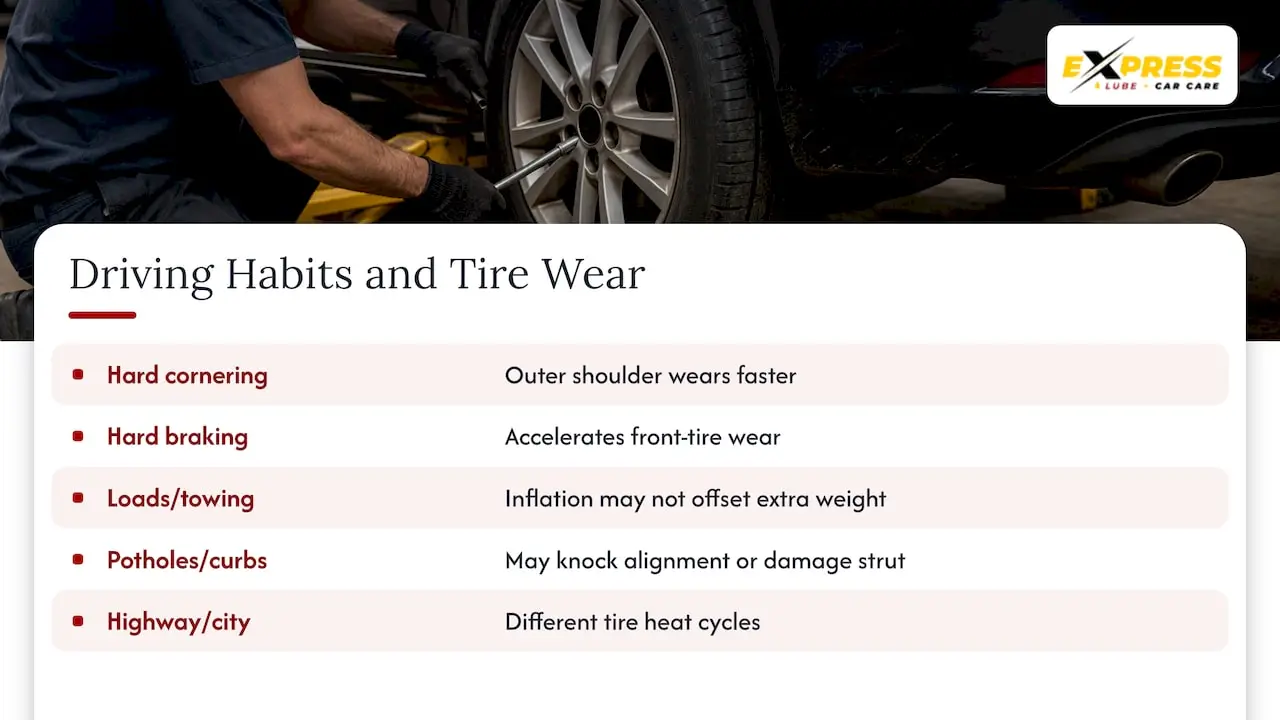
Even routine habits like consistently running on the highway versus frequent short city trips change wear patterns slightly, since tires heat and cool differently under each condition. None of these habits make uneven wear inevitable, but they do explain why two identical vehicles, driven differently, can show very different tread patterns at the same mileage.
Why tire type affects how evenly tread wears down
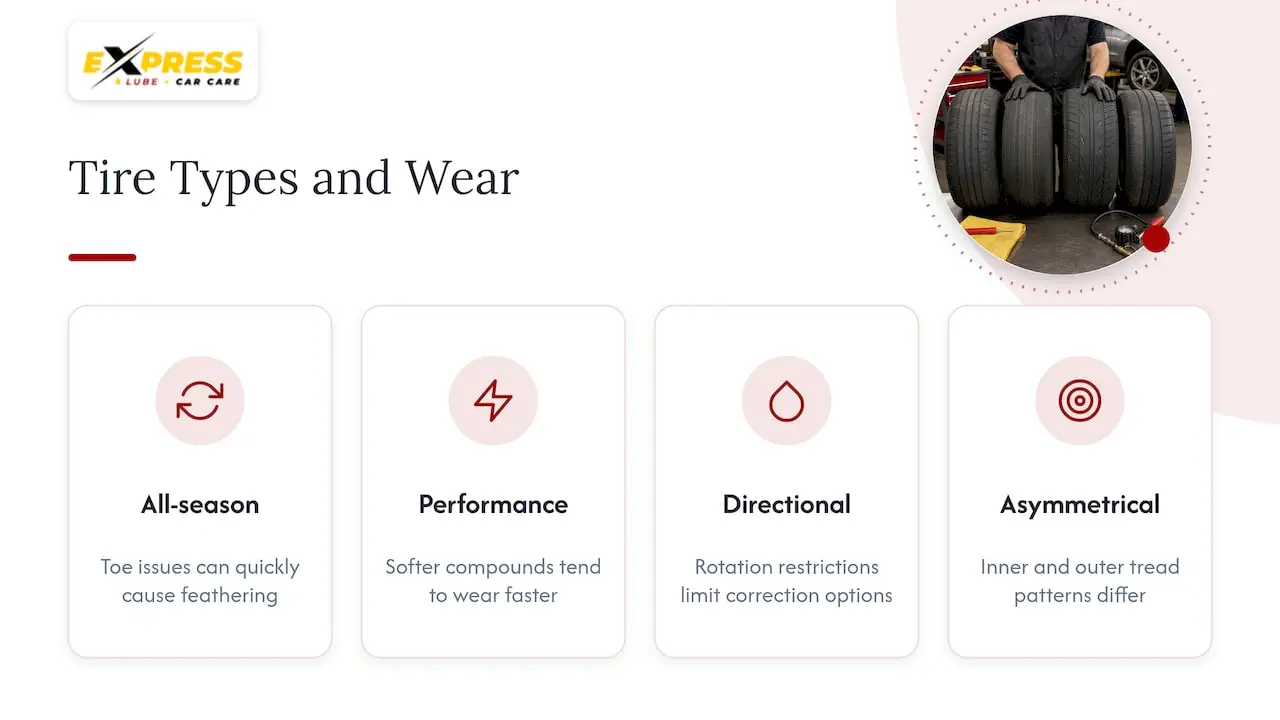
Not every tire wears the same way, and the construction and tread design play a real role in how forgiving or sensitive a tire is to small mechanical issues. All-season tires, the most common original-equipment choice, are built with a tread pattern designed for balanced wear across a wide range of conditions, but that same versatility means they can show alignment-related wear patterns, like feathering, fairly quickly once toe is off.
Performance tires, with softer rubber compounds for better grip, tend to wear faster overall and can be more sensitive to small camber or inflation deviations, since the softer compound shows uneven pressure more visibly. Directional tires, identifiable by an arrow on the sidewall indicating rotation direction, are designed for specific water-evacuation patterns and have rotation restrictions that limit how a shop can address uneven wear once it starts. Asymmetrical tires, with different tread patterns on the inner and outer halves, are built to manage inside and outside wear differently by design, which is part of why matching the correct position during installation matters.
Whatever type you’re running, the underlying wear-pattern causes, inflation, alignment, suspension condition, stay the same. The tire type mostly affects how quickly a given cause shows up and how visible it becomes before it’s noticeable from the driver’s seat.
What you’ll feel and hear inside the car when tires wear unevenly
Your tires often announce a problem before you ever look at the tread. A vibration that comes and goes with speed, particularly one that shows up around highway speeds and fades at lower ones, frequently points to cupping or a balance issue rather than anything in the engine or transmission. A steering wheel that shakes specifically under braking can indicate a different issue, often tied to rotor condition, but combined with uneven tread it’s worth mentioning to a technician as a separate symptom.
Noise is another early signal. A humming or growling sound that changes pitch with speed, especially one that grows louder over a period of weeks, often comes from uneven wear changing how the tread contacts the road. A rhythmic thumping, distinct from a steady hum, can indicate a flat spot or a more advanced cupping pattern.
Pulling to one side while driving on a flat, straight road, even a gentle pull, is one of the more reliable in-cabin signs of an alignment issue, and it frequently shows up well before the wear pattern is obvious to the eye. If you notice any of these symptoms alongside visibly uneven tread, mentioning both together when you describe the problem helps a technician connect the dots faster.
How we approach a same-day tire wear check
When a driver comes in describing a vibration, noise, or visibly uneven tread, we start with a straightforward inspection, no appointment required. Our technicians document tread depth and any visible damage with photos as part of a digital inspection, so you can see exactly what we’re seeing before any work begins. From there, we outline whether the issue points to inflation, alignment, or a suspension component, and we can handle rotations, inspections, or coordinate suspension repair as needed.
— Express Lube & Car Care
Get your tires inspected without waiting for an appointment
We handle tire inspections, rotations, balancing, and suspension diagnostics the same way we handle everything else at our shop: no appointment required, with technicians doing the work and a digital inspection report showing you exactly what we found.

If your tires are showing a pattern you don’t recognize, or you’ve felt a vibration that wasn’t there a few months ago, it’s worth having it looked at before the wear spreads to new tires.
- We inspect tread depth, inflation, and visible wear patterns as part of a standard check.
- We diagnose whether the cause is inflation, alignment, or a worn suspension component before recommending a repair.
- We rotate and balance tires on the schedule your vehicle needs.
- We back our repairs with a warranty.
Stop by or check availability through our Express Lube & Car Care homepage, and we’ll get your tires back on track.
FAQ
Is it possible to fix uneven tire wear?
Yes, in most cases the underlying cause, whether inflation, alignment, or a worn suspension part, can be corrected, which stops the wear from getting worse. The tire itself usually can’t be restored once tread is gone, but catching the pattern early often means only one or two tires need replacing rather than the full set.
How much does a tire alignment cost?
Alignment pricing varies by shop and by vehicle, and we don’t publish a flat rate since the service depends on what your vehicle needs. Contact us directly for current pricing on your specific vehicle.
What is the 3% rule for tires?
This isn’t a standard safety rule referenced by tire manufacturers or regulators, and definitions vary depending on where you encounter the term. The measurement that matters for safety is tread depth: tires are considered unsafe once tread reaches 2/32 of an inch at any point.
What are the symptoms of uneven tire pressure?
Both-shoulder wear typically signals underinflation, while wear concentrated in the center strip points to overinflation. You may also notice reduced fuel efficiency, a softer or harder ride than usual, or a TPMS warning, which activates once a tire is roughly 25% below the recommended cold pressure.
How often should uneven tires be rotated?
Follow your owner’s manual first, and if no interval is listed, rotate every 5,000 to 8,000 miles. If wear is already uneven, have the alignment and suspension checked before rotating, since rotation alone won’t correct a mechanical cause.
Sources
- Tire wear problems and causes — Michelin
- Vehicle tire safety — NHTSA
- Ustires
- Tire tread wear causes — Bridgestone