

Most manufacturers call for a timing belt replacement somewhere between 60,000 and 100,000 miles, according to AAA’s guidance on timing belts. The exact number depends on your engine, so the only figure that counts is the one in your owner’s manual. Many manuals also set a time limit alongside the mileage, and the belt is due when you reach whichever limit comes first.
This guide shows you how to find your own interval, how to read mileage and age together, what to do if you bought the car used or lost the service records, and what the work typically costs. We also cover the warning signs, and we explain why we don’t recommend stretching this one past its due date.
TL;DR
- The typical range is 60,000 to 100,000 miles, but your owner’s manual gives the real interval for your engine.
- Check for a time limit as well as a mileage limit. Whichever you reach first is when the belt is due.
- A belt that breaks in an interference engine can bend valves and damage pistons, which turns a scheduled service into an engine repair.
- If your service history is unknown, have a technician inspect the car and plan the replacement rather than guessing.
- Some engines use a timing chain instead of a belt, and those have no routine replacement interval of this kind.
Table of Contents
- What the timing belt does and why it has an interval
- How often a timing belt should be changed
- Mileage, age, or both
- How to find the interval for your vehicle
- Why we don’t stretch this interval
- Signs the belt may be failing
- What to do if you’re overdue or don’t know the history
- What timing belt replacement costs
- Belt or chain: do you need this at all?
- Our perspective
- Get your timing belt checked in Plano
- FAQ
- Sources
What the timing belt does and why it has an interval
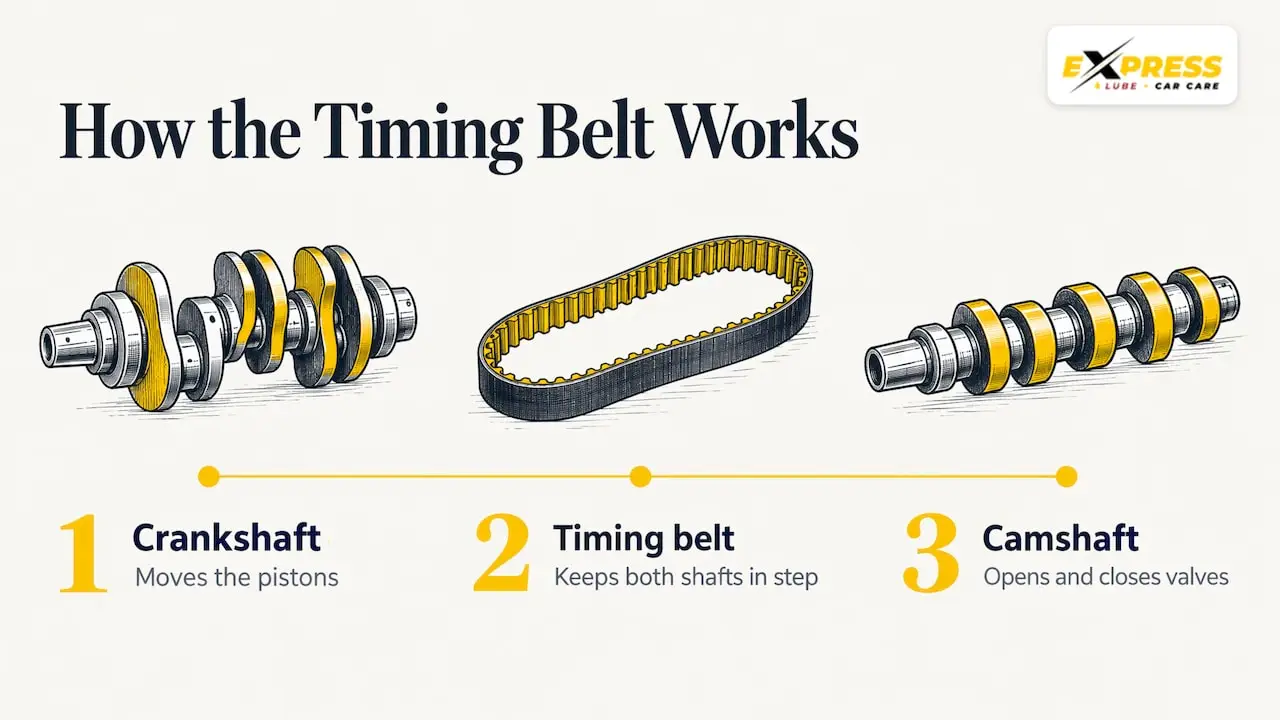
Your engine’s crankshaft and camshaft have to turn in precise relation to each other. The crankshaft moves the pistons, and the camshaft opens and closes the valves. The timing belt is a toothed rubber belt, reinforced with internal cords, that keeps the two in step.
Rubber wears. Heat, oil vapor, and thousands of start and stop cycles gradually harden the belt and wear its teeth. A belt can look fine from the outside and still be near the end of its life, and you can’t see most of it anyway because it sits behind covers at the front or side of the engine. That is why manufacturers set a replacement interval instead of asking you to wait for a symptom.
The timing belt is not the same part as the serpentine belt, the visible belt that drives the alternator, power steering pump, and A/C compressor. The serpentine belt is inspected and replaced on its own schedule. If you want to see how that one works, read our guide on how often to change a serpentine belt.
How often a timing belt should be changed
The range most drivers hear is 60,000 to 100,000 miles, and that matches what AAA reports for most manufacturers. It is a range because engines differ in design, belt material, and how much stress the belt carries. Treat any single number you see online as a rough guide.
Here is how to think about it:
| If your manual says | What it means for you |
|---|---|
| A mileage only | Replace at that mileage. If you drive little, still ask a technician to inspect the belt as the car ages. |
| A mileage and a time limit | Replace at whichever comes first. A low-mileage car can be due by age. |
| No timing belt listed | Your engine may use a timing chain. Confirm the engine code or VIN before you assume. |
| “Inspect” rather than “replace” | Follow the manual, and have the inspection done by a technician who can see the belt condition. |
Two cars with the same badge can have different engines, and the interval can change between model years. Match the interval to your exact engine, not just the model name.
Mileage, age, or both
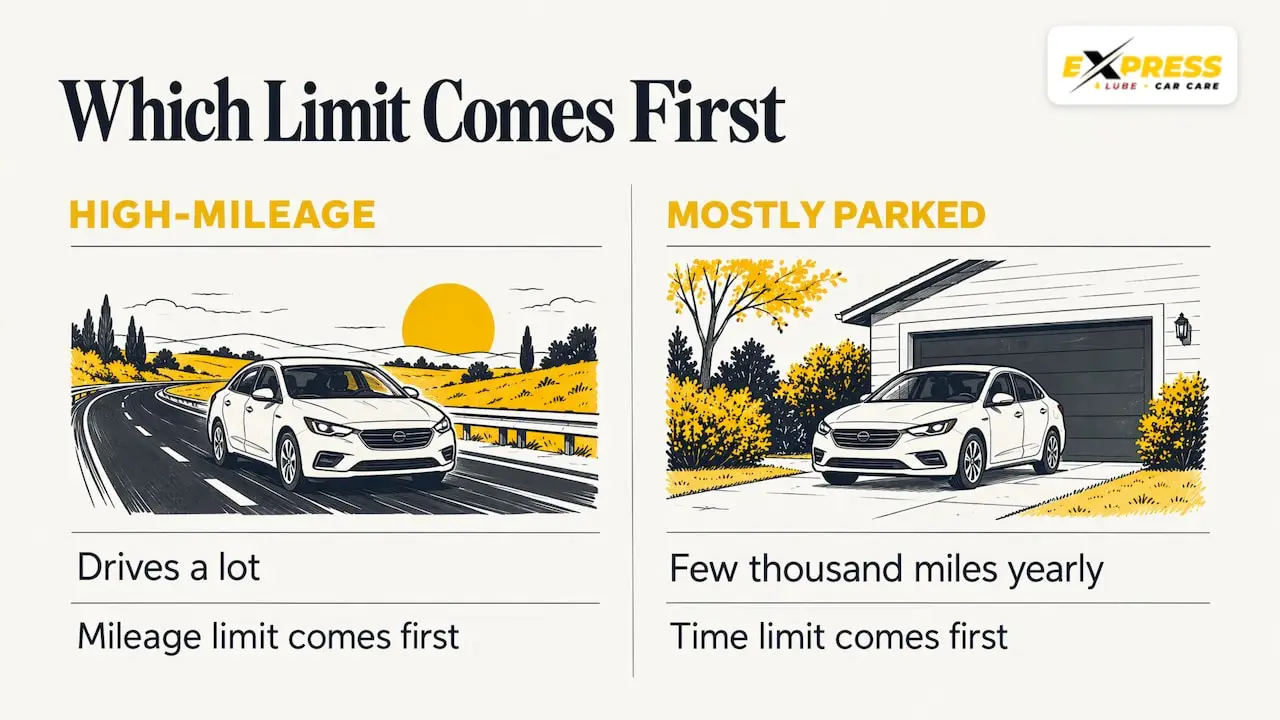
This is the part drivers most often miss. A belt does not only wear when you drive. It also ages while the car sits, because rubber hardens with time and heat. That is why many service schedules pair a mileage figure with a number of years.
Suppose your manual lists a mileage interval and a time interval. A commuter who drives a lot will reach the mileage first. Someone who drives a few thousand miles a year, or keeps a second vehicle mostly parked, will reach the time limit first. In both cases, the first limit reached is the one that counts.
If your manual lists only a mileage, it still makes sense to have the belt looked at as the car gets older, especially if it has been many years since the last replacement. A technician can check for cracking, glazing, fraying, and oil contamination where the belt is accessible.
How to find the interval for your vehicle
AAA’s advice is to consult the owner’s manual, because the interval varies from vehicle to vehicle. Here is a practical order of steps:
- Open the owner’s manual and look in the maintenance schedule section for “timing belt.” Note both the mileage and any time limit.
- Check the engine. Many models offer more than one engine. The interval, and whether the engine has a belt or a chain, can differ between them.
- Look for service records. Receipts, a glovebox log, or dealer records may show whether the belt has already been replaced and at what mileage.
- Look for a sticker or tag. Some shops attach a reminder under the hood with the mileage and date of the last replacement.
- Ask a technician. If you can’t find the manual, a shop can look up the schedule for your exact engine and inspect the car.
If your car uses a maintenance reminder system rather than fixed intervals, follow it, and still confirm what the manual says about the timing belt specifically. For a broader view of what comes due and when, our car maintenance schedule by mileage is a good companion.
Why we don’t stretch this interval
The belt is inexpensive compared with what it protects. If it snaps while the engine runs, the pistons and valves can collide in many engines. The Continental aftermarket workbook says a failure in that situation can cause serious engine damage.
The design of your engine decides how bad the failure is:
- Interference engines have valves and pistons that occupy overlapping space at different moments. If the belt breaks or slips, AAA notes that bent valves and piston damage can result.
- Non-interference engines have clearance between those parts. According to the same AAA guide, a failure may only disable the car without major internal damage. You’d still be stranded, and not every driver knows which type they have.
AAA also frames deferral as a high-stakes gamble, since the cost of a full engine replacement far outweighs the cost of the scheduled service, as its timing belt article explains. Our own view is simple: if the car has an interference engine, or you can’t confirm that it doesn’t, treat the interval as a firm deadline.
Signs the belt may be failing
A timing belt can fail with little warning, so symptoms are not a substitute for the interval. Still, these are worth acting on right away:
- Ticking or whirring from the front of the engine, which can point to a worn tensioner, pulley, or belt.
- Rough running or misfires, which can happen if the belt has slipped a tooth and the valve timing is off.
- Trouble starting, or an engine that cranks but won’t fire, which can mean the timing has been lost.
- Oil leaks near the front of the engine, since oil on the belt or its covers can soften the rubber.
- A check engine light with cam and crank position codes.
None of these proves the belt is the cause. The same signs can come from other parts, which is why we start with a diagnostic check. If you suspect a timing problem, stop driving the car and have it looked at. Continuing to drive with slipped timing can turn a repairable problem into engine damage.
What to do if you’re overdue or don’t know the history
This is common with used vehicles. You buy a car at 110,000 miles, the seller says “it’s been done,” and there’s no paperwork. Or you’ve realized your own car has passed its interval.
Here’s what we’d do in your position:
- Stop treating the belt as a maybe. Without proof of replacement, assume it’s original.
- Find out whether your engine has a belt or a chain. A technician can confirm this quickly from the engine code.
- Get an inspection. Some belts can be partly seen after removing a cover. Condition on inspection is useful information but not a guarantee of how long the belt will last, so don’t use a good-looking belt as a reason to wait past the interval.
- Plan the replacement soon. Drive gently and avoid long trips until it’s done.
- Ask what else is serviced at the same time. The labor to reach the belt overlaps with the tensioner, idler pulleys, and often the water pump when the belt drives it. Replacing them together can avoid paying for the same labor twice. Your technician can tell you which parts apply to your engine.
If you’re buying a used car, a pre-purchase vehicle inspection can help you learn about the car’s condition before you commit, including whether there’s evidence of timing belt service.
What timing belt replacement costs
AAA has said a timing belt package alone can run between $600 and $1,000. That is a general figure, not a quote. Your price depends on:
- Engine layout. Some engines make the belt easy to reach, and others require removing many components first.
- Parts replaced with it. Tensioner, pulleys, and water pump add to the parts cost but can reduce repeat labor.
- Vehicle type. European vehicles, SUVs, and trucks often have different belt layouts and different parts.
- Condition of related parts. Oil leaks or worn components found during the job can add to the work.
We don’t publish a flat price for this job because it depends on the engine. We’ll quote you once we know your vehicle and what the work involves.
Belt or chain: do you need this at all?
Some engines use a metal timing chain in place of a belt. Chains are generally built to last longer and are not on a routine replacement schedule in the same way, though they can still wear, stretch, or have tensioner problems. Your manual will list one or the other. If it lists no timing belt, don’t assume that nothing ever needs attention: listen for rattling on cold starts and respond to timing-related codes.
Our perspective
Drivers rarely come to us asking about the timing belt. They come in for an oil change or a check engine light, and the belt turns up when we look at the mileage and the maintenance schedule.
That’s where we think the shop’s job lies: to read the interval for your exact engine, tell you plainly where the car stands, and show you what we see. Our digital vehicle inspections include photos and technician notes, so you can see the reasoning for yourself rather than take our word for it.
We would rather you do this job on schedule, with a plan, than as an emergency after a breakdown. Our ASE-certified technicians work on everyday vehicles as well as European cars, SUVs, and trucks, and most services are completed the same day with no appointment needed.
Repairs that qualify are backed by our 24-month/24,000-mile limited warranty, whichever comes first. Eligibility, limitations, and exclusions apply, so ask us what covers your specific repair.
Express Lube & Car Care
Get your timing belt checked in Plano
If you’re near your interval, or you aren’t sure where your car stands, we can look up the schedule for your engine, inspect what’s accessible, and give you a clear recommendation. See our timing belt replacement service in Plano for details, or browse all our services.

You can walk in without an appointment, and we’ll go over the findings with you before any work begins. Our warranty on qualifying repairs is 24 months or 24,000 miles, whichever comes first, with eligibility, limitations, and exclusions that apply. If you also need an oil service, it’s convenient to have both looked at on the same visit; see our oil change and preventive maintenance page.
If you drive a high-mileage vehicle, the timing belt is one of several items to prioritize. Our high-mileage maintenance plan shows how to sequence them.
FAQ
How often should a timing belt be changed?
Most manufacturers recommend replacement between 60,000 and 100,000 miles. Your engine’s exact interval is in your owner’s manual, and many manuals add a time limit. Use whichever limit you reach first.
Can a timing belt last 150,000 miles?
Some engines are specified for longer intervals than the typical range, so it depends on your vehicle. Never assume a figure from another model applies to yours. Check your manual and have a technician confirm it for your engine.
What happens if a timing belt breaks?
The engine stops running. In an interference engine, the pistons and valves can collide, causing bent valves and piston damage. In a non-interference engine, the car may only be disabled. Either way, don’t try to restart it, and have it towed to a shop.
Should I replace the water pump with the timing belt?
On many engines the belt drives the water pump, and replacing both together saves repeat labor. Not every engine is built that way, so ask your technician whether it applies to yours.
Does the timing belt interval depend on mileage or age?
Both can matter. Rubber ages even when the car sits, so many manufacturers set a mileage limit and a time limit. Whichever you reach first is when the belt is due.
Sources
- When Should Timing Belts Be Replaced? (AAA Club Alliance)
- Power Transmission Group Automotive Aftermarket workbook (Continental)
- AAA Car Maintenance Guide: Belts
- Should I Repair My Car or Buy a New One? (AAA)