

There is no single mileage that fits every vehicle. Normal-driving intervals commonly fall between 30,000 and 100,000 miles, and towing, heavy loads or severe use can cut that to 15,000 to 50,000 miles. Your owner’s manual sets the number for your exact vehicle, and a front-wheel-drive car may have nothing to service at all. If you drive a truck or SUV around Plano and Collin County, the practical move is to read the manual’s severe-use definition, match it to how you really drive, and have the fluid checked by a technician who can see its condition.
We wrote this guide so you can do that in about ten minutes: what the manufacturers actually print, what changes the number, what the service costs, and what a good shop visit looks like.
TL;DR
- Start with the owner’s manual. Published schedules range from inspection only to replacement every few tens of thousands of miles, depending on the make, model and drivetrain.
- Typical guidance for normal driving runs from 30,000 to 100,000 miles. Towing, hauling, dust, water and repeated short trips move you to the shorter “severe” interval.
- Time counts too. Some manufacturers pair mileage with 12 or 24 months.
- A rear differential fluid change typically costs $85 to $150 depending on the model, according to Consumer Reports.
- Whining, humming or a burnt smell from the axle means the vehicle should be inspected promptly.
Table of Contents
- What differential fluid does and why it wears out
- How often to change differential fluid: what manufacturers publish
- Find the interval for your own vehicle
- Driving conditions that shorten the interval
- Is time as important as mileage?
- What happens if you skip it
- What a differential fluid service involves
- What differential fluid service costs
- Our perspective
- Get your differential checked in Plano
- Related fluids to keep on your schedule
- FAQ
- Sources
What differential fluid does and why it wears out
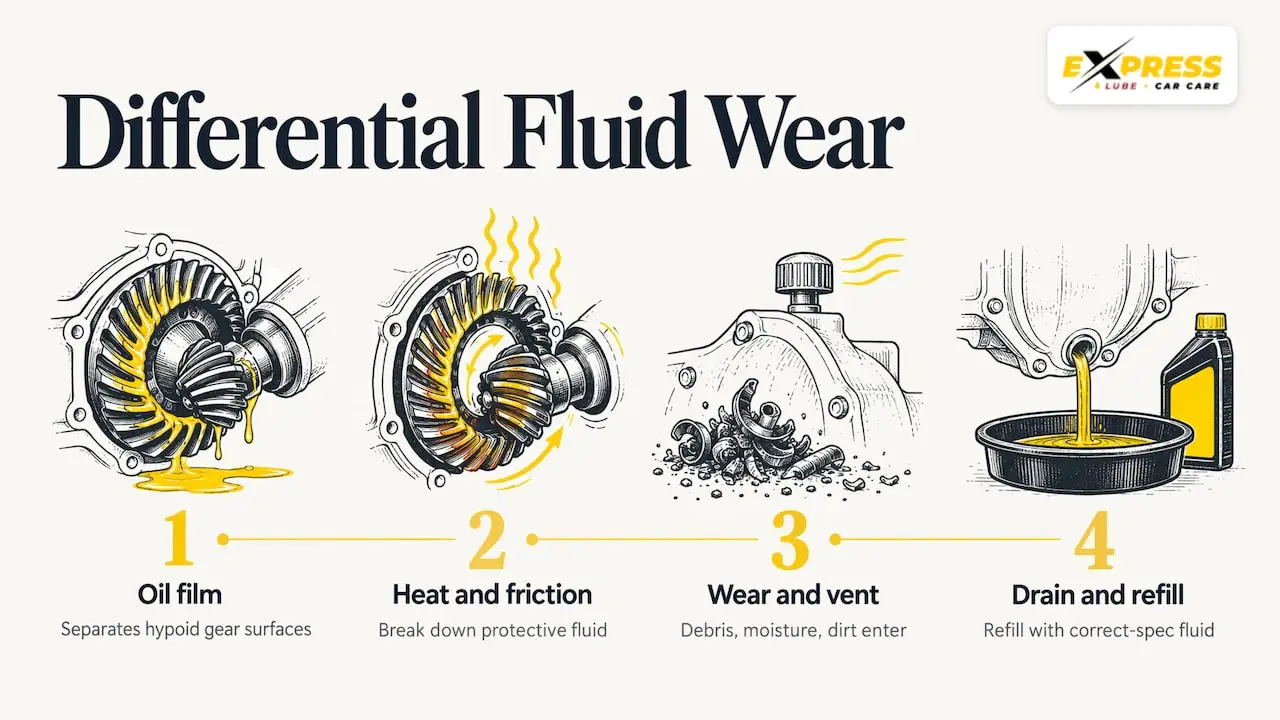
The differential lets your drive wheels turn at different speeds in a corner. Inside, heavy hypoid gears rely on a thin film of gear oil to keep metal from touching metal. Heat and friction slowly break that fluid down, and Castrol notes that it loses its ability to protect those surfaces over time.
Two other things work against it. Normal wear produces fine metallic debris, and because there is no filter, the fluid gets more abrasive as miles add up. Differentials also breathe through a vent without a filter, so moisture and dirt can get in. Dirt causes abrasive wear, and moisture upsets the oil’s viscosity.
The only way to remove those contaminants is to drain the old fluid and refill with fresh fluid of the correct specification.
How often to change differential fluid: what manufacturers publish
The honest answer is a range, because the manufacturers disagree. Here is what the printed schedules and industry sources say.
| Source | Normal driving | Severe or heavy use |
|---|---|---|
| Transmission Digest (April 2026) | About 100,000 miles | About 50,000 miles with regular heavy towing, heavy loads or lots of throttle |
| Castrol | Many automakers recommend 50,000 to 100,000 miles with modern synthetics | 30,000 to 50,000 miles or about 2 to 3 years |
| Consumer Reports (May 2026) | 30,000 to 60,000 miles for a rear differential | Follow the owner’s manual |
| Autoblog (2022) | 10,000 to 50,000 miles for a rear differential, depending on the vehicle | The service manual gives both interval and oil type |
That spread of 10,000 to 100,000 miles is not a mistake. A light sedan with a small rear axle and a three-quarter-ton truck pulling a trailer do very different work.
Real examples from two Nissan schedules
Manufacturer pages show how much the answer depends on drivetrain. Nissan’s 2026 Frontier schedule calls for inspecting the differential oil every 15,000 miles or 12 months under standard conditions. It calls for replacement every 20,000 miles or 24 months under severe conditions.
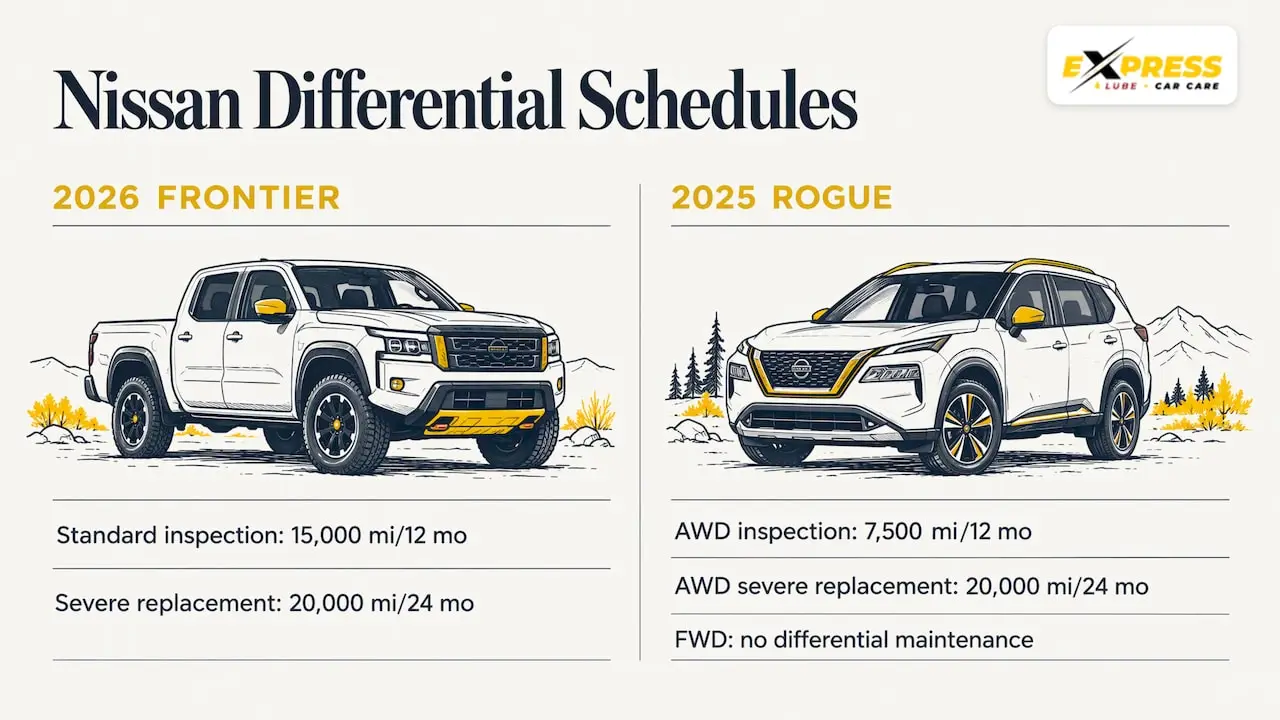
The 2025 Rogue schedule splits by trim. AWD models inspect every 7,500 miles or 12 months and replace every 20,000 miles or 24 months under severe conditions, while FWD trims require no differential maintenance.
So the same brand can tell one owner to inspect twice a year and another to do nothing. This is why we never quote a one-size-fits-all number.
Find the interval for your own vehicle
Use this order. It takes less time than reading forum threads, which tend to contradict each other.
- Confirm your drivetrain. FWD, RWD, AWD and 4WD vehicles have different hardware. An AWD or 4WD vehicle can have a front differential, a rear differential and a transfer case, each with its own fluid and schedule. A front differential may even share fluid with the transmission or transaxle.
- Open the maintenance schedule in the owner’s manual. Look for “differential,” “rear axle,” “final drive” or “gear oil.” Note whether it says inspect or replace.
- Read the severe-use definition. Manufacturers define it differently, so use theirs, not a forum’s.
- Be honest about your driving. Write down whether you tow, haul, or make short trips. If you are unsure, assume you are closer to severe.
- Add the time limit. If your manual lists months as well as miles, whichever comes first applies.
- Ask for a fluid inspection at your next service. A technician can check the level and condition and confirm the specification.
Driving conditions that shorten the interval
Mileage alone can miss the use that works the fluid hardest. Mazda’s scheduled maintenance page for the 2018 CX-3 is a clear example. It says that if the vehicle is mainly used for towing a trailer, driving in dusty, sandy or wet conditions, extended idling, or repeated short trips of under 16 km, the rear differential oil should be replaced every 45,000 km.
In practice, the following all qualify as hard use for many vehicles:
- Towing a boat, camper or equipment trailer. Heat is the main enemy of gear oil.
- Hauling loads. Work trucks and fleet vehicles carrying weight put more stress on the ring and pinion.
- Water crossings or flooded roads. Moisture entering the vent contaminates the oil.
- Off-road or dusty driving. Dust and grit increase abrasive wear.
- Repeated short trips. The fluid rarely reaches full operating temperature.
If your manual defines severe service and you fit it, plan on the shorter interval. Keep a simple log of towing and hauling so the decision is based on what the vehicle does, not on memory.
Is time as important as mileage?
Often, yes. Gear oil ages even when the odometer barely moves. As oil ages it oxidizes and thickens, and viscosity is what protects the bearings and gears, according to the Transmission Digest article. That is why some schedules, like the Nissan ones above, pair miles with 12 or 24 months.
If you drive a low-mileage vehicle, such as a weekend truck or a second SUV, a time-based check is a sensible safeguard. Castrol’s severe-service range likewise includes a time marker of about 2 to 3 years.
What happens if you skip it
The damage rarely announces itself early. Old gear oil can keep a differential running for years, but when it fails, it can fail all at once: a worn ring and pinion, damaged bearings, or in 4WD systems a seized transfer case clutch pack. That is the pattern Wheelscribe describes, and the repairs cost far more than the fluid service that would have prevented them.
Is it ever too late?
Sometimes. If a differential is already whining, adding oil does not undo the harm. TechShop Magazine explains that thicker oil may quiet it temporarily, but worn gears and bearings need an overhaul and replacement. Fresh fluid still helps a healthy unit. It cannot restore damaged parts.
Warning signs worth an inspection
Have a technician look at the vehicle promptly if you notice any of these:
- A humming, whining or howling noise from the axle, especially when turning
- Vibration from underneath the vehicle
- A burnt smell near the rear or front axle
- Fluid on the housing, the ground, or around the axle seals
- A clunk or choppy feel when turning at low speed
These symptoms can have several causes, including wheel bearings, driveshaft joints and tires, so a proper inspection matters more than guessing. Do not keep driving a vehicle with a loud, worsening axle noise.
What a differential fluid service involves
The job is more specific than an engine oil change. A technician identifies the differential or differentials on your vehicle, drains the old fluid, inspects it, and refills to the correct level with the correct fluid. Transmission Digest says the job typically takes about 20 minutes on a straightforward vehicle, though access and the number of differentials vary.
Three details separate a good service from a rushed one:
- The right specification. Castrol warns that gear oils are not interchangeable. Using API GL-4 oil in a differential that requires GL-5 can damage gear tooth surfaces within thousands of miles, and most modern hypoid differentials call for GL-5. Some limited-slip units also need a specific friction modifier, so the manual or axle tag matters.
- A look at the old fluid. Dark, milky or gritty fluid, or one with metal particles, tells the technician more than mileage can.
- The right tools. Transmission service often uses transmission fluid exchangers, while a differential is typically a drain-and-fill job with proper fill-plug access and the correct torque on the plugs.
Our rear differential guide goes deeper on the rear axle. If you drive a 4×4, read our notes on transfer case fluid too, since that is a separate fluid with its own schedule.
What differential fluid service costs
Consumer Reports puts a rear differential fluid change at $85 to $150, depending on the model. Expect the price to rise if your vehicle has both front and rear differentials, a specialty fluid, or hard-to-reach fill plugs.
That same Consumer Reports guide offers a useful rule from mechanic Michael Crossen: your manual decides whether synthetic fluid is required, and flushes offered outside the regular schedule are not always necessary. Ask what your manufacturer specifies and request that it be written on the estimate. Good shops welcome that question. We do not publish a flat price for this service, because the fluid type and the number of differentials change the total. Call us for a quote on your vehicle.
Our perspective
Differentials do not complain until they are damaged, and that is why the interval matters. A gear set that has been running in abrasive, oxidized oil for years can look fine from the outside.
We start with the manufacturer’s schedule for your exact vehicle, then look at how you drive. A commuter in a front-wheel-drive sedan and a family hauling a camper in a three-row SUV need different advice, and we treat them that way.
Our digital vehicle inspections come with photos and technician notes, so you can see what the technician saw before you approve anything. Our ASE-certified technicians handle fluid exchange and drivetrain work, and most services are completed the same day without an appointment.
Qualifying repairs carry our 24-month/24,000-mile limited warranty, whichever comes first, and qualifying suspension repairs carry our Lifetime Suspension Warranty. Eligibility, limitations and exclusions apply to both.
Express Lube & Car Care
Get your differential checked in Plano
If you tow, haul, or are not sure when the differential fluid was last serviced, bring the vehicle in. Our fluid exchange and drivetrain services are performed by ASE-certified technicians. Most services are same-day with no appointment needed, and a digital inspection with photos and technician notes shows you the condition of your fluid.
You can see everything we offer on our services page. Fleet managers can ask about maintenance schedules for work trucks. Qualifying repairs are backed by our 24-month/24,000-mile limited warranty, and eligibility, limitations and exclusions apply.
Related fluids to keep on your schedule
Differential fluid is one item on a longer list. If your truck or SUV is due for other fluids, these guides help you plan one visit rather than several:
- Transmission fluid interval explains why “lifetime” fluid claims can mislead drivers.
- SUV oil change frequency covers engine oil for heavier vehicles.
- Brake fluid change interval covers another fluid that ages with time.
Intervals vary by vehicle, so the owner’s manual remains the reference for each fluid.
FAQ
How often should I change my rear differential fluid?
Follow your owner’s manual. Published guidance ranges widely, from 30,000 to 60,000 miles in Consumer Reports’ guide to 50,000 to 100,000 miles with modern synthetics in Castrol’s. Towing or heavy loads usually bring the shorter figure into play.
How many years does differential fluid last?
It depends on the vehicle. Some manufacturers add a time limit to the mileage, such as Nissan’s 12-month inspection and 24-month severe-use replacement on the 2026 Frontier. If you drive few miles, a time-based inspection is worth keeping.
What happens if I never change differential fluid?
The fluid gets more abrasive and less able to protect the gears and bearings. Eventually that can mean noise, then expensive repairs to the ring and pinion or bearings. If you already hear whining, have the vehicle inspected promptly.
How much does a differential fluid change cost?
Consumer Reports lists $85 to $150 for a rear differential fluid change, depending on the model. Vehicles with front and rear differentials, or ones needing specialty fluid, can cost more. Contact us for a quote on your vehicle.
Does a front-wheel-drive car need differential service?
Often not. Nissan’s 2025 Rogue schedule lists no differential maintenance for FWD trims, though AWD trims have one. Check your manual, because some front-drive vehicles share fluid between the transmission and the differential.
Sources
- Castrol USA: How to Change Differential Fluid
- Nissan USA: 2026 Frontier differential oil maintenance
- Nissan USA: 2025 Rogue differential oil maintenance
- Mazda USA: 2018 CX-3 scheduled maintenance
- Consumer Reports: Guide to Car Maintenance
- Transmission Digest: Do You Need to Change Differential Fluid?
- Autoblog: How to replace rear differential fluid
- TechShop Magazine: Replacement of Gear Lubes Can Prevent Expensive Driveline Problems
- Wheelscribe: Differential and Transfer Case Maintenance
- Garage Equipments: Transmission Fluid Exchangers