
Check your owner’s manual first, but as a practical baseline, plan to change your brake fluid every 2 to 3 years or roughly 30,000 to 45,000 miles. That schedule shifts if you tow, drive mountain roads, or live somewhere humid. If a moisture test shows water content above 3% or a low wet boiling point, replace the fluid now, regardless of what the calendar says.
TL;DR:
- Most vehicles should have their brake fluid tested at least every two to three years, especially if used for towing, mountain driving, or in humid climates.
- Moisture absorption lowers the brake fluid’s boiling point, increasing the risk of vapor lock and brake fade during hard braking.
- Visual inspection alone is unreliable; testing with a moisture gauge or boiling point tester provides an accurate assessment of fluid safety.
- A full brake fluid flush is necessary if testing reveals water content above 3% or if the wet boiling point drops below about 150°C to 155°C.
- Regular testing and timely flushing prevent brake failure and maintain optimal braking performance, regardless of calendar intervals.
Table of Contents
- What Do Manufacturers Actually Recommend for Brake Fluid Change Intervals?
- Why Does Brake Fluid Break Down Over Time?
- Which Driving Habits Shorten Your Brake Fluid’s Lifespan?
- How Can You Tell If Your Brake Fluid Needs Testing Now?
- What Does a Proper Brake Fluid Flush Involve, and When Should You Book One?
- Our Take on Testing Versus Guessing at the Interval
- Get Your Brake Fluid Tested Without an Appointment
- Sources
- FAQ
What Do Manufacturers Actually Recommend for Brake Fluid Change Intervals?
Owner’s manuals don’t agree on a single number, and that’s by design. Every automaker calibrates its brake fluid replacement schedule to its own hydraulic components, seal materials, and expected climate exposure. What they share is a general range that clusters tightly around two to three years.
Most manufacturer guides and service documentation point to a 2-year interval as the conservative standard, with some OEMs extending that to 3 years or expressing it as a mileage window between 30,000 and 45,000 miles. A handful of European and high-performance brands recommend shorter intervals, sometimes annually, because their brake systems run hotter and their fluid volumes are smaller relative to system demand.
Finding your specific interval takes just a few minutes:
- Check the maintenance schedule section of your owner’s manual, usually listed under “brake system” or “fluids.”
- Look at the reservoir cap itself. Most list the DOT rating (DOT 3, DOT 4, or DOT 5.1) required for that vehicle.
- Review any dealer service booklet that came with the car, which sometimes lists intervals not printed in the manual.
- When in doubt, our guide on how often you need a brake fluid flush breaks down interval logic by vehicle type.
If your vehicle is used for towing, fleet duty, or frequent mountain driving, treat the shorter end of any listed range as your target, not the longer one.
Why Does Brake Fluid Break Down Over Time?
Brake fluid failure isn’t about wear in the way brake pads wear. It’s chemistry. Standard glycol-based fluids, which cover DOT 3, DOT 4, and DOT 5.1, are hygroscopic, meaning they actively absorb moisture from the air. This happens continuously, even in a car that sits in a closed garage, because moisture works its way in through microscopic porosity in rubber brake hoses and reservoir seals.
That absorbed water lowers the fluid’s wet boiling point, which matters because your brakes generate intense heat under hard use. When fluid boils inside the lines, it creates vapor bubbles. Vapor compresses instead of transferring hydraulic force, so pedal pressure translates into a mushy stop instead of a firm one. Engineers call this vapor lock or brake fade, and it’s one of the more serious failure modes a hydraulic brake system can experience.
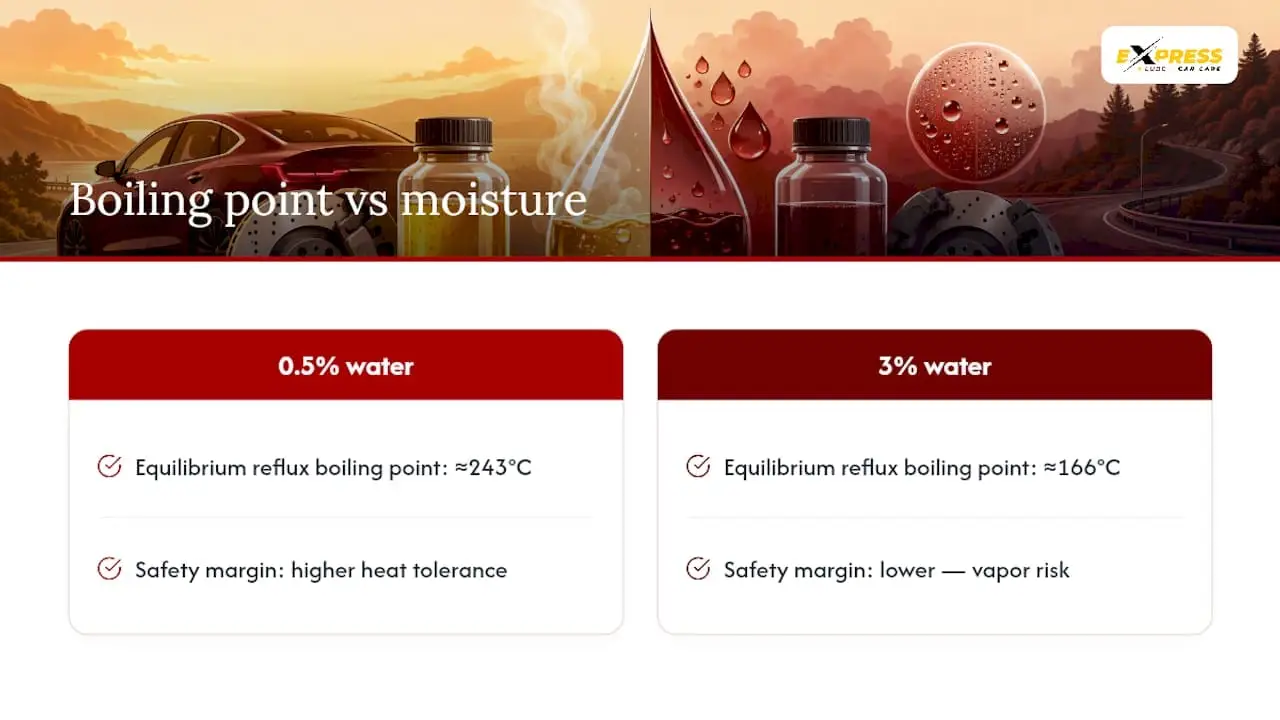
SAE J1706 testing data illustrates the pattern with precision: fluid with roughly 0.5% water content maintains an equilibrium reflux boiling point near 243°C, but at 3% water content, that figure drops to around 166°C. The relationship between moisture and safety margin isn’t gradual. It’s steep, and it accelerates the longer fluid stays in service without a flush.
Which Driving Habits Shorten Your Brake Fluid’s Lifespan?
Calendar-based intervals assume average driving. Plenty of vehicles don’t get average use, and that changes the math considerably.
- High annual mileage, frequent towing, and repeated mountain descents put more heat and moisture stress on brake fluid, accelerating the same boiling point decline described above.
- Heavy stop-and-go city driving cycles the brakes constantly, generating more heat events per mile than highway driving.
- Humid or coastal climates increase moisture ingress through hoses and seals, even for vehicles that rarely leave the driveway.
- DOT 4 and other high wet-boiling-point formulations tend to retain a safety margin longer than DOT 3 under comparable conditions, though neither fluid type is immune to moisture absorption over time.
A car that spends most of its life parked isn’t off the hook, either. Fluid absorbs ambient moisture whether the vehicle moves or not.
Pro Tip: If your vehicle fits more than one risk category, towing plus humid climate, for example, don’t wait for the longer end of your manufacturer’s interval. Get a moisture test at the shorter end of the range, and let the reading decide.
How Can You Tell If Your Brake Fluid Needs Testing Now?
Visual inspection is where most drivers start, and it’s a reasonable first step, but it has real limits. Fluid that looks dark, cloudy, or brown often signals oxidation and contamination, yet clear fluid can still carry dangerous water content that eyesight can’t detect.
Reliable testing requires actual measurement:
- A technician uses a digital moisture tester or chemical test strip to measure water content as a percentage.
- A wet boiling point tester, sometimes a standalone device, sometimes integrated into shop diagnostic equipment, measures the temperature at which the fluid begins to vaporize.
- Results get compared against safety thresholds: replacement is warranted once water content exceeds roughly 3%, or wet boiling point drops below about 150°C to 155°C.
One detail catches a lot of drivers off guard: boiling point can drop fast once fluid is exposed to open air. Recent laboratory testing found that brake fluid left uncapped for even a few days can show a meaningful boiling point decline, which is exactly why topping off with an already-opened bottle from the garage shelf is a poor substitute for a proper flush. Topping off also does nothing to remove the moisture already circulating through your calipers and lines. If a test fails, a full flush is the only fix that actually restores your margin.
What Does a Proper Brake Fluid Flush Involve, and When Should You Book One?
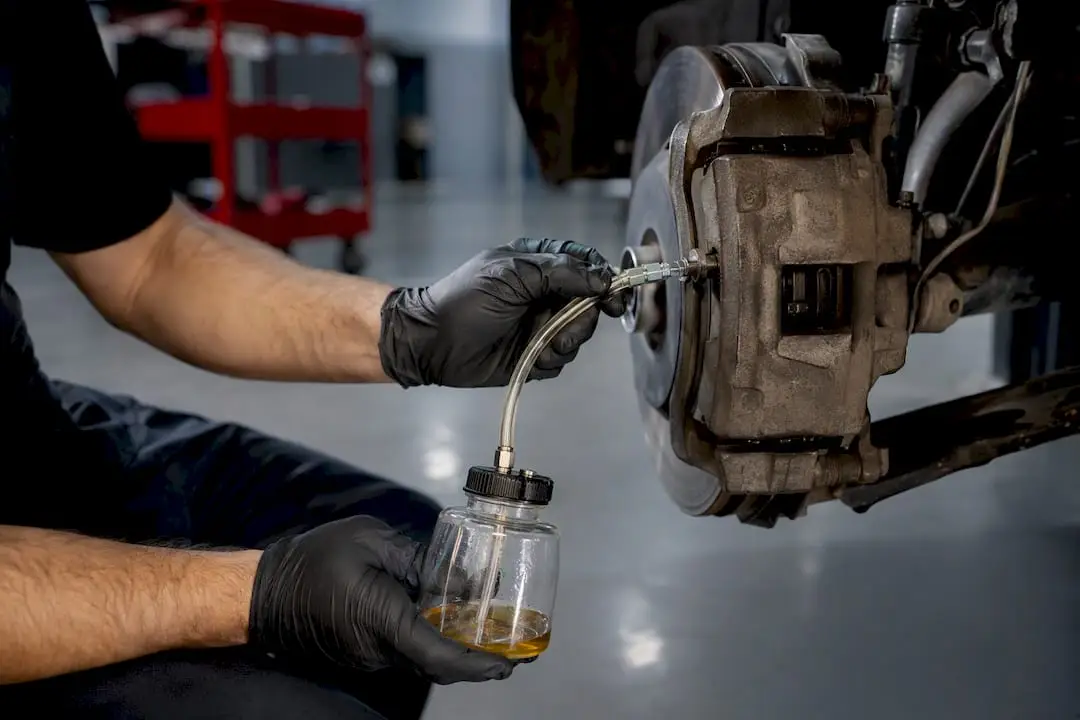
A flush and a top-off are not the same service, even though they sometimes get lumped together. Topping off adds fluid to bring the reservoir up to level. A full flush purges the entire system, old fluid, trapped air, and accumulated moisture, and replaces it with fresh fluid pushed through every line and caliper until only new fluid is present.
A proper shop visit for a brake fluid flush typically includes professional procedures detailed in Car Servicing & MOT Prep in Knutsford, Wilmslow & Crewe:
- Testing the existing fluid for water content and boiling point before any work begins.
- Draining and flushing the system rather than simply refilling the reservoir.
- Bleeding each brake line to manufacturer specification to remove trapped air along with old fluid.
- Installing fresh, sealed fluid at the DOT rating your manufacturer specifies, never fluid from a previously opened container.
Book service if a moisture test fails, if your pedal feels soft or sinks lower than normal, or simply because your owner’s manual’s interval has arrived. If you want a clearer picture of what this service typically costs, our guide on brake fluid flush pricing walks through what factors into the total, and our breakdown of whether a brake flush is necessary covers the topping off versus flushing distinction in more depth.
Our Take on Testing Versus Guessing at the Interval
Calendar intervals are a starting point, not gospel. We follow OEM specifications as the baseline for every vehicle that comes through our bay, but when a customer doesn’t know their brake fluid’s service history, we test it rather than assume. Our certified technicians rely on digital moisture testers to get an actual reading instead of guessing from fluid color, and we recommend a flush whenever results show elevated moisture or a wet boiling point that’s fallen out of a safe range. If you’re not sure where your fluid stands, a quick test settles it faster than another year of wondering.
— Express Lube & Car Care
Get Your Brake Fluid Tested Without an Appointment
Guessing at your brake fluid’s condition isn’t a great plan when it’s the one part of your car standing between you and a stop. They offer walk-in brake fluid testing and flush service, no appointment required, so you can get an actual moisture and boiling point reading the same day you start wondering about it.
Technicians test first and only recommend a flush when the numbers call for it, using fluid that matches OEM specifications rather than whatever happens to be on the shelf. If your vehicle is due, or if you simply don’t know when the fluid was last changed, current brake service specials make it an easy time to find out. For vehicles that need pads, rotors, or ABS attention alongside a fluid service, our brake repair page covers what else we handle in the same visit. Stop by Express Lube & Car Care in Plano and get a straight answer on your brake fluid today.
Sources
This guide draws on SAE J1706 testing data, HELLA’s technical guidance on brake fluid testing, peer-reviewed wet boiling point research, and practical service benchmarks from AutoMedic Mobile. Each source informed a specific threshold or claim cited above.
- Changing the brake fluid: testing and maintenance | HELLA
- Brake Fluid Change Interval: When to Flush Your Brake Fluid
- Wet boiling point characteristics of brake fluids (MDPI, 2025)
- SAE J1706™ JUN2017 (Production, handling, and dispensing of brake fluids)
FAQ
How Often Does Brake Fluid Really Need to Be Changed?
Most manufacturers recommend every 2 to 3 years or about 30,000 to 45,000 miles, though your owner’s manual has the final word for your specific vehicle. Moisture testing can confirm whether you need service sooner.
Is It Necessary to Change Brake Fluid Every 2 Years?
A 2-year interval is a common conservative baseline used by many manufacturers and service guides, though some vehicles specify 3 years or a mileage range instead. Testing water content directly is more reliable than relying on the calendar alone.
What Happens if You Don’t Change Brake Fluid?
Moisture accumulates over time and lowers the fluid’s wet boiling point, which raises the risk of vapor lock and brake fade under hard braking. Left unaddressed, this can produce a soft or sinking brake pedal precisely when you need firm stopping power.
Can Brake Fluid Last 5 Years?
It’s possible in low-mileage, dry-climate conditions, but it’s not something to assume without testing. A moisture test measuring water content and wet boiling point tells you definitively whether fluid at that age is still safe, rather than guessing based on time alone.