

For most owners, the safest path is to follow the manufacturer’s severe duty schedule for towing, off-road, or heavy-load use, and extend toward the upper end of the typical range for normal driving. If you notice a leak, grinding noise, or hesitation when shifting between drive modes, have the transfer case inspected before you drive further.
TL;DR:
- Transfer case intervals commonly fall between 30,000 and 60,000 miles, but occasional towing or gravel road driving can require the shorter schedule.
- Regular towing, heavy loads, dirt roads, off road use, or extreme temperatures qualify as severe driving; two or more conditions justify using the shorter interval.
- Leaks, grinding or whining during mode changes, or difficulty engaging four wheel drive require prompt inspection, even before the scheduled service interval.
- Check fluid on level ground when cool: a low level suggests a leak, while dark or gritty fluid or a burnt smell calls for service, not topping off.
Table of Contents
- How Often Should You Change Transfer Case Fluid
- Warning Signs That Mean Your Transfer Case Needs Attention Now
- What Counts as Severe Driving for Transfer Case Service
- How to Check Your Transfer Case Fluid Level and Condition
- What a Professional Transfer Case Service Includes
- Why We Treat Transfer Case Checks as Cheap Insurance
- Schedule Your Transfer Case Service With Express Lube & Car Care
- FAQ
- Sources
How Often Should You Change Transfer Case Fluid
There is no single mileage number that applies to every truck or SUV, and that frustrates a lot of owners who just want a straight answer. The honest answer is that your owner’s manual is the controlling authority, because manufacturers build their fluid recommendations around the specific transfer case design, fluid chemistry, and seal materials used in that model year.
What we see across owner reports and shop records is a practical range of 30,000 to 60,000 miles, depending on the vehicle and how it gets driven. That range exists because manufacturers split maintenance into two tracks: normal driving and severe or special operating conditions. A 2024 Toyota maintenance guide notes that vehicles used for heavy duty or off-road conditions require significantly more frequent maintenance than standard daily drivers, which is why the same truck can carry two different service intervals depending on how its owner actually uses it.
Some transfer cases are described as “sealed for life,” which sounds like a pass on maintenance altogether. It is not. The same Toyota guidance explains that modern transfer cases can be sealed but still require fluid replacement under severe conditions, and periodic inspection remains important even when a scheduled change is not listed. We treat “sealed for life” as shorthand for “inspect for leaks regularly, and only stretch the interval if your driving genuinely qualifies as normal.”
Rule of thumb: when your maintenance schedule gives a range or distinguishes normal from severe use, pick the shorter interval unless you are certain your driving falls on the easy end.
A few patterns help explain why intervals vary so much from one vehicle to the next:
- Trucks and SUVs built for towing or off-road work often carry a shorter severe-use interval built into the factory schedule.
- Daily commuter use on paved roads, with no towing, typically qualifies for the longer end of the range.
- Vehicles that mix both, occasional towing plus daily commuting, usually need to be serviced on the shorter schedule to stay safe.
- Older transfer cases with higher mileage benefit from more frequent checks even if the original interval was longer.
Forums and owner discussions commonly cite a range of mileage for transfer case fluid changes, which lines up with what we see in practice, though these are owner-reported patterns rather than a single published standard.
Warning Signs That Mean Your Transfer Case Needs Attention Now
Mileage intervals matter, but symptoms override the calendar every time. A transfer case that is leaking, grinding, or slipping between modes needs attention regardless of when the last service happened.
Fluid leaking from the case housing or around a seal is the clearest red flag you will encounter. Jeep’s owner and warranty guidance identifies visible leaks as a symptom that warrants prompt professional inspection, since a transfer case running low on fluid loses the lubrication and cooling it needs to protect its internal gears. A slow leak rarely announces itself the way a sudden one does, which is part of why it is dangerous: fluid levels can drop gradually for weeks before a driver notices anything unusual.
Watch for these additional signs:
- Grinding, whining, or clunking noises when shifting between two-wheel and four-wheel drive.
- Difficulty engaging or disengaging four-wheel drive, or the mode warning light staying illuminated.
- Vibration or shuddering at certain speeds that was not present before.
- Fluid spots under the vehicle near the center of the drivetrain, between the transmission and the rear axle.
- A burnt or metallic smell on the dipstick or fill plug when checked.
Pro Tip: If you spot a fluid spot under your vehicle, note its color and location with your phone camera before it evaporates. That detail helps a technician narrow down whether the leak is coming from the transfer case, the transmission, or a nearby seal.
Delaying service after any of these symptoms show up tends to compound the damage. Low or contaminated fluid lets metal components run drier and hotter than they should, and that wear is cumulative. What starts as a fixable seal replacement can progress into gear damage that costs far more to repair, which is why we treat any of these symptoms as a same-week concern rather than something to monitor for another oil change cycle.
What Counts as Severe Driving for Transfer Case Service
Manufacturers define “severe” or “special” operating conditions more broadly than most owners expect, and recognizing where you fall on that scale is the fastest way to pick the right interval. The 2024 Toyota maintenance guide frames severe use around towing, heavy loading, and driving on dirt or dusty roads, conditions that a lot of truck and SUV owners experience regularly without thinking of themselves as “severe duty” drivers.
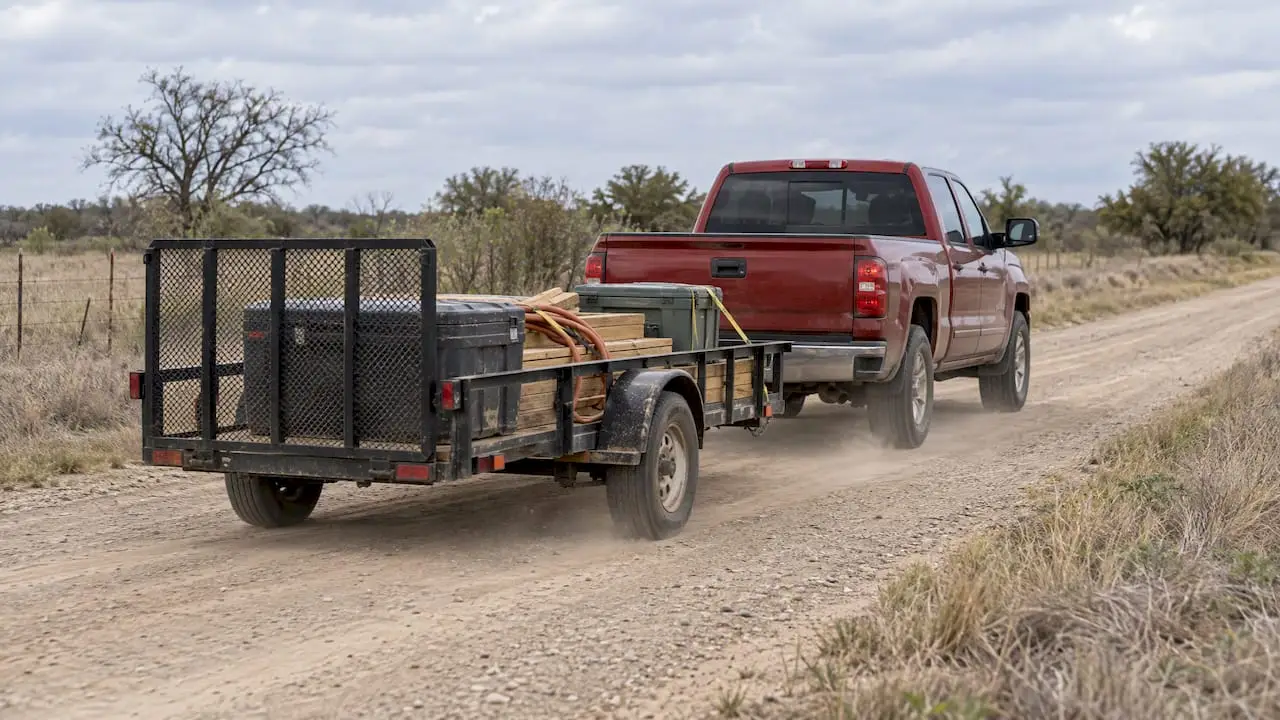
Each of these conditions accelerates wear in a specific way. Towing and heavy loads increase the mechanical stress on the gears inside the transfer case, generating more heat and breaking down the fluid’s lubricating properties faster than normal driving. Dirt and dust roads introduce contamination risk through seals and vents, letting fine particles mix into the fluid over time. Repeated short trips in cold weather can prevent fluid from reaching full operating temperature, which limits its ability to shed moisture and condensation that builds up inside the housing.
Common activities that typically qualify as severe use include:
- Towing a trailer, boat, or camper on a regular basis, even occasionally.
- Driving frequently on gravel, dirt, or dusty rural roads.
- Off-road use involving mud, sand, or water crossings.
- Carrying heavy loads in a truck bed or cargo area regularly.
- Stop-and-go driving in extreme heat or extreme cold climates.
If two or more of these describe your typical week, it is reasonable to reclassify your driving as severe and follow the shorter end of your maintenance schedule’s recommended range. Related driveline components often need attention on a similar timeline. A Ram technical service bulletin covering driveline service notes that double cardan universal joints are commonly greased on routine service intervals, often every several thousand miles depending on the engine and application, which illustrates how closely related drivetrain components can need service more frequently than the transfer case itself.
How to Check Your Transfer Case Fluid Level and Condition
A basic fluid check takes a few minutes and tells you whether you are dealing with a minor top-off situation or something that needs a technician’s attention. Here is how we recommend approaching it:
- Park on level ground and let the vehicle cool. The transfer case should not be hot to the touch; give it at least 30 minutes after driving before you check anything underneath.
- Set the parking brake and chock the wheels if you are working underneath the vehicle, the same precaution you would take for any undercarriage inspection.
- Locate the fill plug, typically on the side of the transfer case housing, using your owner’s manual diagram since placement varies by model.
- Remove the fill plug carefully with the correct size wrench or socket, positioning a drain pan or rag underneath in case fluid runs out as you loosen it.
- Check that fluid sits at or near the bottom of the fill hole. If it is noticeably low, that alone points to a leak somewhere in the system, since these are closed units that should not lose fluid under normal operation.
- Inspect the fluid’s color and smell. Fresh gear oil is typically translucent amber to brown; a burnt smell or dark, gritty texture suggests the fluid has broken down or picked up metal shavings from internal wear.
- Reinstall the plug and torque it to the manufacturer’s specification rather than just snugging it by feel, since an under-torqued plug can leak and an over-torqued one can strip the housing threads.
- Take the vehicle for a short road test, shifting through drive modes if your vehicle allows it, and listen for any grinding or hesitation that was not there before.
Pro Tip: If the fluid smells burnt or looks metallic rather than translucent, do not just top it off. Contaminated fluid usually means a full drain and refill is overdue, and topping off diluted or dirty fluid only delays a repair that is already in progress.
If you find low fluid, visible contamination, a leak at the housing or seals, or any drivetrain noise during the road test, that is your signal to schedule a professional inspection rather than attempt a DIY fix. Transfer cases are sealed systems, and improper reassembly or incorrect fluid specification can cause more damage than the original problem. For a side-by-side look at how this compares with other drivetrain fluids, our guide on how to check transmission fluid level walks through a similar process you can use as a reference point.
What a Professional Transfer Case Service Includes
When you bring a vehicle in for transfer case service, a thorough shop visit covers more than just draining and refilling fluid. A proper inspection starts with checking the seals and housing for any sign of seepage, since a slow leak is often the root cause behind low fluid levels that owners never notice between checks. Jeep’s maintenance guidance points out that periodic digital inspections capture slow leaks and fluid condition issues before they progress into drivability symptoms, which is exactly the gap that owner-only checks tend to miss.
A standard service workflow looks like this:
- Inspect the housing, seals, and fill/drain plugs visually for leaks or damage.
- Drain the existing fluid and inspect it for contamination, metal particles, or discoloration.
- Refill with fluid matching the OEM specification and capacity for that model.
- Replace gaskets or seals if wear or damage is found during inspection.
- Torque the fill and drain plugs to the manufacturer’s specification.
- Road test the vehicle to confirm smooth engagement across drive modes.
- Document the work with digital inspection notes and photos for your records.
Documented digital inspections that pair photos with technician notes catch slow leaks and fluid degradation before a driver notices symptoms on the road, which is a meaningful advantage over relying on dashboard warning lights or driving feel alone, according to Jeep’s owner maintenance guidance.
When you schedule a transfer case service, it is worth asking the technician a few direct questions: what fluid specification they are using and whether it matches OEM requirements, whether they inspected the seals and housing for leaks rather than just performing a drain and fill, and whether you will receive documentation of what was found. ASE-certified technicians who document findings with photos and written notes give you a paper trail that matters later, whether for warranty purposes or simply for your own maintenance records. A related driveline check worth mentioning is universal joint lubrication; Ram’s technical bulletin on drive-line service notes that u-joints are often inspected and greased alongside other driveline maintenance, since output seals and adjacent components are frequently the actual source of noise or vibration that owners attribute to the transfer case itself. If you are also due for a transmission check, our guide on when to change transmission fluid covers how that schedule compares, and our rear differential fluid guide rounds out the picture for drivetrain fluids that tend to get overlooked.
Why We Treat Transfer Case Checks as Cheap Insurance
Transfer case repairs are expensive precisely because the damage is invisible until it is not. A seal that weeps slowly for months costs almost nothing to replace early and a great deal more once the case has run low on fluid long enough to score a gear or bearing. We think the real value of a routine check is not the fluid itself but the inspection that comes with it, the seals, the housing, the fill plug torque, all the small details that prevent a slow leak from becoming a transmission shop’s problem instead of a quick-service one.
For fleet operators, this matters even more, since downtime on a work truck costs more than the service itself ever would. Our stance is simple: follow your manual, treat towing and off-road driving as severe use without exception, and let a technician look at a sealed system you cannot fully inspect yourself.
— Express Lube & Car Care
Schedule Your Transfer Case Service With Express Lube & Car Care
![CTA image placeholder]
We offer transfer case inspection and fluid service with no appointment necessary, so you can visit whenever a leak, noise, or overdue mileage mark catches your attention. Our technicians check the seals and housing, drain and refill with fluid matching OEM specifications, and document the work with inspection photos and notes so you have a record of what was found and fixed. Every service we perform is backed by a warranty, giving you a documented safety net on the work itself.
If your truck or SUV tows regularly, sees dirt roads, or has crossed into higher mileage without a documented transfer case check, visit our services page to see the full range of drivetrain and fluid services we handle, or head to our main services page to find current hours and get started today.
FAQ
How can you tell when transfer case fluid needs to be changed?
The clearest signs are visible leaks around the case housing or seals, grinding or whining noises when shifting between drive modes, and fluid that looks dark or smells burnt when checked at the fill plug. If your mileage matches the severe-use interval in your owner’s manual, that is also a trigger even without obvious symptoms.
What happens if you don’t change transfer case fluid?
Old or contaminated fluid loses its ability to lubricate and cool the gears inside the transfer case, which allows metal-on-metal wear to build up over time. Left unaddressed, this can progress from a simple seal or fluid issue into internal gear damage that requires a far more expensive repair.
What is the life expectancy of a transfer case?
A well-maintained transfer case can last the life of the vehicle when fluid is changed according to the manufacturer’s normal or severe-use schedule and leaks are addressed promptly. Neglected fluid changes and ignored leaks are the most common reasons a transfer case fails well before the rest of the drivetrain.
Is 200,000 miles too late to change transmission fluid?
It is generally not too late, though a technician should inspect the fluid’s condition first since severely degraded fluid at very high mileage can sometimes reveal wear that a routine change alone will not fix. Our guide on when to change transmission fluid covers how to approach high-mileage vehicles and when a fluid exchange still makes sense.
Sources
- Toyota maintenance guide (2024)
- Jeep owner/warranty and maintenance guidance
- Ram technical bulletin (drive-line service)