

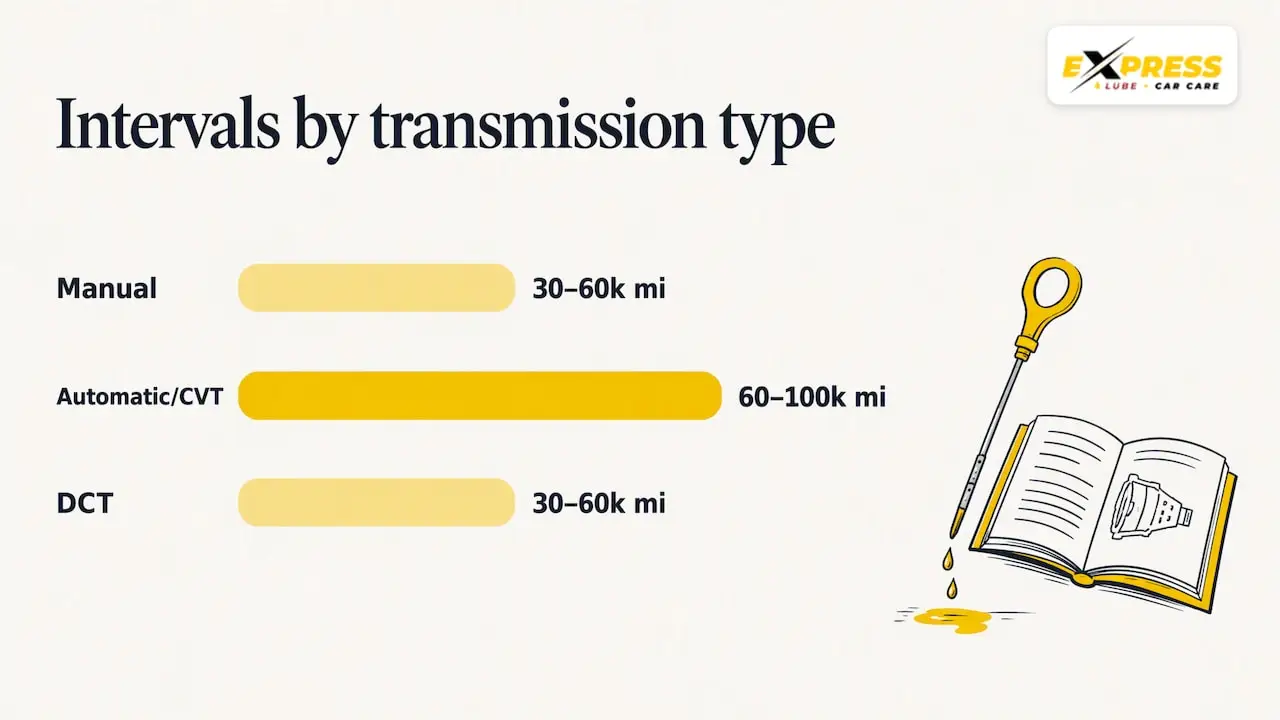
For most drivers, the transmission fluid change interval is about 60,000 to 100,000 miles for automatic and CVT transmissions and 30,000 to 60,000 miles for manual transmissions under normal use, according to AAA guidance. Severe driving can cut those numbers roughly in half. Your owner’s manual always has the final word for your specific vehicle.
TL;DR:
- Manual transmissions often need fluid at 30,000 to 60,000 miles, while dual clutch units commonly use the same interval because they run hot.
- Lifetime fluid still degrades; owners keeping cars for years should consider earlier service, while Consumer Reports suggests checking and likely changing it around 100,000 miles.
- Towing, stop and go traffic, short trips, hills, and extreme heat count as severe use; service may be due near 30,000 miles or sooner.
- Cars without dipsticks generally need professional checks, and fluid appearance alone cannot confirm protection; burnt odor, slipping shifts, noise, or leaks warrant prompt inspection.
- For older transmissions, ask about a drain and fill instead of a pressure flush; CVTs and DCTs require fluid specified by the manufacturer.
Table of Contents
- Recommended intervals by transmission type
- When to follow a severe-service schedule
- How to check transmission fluid and spot warning signs
- Drain-and-fill vs. full flush: choosing the right service
- What to tell your technician and what a service includes
- A note from Express Lube & Car Care
- Schedule a fluid check or transmission service
- FAQ
- Sources
Recommended intervals by transmission type
Every transmission type has its own typical range, and your manual may differ. Treat these numbers as a starting point for a conversation with your technician, not a replacement for the manufacturer’s schedule.
- Manual transmissions: 30,000 to 60,000 miles under normal driving.
- Automatic and CVT transmissions: 60,000 to 100,000 miles under normal driving.
- Dual-clutch (DCT) transmissions: often 30,000 to 60,000 miles, since these units run hot and rely on specialized fluid.
Many newer vehicles carry a “lifetime” fluid label. That wording can be misleading. Industry experts and independent mechanics frequently recommend changing this fluid every 30,000 to 60,000 miles to prevent premature transmission failure. Consumer Reports notes the same trend toward lifetime fluid and suggests checking the fluid and probably changing it around 100,000 miles if you plan to keep the car long-term.
Here is a simple rule: if you plan to keep your vehicle for many years, lean toward earlier service. Keep every receipt, because a documented maintenance history helps with warranty questions and resale value. For a deeper walkthrough, see our guide on when to change transmission fluid.
When to follow a severe-service schedule
Many owners assume their driving is “normal.” Manufacturers define severe service more broadly than most drivers expect, and it shortens the schedule noticeably. Severe conditions include:
- Frequent towing or hauling heavy loads
- Stop-and-go city traffic
- Many short trips that never let the fluid fully warm up
- Mountainous or hilly routes
- Extreme heat or other harsh weather
Heat is the real enemy; however, riders of ATVs and utility vehicles should also follow a specific ATV maintenance schedule to keep their transmissions and other parts in good shape. Cars calls excess heat from stop-and-go driving, hauling and towing the biggest killer of a transmission and its fluid. Under these conditions, service intervals often land near 30,000 miles or sooner, about half the normal schedule.
Only 6% of drivers say they drive in severe conditions, yet about 62% actually do, based on real-world factors like short trips, heavy traffic and climate.
That gap is worth a moment of honest thought. If your week includes commuter traffic on the tollway or short school runs, you may belong on the severe schedule without realizing it.
How to check transmission fluid and spot warning signs
If your vehicle has a dipstick, you can check the fluid yourself. If it does not, skip to the sealed-system note below.
- Park on a level surface and warm the engine to operating temperature, as your owner’s manual directs.
- Follow the manual’s instructions for the gear selector position and whether the engine should be running.
- Pull the dipstick, wipe it clean, reinsert it fully, and pull it again.
- Read the level against the marks and note the color and smell.
Color alone does not tell the whole story. AAA points out that even clean-looking fluid can lose its protective additives, so mileage and time matter more than appearance. Many newer cars use sealed systems with no dipstick, and these generally need a professional to check and top off. Our step-by-step post on how to check transmission fluid level covers the details.
Book service promptly if you notice a burnt smell, dark or black fluid, slipping or delayed shifts, unusual noises, or visible leaks. These can point to a safety issue, so have a technician inspect the vehicle.
Drain-and-fill vs. full flush: choosing the right service
A drain-and-fill drains the pan, replaces the filter where applicable, and refills with fresh fluid. Toyota’s guidance describes the same distinction.
Why do many technicians lean toward drain-and-fill?
- Pressure flushes can dislodge internal debris that then circulates and harms sensitive parts.
- CVTs and many modern automatics are often better served by a drain-and-fill, as AAA notes.
- Older, high-mileage transmissions carry more built-up debris, which raises the stakes of a forceful flush.
- Repeated, modest fluid changes keep the fluid fresher over time.
Fluid type matters just as much as method. CVTs and DCTs are highly sensitive to friction modifiers and usually need transmission-specific fluid, not a “universal” formula. The wrong choice can damage them.
Pro Tip: When in doubt, choose a fluid exchange with filter replacement and insist on the manufacturer-specified fluid. Read more in our article on flushing transmission fluid.
What to tell your technician and what a service includes
A short checklist gets you the right service the first time:
- Share your vehicle’s year, make and model, and mention any towing or severe use.
- Ask whether the filter will be replaced and whether the shop uses the manufacturer-specified fluid.
- Confirm whether the plan is a drain-and-fill or a flush, and ask about warranty on the work.
- Request digital inspection photos or notes so you can see what the technician sees.
A standard service usually includes draining the pan, replacing the fluid and filter, and checking for leaks. We explain the full scope in what a transmission service includes.
A note from Express Lube & Car Care
We recommend following your owner’s manual and shortening the interval when your driving is severe. Our technicians perform fluid exchange services and diagnostics, and we explain what we find. If your car has a sealed system or your situation is unclear, come talk with us.
— Express Lube & Car Care
Schedule a fluid check or transmission service
If you are unsure where your car stands, let us take a look. We offer fluid exchange services and diagnostics. Contact us to discuss your service needs, or learn more on our transmission service page. Learn more on our transmission service page, or schedule your visit at our Plano shop today.
FAQ
How often do I really need to change transmission fluid?
For normal driving, the typical range is 60,000 to 100,000 miles for automatics and CVTs and 30,000 to 60,000 miles for manuals, per AAA. Your owner’s manual sets the exact schedule, and severe driving shortens it.
Can transmission fluid last 10 years?
Some manufacturers label their fluid “lifetime,” but that does not mean it never degrades. Independent experts often advise changing it much sooner to protect the transmission. Time and heat both wear down the fluid’s additives, even on low-mileage cars.
Why do some mechanics say not to change transmission fluid?
The concern usually targets high-pressure flushes on old, high-mileage transmissions, which can loosen debris. A gentler drain-and-fill with the correct fluid is generally the safer route when a transmission has never been serviced.
Is 150,000 miles too late to change transmission fluid?
It is not too late to have the fluid inspected. A technician can check its condition and advise on a drain-and-fill versus leaving it alone. Do not skip the check, since waiting longer only adds wear.
Sources
- How to Check and Maintain Your Transmission Fluid
- News
- Maintain Your Car’s Transmission and Avoid Costly Repairs – Consumer Reports