

The subtle shudder you feel during your daily commute is more than just a vehicle quirk—it's a critical communication from your car. The most common signs of transmission failure often manifest as seemingly minor issues, such as slipping gears, unusual noises, a burnt smell, or fluid leaks. Ignoring these early warnings is akin to neglecting a persistent health symptom; a manageable issue can quickly escalate into a severe and costly mechanical breakdown.
Why Transmission Health is Non-Negotiable

Consider your vehicle's transmission as the vital link that translates engine power into wheel motion. A properly functioning transmission operates seamlessly in the background. However, when it begins to fail, its symptoms become noticeable and demand attention.
For instance, you might experience a split-second hesitation when accelerating from a stoplight, or perhaps a faint whining sound emerges that was previously absent. These subtle changes are mechanical signals indicating an underlying problem. Understanding and responding to them is a fundamental aspect of responsible vehicle ownership.
Your Senses as Diagnostic Instruments
You don't need to be a certified mechanic to detect the initial signs of transmission distress. By actively paying attention to how your car feels, sounds, and smells, you can identify potential problems long before they result in a roadside emergency. Early detection is paramount—it can mean the difference between a routine fluid service and a complete transmission replacement costing thousands of dollars.
Knowing what to look for empowers you to take prompt, preventative action. Here are some of the most critical indicators:
- Delayed Engagement: A noticeable pause when shifting the gear selector from Park to Drive or Reverse.
- Atypical Noises: Any new whining, clunking, or humming sounds are abnormal and warrant investigation.
- Fluid Leaks: Puddles of bright red or dark brown fluid beneath your car signify a leak.
- Burning Odor: An aroma similar to burnt toast often indicates that the transmission fluid is overheating and degrading.
A healthy transmission is integral to a reliable vehicle. The symptoms it displays are not random; they are direct communications about its internal condition. Addressing them promptly is the most effective way to protect your investment and ensure your safety.
Many of these issues originate with the transmission fluid. You can learn more by reading our guide on how to check transmission fluid level to stay ahead of potential problems. If you notice any of these signs, the team at Express Lube Plano is ready to provide an expert diagnosis.
What Gear Slipping and Delayed Shifting Really Mean

Two of the most common—and concerning—signs of transmission failure are delayed engagement and slipping gears. While both indicate a serious problem with the vehicle's ability to transfer power to the wheels, they present differently from the driver's perspective. Recognizing these symptoms is the first step toward addressing a problem before it becomes catastrophic.
Delayed engagement is the noticeable pause that occurs after moving the gear selector from Park into Drive or Reverse. The shift is commanded, but for a moment, nothing happens, followed by an abrupt jolt as the gear finally engages. This hesitation signifies that the transmission is struggling to build the necessary hydraulic pressure to operate correctly.
The Mechanics Behind Transmission Hesitation
This sluggish response is often linked to the transmission fluid. If the fluid level is low or its lubricating properties have degraded, it cannot generate the pressure required for smooth shifting. However, other mechanical or electronic issues could also be the cause:
- Failing Solenoids: These electro-hydraulic valves control the flow of fluid within the transmission. A malfunctioning solenoid can disrupt the precise timing of gear changes.
- Worn Internal Seals: Damaged internal seals allow hydraulic pressure to leak, causing the delay in gear engagement.
- Clogged Filter: A restricted transmission filter impedes fluid flow, effectively starving the system of the pressure it needs to function.
Gear slipping is an even more alarming symptom. During acceleration, the engine RPMs may suddenly increase without a corresponding increase in vehicle speed. It feels as though the car has momentarily shifted into neutral before the gear re-engages. This is a definitive sign that internal transmission components are failing to maintain their grip.
The Root Cause of Gear Slippage
The underlying causes of gear slipping are typically serious and point to significant internal wear. When a transmission slips, it's because the friction components responsible for locking a gear in place—the clutches and bands—are worn out and can no longer hold.
At its core, gear slipping means the transmission’s internal clutches or bands have lost their ability to hold. This creates a disconnect between engine power and vehicle speed, which is not only inefficient but also extremely dangerous in traffic. A professional diagnosis is non-negotiable.
Automotive repair data clearly shows that ignoring these shifting problems leads to catastrophic and expensive failures. When a driver reports even a one or two-second delay, a technician's diagnostic scan can often identify trouble codes before a total breakdown occurs. Too often, vehicle owners wait until the car is barely drivable, transforming a potential $200–$400 service into a $2,000–$4,000 rebuild. You can explore the data on repair market trends and see the value of proactive maintenance by reading research on the global automotive transmission repair market.
Decoding Alarming Smells, Sounds, and Leaks
Beyond the tactile feedback you get while driving, your other senses are often the first to detect signs of transmission failure. Atypical noises and unusual odors are your vehicle's way of signaling that something is mechanically wrong. Disregarding these sensory warnings can allow a small problem to escalate into a major, costly repair.
One of the most distinct red flags is the smell of burning transmission fluid. An acrid, sweet odor—often compared to burnt marshmallows—is a serious warning sign. This indicates the fluid is overheating and breaking down, losing its essential ability to lubricate and cool critical moving parts.
What Those Strange Noises Are Telling You
Just as significant as smells are the sounds your vehicle produces. A healthy transmission operates almost silently, so any new or unusual noise should be investigated. These sounds are auditory clues that help a mechanic diagnose the specific problem.
- Whining or Humming: This noise, which often changes pitch with vehicle speed, can indicate a problem with the torque converter or worn internal gears.
- Clunking or Banging: A harsh, mechanical clunk during gear shifts often points to a severe internal issue, potentially involving the planetary gear set.
- Buzzing Sound: A constant buzzing noise could be a symptom of a failing internal seal, a clogged filter, or low fluid causing the transmission pump to cavitate.
A transmission’s health is directly tied to its fluid. In fact, industry data shows that a staggering 60–70% of major transmission failures are linked to old or degraded fluid. Once it can't lubricate and cool properly, the internal components wear down fast. You can learn more about the trends in transmission repair to see just how critical fluid maintenance really is.
Identifying a Transmission Fluid Leak
Finally, one of the most straightforward signs to identify is a fluid puddle under your vehicle. Fresh automatic transmission fluid (ATF) is typically a translucent, bright red color with a slightly sweet smell. If you discover a puddle of red or dark brown, oily liquid under the front or middle of your car, it is almost certainly a transmission fluid leak.
This puddle represents the lifeblood of your transmission draining away. Operating a vehicle with low transmission fluid is one of the fastest ways to cause catastrophic, irreversible damage.
You can perform a quick inspection to verify. With the engine running and the transmission in Park or Neutral (consult your owner’s manual for the correct procedure), remove the transmission dipstick. Wipe it clean, reinsert it fully, and then remove it again. Check the fluid level, but also observe its color and smell. If the fluid is dark brown, black, or has a burnt odor, it is no longer effective and requires immediate service.
That Little Light on Your Dashboard? Don't Ignore It.
Of all the ways your vehicle communicates a problem, an illuminated dashboard warning light is one of the most direct signs of transmission failure. The check engine light functions as a crucial alert system for your vehicle; it is designed to be conspicuous for a reason. Ignoring it is effectively gambling that a detected fault will resolve itself, which is rarely the case.
When this light activates, your vehicle's onboard computer, or Engine Control Unit (ECU), has detected an anomaly and stored a specific Diagnostic Trouble Code (DTC). This code acts as a digital marker, guiding a technician directly to the source of the problem, whether it's a faulty sensor, a drop in hydraulic pressure, or a more severe internal malfunction.
What is "Limp Mode"?
In cases of a more severe fault, your vehicle may enter a self-preservation state known as "limp mode" or "limp-home mode." This is a built-in safety feature where the ECU restricts engine power and locks the transmission into a single gear (typically second or third). While this experience can be alarming, it is designed to prevent catastrophic damage and provide just enough power to get the vehicle safely to a repair facility.
Limp mode is your vehicle's final, urgent warning. Attempting to continue driving normally can easily escalate a repairable issue into one that necessitates a complete transmission replacement.
Ignoring a dashboard warning light is like unplugging a smoke detector because you don't like the noise. The light isn't the problem—it's the messenger. Simply clearing the code without a proper diagnostic scan just silences the warning while the real issue gets worse, leading to much bigger repair bills.
The Importance of a Professional Scan
While a basic code reader may turn the light off, it does not resolve the underlying issue. To gain a better understanding of these warnings, our guide on the reasons your check engine light is on is an excellent resource.
Modern transmissions are highly complex systems, making electronic faults more prevalent than ever. This complexity contributes significantly to the global $220–$230+ billion transmission repair industry, where failed electronic components are a leading cause of mechanical issues. For drivers, a transmission-related warning light is not an anomaly—it is a direct consequence of the advanced technology in their vehicle.
When that light appears, the only way to accurately diagnose the problem is with a professional-grade scan tool at Express Lube Plano. We have the equipment to perform a deep analysis, identify the root cause, and provide a clear plan for resolution.
Your Action Plan for Suspected Transmission Failure
Recognizing the signs of transmission trouble is the first step; knowing the appropriate response is equally crucial. Your primary concern should always be safety. If you experience a loud noise, a violent shudder, or a sudden loss of power, do not attempt to continue driving. Pull over to a safe location as soon as possible.
However, if the symptoms are more subtle—such as a faint whining noise or slight hesitation during shifting—you can likely drive cautiously to a trusted repair facility. In either scenario, begin documenting the symptoms. Note when the problem occurs, what it feels and sounds like, and whether it is associated with certain speeds, temperatures, or driving conditions. This information is invaluable for a technician performing a diagnosis.
Initial Steps and Diagnosis
Once safely parked, you can conduct a quick visual inspection. If you are comfortable doing so, check your transmission fluid. A low level is a strong indicator of a leak that requires immediate attention. Our guide on when to change transmission fluid further explains the critical role this fluid plays in your vehicle's health.
Following this, your next step should be to schedule a professional diagnostic appointment without delay. Postponing an inspection can allow a minor issue, like a faulty sensor, to cascade into complete transmission failure.
This decision tree offers a simple roadmap, beginning with your dashboard warning lights.
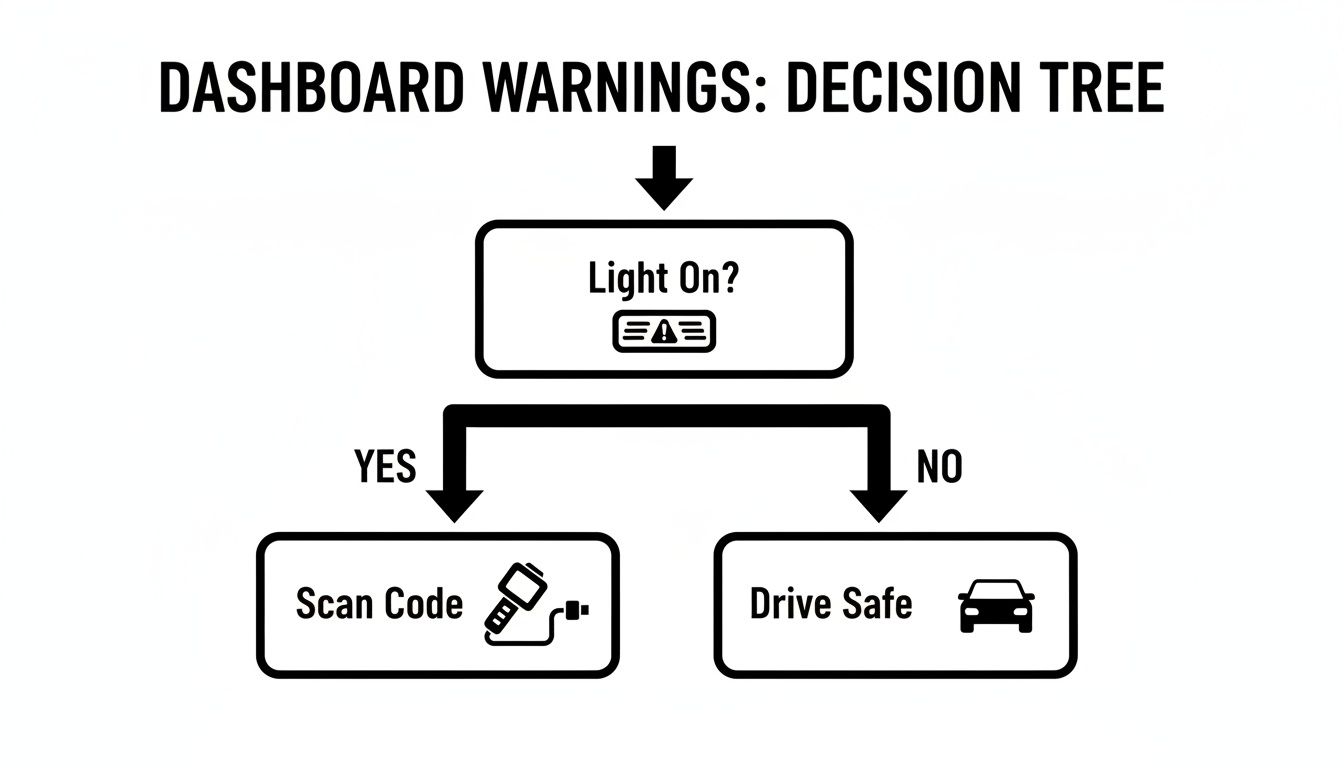
The key takeaway is that any warning light on your dashboard necessitates a diagnostic scan to determine the true nature of the problem.
Making the Repair Versus Replace Decision
A professional diagnosis will clarify the extent of the damage, leading to the fundamental question: repair or replace? The optimal choice depends on your vehicle's age, overall condition, and market value. A full transmission replacement can be a significant expense, but for a newer vehicle you intend to keep, it may be the most prudent long-term investment.
Deciding whether to repair or replace a transmission involves balancing the immediate cost against the long-term value of your vehicle. A technician’s honest assessment is key to making a smart financial choice that keeps you safely on the road without overspending.
A clear, upfront cost estimate is essential for making an informed decision. To help you understand what to expect, we have compiled a table outlining typical price ranges for common transmission services.
Estimated Transmission Service Costs
This table provides a general overview of potential costs for common transmission services, helping you understand the financial scope of different solutions.
| Service Type | Typical Cost Range | Best For |
|---|---|---|
| Fluid Flush and Change | $150 – $400 | Preventive maintenance or minor fluid-related issues. |
| Solenoid or Sensor Replacement | $300 – $800 | Fixing specific electronic shifting problems. |
| Minor Repair (e.g., resealing a leak) | $250 – $600 | Addressing external leaks without internal damage. |
| Transmission Rebuild | $2,000 – $4,500+ | Repairing extensive internal wear in a valuable vehicle. |
| Transmission Replacement (Remanufactured) | $3,000 – $7,000+ | When internal damage is too severe or costly to rebuild. |
Please note that these are estimates. The final cost will vary based on your vehicle's make and model and the specific labor required. At Express Lube Plano, we provide transparent quotes so you always have a clear understanding of the costs before we begin any work.
Trust Your Vehicle with Plano's Transmission Experts
When you first observe the signs of transmission failure, you need a direct, accurate diagnosis and a reliable solution from a team of qualified professionals. At Express Lube Plano, we have built our reputation on technical skill, transparency, and a commitment to returning you to the road safely.
Our team consists of ASE-certified technicians. These are not just mechanics; they are career professionals dedicated to automotive excellence. We equip them with advanced diagnostic tools that go far beyond basic code readers, allowing us to pinpoint the exact cause of your transmission issue. This methodology eliminates guesswork, providing you with a clear, data-backed explanation of the problem and the recommended solution.
Why Plano Drivers Choose Us
We understand that automotive issues are stressful and inconvenient. That is why our service model is designed for maximum convenience and transparency, ensuring you feel confident in every decision.
Here’s what sets Express Lube Plano apart:
- No Appointment Needed: Transmission problems don’t adhere to a schedule. Visit us at your convenience, and we will promptly attend to your vehicle.
- Honest Recommendations: We will show you our findings, explain them in clear terms, and only recommend the work that is truly necessary for your vehicle.
- Community Savings: We proudly offer discounts for military personnel and first responders, in addition to our popular Ladies Day special every Wednesday.
When your car’s health is on the line, the right technician makes all the difference. Our promise is simple: expert care, honest advice, and the respect you and your vehicle deserve.
Do not let transmission concerns disrupt your life. Visit Express Lube Plano for a professional diagnosis and experience the difference that true expertise makes.
Transmission FAQs: Your Questions Answered
Even after identifying potential warning signs, it is natural to have further questions. Here are clear answers to some of the most common concerns we hear from drivers.
How Often Should I Change My Transmission Fluid?
The outdated guideline of changing fluid every 30,000 miles is no longer applicable to most vehicles. Modern transmissions are designed for longer service intervals, typically between 60,000 and 100,000 miles. However, this is just a general recommendation.
Your owner's manual does not account for local driving conditions like extreme summer heat or heavy stop-and-go traffic, both of which accelerate the thermal breakdown of transmission fluid. A more effective strategy is to have us inspect the fluid's condition during your routine oil changes. This quick check allows us to determine if your vehicle would benefit from earlier service to maintain optimal protection.
Can a Transmission Fail Without Any Warning?
It is exceedingly rare for a transmission to fail catastrophically without any preceding symptoms. More often, the initial signs are subtle and easily overlooked.
A slight hesitation during acceleration, a new and faint humming sound, or a shift that feels marginally "off" can be easily dismissed as normal signs of aging. This is precisely why a professional evaluation is so critical. Our technicians are trained to identify these minor indicators before they escalate into a major, expensive failure.
The best way to avoid a sudden breakdown is to stay ahead of it. Those small, seemingly random changes in how your car drives are often the earliest—and most important—warnings you'll get.
Is It Worth Repairing a Transmission on an Older Car?
This is an excellent question, and the answer depends on several factors: the vehicle's overall mechanical condition, its current market value, and the cost of the repair.
If your older vehicle has been reliable and you wish to extend its service life, repairing the transmission is often a sound financial decision. The cost is almost always less than acquiring a new vehicle and can provide several more years of use from a car you know and trust.
At Express Lube Plano, we will provide you with a clear diagnosis and a straightforward assessment of your options. We will tell you honestly if a repair is a logical investment for your vehicle and budget—no pressure, just expert advice.
If you're noticing any of these signs or just want to be sure your transmission is in good shape, don't put it off. Swing by Express Lube & Car Care for an expert diagnosis. No appointment needed—our ASE-certified team is here to help. https://www.expresslubeplano.com