
A dark puddle forming under your vehicle is more than just a stain on your driveway—it's a critical warning sign. To effectively stop an oil leak, you must first identify its origin and then determine the appropriate course of action, whether it's a DIY fix or a job for a professional technician.
One fact is certain: ignoring a leak can lead to critically low oil levels, a condition that is one of the fastest ways to cause catastrophic engine damage.
Why You Should Never Ignore an Oil Leak
A minor drip might seem insignificant, but it often signals a larger issue developing within your engine. Engine oil is the lifeblood of your vehicle, serving three primary functions: lubricating moving parts to reduce friction, cleaning internal components, and dissipating heat to prevent overheating.
When the oil level drops too low, friction and heat escalate rapidly. This can lead to warped components, seized parts, and ultimately, complete engine failure—a repair that can easily cost thousands of dollars. An unaddressed leak is not just a risk to your engine; it's a significant financial liability.
How Small Problems Escalate
What typically begins as a deteriorated gasket or a loose seal can quickly worsen. The longer a repair is postponed, the more oil is lost, and the risk of severe engine damage increases exponentially. It is always more cost-effective to address a leak proactively than to manage the consequences of engine failure.
Consider a slow leak a window of opportunity to intervene while the problem is still manageable. Acting quickly is crucial for several reasons:
- Prevent Engine Damage: Maintaining the correct oil level is non-negotiable for engine health and longevity.
- Avoid Costly Repairs: Replacing a seal is vastly different from replacing an entire engine. A professional leak diagnosis can save you from a $4,000+ engine replacement.
- Ensure Vehicle Safety: Oil dripping onto hot components, such as the exhaust manifold, can create a serious fire hazard.
- Protect the Environment: Motor oil is a significant source of water pollution. Proper containment is an environmental responsibility.
The single greatest danger of an oil leak is operating the engine with insufficient lubrication. Regularly checking your oil level is the most effective first line of defense against major damage.
Understanding how to check your oil is a fundamental skill for any vehicle owner. If you are unfamiliar with the process, our guide provides a simple walkthrough on how to check the oil on your car and interpret the readings on the dipstick.
Finding the Source of the Oil Leak
Before you can stop an oil leak, you must perform some diagnostic work. Accurately pinpointing the source is the most critical step; a misdiagnosis can lead to unnecessary repairs and continued leakage. The best approach is to begin with a clean engine.
Over time, your engine bay accumulates a layer of old oil, dirt, and road grime, which can camouflage a fresh leak. Clean the engine thoroughly with a quality degreaser and a gentle rinse. Once the engine is clean and dry, take the vehicle for a short drive. This allows fresh oil to escape from the leak's origin, making it much easier to identify.
This visual guide offers a starting point for assessing the situation and determining your next steps.
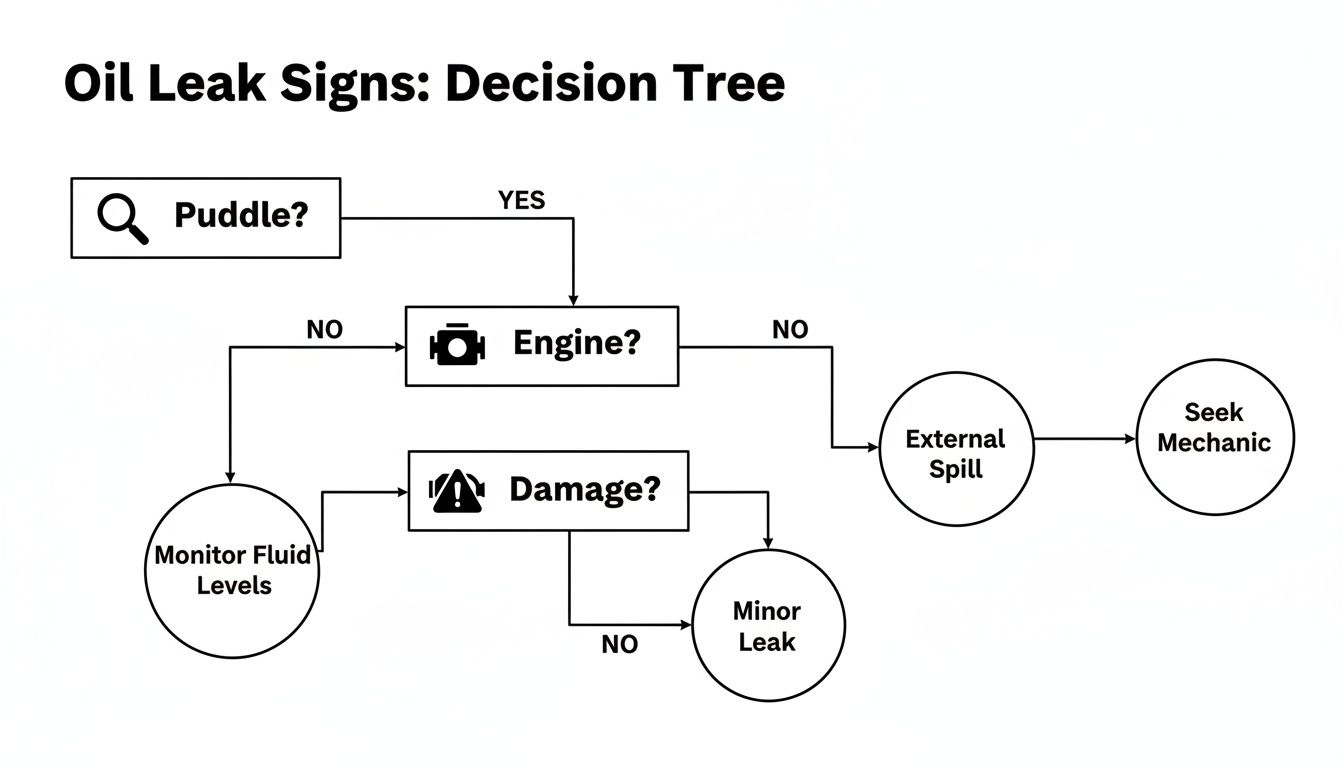
As the chart illustrates, the first step is to confirm that a leak exists. If it does, and it originates from the engine, a closer visual inspection is required.
Is It Really Engine Oil?
Not every fluid puddle under your vehicle is engine oil. Other fluids like coolant, power steering fluid, or transmission fluid can also leak. The simplest way to differentiate them is by placing a clean, white piece of paper under the drip to absorb a sample.
- Engine Oil: Appears amber to dark brown or black. It has a slick, viscous feel and a distinct greasy odor.
- Transmission Fluid: Typically reddish-brown in color and often has a slightly sweet smell. You can find more details in our guide on the signs your car is leaking transmission fluid.
- Coolant (Antifreeze): This fluid is easily identifiable. It's usually bright green, pink, or yellow, feels slimy to the touch, and has a noticeably sweet scent.
The Classic Cardboard Test
One of the most effective and inexpensive diagnostic tools is a large piece of cardboard. Before parking overnight, slide it directly underneath your engine. The next morning, you will have a clear map indicating the precise location of the drips.
A drip near the front of the engine could indicate a problem with the front crankshaft seal or the oil pan. If the spots are closer to the center, a loose oil filter or a failing drain plug are common culprits. This simple method helps narrow the search area significantly.
Pro Tip: Remember that gravity dictates the path of a leak. Oil almost always originates from a higher point and drips downward. If you see oil coating the bottom of the oil pan, the actual leak might be located much higher, such as a faulty valve cover gasket. Always begin your search at the top of the engine and work your way down.
Common Oil Leak Sources and Symptoms
While a leak can technically originate from anywhere, a few components are the most frequent culprits. The table below helps match the location of a drip with its likely cause.
| Potential Source | Drip Location | Signs and Severity |
|---|---|---|
| Valve Cover Gasket | Top/sides of the engine | Oil is visible seeping down the engine block. Often produces a burning oil smell as it drips onto hot exhaust components. |
| Oil Pan Gasket | Bottom of the engine, around the pan's perimeter | A very common source of leaks. Causes drips directly under the engine. Can range from a slow seep to a steady drip. |
| Oil Drain Plug | Directly from the bolt at the base of the oil pan | Frequently occurs after an oil change. Usually a fast, steady drip. May simply require tightening or a new washer. |
| Crankshaft/Camshaft Seals | Front or rear of the engine, behind the pulleys | A more serious and labor-intensive repair. Leaks can be substantial, coating the entire underside of the engine. |
| Oil Filter | Side of the engine, near the oil pan | Another common issue following an oil change. Verify that it is screwed on tightly—snug, but not overtightened. |
Familiarity with these common failure points provides a significant advantage in diagnosis. These are almost always the first places a professional mechanic will inspect when identifying a leak.
Temporary Fixes to Maintain Engine Health
Discovering an oil leak doesn't necessarily mean your car is out of commission. For minor drips caused by aging seals, certain temporary measures can provide enough time to schedule a proper repair without compromising your engine.
While these are not permanent solutions, they can be effective stopgaps to keep your vehicle operational.
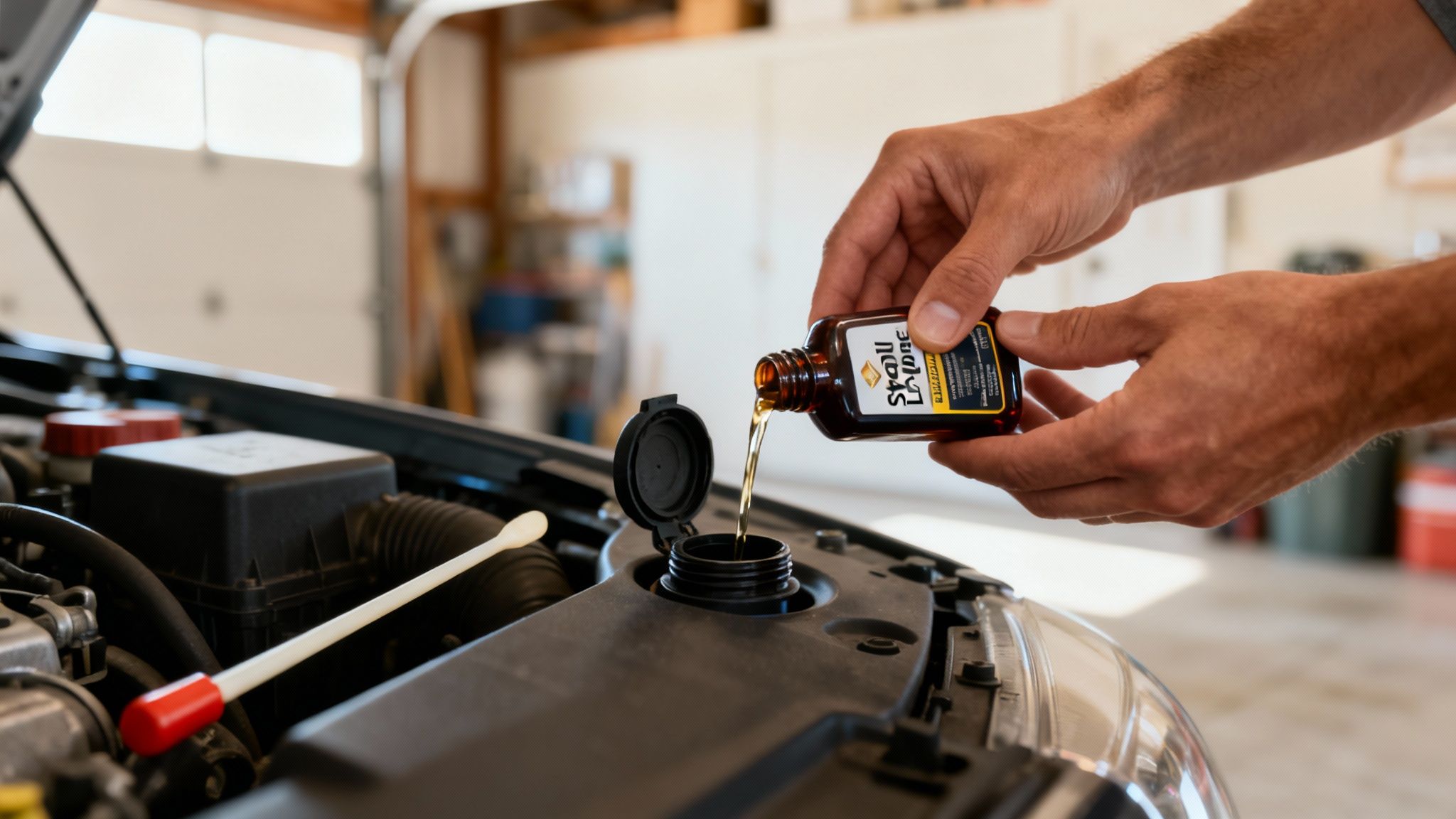
A common temporary fix is an oil stop leak additive. These products are formulated with chemicals that recondition and soften the rubber seals and gaskets within your engine. After years of exposure to thousands of heat cycles, rubber can become hard, brittle, and shrink—creating the perfect conditions for a slow leak.
How Stop Leak Additives Work
These additives function as a conditioner for your engine's seals. They contain special polymers that are absorbed by the rubber, causing the seals to gently swell and regain their flexibility. This slight expansion is often sufficient to close the microscopic gaps where oil has been seeping out.
However, it is crucial to understand that these additives are not a universal solution. Their effectiveness depends entirely on the root cause of the leak.
- Best For: Slow, weeping leaks from hardened rubber seals, such as a rear main seal or valve cover gaskets. This is their ideal application.
- Not For: Physical damage. If a gasket is torn, an oil pan is cracked, or a drain plug is simply loose, an additive will have no effect.
Application is straightforward: pour the product into your engine during an oil change or add it directly to your existing oil. The engine must run for several hours over multiple days for the formula to circulate completely and take effect.
The primary purpose of a temporary fix is to maintain a safe oil level in the engine. The drip itself is not the immediate danger—the real threat is the oil level dropping so low that it causes catastrophic friction and heat damage.
Constant Monitoring is Your Best Defense
While an additive is at work, it is absolutely essential to become vigilant about checking your oil level. This is a non-negotiable step. The most significant mistake is to add the product, assume the problem is solved, and cease monitoring.
Develop a habit of checking the dipstick every few days—or daily if the leak is steady. The oil level should always remain safely between the "Full" and "Add" marks.
Topping off your oil is a simple but vital task. Ensure you are using the correct oil viscosity (e.g., 5W-30 or 0W-20) recommended by your vehicle’s manufacturer. Our guide on how to change engine oil at home offers helpful tips that also apply to topping off. Diligent monitoring is what will keep your vehicle safely on the road until a permanent repair can be made.
Understanding Permanent Repair Costs and Options
When a temporary measure is no longer sufficient, it is time to consider a permanent solution to stop the oil leak. While no one enjoys a repair bill, understanding the common repairs and their typical costs can help demystify the process.
The final price to fix an oil leak varies widely, depending on which component has failed and its accessibility within the engine bay. Some repairs are quick and straightforward, while others are complex and require hours of skilled labor.
Common Leaks and Realistic Repair Costs
Let's examine a few real-world examples, from simple jobs to more involved procedures. These estimates include both parts and labor, with labor often being the largest component of the final cost.
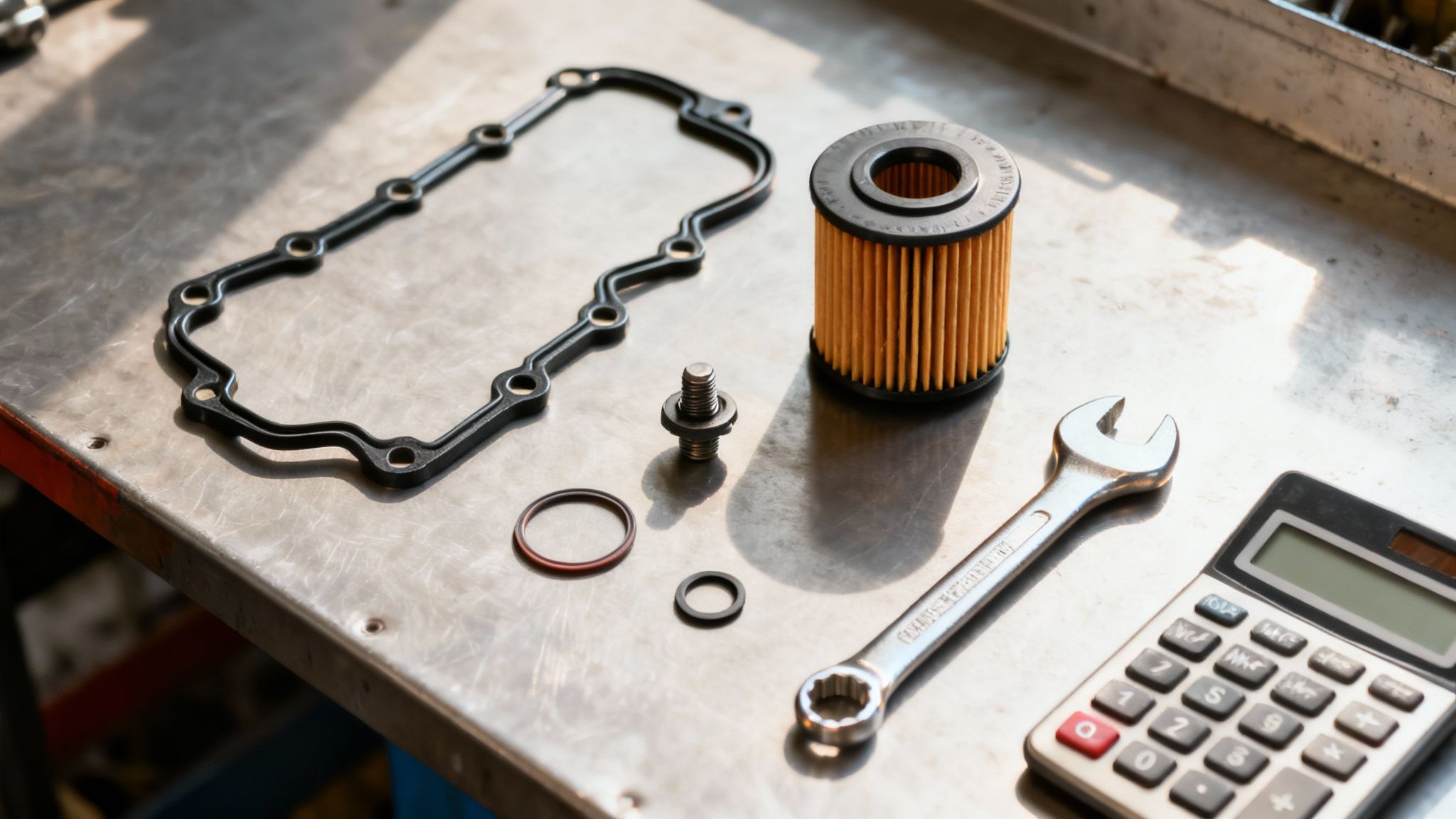
One of the most frequent and least expensive fixes is a faulty oil drain plug or its washer. If a drip appears immediately after an oil change, this is the most likely cause. The repair is simple, with costs typically ranging from $20 to $50.
Another common source is a failed oil pan gasket, which seals the joint between the oil pan and the engine block. This repair is more involved, as it requires draining the oil and removing the entire pan.
- Cost: The repair generally ranges from $150 to $400.
- Labor: A mechanic typically needs 1 to 3 hours to complete the job.
- Complexity: On some vehicles, components like exhaust pipes or frame crossmembers must be moved to access the pan, increasing labor time and cost.
This demonstrates how a vehicle's design can significantly impact the price of a repair. What is an easy fix on one model can be a major undertaking on another.
More Involved Gasket and Seal Replacements
Moving higher up the engine, a leaking valve cover gasket is another common culprit. This gasket seals the top of the engine. When it fails, oil often seeps down the side of the engine block and drips onto the hot exhaust, producing a distinct burning oil smell.
For a typical 4-cylinder engine, this gasket replacement costs between $200 and $500. However, on a V6 or V8 engine with two valve covers, the rear cover can be difficult to access, making the job more complex and expensive.
The most significant factor in any oil leak repair is almost always labor. A $15 gasket can easily result in a $600 repair bill if it takes a technician several hours just to access it.
One of the most challenging leaks to repair is the rear main seal. This seal is located between the engine and the transmission. To replace it, the entire transmission must be removed.
- Part Cost: The seal itself is inexpensive, usually under $50.
- Labor Cost: This is the major expense. It is a large job, requiring 6 to 10 hours of labor.
- Total Cost: The final bill can range from $800 to over $1,500.
Due to the intensive labor involved, this is a repair that must be done correctly the first time.
The Value of an ASE-Certified Technician
When you invest in a permanent repair, you are paying for both a part and professional expertise. An ASE-certified technician has the training, knowledge, and tools to correctly repair your specific vehicle. They use high-quality parts and follow manufacturer procedures to ensure the job is done right.
Choosing a certified professional at a trusted repair facility like Express Lube & Car Care is an investment in your vehicle's long-term health, providing peace of mind that the leak is resolved permanently.
When a DIY Fix Is Not the Answer
Knowing your limits is as important as knowing how to use tools. While a minor drip from an accessible component might be a manageable DIY project, some oil leaks are indicators of serious internal engine problems. Attempting to fix these without proper knowledge can lead to catastrophic failure.
Think of these signs as your vehicle's distress signal. It's time to park the car and consult a professional.
Critical Warning Signs to Watch For
If you observe any of the following symptoms, it is a clear indication that your vehicle needs immediate attention from a mechanic.
-
Blue Smoke From the Exhaust: Puffs of blue or gray smoke from your tailpipe mean that oil is being burned inside the engine's combustion chambers. This points to severe internal issues like worn piston rings or failing valve seals, which require major engine repair.
-
A Strong Burning Oil Smell: A sharp, acrid smell of burning oil is a serious warning. It indicates that oil is leaking onto a red-hot engine component, such as the exhaust manifold. This is not just a messy problem; it is a significant fire hazard.
These two symptoms often occur together. The smoke you see is the result of oil vaporizing on the hot exhaust, with the resulting fumes entering the cabin or rising from under the hood.
An oil leak dripping onto an exhaust manifold, which can reach temperatures over 500°F, creates a high risk of ignition. This is one of the most dangerous situations an oil leak can cause.
When Your Dashboard Lights Up
Your vehicle's dashboard provides critical information. Pay attention to its warnings.
A rapidly dropping oil level is a sign of a severe leak. If you are adding a quart of oil every few hundred miles, a stop-leak additive will not suffice. Your engine is at constant risk of running dry.
Similarly, an illuminated check engine light is a direct alert from the vehicle's onboard computer that a sensor has detected a problem. When it appears in conjunction with an oil leak, it often signals low oil pressure or other critical issues. Continuing to drive is a serious gamble.
Your Top Questions About Oil Leaks Answered
When dealing with a potentially serious issue like an oil leak, clear and accurate information is essential. Here are answers to some of the most common questions we receive.
Is It Safe to Drive with a Small Oil Leak?
Driving with any oil leak is a risk. The primary danger is not the puddle on the ground but the potential for the engine's oil level to fall below the minimum safe threshold.
Low oil leads to increased friction and extreme heat, which can cause severe and costly engine damage. Furthermore, if oil drips onto a hot exhaust pipe, it poses a genuine fire risk. The safest course of action is to check your oil level daily and have the leak professionally inspected as soon as possible.
How Much Does It Cost to Diagnose an Oil Leak?
The diagnostic cost depends on the leak's accessibility. A technician may spot an obvious source, like a loose drain plug, during a routine inspection with little to no extra charge.
For more elusive leaks, a more advanced diagnostic procedure is required. This typically involves adding a special fluorescent UV dye to the oil, running the engine, and then using a blacklight to trace the glowing trail directly to its source. This diagnostic service usually costs between $50 and $150, covering the technician's time and ensuring an accurate diagnosis.
A proper diagnosis is a wise investment. It guarantees that you are paying to fix the actual problem rather than wasting money on guesswork and replacing incorrect parts.
Will a Standard Oil Change Stop an Oil Leak?
An oil change can resolve a leak, but only under very specific circumstances. If the leak originates from a loose oil filter or a worn drain plug gasket, then a professional oil change will correct the issue by installing a new filter and gasket, torqued to the proper specification.
However, if the leak is from any other source, such as a failing valve cover gasket or a worn rear main seal, a fresh oil change will have no effect. New oil will simply leak out from the same compromised point. This is why accurately identifying the source is the only way to truly stop an oil leak.
If you are dealing with a persistent oil leak or have concerns about your vehicle's health, do not wait for a small problem to escalate. The ASE-certified technicians at Express Lube & Car Care in Plano have the tools and expertise to diagnose and repair any leak accurately. Visit us today for fast, reliable service to keep your car running safely. Find out more at https://www.expresslubeplano.com.