

Have you ever stepped on the gas pedal, heard your engine rev up, but felt your car hesitate or fail to accelerate? That unsettling disconnect between engine RPMs and actual vehicle speed is a classic symptom of transmission slipping. It’s a clear signal from your vehicle that a problem exists within the complex system responsible for transferring engine power to the wheels.
The most frequent transmission slipping causes are often related to routine maintenance, such as low or contaminated transmission fluid. However, these symptoms can also indicate more significant issues like worn-out internal clutch plates, torque converter malfunction, or even faulty electronic solenoids
Authoritative Source on High RPM Low Speed Transmission Slipping Symptoms: Recognizing the Signs
To understand transmission slipping, imagine riding a bicycle when the chain suddenly skips a tooth on the gears. Your legs are pedaling furiously, but for a moment, the bike lurches and loses momentum. This is an excellent analogy for what happens inside your car. The engine is producing power, but your car’s transmission is failing to successfully engage the gear, preventing that power from reaching the road.
This is not a minor quirk to be ignored; it’s a critical warning. Overlooking the signs of slipping can escalate a manageable issue into a complete transmission failure—one of the most expensive repairs a vehicle owner can face. The key is early detection and diagnosis.
This guide is designed to educate you on the common clues that indicate your transmission is slipping. Recognizing early warning signs can help prevent major transmission trouble.
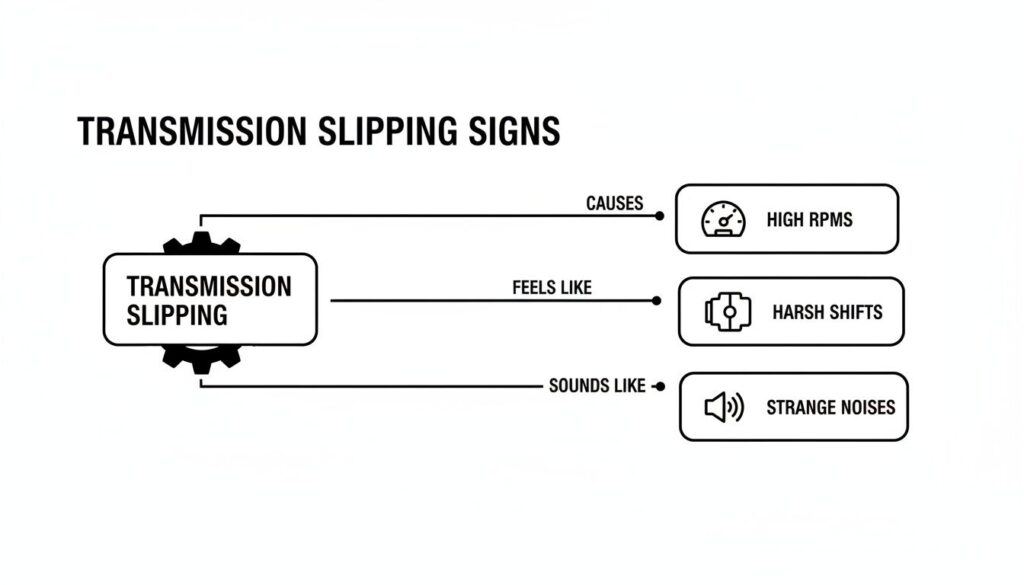
As this image illustrates, the symptoms are quite distinct once you know what to look and listen for. When the engine revs high without a speed increase, it is a classic sign of transmission trouble. A high-revving engine without acceleration, issues with changing gears smoothly such as abrupt or delayed gear changes, and unusual sounds are all direct indicators that your transmission requires immediate professional attention.
Common Symptoms You Might Experience
While the underlying causes of transmission slipping vary, the symptoms presented are generally consistent across different vehicle types. Here are the red flags every driver should be educated on:
Sudden High RPMs: Your engine revs significantly as you accelerate, but the car’s speed does not increase proportionally. It may feel as if the car has momentarily shifted into neutral.
Delayed or Harsh Shifting: You perceive a noticeable pause or a jarring “clunk” as the transmission changes gears, sometimes accompanied by rough gear changes. This is often most apparent when shifting from Park to Drive.
Lurching or Jerking: The vehicle may shudder or jerk forward unexpectedly, particularly during gear shifts, which can be signs of slipping gears and indicate the transmission is struggling to engage the gear correctly.
Strange Noises: Listen for unusual whining, buzzing, or grinding sounds that originate from the transmission. These noises often change in pitch or volume as the engine’s RPMs change.
Poor acceleration and delayed acceleration are also common symptoms of transmission slipping, often signaling underlying issues that require prompt attention.
A slipping transmission is more than an inconvenience—it’s a significant safety hazard. Your vehicle might fail to accelerate when you need it most, such as when merging onto a highway. This potential for failure makes prompt diagnosis and repair essential.
To further clarify, here is a quick reference guide to what these symptoms often mean from a mechanical perspective.
Quick Reference Guide to Transmission Slipping Symptoms
This table breaks down what you might feel or hear and what it could indicate about your transmission’s health, helping you have a more informed conversation with a technician.
Symptom | What It Feels or Sounds Like | Potential Indication |
|---|---|---|
Engine Races | The tachometer needle jumps up, but the car’s speed doesn’t match—no speed increase despite high RPMs. | The transmission is failing to engage the next gear, often due to gear slippage, leading to a temporary loss of power transfer to the drivetrain. |
Harsh Shifts | A loud “thud” or “bang” when the car changes gears automatically. | This can point to low fluid pressure, worn internal clutches, or a faulty solenoid preventing a smooth hydraulic engagement. |
Unusual Noises | A high-pitched whine or a low grinding noise that changes with engine speed. | Often indicates a problem with fluid circulation (aeration), a failing torque converter, worn planetary gears, or other internal issues. |
Paying close attention to these symptoms can help you identify a problem before it results in a breakdown.
Gear slippage can cause the engine to rev without a corresponding speed increase, which is a key sign of transmission trouble. Grinding noises are also abnormal and may indicate internal transmission or component issues.
Why Transmission Fluid Is the System's Lifeblood

When a vehicle’s transmission begins to slip, it’s natural to assume a catastrophic mechanical failure. However, the root cause is frequently something much more fundamental: the transmission fluid.
This specialized fluid serves multiple functions beyond simple lubrication. It is, first and foremost, a hydraulic fluid, engineered to create the immense pressure required to engage clutch packs and shift gears. A helpful analogy is a hydraulic jack with insufficient oil; you can pump the handle indefinitely, but it will never generate enough force to lift a vehicle. Your transmission operates on the same principle—if the fluid level is low, it cannot produce the hydraulic pressure needed to hold a gear, causing it to slip under load.
To keep your vehicle running smoothly and prevent these issues, it’s important to change the fluid regularly as part of routine maintenance.
The Role of Low and Contaminated Fluid
Low transmission fluid is a significant warning sign, almost always indicating a leak. As the fluid level drops, the transmission pump can begin to draw in air, introducing bubbles into the hydraulic circuits. This aerated, foamy fluid is compressible and cannot maintain consistent hydraulic pressure, which prevents the clutch packs from engaging securely. This leads directly to slipping, especially during acceleration.
The condition of the fluid is just as critical as its level. Over many thousands of miles, the intense heat and pressure of normal operation cause the fluid to degrade chemically. It becomes contaminated with microscopic metal shavings from gears and friction material from clutch plates, transforming from a clean, translucent red to a sludgy, dark brown. Contaminated transmission fluid can cause erratic shifting and slipping, as impurities interfere with the transmission’s ability to maintain proper gear changes.
Degraded or low transmission fluid remains a primary reason for transmission slipping across all vehicle types, contributing to a large number of service calls at repair shops. As fluid levels fall or the fluid breaks down, hydraulic pressure weakens, which keeps clutch packs from engaging reliably. Discover more insights about transmission fluid issues on MisterTransmission.com.
Once the fluid becomes contaminated, its lubricating properties diminish, and its viscosity can change. This makes it more difficult for the transmission’s sensitive valves and solenoids to direct fluid flow precisely. The result is delayed gear engagement, harsh shifts, and ultimately, slipping.
Why Old or Burnt Fluid Causes Slipping
One of the most vital functions of transmission fluid is to dissipate heat from the transmission’s internal components. A modern automatic transmission generates a tremendous amount of heat through friction, and healthy fluid continuously circulates through a dedicated cooler to maintain stable operating temperatures.
As the fluid ages, the chemical additives that help it manage heat and resist oxidation break down. This can lead to the transmission overheating—its single worst enemy. Excessive heat rapidly degrades seals, gaskets, and the friction material bonded to the clutch plates.
If you ever detect a burning smell or burning odor—often described as a burnt toast smell—from your vehicle, it is a serious warning sign of overheating transmission fluid and ongoing internal wear. Burnt or degraded fluid not only loses its ability to provide the necessary friction for the clutches to hold, but also accelerates internal wear of transmission components, which is a direct cause of slipping. This is precisely why we wrote our guide on when to flush transmission fluid—proactive maintenance is crucial.
How to Check Your Transmission Fluid
You don’t need to be a certified mechanic to perform a basic assessment of your transmission’s health. A simple fluid check can provide valuable information and potentially prevent a costly repair.
1. Check the Level: With the engine running and the transmission in Park or Neutral (consult your owner’s manual for the correct procedure), remove the transmission dipstick. Wipe it clean with a lint-free cloth, reinsert it fully, and then withdraw it again to check the level. It should fall between the “Full” and “Add” marks.
2. Inspect the Color: Fresh, healthy automatic transmission fluid (ATF) is a bright, translucent red. If your fluid appears dark brown or black, it is past its service life and is likely saturated with contaminants.
3. Note the Smell: Carefully smell the fluid on the dipstick. A distinct burnt odor is a definitive sign of overheating and suggests potential internal component wear.
Identifying fluid-related problems early is the most effective action you can take to prevent severe transmission damage. Regular transmission service—including checking fluid levels, replacing filters, and ensuring proper hydraulic function—can help prevent slipping and erratic shifting. A fluid and filter service is a relatively inexpensive maintenance procedure that can prevent a complete rebuild costing thousands.
Understanding Internal Mechanical Failures
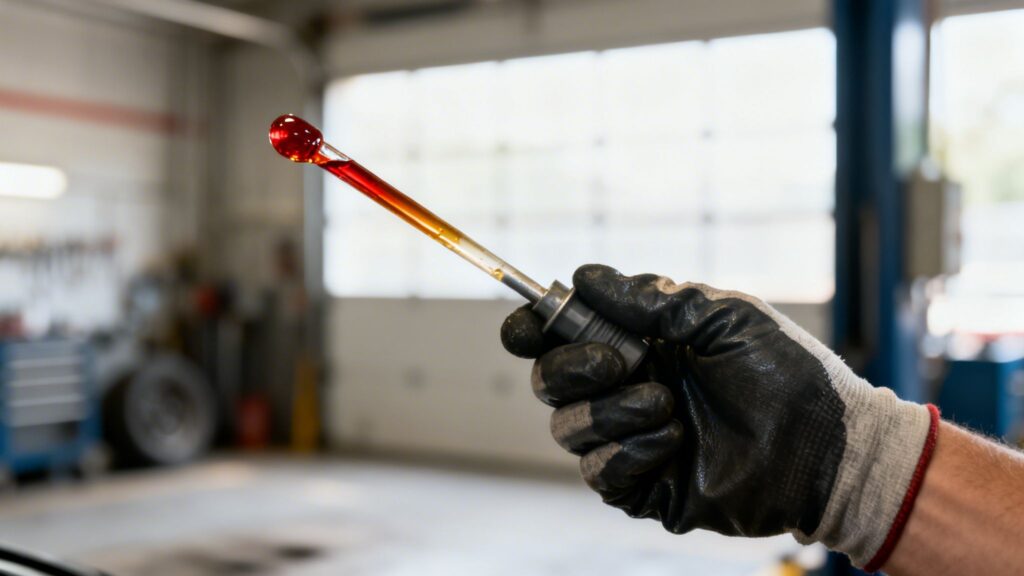
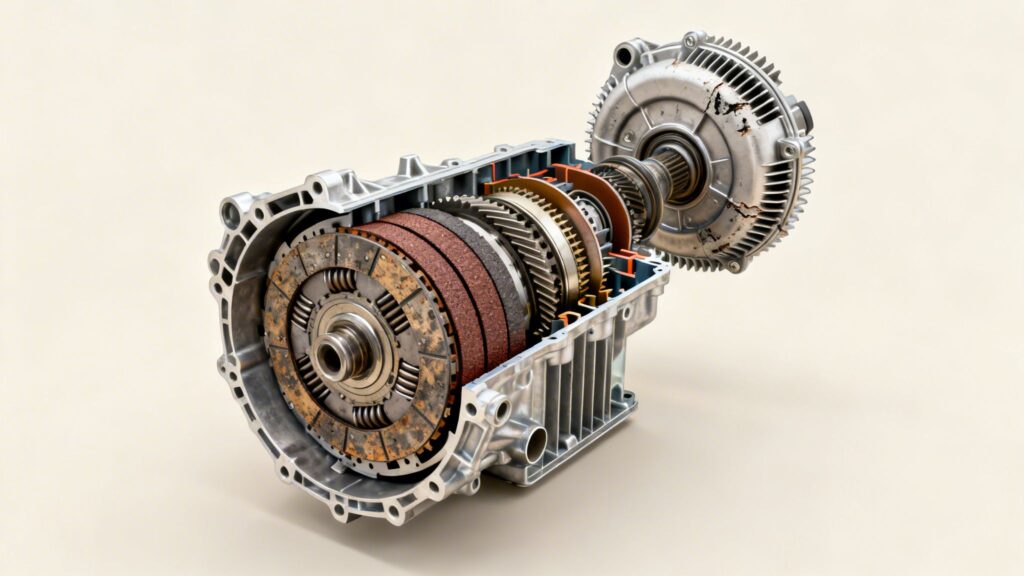
If you’ve confirmed the transmission fluid is clean and at the correct level, but the slipping persists, it strongly suggests the problem is mechanical and located deep within the transmission housing. Internal wear can eventually lead to major internal damage, requiring extensive repairs or even a full transmission replacement.
After enduring thousands of miles of extreme forces, the hardworking internal components inevitably begin to wear. This is a natural aging process, particularly in higher-mileage vehicles. Think of the transmission as a complex mechanical dance—if one component falters, the entire system is disrupted. The most common mechanical culprits are worn clutch packs, a failing torque converter, or damaged transmission bands. Manual transmissions can also experience slipping due to worn internal components, such as clutches or gears.
Worn Clutch Packs
Inside every automatic transmission are multiple clutch packs. Each pack consists of a stack of alternating steel plates and friction plates. To engage a specific gear, hydraulic fluid is forced into a drum, compressing these plates together and locking them to the gearset. It is a highly effective design.
The friction plates are coated with a specialized material, similar in concept to a brake pad, designed for maximum grip under high heat and pressure. Just like brake pads, this friction material wears away over time. When it becomes too thin, the plates can no longer clamp together with enough force to hold the gear securely against the engine’s torque.
As the clutch plates wear, they can no longer hold the immense torque from the engine. This causes the transmission to slip between gears, resulting in a sudden surge in engine RPM without a corresponding increase in speed. It’s the mechanical equivalent of a worn-out clutch and clutch pedal in a manual car, where a soft or spongy clutch pedal can signal the clutch is no longer fully engaging.
This loss of gripping force is what causes the classic slipping sensation. You will experience it as a hesitation or notice the engine RPMs flaring up during a shift, all because the transmission is physically unable to maintain its hold.
Torque Converter Troubles
The torque converter is the component that connects your engine to your transmission, functioning as a fluid coupling. It allows the engine to idle while the car is in gear, multiplies torque during initial acceleration, and is responsible for transferring engine power to the transmission. Imagine two fans facing each other: the first fan (the engine) is on and its airflow spins the second fan (the transmission). A torque converter accomplishes the same task but uses fluid instead of air.
Over time, the delicate fins inside the converter can become damaged or warped from heat and stress. When this occurs, they can no longer direct the transmission fluid effectively, leading to noticeable performance issues.
A failing torque converter can produce several key symptoms:
Shuddering at Low Speeds: You might feel a vibration akin to driving over small rumble strips, especially during gentle acceleration.
Slipping During Acceleration: The vehicle may feel weak or unresponsive as the converter struggles to efficiently transfer power.
Overheating: A damaged torque converter generates excessive heat, which can quickly degrade your transmission fluid and damage other internal components.
Damaged Transmission Bands
Another key component is the transmission band. This is a steel band that wraps around a planetary gearset drum. When a specific gear is selected, hydraulic pressure tightens the band, holding a section of the gearset stationary to achieve the correct gear ratio. Transmission bands play a crucial role in engaging higher gears during acceleration, allowing the vehicle to shift smoothly as speed increases.
Like clutch plates, these bands can wear out, stretch, or even break. When a band can no longer grip the drum tightly, the transmission cannot hold the gear properly. A worn or broken band is a definitive cause of slipping and often manifests as a complete failure to engage a certain gear or even a total loss of Reverse.
How Electrical Problems Can Cause Slipping
Not all transmission slipping is caused by worn mechanical parts or degraded fluid. Modern transmissions are highly sophisticated mechatronic systems, and when their electronic components malfunction, the symptoms can perfectly mimic a mechanical failure. Issues with the valve body—a crucial component that directs hydraulic fluid to control gear shifts—can also cause shifting problems and may mimic electrical faults, making diagnosis more complex.
Consider this analogy: your transmission’s computer, sensors, and solenoids act as the air traffic control system for your gears. If the control tower issues a faulty command or a component fails to respond, chaos ensues—even if the transmission’s mechanical parts are in perfect condition.
This is why a precise diagnosis to identify the true cause of slipping is so critical.
The Problem With Transmission Solenoids
One of the most common electrical culprits is a transmission solenoid.
These small, electro-hydraulic valves are the “traffic cops” inside your transmission. When it’s time to shift gears, your car’s computer sends an electrical signal to a specific solenoid, commanding it to open or close. This action directs high-pressure fluid to the correct hydraulic circuit to engage the next gear almost instantly.
However, if a solenoid becomes stuck, develops an electrical short, or simply fails, that pressurized fluid is routed to the wrong place—or not at all. The result? The engine revs, but the gear doesn’t engage. That’s a classic slip and a frequent source of transmission trouble.
A faulty solenoid is unable to properly regulate the hydraulic pressure needed to hold a gear, leading to missed shifts, harsh clunking, or the frustrating sensation of slipping.
A bad solenoid creates a “traffic jam” in your transmission’s hydraulic circuits. It’s a prime example of a small electrical part causing a major mechanical symptom.
Often, a malfunctioning solenoid will trigger your check engine light. The resulting diagnostic codes are invaluable clues for technicians, pointing them toward an electrical issue rather than a much more costly internal mechanical breakdown. You can learn more about interpreting these alerts by understanding how to read check engine codes.
When the Transmission's Brain Goes Bad
The master controller for the gearbox is the Transmission Control Module (TCM). This dedicated computer constantly analyzes data from various sensors to determine the optimal moment to shift.
It processes information such as:
Vehicle Speed: How fast the car is actually moving.
Engine RPM: The rotational speed of the engine.
Throttle Position: How hard you are pressing the accelerator.
Based on this real-time data, the TCM commands a precise and smooth shift. But what if a sensor provides incorrect data? A faulty speed sensor might tell the TCM the vehicle is stationary when it’s traveling at 40 mph. The TCM becomes confused, commands the wrong gear for the situation, and causes a slip or harsh shift.
In more severe cases, the TCM itself can fail due to software corruption, internal circuit board failure, or electrical damage. These issues can trigger warning lights on the dashboard, such as the ‘Check Engine’ or transmission warning lights, alerting you to potential problems. A failing TCM can cause a wide range of erratic behaviors, from slipping and violent shifts to becoming stuck in a single gear—a fail-safe condition known as “limp mode.”
How Professionals Diagnose Transmission Slipping
Diagnosing the cause of a slipping transmission is not a matter of guesswork; it’s a methodical diagnostic process that skilled mechanics use to differentiate between minor issues and major failures. For an accurate diagnosis, it’s best to seek out a trusted mechanic or a specialized transmission shop, as their expertise ensures comprehensive and reliable service. When you bring your vehicle to a reputable shop, a technician will follow a clear path to identify the root cause, ensuring you only pay for necessary repairs.
The process begins with a detailed conversation. A good technician will ask you specific questions about the symptoms you’re experiencing. Are the shifts harsh or delayed? Does the engine simply rev high without corresponding acceleration? Your answers provide crucial clues before any tools are used.
Regularly having your transmission checked by a professional can help catch issues early and prevent more costly repairs down the road.
The Initial Visual and Fluid Inspection
The first hands-on step is always a thorough visual inspection. A technician will search for obvious red flags, such as leaking fluid from seals, gaskets, or transmission cooler lines. Leaking fluid—especially a reddish puddle underneath your vehicle—is a classic sign of transmission problems and is often the “smoking gun” for low fluid, one of the most common causes of slipping.
Next, they will evaluate the transmission fluid itself. This single step can reveal a great deal about the transmission’s health:
Low Fluid Level: This almost always indicates a leak. Without sufficient fluid, the hydraulic pressure required to engage gears cannot be achieved.
Dark or Black Fluid: This is a sign of severe degradation. It means the fluid is old and contaminated with burnt friction material, compromising its ability to lubricate and cool.
Burnt Smell: A sharp, acrid odor is a serious warning. It signifies that the transmission is overheating, which can quickly destroy internal components like clutch packs and seals.
This initial check is efficient, inexpensive, and frequently identifies the problem without requiring more invasive diagnostics.
The Diagnostic Road Test
If the fluid appears to be in good condition but the problem persists, the next step is a diagnostic road test. A technician will drive your car, attempting to replicate the slipping condition you described. This is not a casual drive; they are systematically operating the transmission under specific loads and conditions.
During the test, the technician closely monitors how the vehicle responds to the gas pedal during acceleration, noting any hesitation or abnormal RPM changes that may indicate transmission slipping. They will pay close attention to when the slip occurs. Does it happen only under hard acceleration? Is it isolated to a specific gear change, like the 2-3 shift? Does the issue worsen when the engine is cold or only after it’s fully warmed up? This helps differentiate between a single faulty solenoid and a more widespread problem like a failing torque converter.
A road test lets a technician feel, hear, and see the problem in real-time. It connects the dots between what you’re describing and how the transmission is actually behaving under load, which is essential for a dead-on diagnosis.
Using Scan Tools to Read Trouble Codes
The final piece of the diagnostic puzzle involves modern technology. A mechanic will connect a professional OBD-II (On-Board Diagnostics) scanner to your vehicle’s data link connector. OBD-II diagnostics are available on most vehicles, making this process widely applicable. This tool communicates directly with the Transmission Control Module (TCM), the transmission’s onboard computer.
If an electrical component like a sensor or solenoid is failing, the TCM will have stored a Diagnostic Trouble Code (DTC). These codes act as digital breadcrumbs, leading the technician directly to the faulty component. For example, a code might specifically identify “Shift Solenoid ‘B’ Performance” or an “Input/Output Speed Sensor Circuit Malfunction.” For a deeper dive, check our guide on how to diagnose transmission problems. This data-driven approach eliminates guesswork and confirms whether the issue is electrical or mechanical.
Your Next Steps for a Reliable Repair in Plano
We understand. The thought of a significant transmission repair can be stressful, but getting it diagnosed in Plano shouldn’t add to that anxiety. The first step is always an accurate diagnosis from a team you can trust—guesswork has no place when dealing with your vehicle’s most complex systems.
At Express Lube & Car Care, we have heard countless stories of drivers being pressured into expensive, unnecessary work. Our entire approach is founded on providing honest advice backed by verifiable diagnostics. Our responsibility is to identify the true cause of your transmission slipping, not just the most profitable one.
Honest Diagnostics and Clear Pricing
Our ASE-certified technicians utilize modern scan tools and proven diagnostic procedures to determine precisely why your transmission is malfunctioning. We believe in being transparent and upfront from the moment you arrive.
We will never recommend a complete transmission replacement if a simpler, more targeted repair will solve the problem correctly. In many cases, slipping is caused by a much less severe issue, such as:
A faulty shift solenoid
A malfunctioning speed sensor
Low, degraded, or incorrect transmission fluid
If a straightforward repair is all that is required, that is exactly what we will recommend. Our primary goal is to return your vehicle to you in safe, reliable condition at a fair price, because we aim to earn your trust for the long term.
We're proud to serve our Plano community with integrity. That means clear explanations, fair prices, and work we stand behind. Your peace of mind is what matters most.
Service That Fits Your Life
We know that life in Plano is fast-paced. Between commutes, family commitments, and daily errands, you don’t have time to be without your vehicle. That’s why we invite you to stop by for an expert diagnosis with no appointment needed. We have structured our shop to provide high-quality service, conveniently.
We also want to express our gratitude to those who keep our community safe. To show our appreciation, we proudly offer special discounts for all our military and first responder customers. It’s a small way for us to give back to those who contribute so much.
Don’t let a slipping transmission disrupt your life. Visit Express Lube & Car Care in Plano today for a professional, honest evaluation. Let our experts find the right solution so you can drive with confidence again.
Your Top Questions About Transmission Slipping
Even with a solid understanding of the causes of transmission slipping, you likely still have some questions. It’s a concerning problem, and getting clear answers is the best way to determine your next steps. We’ve compiled answers to the most common questions we hear from drivers in Plano.
Can I Still Drive with a Slipping Transmission?
It is strongly advised against. Driving with a slipping transmission poses a significant safety risk. Imagine attempting to merge onto a busy highway like the George Bush Turnpike—you press the accelerator, but the car only revs without gaining speed. This sudden inability to accelerate can be extremely dangerous for you and other drivers.
Beyond the immediate safety concerns, continuing to drive risks far more extensive and costly damage. A slipping transmission generates immense internal heat and friction, which rapidly destroys sensitive components. What might have been a simple fluid service or sensor replacement can quickly escalate into a full transmission rebuild—one of the most expensive repairs in the automotive world. It is always safer and more cost-effective to have it inspected immediately.
How Much Does It Cost to Fix Transmission Slipping?
The cost to repair a slipping transmission varies dramatically because the potential causes are so diverse. The only way to get an accurate estimate is to have a professional technician perform a thorough diagnosis.
Here is a general breakdown of what you might expect:
Minor Fixes: If the issue is low or contaminated fluid, a transmission fluid and filter service is the best-case scenario. This typically costs a few hundred dollars.
Mid-Range Repairs: Replacing an external component like a faulty shift solenoid or speed sensor usually falls in the range of $400 to $1,000, depending on the vehicle and accessibility of the part.
Major Repairs: This is where costs increase significantly. If internal clutch packs are worn out or the torque converter has failed, you are likely looking at a transmission rebuild or replacement. These intensive jobs can easily range from $2,500 to over $5,000.
A proper diagnosis is paramount. It ensures you are not paying for a complete rebuild when a simpler, less expensive repair would have resolved the issue.
Will a Transmission Fluid Change Always Fix Slipping?
No, a fluid change is not a universal solution. It is only effective if the slipping is a direct result of low, old, or degraded fluid. In those cases, fresh fluid restores the hydraulic pressure and frictional properties the transmission needs to shift correctly.
However, if mechanical components have already failed, new fluid cannot repair them. A fluid change will not fix worn clutch plates, a broken band, or a malfunctioning solenoid, just as changing your engine oil will not fix a broken piston. The new fluid might provide a temporary, slight improvement in performance, but it will not resolve the underlying root cause.
How Often Should I Service My Transmission?
Preventative maintenance is your best defense against premature transmission failure. Most vehicle manufacturers recommend a transmission fluid and filter service every 30,000 to 60,000 miles
Always consult your owner’s manual for the specific service interval recommended for your vehicle. If you frequently engage in demanding activities like towing, hauling heavy loads, or extensive stop-and-go city driving, it is wise to service the transmission more frequently. Regular maintenance keeps the fluid clean and the transmission operating reliably for years to come.
If you’re noticing any signs of a slipping transmission, don’t wait for it to become a bigger, more expensive problem. The ASE-certified technicians at are here to give you an honest, accurate diagnosis to find the real issue. Visit us in Plano for expert auto service you can count on.