

Have you ever considered what allows your car to remain stable during an emergency stop or on a slippery road? The answer lies in a small but vital component known as the wheel speed sensor.
This device serves as a dedicated monitor at each of your vehicle's four wheels. Its primary function is to continuously measure the rotational speed of its assigned wheel and transmit this data to the car's central computer, often called the Engine Control Unit (ECU) or a dedicated control module.
The Foundation of Modern Vehicle Safety Systems
This constant flow of data is fundamental to the operation of your vehicle’s most critical active safety features, including:
- Anti-lock Braking System (ABS): This system modulates brake pressure to prevent the wheels from locking up during heavy braking, which allows the driver to maintain steering control.
- Traction Control System (TCS): This system prevents wheelspin during acceleration on low-traction surfaces by reducing engine power or applying brake force to the spinning wheel.
- Electronic Stability Control (ESC): This advanced system helps the driver maintain control during sharp turns or sudden evasive maneuvers by selectively applying brakes to individual wheels.
A single malfunctioning sensor can disable these crucial systems. This is a significant safety concern, especially in regions where weather conditions can change rapidly, turning a routine drive into a hazardous situation.
First integrated with ABS in the 1980s, these sensors revolutionized automotive safety. By enabling a vehicle to prevent wheel lock-up, they significantly enhance a driver's ability to stop and steer in an emergency. Studies have demonstrated that ABS can shorten stopping distances by as much as 30% on wet surfaces. You can explore the evolution of this technology and its market impact to understand its profound importance.
Key Takeaway: The wheel speed sensor is a foundational component of your car's active safety network. It directly influences your ability to control the vehicle, particularly in critical, split-second situations.
Without precise speed data from all four wheels, the vehicle's computer operates without essential information. It cannot execute the instantaneous adjustments required to maintain vehicle stability and driver safety. This is why an illuminated ABS or traction control warning light on your dashboard should never be disregarded.
How Wheel Speed Sensors Function
The operating principle of a wheel speed sensor is analogous to the simple computers used on bicycles to track speed. A small magnet on a wheel spoke passes a sensor on the fork with each rotation, allowing the computer to calculate speed. A vehicle's wheel speed sensor operates on this same fundamental concept, but employs far more sophisticated and robust technology to ensure passenger safety.
Ultimately, the sensor's purpose is to report the rotational velocity of each wheel. However, the method of achieving this varies. Modern vehicles utilize one of two primary sensor types: passive or active.
This diagram illustrates how the sensor translates a wheel's physical rotation into digital data that the vehicle's computer can interpret and act upon.
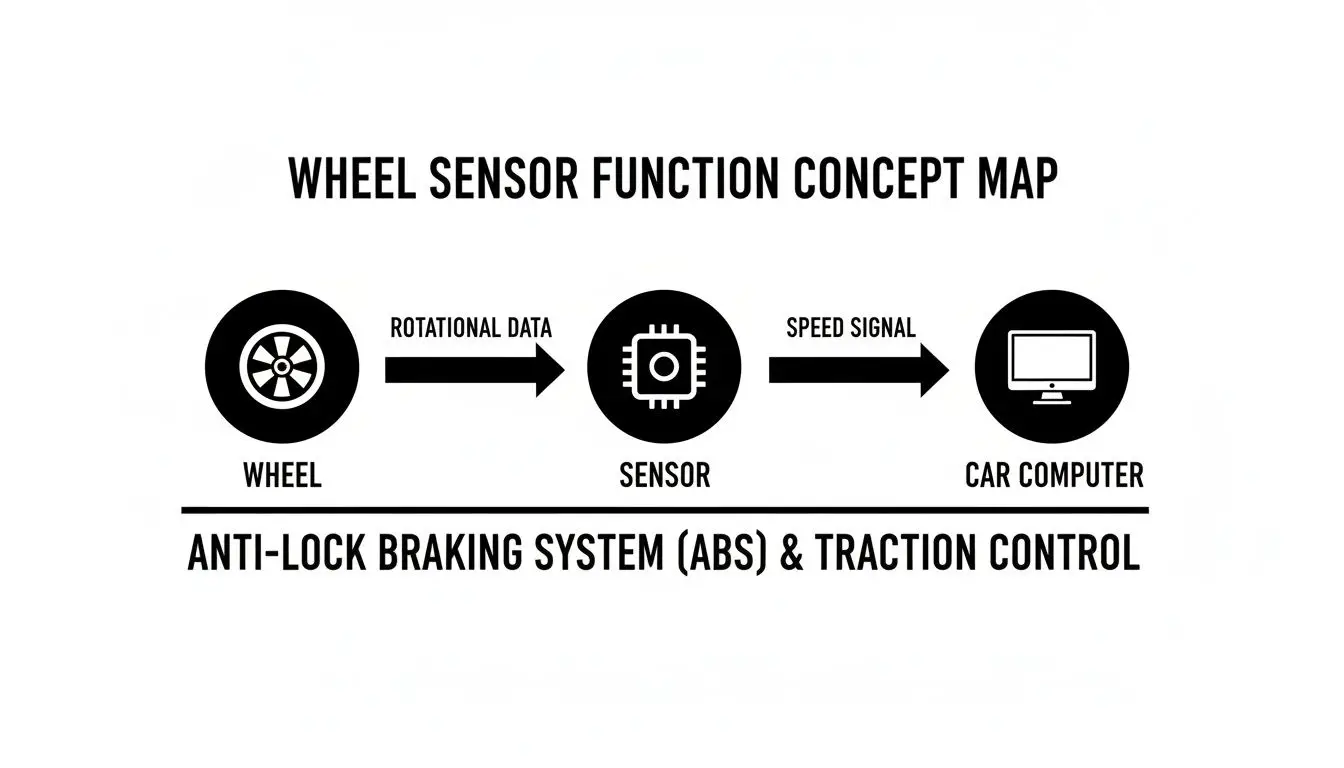
As shown, the sensor is the critical interface between the mechanical motion of the wheel and the vehicle's advanced electronic safety systems. To better understand this technology, it is useful to compare the two main types of sensors found in vehicles today.
Passive vs. Active Wheel Speed Sensors
| Feature | Passive Sensor (Magnetic Inductive) | Active Sensor (Magneto-Resistive/Hall Effect) |
|---|---|---|
| Operating Principle | Uses a toothed reluctor ring and a magnetic coil to generate its own weak analog (AC) electrical signal through electromagnetic induction. | Powered by the car's electrical system; uses a magnetic encoder ring and a semiconductor sensor to generate a strong digital signal. |
| Signal Type | Analog sine wave. Signal strength and frequency are proportional to wheel speed. | Digital square wave. Provides a clear, consistent signal at all speeds. |
| Accuracy | Less accurate at very low speeds (typically below 5-10 mph), as the generated signal becomes too weak to read reliably. | Highly accurate across the full range of speeds, including a complete stop (0 mph). |
| Capabilities | Can only measure rotational speed. | Can measure speed, direction of rotation, and standstill (zero speed). |
| Commonly Found In | Older vehicles, generally manufactured before 2005. | Most modern vehicles. |
The transition from passive to active sensors has enabled automotive engineers to develop more intelligent and responsive safety features.
The Legacy Method: Passive Sensors
You will typically find passive sensors on older vehicles. These are relatively simple devices, consisting of a magnetic pickup (a permanent magnet wrapped in a coil of wire) positioned near a toothed metal wheel known as a reluctor ring or tone ring. This ring is attached to and rotates with the axle or wheel hub.
As each "tooth" of the ring passes the sensor, it alters the magnetic field, inducing a small AC voltage pulse in the coil. The frequency of these pulses corresponds to the wheel's speed. The vehicle's computer counts these pulses to calculate wheel speed, but the signal becomes weak and unreliable at very low velocities.
The Modern Standard: Active Sensors
Nearly all new vehicles are equipped with active sensors. Unlike their passive counterparts, these sensors are supplied with power from the vehicle's electrical system. This allows them to use more advanced Hall Effect or magneto-resistive technology, which produces a clean, consistent digital signal (a square wave).
Their most significant advantage is their precision, even at extremely low speeds or a complete standstill.
Because they can detect the direction of rotation and provide accurate data from 0 mph, active sensors are indispensable for modern safety systems like electronic stability control, hill-start assist, and other advanced driver-assistance features.
This technology is a specialized application of principles used in many industrial automation systems. To learn more about the underlying mechanics, you can read about the general principles of how proximity sensors function. The technological leap to active sensors is a primary reason why today’s vehicles can react much faster and more intelligently to challenging road conditions.
The Role of Sensors in On-Road Safety
What is the practical application of this sensor data? It serves as the "secret ingredient" for the safety systems that maintain vehicle control, transforming raw speed information into life-saving actions.
Consider accelerating onto a highway on a rainy day. If a tire encounters a patch of standing water and begins to lose traction and spin faster than the others, your vehicle’s Traction Control System (TCS) instantly detects this discrepancy using data from that wheel's sensor. The system then intervenes by reducing engine power or applying the brake to that single wheel, helping you regain traction, often before you are even aware of the potential for a skid.

The same process occurs during a panic stop. If another vehicle cuts you off and you must brake suddenly, the Anti-lock Braking System (ABS) is activated. It monitors the data from each wheel speed sensor, and if it detects that a wheel is about to lock up and cause a skid, the ABS computer rapidly pulses the brake pressure to that specific wheel. This allows you to achieve maximum braking force while retaining the ability to steer around the obstacle.
These systems are complex, and their inspection is a key part of routine maintenance. You can learn more in our guide on what a brake service includes.
Beyond Braking: Enhancing Stability and Control
The wheel speed sensor's responsibilities extend further. It is also the cornerstone of your Electronic Stability Control (ESC) system. ESC continuously compares the driver's steering input with the vehicle's actual direction of travel, using wheel speed as a primary reference. If you enter a corner too quickly and the vehicle begins to oversteer or understeer (slide), ESC intervenes by applying individual brakes to stabilize the vehicle and bring it back to the driver's intended path.
The effectiveness of ESC, which relies on wheel speed sensor data, is well-documented. In the U.S., the widespread adoption of ESC has been credited with reducing fatal single-vehicle rollover crashes in SUVs by 74% since 2006, saving countless lives.
All of these systems—ABS, TCS, and ESC—are integral components of what are now broadly termed Advanced Driver-Assistance Systems (ADAS). For these systems to function correctly, they require flawless data, which is why proper Advanced Driver-Assistance Systems (ADAS) calibration is essential following certain repairs.
It is evident how heavily your safety depends on these small sensors. Consequently, a faulty sensor is not merely an inconvenience; it is a genuine risk that requires immediate attention.
Warning Signs of a Failing Wheel Speed Sensor
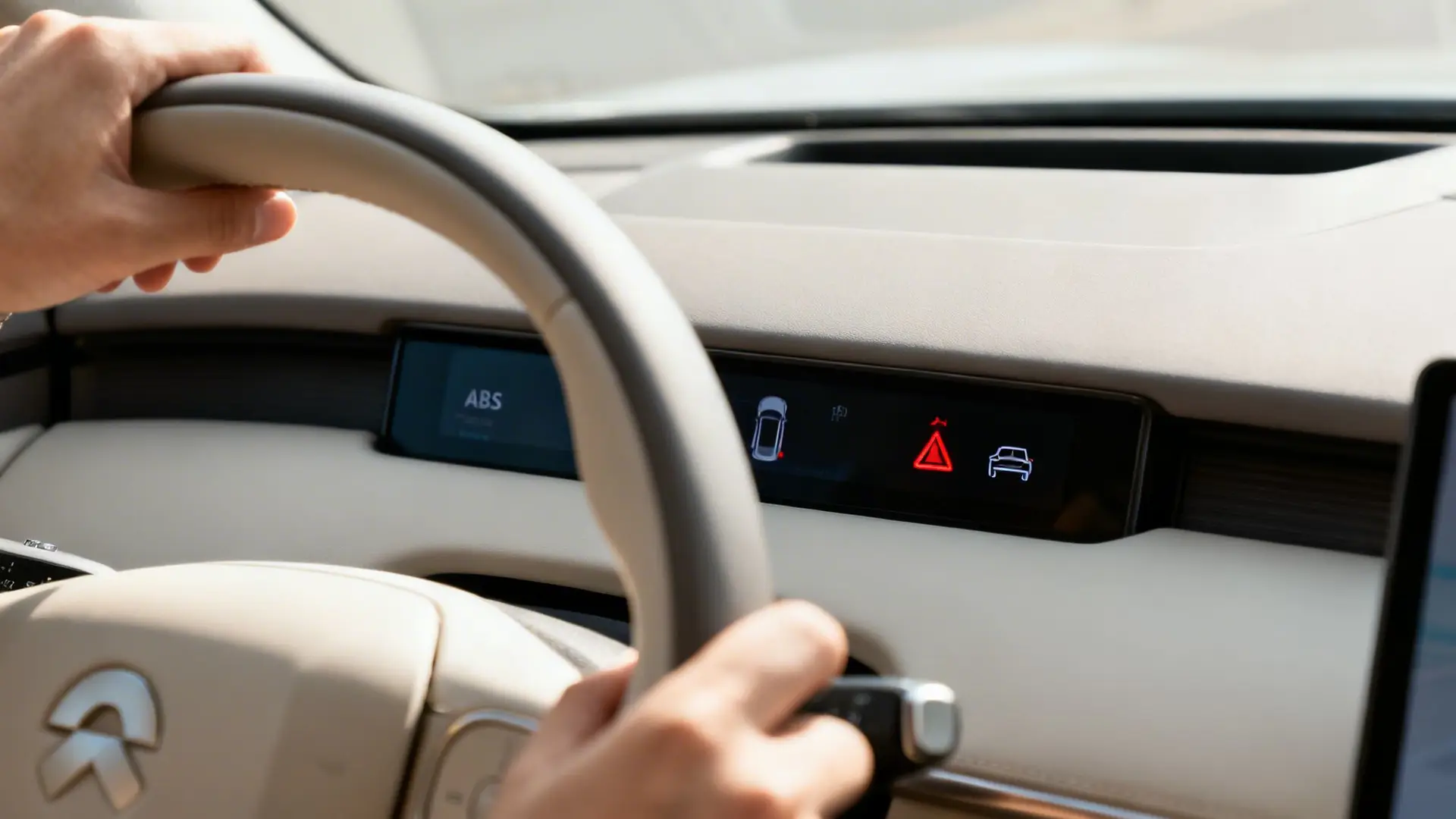
Your vehicle is equipped to communicate component failures, and a faulty wheel speed sensor is no exception. The most direct indication is the illumination of one or more warning lights on your dashboard.
Typically, you will see the ABS light, traction control light (TCS), or stability control light (ESC) illuminate. When the onboard computer receives an invalid, erratic, or missing signal from a wheel speed sensor, it deactivates the associated safety systems as a precaution and alerts the driver via these warning lights.
Unpredictable Brake and Drivetrain Behavior
Beyond dashboard warnings, you may begin to feel the problem during operation. A common symptom is an unusual pulsing or vibration in the brake pedal, particularly during gentle braking at low speeds. This occurs when the ABS module, confused by faulty data, activates unnecessarily.
If you ever notice a car making grinding noise when braking, this could indicate other brake issues, so it is always wise to seek a professional inspection immediately.
A malfunctioning sensor can also affect other vehicle systems. Be observant for these issues:
- Erratic Shifting: The transmission control module uses wheel speed data to execute smooth gear changes. A faulty sensor can lead to harsh, delayed, or improper shifting.
- Speedometer Malfunctions: In some vehicle designs, a failing wheel speed sensor can cause the speedometer to behave erratically, fluctuate, or cease functioning entirely.
From early ABS to the enabling technology in future autonomous vehicles, wheel speed sensors have undergone significant evolution. Industry experts project an 8% annual growth for the sensor market through 2030, driven by the rise of electric vehicles and autonomous tech. A malfunctioning sensor can do more than disable safety features; it can disrupt transmission performance or reduce braking efficiency by 20-30%. This highlights the critical nature of these small components.
Recognizing these symptoms early is the most effective way to ensure your vehicle remains safe and to prevent more complex and costly repairs later.
How Professionals Diagnose and Replace Faulty Sensors
When an ABS or traction control light appears on your dashboard, it is a clear signal that a key safety system has been compromised. While it may be tempting to disregard the warning or guess at the cause, a qualified technician utilizes specialized tools to diagnose the problem with precision. The goal is accurate fault-finding, not simply clearing a diagnostic code.
The diagnostic process begins by connecting a professional-grade OBD-II scanner to the vehicle. This tool is more advanced than a basic code reader, as it allows the technician to communicate directly with the ABS control module. The scanner retrieves specific Diagnostic Trouble Codes (DTCs) that typically identify the exact wheel speed sensor that is malfunctioning.
However, a thorough diagnosis does not end with reading a code. A skilled technician will also analyze the live data stream from each sensor while the wheels are rotated. This allows them to observe the sensor's signal output in real-time, confirming if it is erratic, weak, or absent entirely. This step validates the DTC and ensures the correct fault has been identified.
What to Expect During Replacement
Once the faulty component has been pinpointed, the repair can begin. The issue may be the sensor itself, but it could also stem from a corroded wire, a damaged connector, or a contaminated or broken reluctor ring (the toothed or magnetic ring the sensor reads). This is precisely why a comprehensive diagnosis is crucial—it prevents the unnecessary replacement of parts.
To understand the full scope of a diagnostic check, learn more in our guide on the benefits of a professional car diagnostic test.
The replacement procedure can range from simple to highly complex, depending on several factors:
- Vehicle Design: On some vehicles, the sensor is an external, easily accessible component. On others, it is integrated into the wheel hub and bearing assembly, requiring a more extensive and labor-intensive replacement.
- Corrosion: Environmental factors like road salt and moisture can cause rust to seize the old sensor in its mounting hole. Careful and time-consuming work is often required to remove it without damaging the surrounding components.
While a new wheel speed sensor itself is often an affordable part, labor costs are the most significant factor in the final repair bill. An experienced technician ensures the new sensor is installed correctly and performs a post-repair test to verify that all related safety systems are fully operational.
Ultimately, repairing a faulty wheel speed sensor is not just about extinguishing a warning light. It is about restoring the full functionality of your ABS and stability control systems, ensuring they are ready to protect you when you need them most.
Answering Your Wheel Speed Sensor Questions
Understanding what a wheel speed sensor is and recognizing its importance are the first steps. Knowing what to do when a problem arises is equally critical. Here are answers to the most common questions we receive from drivers.
Can I Drive with a Bad Wheel Speed Sensor?
Technically, the vehicle will remain operable, but it is strongly inadvisable. When a wheel speed sensor fails, it disables your vehicle's primary active safety features: the Anti-lock Braking System (ABS), Traction Control System (TCS), and Electronic Stability Control (ESC).
Without these systems, your vehicle loses its automated ability to assist you in maintaining control during an emergency stop or on a low-traction surface. This constitutes a significant safety risk that should not be taken.
How Often Do Wheel Speed Sensors Need Replacing?
Unlike consumable items like oil filters or brake pads, wheel speed sensors do not have a prescribed replacement interval. They are designed to last the lifetime of the vehicle but can fail prematurely due to a variety of factors.
The most common causes of failure include exposure to road grime, corrosion from moisture, physical damage from road debris, or stretching/chafing of the sensor's wiring. The illumination of a dashboard warning light is the vehicle's signal that an inspection is required.
Is an ABS sensor the same as a wheel speed sensor? Yes, the terms are used interchangeably. Because the sensor's data is fundamental to the operation of the Anti-lock Braking System, the component is very commonly referred to as an "ABS sensor."
If your ABS or traction control light is illuminated, do not ignore it. The ASE-certified technicians at Express Lube & Car Care can diagnose the issue accurately and restore your vehicle’s safety systems to proper working order. Stop by our Plano shop or find us online at https://www.expresslubeplano.com for service you can count on.