

Oil grade is the specific viscosity and performance standard your engine manufacturer requires for reliable protection and efficient operation. Using the correct oil grade protects your engine by delivering the right film thickness at startup, maintaining lubrication under heat, and preventing wear that accumulates into costly repairs. The Society of Automotive Engineers (SAE) viscosity grading system, combined with API and ILSAC performance certifications, defines exactly what your engine needs. Getting this wrong, even by one grade, affects fuel economy, accelerates wear, and can void your factory warranty. Express Lube & Car Care’s certified technicians verify oil specifications on every visit to keep your engine running as designed.
Why correct oil grade protects your engine at cold start
Cold start wear is the most destructive phase of your engine’s life. Research shows that 80% of engine wear occurs during startup, before oil fully circulates to bearings, camshafts, and cylinder walls. That single statistic explains why the “W” rating in your oil grade matters more than most drivers realize.
The “W” stands for winter, and the number before it describes how quickly oil flows at low temperatures. A 0W-20 flows faster at cold temperatures than a 10W-30. That difference in cold flow speed determines how quickly oil reaches critical components in the first seconds after you turn the key. Those seconds define how much metal-on-metal contact your engine tolerates every morning.
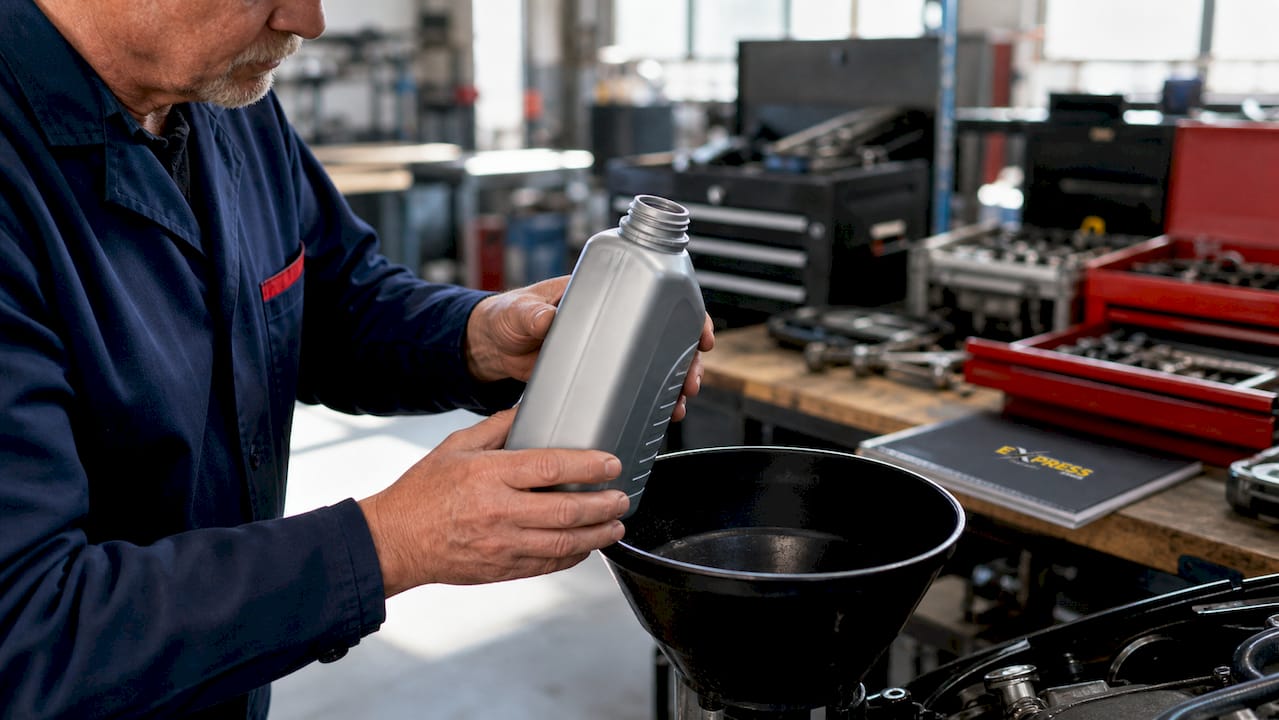
Viscosity is a precision parameter matched to your engine’s internal clearances. Bearings and journals are machined to tight tolerances, and the oil film that fills those gaps must arrive fast and at the right thickness. Oil that is too thick at cold temperatures delays that film, leaving metal surfaces in direct contact longer than the engine was designed to tolerate.
Common SAE viscosity grades and their cold-start behavior:
- 0W-20: Fastest cold flow, used in modern fuel-efficient engines with tight tolerances
- 5W-30: Standard grade for a wide range of passenger vehicles in moderate climates
- 5W-40: Common in European engines and turbocharged applications requiring higher hot viscosity
- 10W-30: Older specification, suited to warmer climates and higher-mileage engines
Pro Tip: Check your owner’s manual for the manufacturer-specified grade before buying oil. If you live in a region with cold winters, the lower the “W” number, the better your cold-start protection.
What happens when you use the wrong oil grade?
Using the wrong oil grade creates a chain of mechanical problems that compound over time. One viscosity grade thicker than specified increases friction and reduces fuel economy, while oil that is too thin fails to maintain the protective film between moving parts. Neither outcome is acceptable for an engine designed to precise tolerances.
Thick oil moves slowly through narrow passages. It takes longer to reach the upper valvetrain, turbocharger bearings, and variable valve timing actuators. During that delay, those components operate without adequate lubrication. Over thousands of miles, that repeated stress adds up to measurable wear that shortens engine life.
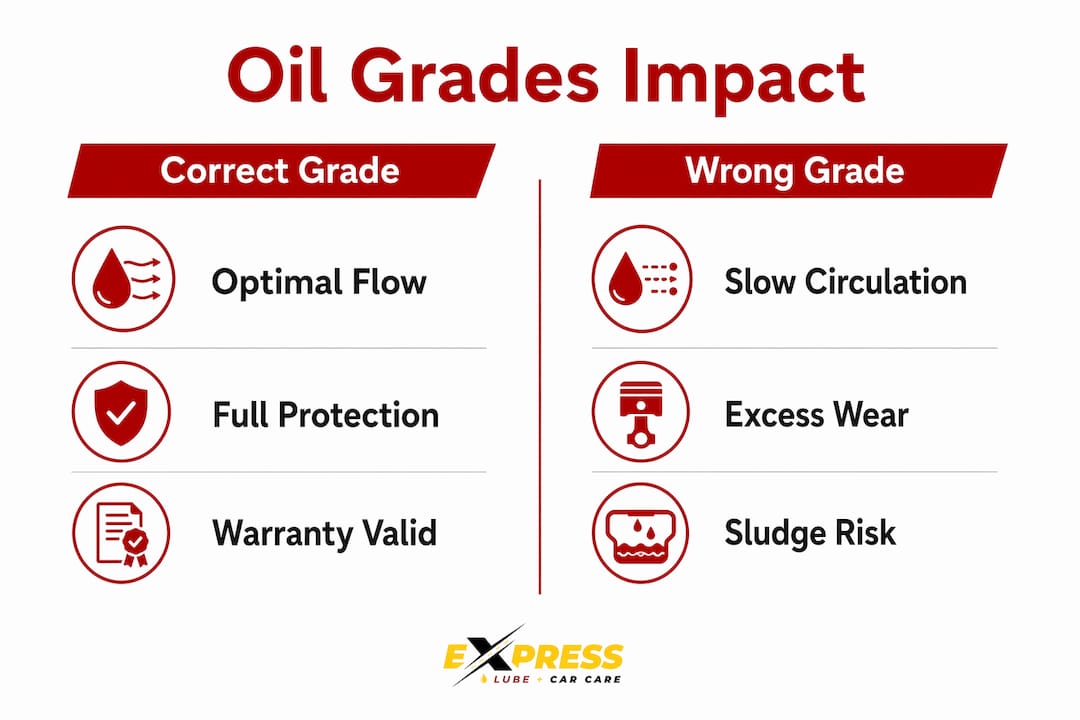
Thin oil presents the opposite problem. It reaches components quickly, but the film it forms under load and heat is too weak to prevent metal contact. Wrong oil disrupts engine thermal balance, with thick oil trapping heat in high-friction zones and thin oil flashing off under sustained operating temperatures. Both scenarios push engine temperatures beyond design limits.
Sludge is another serious consequence. Mixing oil types or using incorrect grades causes additive incompatibility that produces sludge. That sludge clogs oil passages and damages variable valve timing systems, which are expensive to repair and sometimes require full engine teardown. The cost of an incorrect oil grade compounds far beyond the price of the oil itself.
Warranty compliance is a real concern too. Manufacturer-recommended oil grades are often required to maintain your factory warranty, and service records are checked during warranty claims. Using a non-specified grade gives manufacturers grounds to deny coverage for engine damage, even if the damage appears unrelated to oil grade.
Understanding oil change and engine longevity starts with recognizing that the oil grade is not a suggestion. It is a design requirement built into your engine’s engineering.
How do oil performance standards complement viscosity grades?
Viscosity alone does not equal protection. API and ACEA certifications on an oil container verify its protective capabilities against deposits and wear, going well beyond what viscosity numbers describe. An oil can carry the correct SAE grade and still fail to protect adequately if its additive package is weak.
Performance standards like API SP, ILSAC GF-6, and OEM approvals from manufacturers such as GM, Ford, and BMW guarantee that an oil has passed specific tests for deposit control, oxidation resistance, and wear protection. These certifications exist because thermal and oxidative stability from oil additives is critical to preventing sludge buildup and deposit formation. Viscosity handles film thickness; additives handle everything else.
Key certifications and what they guarantee:
- API SP: Current American Petroleum Institute standard for gasoline engines; covers wear, deposits, and fuel economy
- ILSAC GF-6: International standard aligned with API SP, adds low-speed pre-ignition protection for turbocharged engines
- OEM approvals (e.g., BMW LL-04, GM dexos1 Gen 3): Manufacturer-specific tests that exceed API/ILSAC minimums for particular engine designs
- ACEA ratings: European standard covering additional high-temperature deposit control requirements
Synthetic oil at the correct viscosity offers superior film strength and heat resistance compared to conventional mineral oil of the same grade. The base stock quality in full synthetic oil maintains viscosity more consistently across temperature extremes, which matters most in turbocharged engines and vehicles operating in severe conditions. You can read more about synthetic oil advantages for large and performance engines.
Pro Tip: Look for both the SAE viscosity grade and the API/ILSAC certification on the oil container before purchasing. Meeting only one of those two requirements is not enough for full engine protection.
How to choose and maintain the correct oil grade for your vehicle
Selecting the right oil grade takes less than five minutes when you know where to look. The steps below apply to any passenger vehicle, truck, or SUV.
- Check your owner’s manual. The manual lists the exact SAE grade and any OEM approval codes required. This is the definitive source, not the label on the oil shelf.
- Look at the oil filler cap. Many manufacturers print the required viscosity grade directly on the cap for quick reference.
- Consider your climate. If you live in a region with cold winters, a lower “W” rating improves cold-start protection. If you drive in sustained high heat, confirm your grade maintains adequate hot viscosity.
- Choose the right oil type. Synthetic versus conventional oil is a meaningful choice. Switching from conventional to synthetic requires no special steps in most modern engines, but switching back is not recommended once you have made the change.
- Verify the certification codes. Match the API or ILSAC code on the bottle to what your manual specifies. OEM approvals like dexos1 or BMW LL-04 are non-negotiable for those vehicles.
- Follow oil change intervals. Oil change intervals vary by mileage and driving conditions. High-mileage vehicles may benefit from a grade formulated with seal conditioners to reduce leaks and maintain compression.
- Use a certified technician. ASE-certified technicians verify oil specifications against your vehicle’s requirements, reducing the risk of grade errors that accumulate into engine damage.
ASE-certified technicians stress that optimal viscosity is determined by engine clearances and operating conditions, not by the “thicker is safer” myth. That myth costs drivers money. Thicker oil does not automatically protect better. It protects correctly only when it matches what the engine was designed to use. Understanding what oil viscosity means for your engine’s health gives you the foundation to make that choice confidently.
For drivers who want premium protection, pairing the correct viscosity grade with a high-quality component like titanium wheel hardware reflects the same principle: OEM specifications exist for a reason, and precision parts perform best when matched to design requirements.
Key Takeaways
Using the correct oil grade is the single most effective step you can take to protect your engine from wear, overheating, and premature failure.
| Point | Details |
|---|---|
| Cold start wear is the priority | 80% of engine wear occurs at startup; the correct “W” rating delivers fast oil flow to critical components. |
| Wrong grade causes compounding damage | Oil that is too thick or too thin disrupts lubrication, thermal balance, and can cause sludge in valve timing systems. |
| Viscosity and certification both matter | The SAE grade sets film thickness; API/ILSAC certifications confirm the additive package meets engine protection standards. |
| Synthetic oil adds measurable protection | Full synthetic oil at the correct viscosity maintains film strength under heat better than conventional oil of the same grade. |
| Warranty compliance requires exact specs | Manufacturers require the specified oil grade for warranty validity; service records are reviewed during claims. |
What we have learned from years of oil change service
The most common and costly mistake we see at Express Lube & Car Care is drivers treating oil grade as a preference rather than a specification. Car owners often arrive having used a thicker grade because they assumed it would protect better. The engine does not work that way. Viscosity is an engineering parameter, not a safety margin you can increase by going heavier.
We have seen engines develop sludge in variable valve timing actuators after just a few oil changes with the wrong grade. That repair runs into hundreds of dollars, sometimes more. The oil that caused it cost the same as the correct grade at the shelf. The difference was the label.
What we consistently observe is that customers who follow manufacturer oil specifications, and who change oil on schedule, rarely face the kind of internal engine damage that requires teardown. Their engines run cleaner, their fuel economy stays consistent, and their warranty coverage remains intact. That outcome is not luck. It is the direct result of using the right oil every time.
The shift toward full synthetic oils in modern vehicles is not a marketing trend. Engines built in the last decade run tighter tolerances and higher temperatures than older designs. Those engines require the film strength and thermal stability that only a quality synthetic at the correct grade can deliver. If your manufacturer specifies a synthetic, using conventional oil of the same viscosity grade is not an equivalent substitute.
— Express Lube & Car Care
Certified oil changes at Express Lube & Car Care
Express Lube & Car Care’s certified technicians verify your vehicle’s exact oil specification before every service, matching both the SAE viscosity grade and the required API or ILSAC certification to your manufacturer’s standards.
No appointment is needed. Bring your vehicle in and the team handles the grade selection, filter replacement, and fluid check while you wait. Express Lube & Car Care also offers oil change specials that make staying on schedule straightforward and affordable. Military personnel and healthcare providers receive additional discounts as part of the shop’s commitment to the community. Protecting your engine starts with the right oil. Let the professionals get it right the first time.
FAQ
Why does the correct oil grade matter for engine protection?
The correct oil grade delivers the precise film thickness your engine’s bearings and components require at both cold start and operating temperature. Using the wrong grade causes increased friction, overheating, or sludge formation that shortens engine life.
What does the SAE viscosity grade number mean?
The number before the “W” describes cold-flow speed, and the number after describes hot-film strength at operating temperature. Both values must match your engine’s design tolerances for full protection.
Can using thicker oil protect my engine better?
Thicker oil does not protect better. ASE-certified technicians confirm that oil exceeding the specified viscosity delays cold-start lubrication and increases friction, causing more wear than the correct grade would.
Does the wrong oil grade void my warranty?
Compliance with manufacturer-specified oil grades is often required to keep your factory warranty valid. Garages and dealerships verify oil specifications during warranty service reviews, and non-compliant oil use can be grounds for claim denial.
How often should I change my oil to maintain engine protection?
Oil change intervals vary by vehicle, driving conditions, and oil type. High-mileage vehicles and those using conventional oil typically require more frequent changes than vehicles running full synthetic at the manufacturer-specified grade.