

What a scheduled maintenance plan actually does
A scheduled maintenance plan is an operational framework that defines who performs specific maintenance tasks, what those tasks involve, when they occur, and how they get executed. It translates maintenance strategy into day-to-day action by assigning technicians to inspections, servicing, and repairs on a fixed timeline or at condition-triggered intervals. The goal is straightforward: prevent failures before they happen and keep assets performing reliably over the long term.
Think of it like a car’s service schedule. You don’t wait for the engine light to come on before changing the oil. You follow a defined interval, assign the task to a qualified technician, and document the work. That same logic applies across every industry that depends on functioning equipment.
Core components of any effective scheduled maintenance plan include:
- Asset inventory with criticality ratings for each piece of equipment
- Maintenance intervals based on time, usage, or condition data
- Assigned responsibilities specifying which technician handles each task
- Standard operating procedures (SOPs) for consistent task execution
- Spare parts and tools lists so technicians arrive prepared
- Documentation and compliance records for audits and performance tracking
The three main types of scheduled maintenance plans
Not every asset needs the same maintenance approach. The type you choose depends on the equipment, its operating environment, and the consequences of failure.

Time-based scheduled maintenance runs on a calendar. Tasks happen monthly, quarterly, or annually regardless of how much the asset has been used. Air filter replacements in an HVAC system every 30 days is a classic example. This approach works well for equipment with predictable wear patterns.
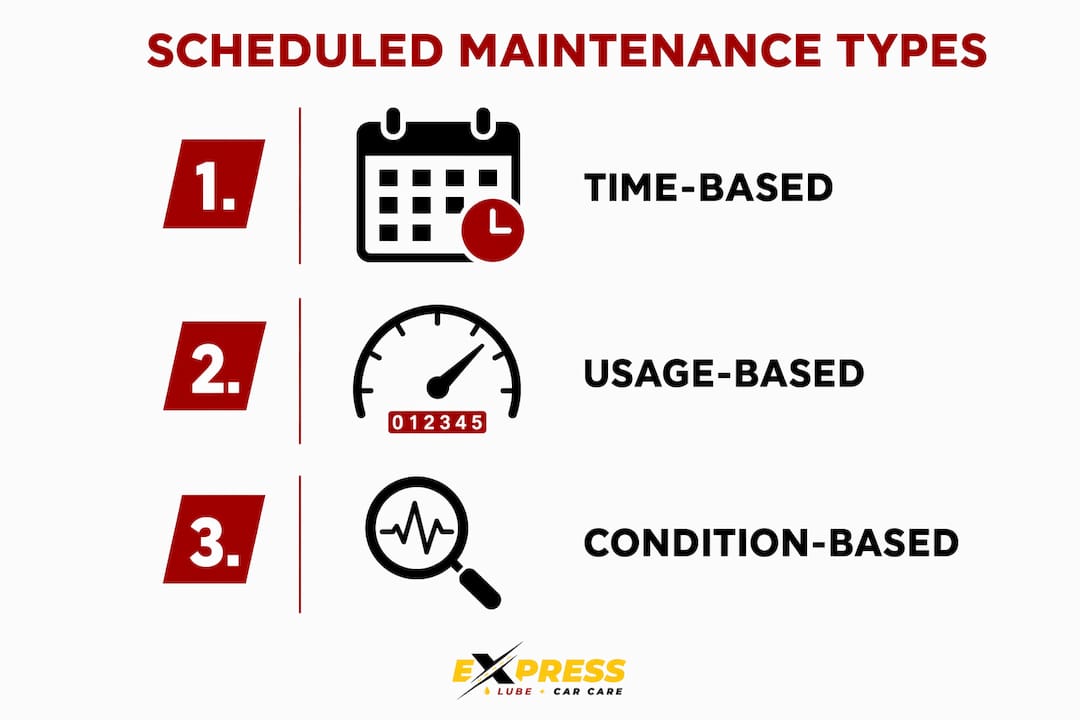
Usage-based maintenance triggers service at specific operational milestones rather than calendar dates. Oil changes, servicing, and adjustments keyed to mileage, machine hours, or production cycles fall into this category. A delivery fleet scheduling oil changes every 5,000 miles uses usage-based logic.
Condition-based scheduled maintenance relies on sensor data, inspections, or monitoring tools to determine when service is needed. Vibration analysis on conveyor belt bearings, for example, can flag wear before it causes a breakdown. This type tends to be the most resource-efficient because it avoids unnecessary service on equipment that is still performing well.
A practical comparison:
- Time-based: HVAC filter swap every 30 days, annual roofing inspection
- Usage-based: Oil change at 5,000 miles, bearing replacement at 10,000 operating hours
- Condition-based: Vibration check when sensor thresholds are exceeded, coolant test when temperature readings drift
Many facilities use all three types simultaneously, applying each where it fits best.
How scheduled maintenance differs from planned maintenance
These two terms get used interchangeably, but they describe different levels of the same process. Understanding the distinction helps you build a better maintenance strategy.
Planned maintenance is the broader strategic framework. It defines which assets need attention, what types of maintenance apply (preventive, predictive, corrective), and how resources should be allocated. Planned maintenance encompasses preventive, condition-based, and corrective tasks, all organized in advance with data-driven scheduling.
Scheduled maintenance is how that plan gets executed. It assigns specific tasks to specific technicians with deadlines, turning strategy into a working calendar of predetermined tasks with clear deadlines.
Key differences at a glance:
- Scope: Planned maintenance sets the strategy; scheduled maintenance executes it
- Scheduling: Planned maintenance uses flexible, data-driven timing; scheduled maintenance uses fixed assignments and deadlines
- Decision-making: Planned maintenance decisions draw on condition monitoring and risk assessment; scheduled maintenance decisions follow the established plan
- Operational focus: Planned maintenance is a management function; scheduled maintenance is a technician-level function
Preventive maintenance sits inside planned maintenance as a subset. All preventive maintenance is planned, but planned maintenance covers more than just fixed-interval tasks.
Why a scheduled maintenance plan pays for itself
The financial case for scheduled maintenance is direct. Emergency repairs cost 3–5 times more than planned maintenance because of overtime labor, rush-ordered parts, and collateral damage to surrounding systems. Avoiding even one major unplanned failure can cover months of routine service costs.
Beyond the budget, the benefits stack up quickly:
- Extended equipment lifespan: Consistent inspections catch small issues, like a seal leak, before they become expensive structural failures. Annual roofing checks, for instance, can extend a roof’s functional life by decades.
- Reduced downtime: Planned service windows cause far less disruption than emergency shutdowns.
- Improved safety: Regular checks on life-safety systems, fire alarms, and electrical panels keep facilities compliant and personnel protected.
- Better resource planning: Technicians know what’s coming, so labor and parts can be staged in advance rather than scrambled at the last minute.
- Environmental benefits: Extending machinery life through scheduled maintenance reduces electronic and chemical waste, supporting sustainability goals.
The shift from reactive to scheduled maintenance also changes how a facility operates day to day. Combining preventive and corrective maintenance in a single plan moves management from crisis response to predictable lifecycle management.
Which industries rely on scheduled maintenance plans most heavily
Scheduled maintenance is not industry-specific. Any operation that depends on functioning equipment benefits from a structured plan.
- Manufacturing: Conveyor systems, CNC machines, and production lines require regular lubrication, calibration, and part replacement to avoid costly production halts.
- Facility management: HVAC inspections, elevator certifications, fire suppression system checks, and plumbing maintenance all follow defined schedules in commercial buildings.
- Transportation and fleet management: Vehicle fleets use rotating service schedules for oil changes, brake inspections, tire rotations, and fluid checks to keep vehicles road-ready.
- Healthcare: Medical equipment calibration, sterilization system checks, and imaging machine servicing are often legally mandated on fixed schedules.
- Commercial properties: Landlords and property managers schedule seasonal HVAC tune-ups, roof inspections, and lighting system checks to protect asset value and meet lease obligations.
Regulatory compliance drives scheduled maintenance in several of these sectors. Buildings must demonstrate operational fire safety systems before occupancy is permitted, and the inspection records must be available for audit. Skipping scheduled service in a regulated environment is not just a maintenance failure; it can be a legal one.
Essential components of an effective scheduled maintenance plan
Building a plan that actually works requires more than a calendar of tasks. Each of these elements needs to be in place before the first work order goes out.
- Asset inventory with criticality ratings: Document every piece of equipment, including manufacturer, model, installation date, and the potential impact of its failure. Life-safety systems rank highest; aesthetic items rank lowest.
- Maintenance intervals: Assign time-based, usage-based, or condition-based intervals to each asset based on manufacturer recommendations and operational history.
- Assigned responsibilities: Name the technician or team responsible for each task. Ambiguity about ownership is one of the most common reasons tasks get missed.
- Standard operating procedures: Written SOPs keep service quality consistent regardless of which technician performs the work.
- Spare parts and tools: Identify required materials in advance so technicians are not waiting on parts mid-job.
- Safety and compliance integration: Include lockout/tagout procedures, PPE requirements, and regulatory inspection checklists directly in the plan.
- Documentation and record keeping: Log every completed task with the date, technician name, observations, and any parts replaced. These records support warranty claims, compliance audits, and future scheduling decisions.
Pro Tip: Start your maintenance intervals with manufacturer recommendations, then adjust based on what you actually observe. If equipment consistently passes inspections with no issues, you may safely extend the interval slightly. If problems keep showing up, shorten it. Experience refines the schedule in ways a manual never can.
Technology plays a growing role here. A Computerized Maintenance Management System (CMMS) automates scheduling, sends reminders to technicians, tracks work order completion, and generates reports on maintenance effectiveness. For facilities managing dozens of assets, a CMMS turns a complex spreadsheet into a manageable workflow.
How to evaluate and optimize your scheduled maintenance plan
A plan that worked well two years ago may not fit your current asset mix or staffing levels. Regular evaluation keeps the schedule aligned with actual conditions.
Start by reviewing completion rates. If a high percentage of scheduled tasks are being deferred or skipped, the schedule may be too aggressive for your team’s capacity. Pull work order records from your CMMS or maintenance log and look for patterns: which tasks get pushed most often, and why.
Next, compare your planned maintenance costs against your unplanned repair costs over the past 12 months. A well-functioning plan should show a clear trend toward fewer emergency calls over time. If emergency repairs are still frequent, the plan may have gaps in coverage or intervals that are too long for high-wear assets.
Asset condition data is your most reliable feedback loop. If a machine consistently shows no issues at inspection, the interval may be longer than necessary. If technicians are finding problems at every visit, the interval is too short or the wrong type of maintenance is being applied. Adjust based on evidence, not assumption.
Finally, revisit criticality ratings annually. Equipment that was low-priority three years ago may now be central to operations, and its maintenance schedule should reflect that change.
What a scheduled maintenance schedule looks like in practice
A maintenance schedule template does not need to be complex to be useful. The structure matters more than the format.
A basic facility maintenance schedule might look like this:
| Frequency | Task | Asset | Responsible Party |
|---|---|---|---|
| Monthly | Air filter replacement | HVAC units | Facilities technician |
| Quarterly | Lubrication and belt inspection | Conveyor system | Mechanical team |
| Semi-annual | Fire suppression system check | Sprinkler network | Licensed contractor |
| Annual | Full electrical panel inspection | Building electrical | Certified electrician |
| Every 5,000 miles | Oil change and fluid check | Fleet vehicles | Service technician |
For vehicle fleets, a family or commuter vehicle maintenance plan typically layers oil changes, tire rotations, brake inspections, and filter replacements across mileage and time intervals. The key is that every task has a trigger, an owner, and a record.
Digital templates in tools like Microsoft Dynamics 365 Asset Management allow maintenance plan lines to be set by time interval or counter value, with the system automatically generating scheduled work orders when thresholds are reached. Spreadsheet-based templates work for smaller operations, though they require manual tracking and are more prone to gaps.
Tools and technologies that support scheduled maintenance planning
The right tool depends on the scale of your operation and how many assets you’re managing.
CMMS platforms are the standard for facilities with multiple assets and technicians. They automate work order generation, track completion, manage parts inventory, and produce maintenance history reports. Microsoft Dynamics 365 Supply Chain Management includes a built-in asset management and maintenance planning module that handles both time-based and counter-based maintenance plan lines.
IoT sensors and condition monitoring tools feed real-time data into condition-based maintenance programs. Vibration sensors, thermal cameras, and fluid analysis kits give technicians objective data rather than relying on visual inspection alone.
Mobile work order apps let technicians receive assignments, document completed tasks, and flag issues from the field without returning to a desktop. Entry-level field apps handle basic scheduling and checklists; enterprise platforms integrate with ERP systems and asset databases.
Spreadsheets and calendar tools remain viable for small operations managing fewer than a dozen assets. The limitation is that manual systems depend entirely on the person maintaining them, with no automated reminders or audit trail.
For vehicle maintenance specifically, keeping your car’s glass and exterior components in good condition is part of a complete scheduled care routine, alongside mechanical service intervals.
Keep your vehicle on schedule with Express Lube & Car Care

A scheduled maintenance plan only works if the service actually gets done on time. Express Lube & Car Care in Plano, TX makes that easy with no-appointment-needed service and certified technicians who handle everything from oil changes and fluid services to brake inspections and engine diagnostics. Skipping scheduled service has real consequences: deferred maintenance costs more and shortens the life of your vehicle. Whether you’re following a manufacturer’s recommended schedule or building a custom plan for your fleet, Express Lube & Car Care keeps your vehicles running reliably without the wait.
Key Takeaways
A scheduled maintenance plan prevents costly failures by assigning specific tasks to technicians on defined intervals, turning maintenance strategy into consistent, documented action.
| Point | Details |
|---|---|
| Core definition | A scheduled maintenance plan assigns who, what, when, and how for every maintenance task. |
| Three main types | Time-based, usage-based, and condition-based intervals each suit different assets and failure patterns. |
| Cost advantage | Emergency repairs cost significantly more due to overtime, rush parts, and collateral damage. |
| Key components | Effective plans require asset inventories, SOPs, assigned responsibilities, spare parts lists, and compliance records. |
| Optimization cycle | Review completion rates, unplanned repair costs, and asset condition data annually to keep the schedule accurate. |
FAQ
What is an example of scheduled maintenance?
An oil change every 5,000 miles is a usage-based scheduled maintenance task. Monthly HVAC filter replacements and annual fire suppression system inspections are time-based examples common in facility management.
What does a scheduled maintenance plan include?
A scheduled maintenance plan includes an asset inventory with criticality ratings, maintenance intervals, assigned technician responsibilities, SOPs, spare parts lists, and compliance documentation for each task.
Is scheduled maintenance worth the cost?
Yes. Emergency repairs cost 3–5 times more than planned maintenance because of overtime labor, rush-ordered parts, and collateral damage. Consistent scheduled service also extends asset lifespan and reduces unplanned downtime.
What is the difference between scheduled and planned maintenance?
Planned maintenance is the broader strategy defining which tasks to perform and how to allocate resources. Scheduled maintenance is the operational execution of that strategy, assigning specific tasks to technicians with defined deadlines.
What should be included in a maintenance plan?
A maintenance plan should include a complete asset inventory, time or usage-based service intervals, named responsible parties, written SOPs, required tools and parts, and records of every completed task for compliance and performance tracking.