

The six highest-impact, low-cost practices every car owner should prioritize are regular oil changes, tire rotation and pressure checks, battery terminal inspections, fluid top-offs, air and cabin filter replacements, and prompt brake inspections. Together, these tasks address the most common failure points before they escalate into four-figure repairs. They are affordable because they require minimal tools, take under an hour each, and can often be done at home or during a quick no-appointment shop visit.
- Oil changes: Prevents sludge buildup and engine wear
- Tire rotation and pressure: Extends tread life and improves fuel economy
- Battery checks: Catch corrosion and weak cells before a no-start situation
- Fluid top-offs: Coolant, brake fluid, and power steering fluid protect critical systems
- Air and cabin filters: Cheap to replace; dirty ones hurt engine efficiency and air quality
- Brake inspections: Catching worn pads early avoids rotor damage and much higher repair costs
Pro Tip: If budget or time is tight this month, prioritize oil and tire pressure above everything else. Those two items alone prevent the majority of roadside breakdowns and premature engine wear.
Table of Contents
- What do affordable car upkeep best practices actually look like on a schedule?
- Which maintenance tasks give you the biggest return on investment?
- What should you DIY, and what belongs at a shop?
- How should you budget for car upkeep and what is the $3,000 rule?
- What seasonal and pre-trip checks protect your car year-round?
- Which warning signs mean you need a shop visit right now?
- What tools and resources make DIY maintenance cheaper and smarter?
- What does a certified technician actually do in a quick service visit?
- Key Takeaways
- Why routine checks matter more than most drivers realize
- Fast, professional service that fits your budget and your schedule
- Useful sources
- FAQ
What do affordable car upkeep best practices actually look like on a schedule?
A practical maintenance schedule does not need to be complicated. Think of it in three tiers: what you check monthly, what a shop or a capable DIYer handles every few months, and what gets done once a year or at major mileage milestones.
Monthly checks (owner-level, 10 minutes)
- Tire pressure (including the spare)
- All exterior lights
- Visible fluid leaks under the car
- Dashboard warning lights
- Quick visual on battery terminals for white or blue corrosion
Every 3–6 months or 3,000–7,500 miles
- Oil and filter change (follow your owner’s manual interval, not a blanket 3,000-mile rule)
- Tire rotation every 5,000–7,500 miles for even wear and better fuel economy
- Air filter and cabin filter inspection
- Wiper blade condition
- Brake inspection (visual pad thickness check)
Annual or major mileage checkpoints
- Cooling system and brake fluid condition
- Transmission service if the manufacturer specifies it
- Wheel alignment (roughly once a year)
- Timing belt check for belt-driven engines (timing chains on most modern vehicles do not require scheduled replacement)
- Full multi-point safety inspection
The 30-60-90 rule — servicing at 30,000, 60,000, and 90,000 miles — is a useful planning shorthand, but modern components often exceed those intervals. Iridium spark plugs, for example, can last very long intervals beyond standard service milestones. Your owner’s manual is the authoritative source; it overrides any general rule.
| Timeframe | Key Tasks | Who Does It |
|---|---|---|
| Monthly | Tire pressure, lights, fluid leaks, dashboard warnings | Owner |
| Every 3–6 months | Oil/filter, tire rotation, filters, wipers, brake visual | Owner or shop |
| Annually | Alignment, cooling/brake fluid, full inspection | Shop |
| Major mileage (30K/60K/90K) | Spark plugs, belts, transmission service (if required) | Shop |
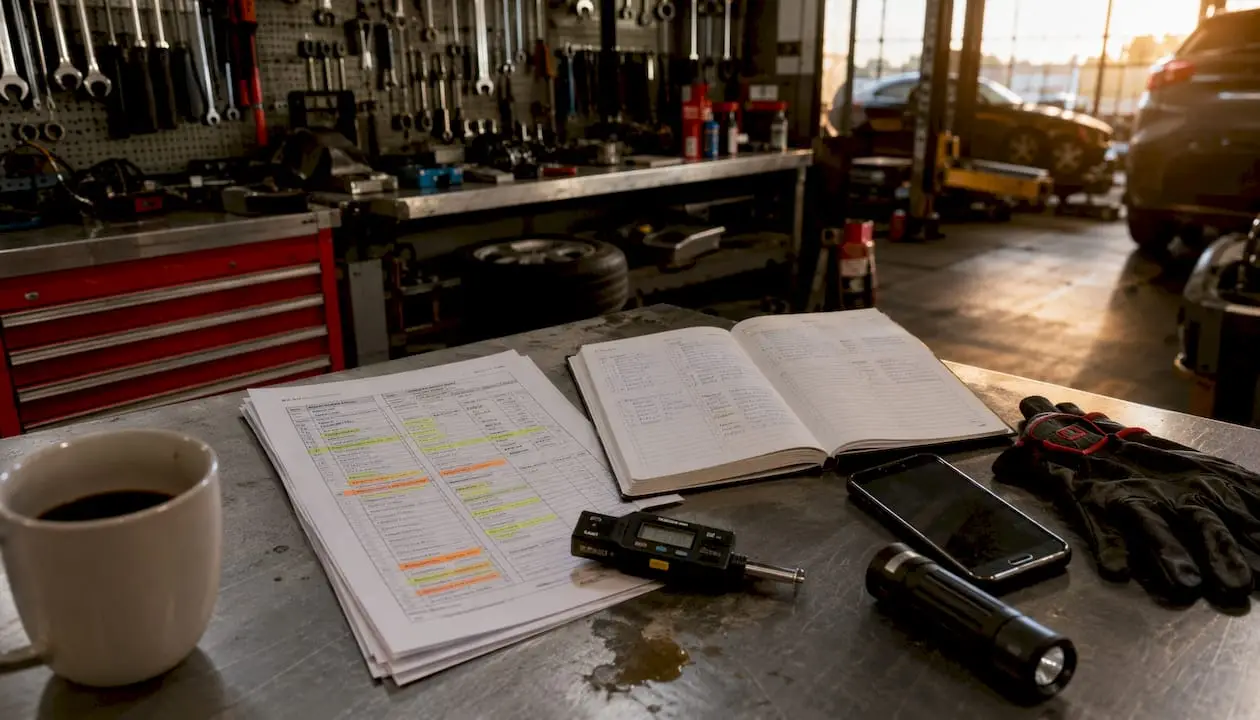
Pro Tip: Set a recurring phone reminder tied to your odometer reading, not just a calendar date. Mileage-based intervals are more accurate than time-based ones for most drivers.

See the local auto maintenance checklist for a printable version of these checkpoints.
Which maintenance tasks give you the biggest return on investment?
Preventive maintenance is not all equal. Some tasks cost $20 and prevent a $3,000 repair; others are genuinely optional for another 20,000 miles. Here is the priority order based on failure risk and repair cost avoided.
- Oil changes with the correct viscosity: Engine rebuilds start at several thousand dollars. An oil change costs $40–$80. The math is straightforward.
- Tire rotation and alignment: Rotation every 5,000–7,500 miles and alignment once a year extend tire life significantly and protect suspension components.
- Brake pad inspection: Replacing pads before they wear to metal costs $150–$300 per axle. Waiting until the rotors are scored can push that to $500–$800.
- Battery maintenance: Cleaning terminals with a wire brush and baking soda costs nothing. A dead battery stranding you on the highway costs a tow plus a new battery.
- Coolant and timing belt awareness: A 30K service varies moderately in cost; a 90K service with timing-belt replacement can be more expensive. Skipping the belt on an interference engine risks catastrophic valve damage.
Cost reality check: A 30K milestone service typically costs $200–$500. A 60K service is $400–$1,200. A 90K service, especially if timing-belt replacement is included, ranges from $800 to $2,500. These are planned expenses. An unplanned engine or transmission failure typically starts at $3,000 and climbs from there.
Simple checks that catch early failure: use a tread depth gauge (anything under 2/32" requires immediate replacement), a basic battery voltage tester (below 12.4 volts at rest signals a weak cell), and a visual brake pad check through the wheel spokes.
Pro Tip: Keep tires inflated to the door-jamb spec, not the maximum listed on the sidewall. Correct pressure reduces rolling resistance, improves fuel economy, and prevents uneven wear that shortens tire life by thousands of miles.
For battery care specifics, including how to test voltage at home, the Express Lube & Car Care battery guide covers the process step by step.
What should you DIY, and what belongs at a shop?
The line between smart DIY and costly mistake is usually drawn by three factors: safety risk, specialized tooling, and vehicle complexity. Get the division right and you can save hundreds per year without putting yourself or your car at risk.
Safe, high-value DIY tasks
- Checking and topping off fluids (oil, coolant, washer fluid, power steering)
- Replacing wiper blades
- Swapping cabin and engine air filters (typically two screws or clips)
- Checking tire pressure and inflating to spec
- Replacing exterior bulbs on most vehicles
- Cleaning battery terminals with a wire brush and a baking soda solution
Tasks that belong at a shop
- Full brake jobs (caliper, rotor, or line work beyond pad swaps)
- Transmission fluid service (requires specific fluid and often a flush machine)
- Engine diagnostics with scan tools beyond basic OBD-II code reading
- Timing belt replacement (incorrect installation causes engine destruction)
- Major electrical diagnosis and repair
- Suspension and steering component replacement
When vetting a shop, look for ASE-certified technicians, written estimates before any work begins, a warranty on parts and labor (typically 12 months or 12,000 miles at reputable shops), and itemized invoices you can read line by line. Getting two quotes on any repair over $300 is standard practice, not an insult to the shop. A trustworthy service center welcomes the comparison.
Pro Tip: Always ask for a printed inspection checklist and keep every receipt. Documented maintenance history preserves your warranty coverage and can increase resale value at trade-in — missing records have cost owners thousands of dollars in reduced offers.
How should you budget for car upkeep and what is the $3,000 rule?
The $3,000 rule appears in three different contexts, and confusing them is a common financial mistake. Some guides use it as a total car budget, others as a down payment target, and others as a repair reserve. The most practical application is keeping $3,000 as a separate post-purchase repair buffer, not spending it on the vehicle itself.
Early ownership repairs — water pumps, alternators, wheel bearings — commonly run $800–$2,500 depending on the vehicle and local labor rates. A $3,000 reserve covers most of those without forcing you onto a high-interest credit card.
For ongoing maintenance, a monthly savings target at a moderate level scaled by vehicle age and annual mileage is recommended. An older vehicle with 100,000+ miles warrants the higher end. A newer car under warranty can sit closer to $75.
- Year 1 of ownership: Build the $3,000 reserve before spending on upgrades or accessories
- Ongoing: Set aside $75–$150 monthly in a dedicated savings account
- Unexpected repair over $500: Draw from the reserve; replenish it over the next 3–4 months
- Never skip: Oil changes, tire pressure, and brake checks — these three prevent the most expensive failures
A quick example: setting aside $100 per month gives you $1,200 in a year. An $800 alternator replacement becomes a minor inconvenience rather than a financial emergency. Without the reserve, that same repair often lands on a credit card at 20%+ APR, costing significantly more over time.
Pro Tip: When budget forces a choice, never defer an oil change or a brake inspection. Those two items have the highest probability of causing secondary damage if skipped — and secondary damage multiplies the repair bill.
A scheduled maintenance plan can also help you predict and spread costs across the year rather than absorbing them as surprises.
What seasonal and pre-trip checks protect your car year-round?
Weather and long trips stress vehicle systems in predictable ways. A short checklist before each season — and before any drive over 200 miles — catches the issues most likely to cause a breakdown.
Summer checklist
- Coolant level and condition (flush if it looks brown or smells burnt)
- AC system function check before the first hot week
- Tire pressure (heat increases pressure; check cold in the morning)
- Battery load test (heat accelerates battery degradation as much as cold does)
Winter checklist
- Battery health (cold cranking amps drop sharply below 32°F)
- Antifreeze concentration (should protect to at least -20°F in most U.S. climates)
- Wiper blades rated for ice and snow
- Washer fluid rated for freezing temperatures
- Tire tread depth (3/32" minimum for safe winter driving; consider all-season or winter tires in snow-prone areas)
Pre-trip essentials (any trip over 200 miles)
- All fluid levels
- Tire condition and pressure, including the spare
- Spare tire, jack, and lug wrench present and functional
- All lights operational
- Brake feel and response
- Battery voltage
If you tow a trailer or carry heavy loads regularly, shorten your oil change and brake inspection intervals. Severe-duty use accelerates wear on brakes, transmission, and cooling systems faster than standard intervals account for.
Pro Tip: Combine your seasonal check with a routine oil change visit. A shop performing the oil change can simultaneously inspect the battery, brakes, and fluids at little or no additional labor cost, reducing your per-item expense.
Which warning signs mean you need a shop visit right now?
Some warning signs allow a few days of monitoring. Others mean pull over immediately. Knowing the difference prevents a manageable repair from becoming an engine replacement.
Stop driving immediately:
- Smoke from the hood or a burning smell (overheating or electrical fault)
- Red temperature warning light (engine is overheating; continued driving causes head gasket or engine damage)
- Oil pressure warning light (driving even a mile can destroy an engine)
- Grinding or metal-on-metal sound from brakes (rotors are being damaged with every stop)
- Fluid puddle under the car that is not condensation from the AC
Get to a shop within 24–48 hours:
- Steady check engine light (not flashing)
- Pulling to one side under braking
- Vibration at highway speeds (wheel balance or alignment issue)
- Soft or spongy brake pedal
- Unusual engine noise at startup that fades after warming up
Urgent but not a roadside emergency:
- Wiper streaking in rain
- One exterior light out
- Slight hesitation on acceleration
Pro Tip: A flashing check engine light is categorically different from a steady one. A steady light means schedule a diagnostic soon. A flashing light means a misfire is actively occurring — continued driving can damage the catalytic converter, turning a $150 diagnostic into a $1,500 repair.
Recognizing early signs of car problems before they escalate is one of the most cost-effective skills a driver can develop.
What tools and resources make DIY maintenance cheaper and smarter?
You do not need a full garage to handle basic maintenance. A small, inexpensive toolkit covers the majority of owner-level tasks and pays for itself after one or two DIY jobs.
Basic toolkit (under $100 total for most items):
- Tire pressure gauge (digital, $10–$15)
- Tread depth gauge ($5–$10)
- Basic socket set (3/8" drive, metric and standard)
- Funnel and fluid transfer pump
- Work gloves and safety glasses
- OBD-II code reader ($25–$60) for reading and clearing check engine codes
For maintenance tracking, a simple spreadsheet or a dedicated vehicle maintenance app works well. Log the date, mileage, task performed, and cost. That record becomes your maintenance history, which matters for warranty claims and resale.
Authoritative resources every owner should bookmark:
- Your vehicle’s owner’s manual (the single most accurate source for your specific car’s intervals)
- NHTSA recall lookup at nhtsa.gov — free, takes 30 seconds with your VIN
- Consumer Reports’ car maintenance guide for general interval guidance
- AARP’s DIY car maintenance tips for accessible, step-by-step guidance
On learning safe DIY skills: Community college automotive programs and manufacturer-approved YouTube channels (search the channel name plus your vehicle’s make and model) are the most reliable free learning sources. Before following any tutorial, verify the creator has ASE credentials or a documented professional background — a confident presenter is not the same as a qualified one.
Pro Tip: Run your VIN through the NHTSA recall database before your next service visit. Open recalls are repaired free by the dealer, and many owners never claim them simply because they did not know.
For transmission fluid checks specifically, the Express Lube & Car Care guide walks through the process vehicle by vehicle, since dipstick location and fluid color interpretation vary significantly by make.
What does a certified technician actually do in a quick service visit?
A fast, no-appointment service visit is not just an oil change. At a properly run quick-service bay, a certified technician works through a structured multi-point inspection while the oil drains, covering ground that most owners cannot easily check themselves.
Typical quick-service inspection checklist:
- Drain old oil, replace drain plug with correct torque, install new filter
- Refill with OEM-specified oil type and viscosity
- Top off washer fluid, coolant reservoir, and power steering fluid
- Check tire pressure on all four tires and the spare
- Visual tread depth assessment
- Battery terminal condition and voltage test
- Brake pad thickness visual (through wheel spokes)
- Exterior light function check
- Belt and hose condition (visual)
A 30K service typically includes all of the above plus air and cabin filter inspection, tire rotation, and a more detailed brake inspection. Ask for a printed multi-point inspection report at the end of every visit. That document shows what was checked, what passed, and what the technician recommends addressing next.
Quick services at a reputable shop typically take 20–45 minutes. Cost for a standard oil change and multi-point inspection runs $40–$80 depending on oil type (conventional vs. full synthetic) and location.
Pro Tip: Ask the technician to run an OBD-II scan during the visit even if no warning light is on. Pending codes — faults that have not yet triggered the check engine light — show up on the scan and give you a heads-up before a minor issue becomes a dashboard alarm.
Keeping complete service records from every visit protects your warranty and gives a future buyer confidence in the vehicle’s history.
Key Takeaways
Consistent, low-cost preventive maintenance — particularly oil changes, tire care, and brake inspections — prevents the majority of expensive automotive repairs before they start.
| Point | Details |
|---|---|
| Prioritize six core tasks | Oil changes, tire rotation, battery checks, fluid top-offs, filter swaps, and brake inspections deliver the highest repair-prevention ROI. |
| Follow your owner’s manual | The 30-60-90 rule is a planning shorthand; modern components often exceed those intervals, so OEM specs take priority. |
| Build a $3,000 repair reserve | Keep this buffer separate from purchase funds; early ownership repairs commonly run $800–$2,500. |
| Save $75–$150 monthly | This range covers routine maintenance and replenishes your reserve after unexpected repairs without relying on high-interest credit. |
| Express Lube & Car Care | No-appointment quick-service visits cover oil changes, brake inspections, and multi-point checks — a practical fallback for budget-conscious drivers who prefer a certified technician. |
Why routine checks matter more than most drivers realize
The most expensive repairs we see at Express Lube & Car Care share a common thread: they were preventable. Not by expensive interventions or specialized knowledge, but by the kind of consistent, low-friction attention that takes ten minutes a month. A tire that loses two PSI per week and goes unchecked for three months does not just wear unevenly — it compromises handling in an emergency stop. A battery showing 12.2 volts in October becomes a no-start at 7 AM in January.
The conventional wisdom says “follow the 30-60-90 schedule.” That is reasonable advice, but it misses the more important point: modern car health depends more on proactive observation than on rigid mileage milestones. Fluid color, unusual sounds, fuel economy changes, and subtle handling shifts are the real early-warning system. The schedule gives you a minimum floor; your own attention raises the ceiling.
Documented maintenance is also undervalued. Drivers who keep printed inspection reports and receipts from every service visit protect their warranty, simplify insurance claims after accidents, and command stronger trade-in offers. Missing records have cost owners thousands at the dealership counter.
Pro Tip: The single most common mistake we see is deferring an oil change by 2,000–3,000 miles “just this once.” It happens repeatedly, and over time it accelerates sludge buildup in ways that are not reversible without an engine flush or, in severe cases, internal engine work.
Fast, professional service that fits your budget and your schedule
Skipping a maintenance task because you do not have time to book an appointment is one of the most avoidable reasons cars develop expensive problems. Express Lube & Car Care eliminates that barrier entirely with no-appointment-needed service in Plano, TX, staffed by certified technicians who work through a full multi-point inspection on every visit.
For budget-conscious drivers, the practical advantage is straightforward: you get an oil change, brake inspection, fluid top-offs, battery check, and a printed inspection report in one 20–45 minute stop, without scheduling days in advance. Bundling services in a single visit reduces per-item labor cost compared to separate appointments. Current oil change specials make routine service even more accessible, and if the inspection surfaces a brake concern, the brake repair service is handled by the same certified team without a separate visit. Military and healthcare providers receive additional discounts. Pull in, get it done, and drive out with documentation in hand.
Useful sources
The guidance in this article draws on manufacturer-aligned service schedules, U.S. automotive cost data, and established financial planning principles for vehicle ownership. The sources below are worth bookmarking for ongoing reference.
Why your owner’s manual outranks every general guide: Manufacturer-specified intervals are tested for your exact engine, transmission, and climate range. A general 30-60-90 schedule is a useful starting point, but your manual is the document that actually governs your warranty and your vehicle’s long-term health.
Official and high-authority resources:
- Owner’s manual: The primary source for your vehicle’s specific intervals, fluid specs, and warning light definitions
- NHTSA recall lookup (nhtsa.gov): Free VIN-based search for open safety recalls repaired at no cost by the dealer
- Consumer Reports car maintenance guide: Broad interval guidance and cost benchmarks for U.S. drivers
- AARP DIY car maintenance tips: Accessible, step-by-step guidance for common owner-level tasks
- Express Lube & Car Care blog: Technician-written guides on battery maintenance, routine checklists, and commuter priorities
Research sources cited in this guide:
- 30-60-90 rule analysis — Jalopnik
- 30K/60K/90K cost ranges and tire rotation intervals — Performance Plus Tire
- 30K service checklist — SM Engineers
- $3,000 rule interpretations — Build Price Option
- Monthly savings guidance — Jimmy Britt Chevrolet
This article provides general maintenance guidance for informational purposes only. Consult your vehicle’s owner’s manual and a qualified technician for advice specific to your car, driving conditions, and local regulations.
FAQ
What is the $3,000 rule for cars?
The $3,000 rule has three common interpretations — total budget, down payment, and repair reserve — but the most practical use is keeping $3,000 as a separate post-purchase repair buffer to cover early ownership fixes without going into debt.
What is the 30-60-90 rule for car maintenance?
The 30-60-90 rule refers to service milestones at 30,000, 60,000, and 90,000 miles, covering tasks like oil changes, filter replacements, and brake inspections. It is a useful planning framework, but modern components often exceed those intervals, so your owner’s manual takes priority.
How much should I set aside monthly for car maintenance?
A monthly savings target of $75–$150 is a practical range for most U.S. drivers, scaled toward the higher end for older vehicles or high annual mileage.
What are the 3 C’s of auto repair?
The 3 C’s are Condition, Cause, and Correction — the standard diagnostic documentation format technicians use to describe what the customer reported, what caused it, and what repair was performed. Asking for this documentation on your invoice gives you a clear, warranty-valid record of every service.
What is the most reliable and cheapest car to maintain?
Japanese brands, particularly Toyota and Honda, consistently rank among the lowest total-cost-of-ownership vehicles in U.S. consumer studies, largely because of parts availability, long component life, and straightforward maintenance schedules. That said, any vehicle maintained consistently on its manufacturer’s schedule will cost significantly less to own than a neglected one, regardless of brand.