

A flashing check engine light means an active engine misfire that can rapidly destroy the catalytic converter. Stop driving and pull over as soon as you can safely do so, ideally within two to three miles, then shut off the engine. Towing is almost always cheaper than replacing a ruined converter, so resist the urge to push on to your destination.
TL;DR:
- A flashing check engine light indicates an active misfire that can quickly damage the catalytic converter, often within just a few miles of driving at highway speed.
- Immediate actions include easing off the gas, finding a safe place to stop, shutting off the engine, and avoiding restarting if there’s smoke, a fuel smell, or shaking.
- Most causes relate to cylinder misfires from ignition coil failure, fouled spark plugs, or failing fuel injectors, which can often be diagnosed with a quick code read or coil swap.
- Ignoring the warning risks melting the converter’s internal structures, leading to costly repairs that can range from $800 to $3,500, making towing a more economical option.
- Drivers should get a diagnostic scan promptly, especially if symptoms worsen or the light persists after restart, to prevent extensive engine or exhaust system damage.
Table of Contents
- Flashing Check Engine Light Vs. Solid: What’s the Difference?
- What Usually Causes a Flashing Check Engine Light?
- What to Do the Moment the Light Starts Flashing
- How to Read the Codes Behind a Flashing Check Engine Warning
- How Fast Does a Flashing Light Turn Into Expensive Damage?
- Should You Tow the Car or Drive It a Short Distance?
- Preventing the Next Flashing Check Engine Light
- Our Take: Why Drivers Ignore This Warning at Their Own Risk
- Get Your Flashing Check Engine Light Diagnosed Today
- Sources
- FAQ
Flashing Check Engine Light Vs. Solid: What’s the Difference?
A solid check engine light means the computer stored a fault code, often something minor like a loose gas cap or an aging oxygen sensor. It’s worth a look soon, but it’s not an emergency.
A flashing light is a different animal entirely. It means your engine’s computer is watching an active misfire in real time, counting failed combustion events against a set threshold as the crankshaft turns. Cross that line, and the light starts flashing to warn you before the damage spreads downstream.
Quick cues while you’re driving:
- Solid glow, engine feels normal: no rush, schedule a diagnostic soon.
- Flashing light plus a rough idle or shaking: an active misfire is happening right now.
- Flashing light with a fuel smell or visible smoke: stop immediately and don’t restart until inspected.
What Usually Causes a Flashing Check Engine Light?
Most flashing check engine light causes trace back to a single cylinder failing to burn fuel properly. The usual suspects, roughly in order of frequency:
- Ignition coil failure — the most common trigger, especially on engines with individual coils per cylinder.
- Fouled or cracked spark plug — worn electrodes can’t generate a strong enough spark to ignite fuel consistently.
- Dead or clogged fuel injector — starves one cylinder of fuel even while the others run fine.
- Vacuum leaks — unmetered air throws off the fuel mixture and can cause a rough, uneven burn.
- Low fuel pressure — a failing pump or clogged filter can’t deliver enough fuel under load.
- Faulty MAF sensor — bad airflow readings confuse the computer’s fuel calculations.
- Low compression or a blown head gasket — more serious mechanical faults that mimic electrical misfires.
Symptoms often point you in the right direction before a scanner ever gets involved. A pronounced shake at idle usually means a coil or plug. A loss of power under acceleration paired with a fuel odor suggests an injector or pressure problem. Heavy white smoke or a sweet smell hints at coolant entering the combustion chamber, which is a head gasket red flag.
What to Do the Moment the Light Starts Flashing
Act in this order the instant you notice the flashing check engine light:
- Ease off the gas immediately. Reducing engine load slows the misfire’s pace and buys you time.
- Find the nearest safe spot to stop — a parking lot or wide shoulder, not the fast lane.
- Pull over, set the parking brake, shift to Park or Neutral, and shut off the engine. This stops the flow of unburned fuel into the exhaust.
- Check for smoke, a strong fuel smell, or severe shaking. Any of those means call a tow truck; do not restart the engine.
- If you genuinely must move the car a short distance, keep speeds under 25 mph, avoid hills and heavy throttle, and watch the light closely.
- Get a code read before repairs begin. Many auto parts stores offer free OBD-II scans in their parking lot, or you can use a Bluetooth OBD-II dongle and a phone app.
Pro Tip: Keep a cheap Bluetooth OBD-II adapter in your glove box. Pairing it with a free phone app takes thirty seconds and can tell you whether you’re dealing with one bad coil or something that demands an immediate tow.
How to Read the Codes Behind a Flashing Check Engine Warning
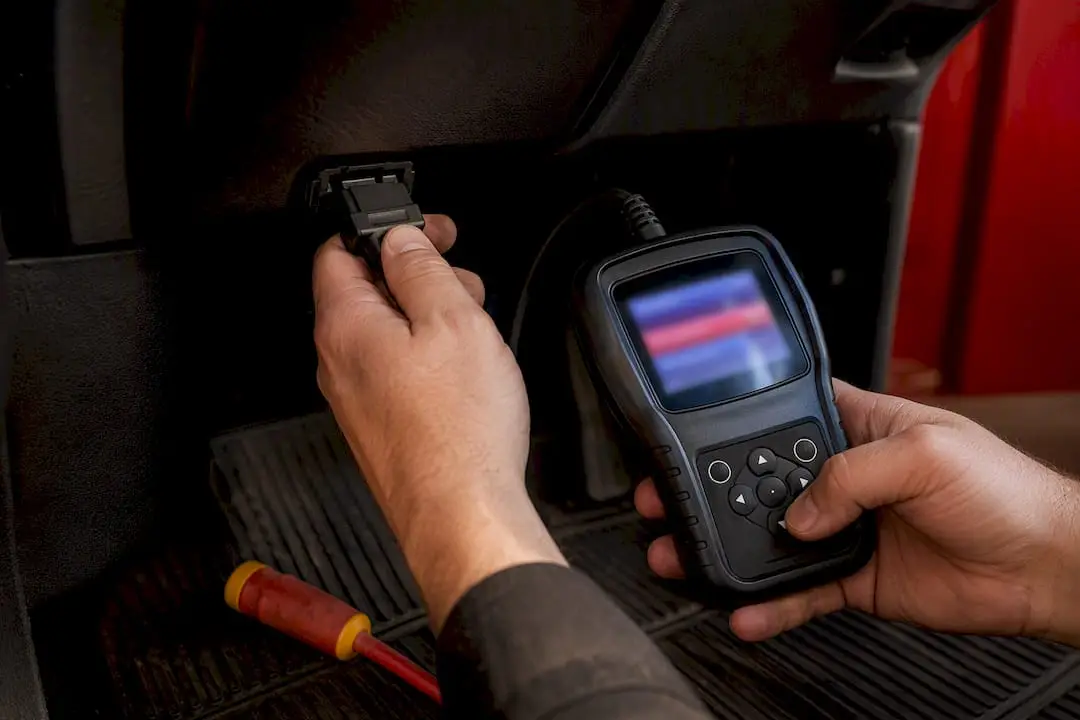
Every vehicle built since 1996 has an OBD-II port, usually tucked under the dashboard near the steering column. Plug in a scanner there, or hand the job to a parts store or a shop for a full diagnostic read.
The codes you’ll most likely see:
- P0300 signals a random or multiple-cylinder misfire, often pointing to a system-wide issue like a vacuum leak or low fuel pressure.
- P0301 through P0308 each identify a specific cylinder misfiring, which usually narrows the problem to one coil, plug, or injector.
- P0171 or P0174 indicate a lean fuel condition, which is a common underlying cause of the cylinder-specific misfire codes above.
A technician’s fastest diagnostic move is often the coil-swap test: move the coil from a suspected cylinder to another position and see if the misfire code follows it. If it does, you’ve found a bad coil without tearing anything apart. From there, a quick check of spark plugs, fuel pressure, and vacuum lines, plus a look at freeze-frame data showing engine load at the moment of failure, usually confirms the fix.
How Fast Does a Flashing Light Turn Into Expensive Damage?
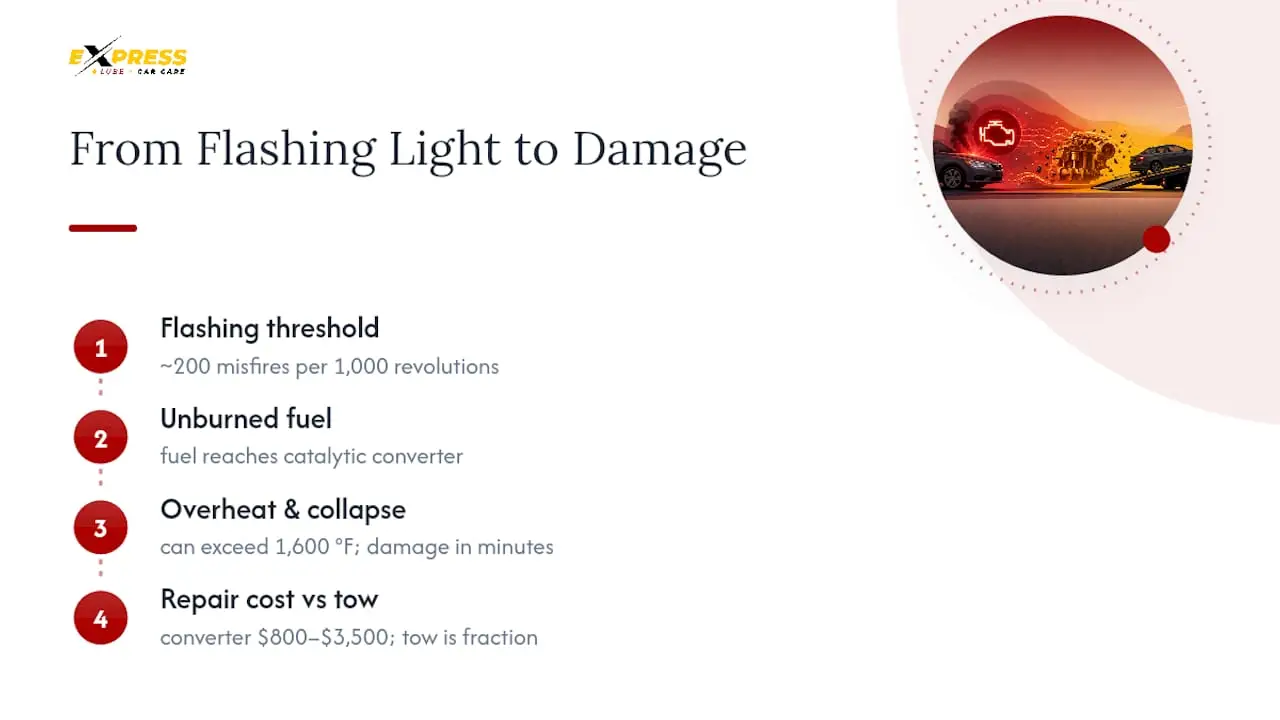
The threshold that triggers the flashing light isn’t arbitrary. OBD-II systems follow an EPA-defined limit of roughly 200 misfire events per 1,000 crankshaft revolutions before the light switches from steady to flashing, a point where unburned fuel starts reaching the catalytic converter in quantities that can cause real harm.
The real cost of ignoring it: unburned fuel dumped into a converter running at exhaust temperature can push it past 1,600 degrees Fahrenheit, melting its internal honeycomb structure within minutes at highway speed. Damage can begin within just a few miles of sustained misfiring.
Once that honeycomb collapses, you’re not looking at a repair. You’re looking at a replacement that commonly runs from roughly $800 to $3,500 depending on the vehicle. A tow truck, by comparison, is a fraction of that bill.
Should You Tow the Car or Drive It a Short Distance?
Call a tow truck when any of these show up:
- The light keeps flashing after you restart the engine.
- You feel severe vibration or shaking through the pedals or seat.
- You smell fuel or see smoke from the exhaust or under the hood.
- The engine has lost significant power or struggles to maintain speed.
A limited limp, two to three miles at most, is reasonable only if the flashing stops after restart, symptoms are mild, and your route is flat with no heavy acceleration. Even then, watch the light the entire way.
One warning worth taking seriously: if the flashing stops after a restart, the underlying fault almost always remains and tends to return under load. Towing preserves that freeze-frame diagnostic data and keeps your warranty coverage intact, which matters more than it sounds like when a converter claim is on the line.
Preventing the Next Flashing Check Engine Light
Most flashing check engine light emergencies trace back to maintenance that got pushed off too long. Standard copper spark plugs typically need replacement every several tens of thousands of miles, while iridium or platinum plugs can often last much longer depending on the manufacturer’s schedule. Watch for early warning signs: a rough idle, hesitation on acceleration, or a slight drop in fuel economy often shows up weeks before a coil or plug fails outright.
Beyond spark components, a few habits go a long way:
- Replace fuel filters on schedule and consider periodic injector cleaning if you notice hesitation.
- Have MAF and oxygen sensors checked during routine service, since dirty or failing sensors throw off fuel calculations long before they trigger a full misfire.
- Get a scan before long trips. A quick engine diagnostic check catches a marginal coil or a slow fuel pressure drop before it turns into a roadside emergency.
Our Take: Why Drivers Ignore This Warning at Their Own Risk
Here’s what surprises most drivers: the flashing check engine light isn’t a glitch or an overly cautious computer being dramatic. It was engineered specifically to stop you from destroying your catalytic converter, and it does exactly what it was built to do. The real problem is that most people have been trained by years of solid, low-stakes check engine lights to treat every dashboard warning the same way.
We’d argue the conventional advice, “get it checked when you can,” is actually dangerous when applied to a flashing light. That advice works fine for a stored code. It fails badly for an active misfire, where every extra mile at highway speed is heat cycling a converter that’s already under stress. The math rarely favors waiting: a tow costs a fraction of a converter replacement, and the diagnostic data your shop needs is often lost the moment the fault clears itself after a restart.
What we see most often at Express Lube & Car Care is a simple, fixable problem, usually one coil or one plug, that got treated like a crisis or ignored like a nuisance instead of handled like the routine repair it actually is. Respect the flashing light, but don’t panic over it. Get it read, get it fixed, and get back on the road.
— Express Lube & Car Care
Get Your Flashing Check Engine Light Diagnosed Today
Express Lube & Car Care gets you back on the road faster than scheduling a wait-and-see appointment somewhere else, because our ASE-certified technicians run full diagnostics the same day you walk in, no appointment required. That matters most when your check engine light is flashing and every hour of uncertainty is an hour your converter is at risk.
Our process starts with an OBD-II scan and visual inspection, then moves to a coil-swap test or targeted checks to pin down single-cylinder faults fast, all documented with photos and technician notes so you know exactly what’s wrong before you approve any repair. Whether the issue turns out to be a $150 coil or something bigger, our engine diagnostics and repair service is backed by a 24-month/24,000-mile warranty, so you’re not gambling on the fix holding.
If your check engine light is flashing right now, don’t wait on a callback. Drive it in slowly and safely if you can, or call us to arrange a tow, and we’ll have a technician on it as soon as you arrive.
Sources
- What does a flashing check engine light mean? — AutoZone
- What does the check engine light mean? — Consumer Reports
- Flashing check engine light — OBDGuides
- Check engine light flashing: what it means, how long you have + what to do
FAQ
Can I Drive My Car With the Check Engine Light Blinking?
You should not drive any real distance with the check engine light blinking. A short, slow trip to the nearest safe location is acceptable only if the flashing stops after restart and symptoms are mild; otherwise, stop and call a tow.
What Is the Most Common Cause of a Flashing Check Engine Light?
A failing ignition coil is typically the most common cause, followed closely by a fouled spark plug or a failing fuel injector. All three produce the same active misfire that triggers the flashing warning.
How Do You Fix a Flashing Check Engine Light?
Read the diagnostic code first, since P0301 through P0308 point to a specific misfiring cylinder while P0300 suggests a broader issue like a vacuum leak. From there, a technician typically runs a coil-swap test and checks plugs, fuel pressure, and vacuum lines to isolate the fault.
Which Is Worse: Blinking or Solid Check Engine Light?
A blinking light is significantly more urgent than a solid one. Solid means a stored fault worth checking soon; blinking means an active misfire is risking your catalytic converter right now.
How Long Can I Drive With a Flashing Check Engine Light Before Damage Occurs?
Catalytic converter damage can begin within just a few miles of sustained misfiring at highway speed, sometimes within minutes. There’s no safe window for extended driving once the light starts flashing.