

Follow a severe-duty maintenance schedule, shorten your oil-change intervals, and add one weekly 30-minute sustained drive. Those three moves do more to extend engine life with frequent driving than any single product or additive on the market. If you drive daily in stop-and-go traffic, make repeated short trips under 5 miles, or idle regularly, your vehicle qualifies as severe-duty use under most manufacturer definitions, and the standard maintenance schedule is not enough.
Your three immediate priorities:
- Switch to the severe-duty maintenance schedule in your owner’s manual now
- Shorten oil-change intervals to match your actual driving pattern, typically more frequent for severe use
- Plan one continuous 30-minute drive per week at light-to-moderate load to clear moisture and deposits
Pro Tip: Check your oil level and color every two weeks. If the oil looks dark and gritty before your next scheduled change, you are already overdue.
Key Takeaways
| Point | Details |
|---|---|
| Follow the severe-duty schedule | Short trips under 5 miles qualify as severe use; switch to the manufacturer’s severe maintenance intervals. |
| Shorten oil intervals | Change oil every 3,000–5,000 miles for severe use; turbo engines require full synthetic and tighter intervals. |
| Add a weekly 30-minute drive | One continuous drive per week at light-to-moderate load evaporates moisture and burns off carbon deposits. |
| Watch for early warning signs | A flashing check-engine light, oil pressure warning, or overheating gauge requires immediate action, not a scheduled visit. |
| Express Lube & Car Care | ASE-certified technicians, same-day service, and digital inspection records support a complete severe-duty maintenance program. |
Table of Contents
- How does frequent driving accelerate engine wear?
- What does a maintenance checklist for frequent drivers look like?
- Which driving habits protect your engine during frequent use?
- What do severe-duty maintenance intervals actually look like?
- What warning signs mean your engine needs attention now?
- How long do common services take, and what do they cost?
- How should you organize records and plan maintenance?
- What technicians know about frequent driving that most guides miss
- Our perspective on what frequent drivers actually need
- Frequent drivers get more from Express Lube & Car Care
- Sources
- FAQ
How does frequent driving accelerate engine wear?
Most drivers assume high mileage is the enemy. The real culprit is the pattern of use, not the total distance. Short trips concentrate wear in cold-start cycles, where oil has not yet reached full operating temperature and cannot form a complete hydrodynamic film between metal surfaces. During those first few minutes, engine components run under boundary lubrication conditions, meaning metal-to-metal contact is only partially prevented. Repeat that cycle five or ten times a day and the cumulative wear adds up fast, even when the odometer barely moves.
Beyond metal wear, short trips create three compounding problems. Incomplete combustion leaves unburned fuel that dilutes the oil, reducing its viscosity and lubricating ability. Moisture from combustion gases condenses inside the crankcase instead of evaporating, which accelerates sludge formation and corrodes internal components. Carbon deposits build up on intake valves, piston crowns, and injector tips faster than the engine’s self-cleaning mechanisms can handle. Meanwhile, the alternator never gets enough run time to fully recharge the battery, so repeated short trips gradually drain reserve capacity and shorten battery life.
| Severe-Duty Trigger | Primary Engine Effect |
|---|---|
| Short trips under 5 miles | Boundary lubrication, oil dilution, deposit buildup |
| Stop-and-go traffic | Elevated thermal cycling, coolant stress |
| Repeated cold starts | Accelerated cylinder wall and bearing wear |
| Extended idling | Incomplete combustion, fuel dilution |
| Frequent towing or loads | Elevated oil and coolant temperatures |
Manufacturers classify all of these conditions as severe use and direct owners to follow more frequent service intervals for oil, filters, and fluids. The standard schedule assumes mostly highway miles with long warm-up periods. Your commute does not look like that.
What does a maintenance checklist for frequent drivers look like?
Prioritize by consequence. A missed oil change can destroy an engine. A skipped air filter costs you fuel economy. Keep that hierarchy in mind when budgeting time and money.
Critical services (do these first)
- Oil and oil filter: Change every 3,000–5,000 miles for severe use with conventional oil, or every 5,000–7,500 miles with full synthetic. Intervals vary by oil type and manufacturer spec, so confirm your owner’s manual. If you drive a turbocharged or downsized engine, use the manufacturer-specified grade and never stretch the interval. Turbo engines run oil through the turbocharger bearing at high temperature, and degraded oil accelerates turbo wear faster than in naturally aspirated engines.
- Coolant level and condition: Check monthly. A low coolant level in a frequently driven vehicle can cause overheating within minutes. Flush and replace coolant per the severe-duty schedule, typically every few years or as specified by the manufacturer.
- Timing belt or chain: A broken timing belt is catastrophic. Inspect timing belt according to the manufacturer’s recommendation and replace before failure. Timing chains generally last longer but still require inspection if you notice rattling on cold starts.
Medium-priority services
- Air filter: Replace air filter more frequently in urban driving environments. City air carries more particulates than highway air, so the filter loads up faster.
- Fuel filter: Replace fuel filter periodically as recommended, more often in dusty or demanding conditions. A clogged fuel filter forces the pump to work harder and can cause rough idle and hesitation.
- Spark plugs: Replace spark plugs according to type and manufacturer recommendations. Worn plugs cause misfires that increase fuel consumption and deposit formation.
- PCV valve: The positive crankcase ventilation valve routes blow-by gases back into the intake. A stuck or clogged PCV valve increases crankcase pressure and accelerates oil leaks and sludge. Replace PCV valve periodically as recommended to prevent sludge buildup.
- Battery check: Have the battery load-tested annually if you drive mostly short trips. Frequent short trips undercharge the battery, and a weak battery stresses the alternator.
Optional but beneficial
- Fuel system cleaner: A quality detergent additive used every 10,000–15,000 miles can help keep injectors and intake valves cleaner, particularly on direct-injection engines prone to carbon buildup.
- Intake cleaning: For direct-injection engines with high carbon deposits, a professional intake cleaning service every 30,000–50,000 miles can restore lost power and fuel economy.
Pro Tip: For a detailed breakdown of oil-change intervals for commuter vehicles, including how synthetic oil changes the math for short-trip drivers, check the linked guide before your next service.
Which driving habits protect your engine during frequent use?
The way you drive matters as much as how often you service the vehicle. Small habit changes reduce wear without requiring any extra time or money.
Cold-start routine: Skip the prolonged idle. Modern fuel-injected engines do not need more than 30–60 seconds of idle before driving. Instead, drive gently for the first 5 minutes, keeping RPM below 2,500 and avoiding hard acceleration. Driving gently under load circulates oil through the entire drivetrain and raises temperatures more uniformly than idling, which means faster, more complete warm-up with less wear.
Combine errands and plan a weekly run:
- Group short errands into one trip rather than making five separate cold starts
- Once a week, take a continuous 30-minute drive at highway or light-load speeds to evaporate moisture, clear deposits, and fully charge the battery
- Avoid aggressive throttle inputs until the coolant temperature gauge reaches its normal operating range
Throttle and gearing discipline:
- Avoid lugging the engine in too high a gear at low RPM. Lugging creates high cylinder pressure with insufficient oil film, which accelerates bearing wear.
- Use cruise control on highway segments to maintain steady load and reduce unnecessary RPM variation.
- When towing or carrying heavy loads, check your manufacturer’s towing capacity and reduce oil-change intervals by 20–25% during periods of sustained heavy use.
Pro Tip: If your daily commute is under 5 miles each way, consider combining it with a longer errand run twice a week. That single habit change reduces cold-start cycles and gives the engine time to fully warm up and self-clean.
What do severe-duty maintenance intervals actually look like?
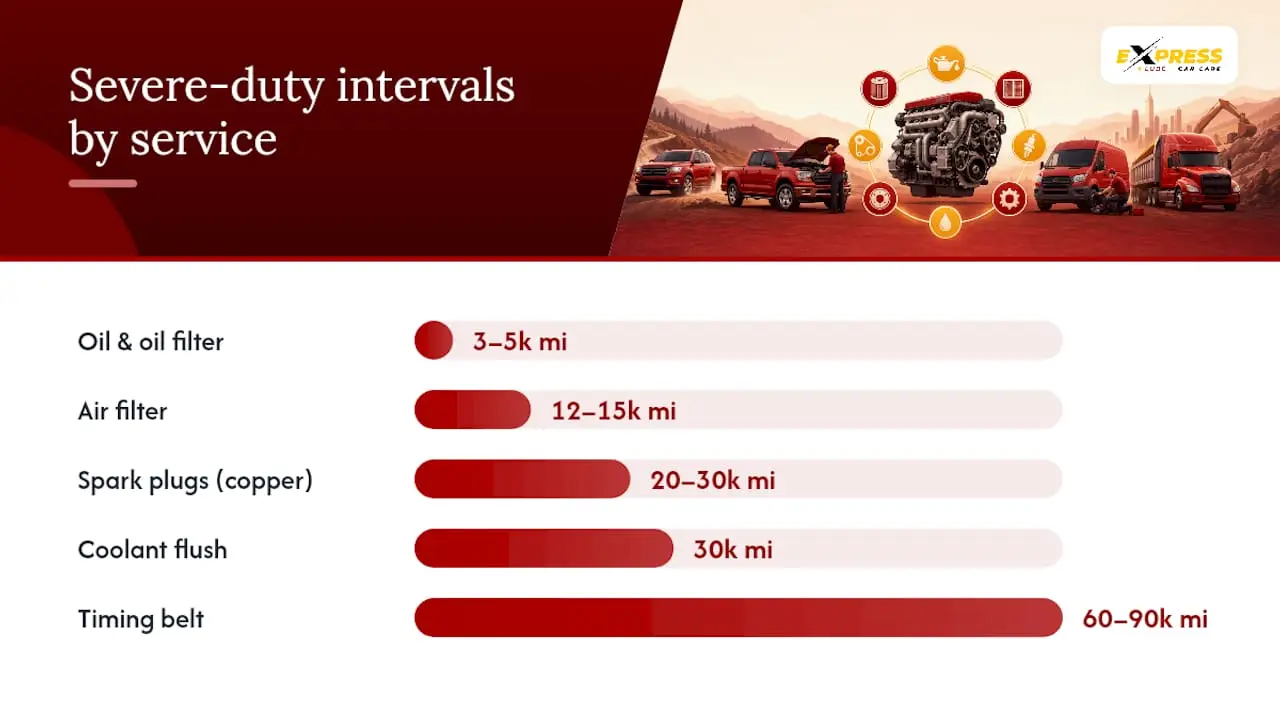
The table below reflects research-backed baselines adapted from manufacturer severe-duty schedules. Your owner’s manual is the authoritative source; treat these as a practical starting point.
| Service | Severe-Duty Interval | Standard Interval | Notes |
|---|---|---|---|
| Oil and oil filter | 3,000–5,000 mi / 3–6 mo | 7,500–10,000 mi | Shorten further for turbo engines or extreme heat |
| Air filter | 12,000–15,000 mi | 20,000–30,000 mi | More frequent in dusty or urban environments |
| Spark plugs (copper) | 20,000–30,000 mi | 30,000 mi | Iridium/platinum: 60,000– |
| Coolant flush | 30,000 mi / 2 yr | 50,000 mi / 5 yr | Check level monthly |
| Timing belt | 60,000–90,000 mi | 90,000– | Replace before failure; inspect earlier if noisy |
| PCV valve | 30,000– | 50,000 mi | Critical for sludge prevention on short-trip vehicles |
| Battery load test | Annually | Every 2–3 yr | More critical for short-trip drivers |
A realistic cadence table like this helps owners act before failure rather than after it. For vehicles used in mountain grades, extreme Texas heat, or regular towing, shorten the oil and coolant intervals by one step. If your vehicle spends extended periods parked between uses, add calendar-based triggers for fluids and rubber components because those degrade with age regardless of mileage.
Pro Tip: Some fleet operators track engine hours rather than miles for vehicles that idle frequently. If your vehicle idles more than 30 minutes per day on average, ask your technician whether an engine-hour-based oil interval makes more sense than a mileage trigger.
For a full car maintenance schedule by mileage that maps these intervals to specific odometer readings, the linked guide provides a printable format you can keep in the glove box.
What warning signs mean your engine needs attention now?
Catching a problem early is the difference between a $150 repair and a $3,000 one. Know which signals demand immediate action and which allow a few days to schedule service.
Act immediately if you see or hear:
- Check-engine light flashing (not steady): a flashing light indicates an active misfire that can damage the catalytic converter within minutes. Pull over safely and call for service.
- Coolant temperature gauge in the red or steam from the hood: shut the engine off. Driving an overheating engine even a short distance can warp the cylinder head.
- Oil pressure warning light: stop driving. Low oil pressure means inadequate lubrication and imminent bearing damage.
- Sudden loud knocking or rattling from the engine bay
Schedule service within a few days for:
- Steady check-engine light with no drivability issues
- Increased oil consumption (more than one quart per 1,000 miles)
- Rough idle, hesitation, or misfires at low speed
- White or blue smoke from the exhaust
- Battery warning light or difficulty starting after short trips
Simple checks you can do at home:
- Pull the dipstick and check oil level and color. Black, gritty oil means it is overdue for a change. Milky or foamy oil suggests coolant contamination.
- Check the coolant reservoir level against the MIN/MAX marks when the engine is cold.
- Use an inexpensive battery tester or ask a parts store to load-test the battery for free.
- Note any unusual smells, sounds, or changes in fuel economy and write them down before visiting a shop. Specific observations help technicians diagnose faster.
How long do common services take, and what do they cost?
Knowing what to expect prevents sticker shock and helps you plan around your schedule.
- Oil change: 20–45 minutes; $50–$120 depending on oil type (conventional vs. full synthetic) and vehicle. Turbocharged engines typically require full synthetic, pushing the cost toward the higher end.
- Coolant flush: 30–60 minutes; $100–$200 at most shops.
- Air filter replacement: 10–20 minutes; $20–$60 parts and labor. A straightforward DIY task on most vehicles.
- Spark plug replacement: 30 minutes to 2 hours depending on engine layout; $100–$400. V6 and V8 engines with rear-bank plugs take longer and cost more in labor.
- Timing belt service (belt, tensioner, water pump): 2–5 hours; $400–$1,000. Skipping this service risks a repair bill of $2,000–$5,000 or a totaled engine.
- Battery replacement: 15–30 minutes; $150–$350 including the battery.
- Engine diagnostics (scan and inspection): 30–60 minutes; $75–$150 for a professional diagnostic scan. Many shops apply the fee toward the repair if you proceed.
Pro Tip: Bundling services saves both time and money. Pairing an oil change with a battery check and air filter inspection at the same visit costs less in labor than three separate appointments.
The ROI math on preventive maintenance is straightforward. A timing belt replacement at 80,000 miles costs roughly $600. An engine replacement after a belt failure costs $3,000–$6,000 or more. Frequent drivers who follow severe-duty intervals spend more per year on maintenance but far less over the life of the vehicle.
How should you organize records and plan maintenance?
A simple recordkeeping system is what separates drivers who catch problems early from those who discover them at the roadside.
Structured preventive maintenance programs reduce unplanned breakdowns by roughly 35–50% and can extend vehicle life by about 30% when service intervals match the vehicle’s duty cycle. Fleet operators have known this for decades. The same logic applies to a single commuter vehicle.
Build your system in three steps:
- Create a service log. A simple spreadsheet or a free app like CarFax Car Care or Drivvo works well. Record the date, mileage, service performed, shop name, and cost for every visit.
- Set reminders. Use your phone’s calendar to set alerts at your next oil-change mileage and date. Set a second alert 500 miles early as a buffer.
- Keep physical receipts. A folder in the glove box with dated receipts documents the maintenance history for resale and warranty purposes.
When to use which trigger:
- Mileage-based triggers work best for vehicles driven consistently every day.
- Calendar-based triggers matter for fluids and rubber components that degrade with age, regardless of miles driven. Coolant, brake fluid, and belts all have time-based limits.
- Engine-hour triggers apply to vehicles that idle frequently, such as delivery vans or vehicles used in construction-adjacent work.
For a deeper look at preventive vehicle maintenance services and how structured programs reduce costs over time, the linked guide breaks down each service category with interval guidance.
What technicians know about frequent driving that most guides miss
The advice to “drive gently and change your oil” is correct but incomplete. Here is what experienced technicians add to that picture.
Once an engine reaches full operating temperature, periodic meaningful load and varied RPM actively help burn off carbon deposits that accumulate from short-trip driving. This is not a myth. Technician guidance confirms that a 30-minute continuous drive at light-to-moderate load at least once a week helps stabilize temperatures and evaporate accumulated moisture, clearing deposits that idling never addresses. The engine needs to reach and sustain operating temperature long enough for combustion to complete cleanly.

Idling, by contrast, runs the engine at low temperature and low load, which is the worst possible condition for deposit clearance. A 10-minute idle in the driveway does nothing that a 2-minute gentle drive would not do better.
The practical takeaway: treat your weekly 30-minute drive as a maintenance action, not a luxury. Schedule it the same way you schedule an oil change.
Our perspective on what frequent drivers actually need
Most maintenance advice assumes a driver who puts on 12,000–15,000 miles per year in a mix of highway and city driving. The reality for many drivers in Plano and Collin County looks nothing like that. Commuters, delivery drivers, and families running school and errand routes often make five to ten cold starts per day, rarely exceed 5 miles per trip, and wonder why their vehicles feel worn at 60,000 miles.
The answer is not that they drive too much. It is that the standard maintenance schedule was never designed for their pattern of use. Severe-duty intervals exist precisely for this situation, and following them consistently is the single highest-leverage action a frequent driver can take.
What gets overlooked is documentation. A vehicle with a clean, complete service history is worth more at resale, easier to diagnose when something goes wrong, and less likely to develop compounding failures. Digital inspection records with photos, the kind that ASE-certified technicians produce at a properly equipped shop, give drivers a clear picture of what was found, what was done, and what to watch next. That transparency is not a luxury. For a frequent driver, it is part of the maintenance program.
Frequent drivers get more from Express Lube & Car Care
Frequent driving demands more from your vehicle and more from your service provider. Express Lube & Car Care in Plano serves commuters, delivery drivers, and busy families who cannot afford downtime or a missed service interval. No appointment is needed, service is same-day, and every job is handled by ASE-certified technicians who understand severe-duty use.
Every visit includes a digital vehicle inspection with photos and technician notes, so you leave with a clear record of what was checked and what comes next. Oil changes, engine diagnostics, battery replacement, cooling system service, and fleet accounts are all available under one roof, backed by a 24-month/24,000-mile warranty. Military personnel and healthcare providers receive special discounts.
Check the current oil change and service specials and book your next severe-duty service today. If warning signs have already appeared, the engine diagnostics team in Plano can identify the issue the same day.
Sources
- Does a Long Drive Actually Help the Engine? – EagleTuning
- Truck fleet preventive maintenance schedule template by vehicle type (2026)
- Ultimate car maintenance checklist – Bridgestone
- Why short trips are harder on your car than long road trips – DG Motors
- Extend car engine life: habits and maintenance plan – CarCareRoutine
FAQ
How can I make my engine last 300,000 miles?
Consistent severe-duty oil changes, timely timing belt replacement, and a weekly 30-minute sustained drive to clear deposits are the core habits. Vehicles that reach 300,000 miles almost always have complete, documented maintenance histories with no skipped intervals.
What is the 30-60-90 rule for cars?
It refers to common service milestones: around 30,000 miles for air filter and fuel filter replacement, 60,000 miles for spark plugs and timing belt inspection, and 90,000 miles for timing belt replacement and major fluid services. Severe-duty drivers should apply these milestones earlier.
Is 20,000 miles a year on a car a lot?
Twenty thousand miles per year is above the national average of roughly 13,500 miles, but the pattern matters more than the total. Twenty thousand miles of highway driving is easier on an engine than 10,000 miles of daily short trips, because highway miles involve fewer cold starts and longer warm-up periods.
When should I see a professional instead of handling maintenance myself?
DIY tasks include checking fluid levels, replacing air filters, and reading basic OBD-II codes. Bring the vehicle to an ASE-certified technician for anything involving the cooling system, timing components, engine diagnostics, or any warning light that returns after a reset. Express Lube & Car Care offers same-day diagnostics with no appointment required.