

The best oil change interval for a commuter vehicle falls between 5,000 and 10,000 miles, depending on your driving conditions and the type of oil your engine uses. Industry terminology calls this the “service interval,” and it varies far more for commuters than most drivers realize. Short trips and stop-and-go traffic qualify as severe service conditions, which cut that interval nearly in half compared to highway driving. Your owner’s manual defines two categories: normal service and severe service. Most daily commuters fall into the severe category without knowing it. This guide explains how to identify your service category, read your oil life monitor, and build a maintenance schedule that protects your engine and your budget.
How does commuting affect oil change intervals?
Daily commuting is harder on engine oil than most drivers expect. Frequent short trips and stop-and-go traffic qualify as severe service, which means your oil degrades faster than the standard mileage recommendation accounts for.
The core problem is engine temperature. Short, frequent trips prevent engines from reaching full operating temperature. When the engine stays cold, moisture and unburnt fuel accumulate in the oil. Over time, that contamination leads to sludge buildup inside the engine, which restricts oil flow and accelerates wear on bearings, camshafts, and other critical components.

Stop-and-go traffic adds a second layer of stress. Idling and repeated acceleration cycles put continuous load on the oil without the sustained heat needed to burn off contaminants. The result is oil that looks clean on the dipstick but has already lost much of its protective capacity.
Severe service conditions relevant to commuters include:
- Trips shorter than 5 miles in normal temperatures
- Trips shorter than 10 miles in freezing temperatures
- Sustained stop-and-go city driving
- Extreme heat or cold during regular commutes
- Towing or carrying heavy loads regularly
For drivers in any of these categories, the recommended severe service interval is approximately 5,000 miles or every 6 months, whichever comes first. That 6-month time limit matters because oil oxidizes and breaks down even when the car sits idle.
Pro Tip: Check your owner’s manual for the severe service definition. If two or more conditions on that list match your daily drive, treat every oil change as a severe service interval.
What role do oil type and manufacturer specs play?
Oil type is the single biggest variable in determining how long your oil lasts between changes. The industry recognizes three main categories: conventional, synthetic blend, and full synthetic. Each carries a different service interval for commuter vehicles.
| Oil Type | Normal Service Interval | Severe Service Interval |
|---|---|---|
| Conventional | 3,000–5,000 miles | 3,000 miles or 3 months |
| Synthetic blend | 5,000–7,500 miles | 4,000–5,000 miles |
| Full synthetic | 7,500–10,000 miles | 5,000 miles or 6 months |
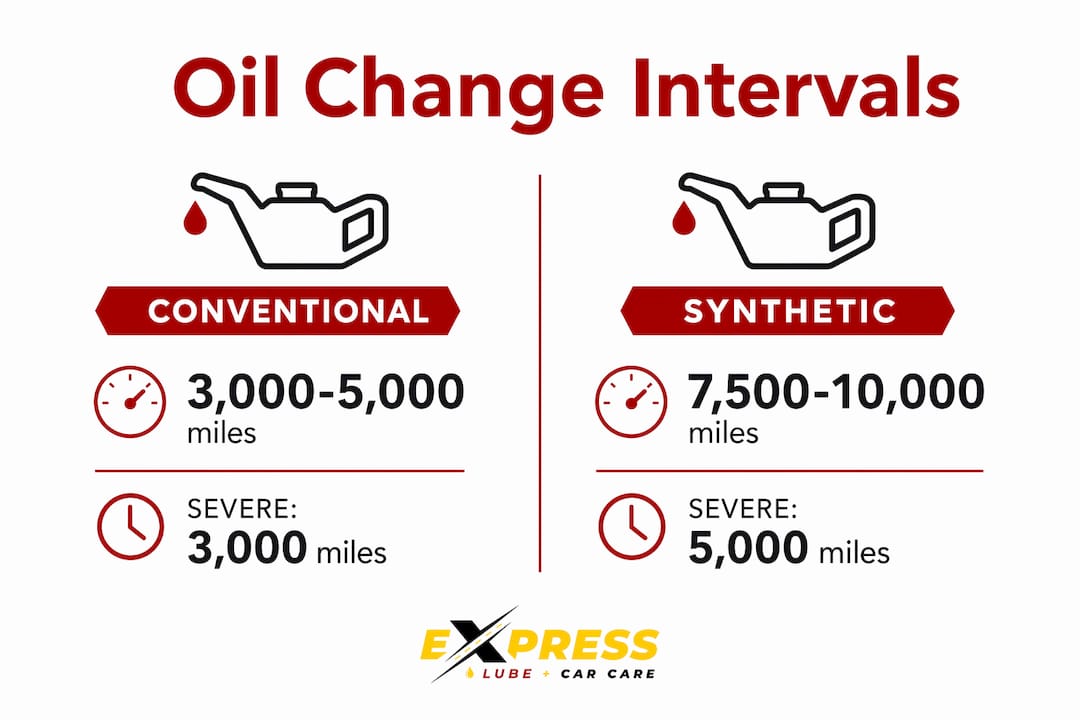
Full synthetic oil resists thermal breakdown and oxidation far better than conventional oil. That resistance is why modern vehicles using full synthetic can go 7,500 to 10,000 miles under normal conditions. Severe service cuts that range back to 5,000 miles, but the oil still outperforms conventional options at the same interval.
The owner’s manual is the authoritative source for your specific vehicle. Manufacturers engineer their engines around a specific oil viscosity and change interval. Deviating from those specs, especially by stretching intervals beyond what the manual allows, can void powertrain warranties and cause long-term engine damage.
Key points to verify at every oil change:
- Confirm the oil viscosity grade matches the manual (e.g., 5W-30, 0W-20)
- Check whether the oil carries the API service rating your engine requires
- Note whether the manual specifies full synthetic or allows synthetic blend
The outdated 3,000-mile rule causes unnecessary expense and environmental waste. Consumer Reports notes that following modern intervals can save drivers roughly $600 over 30,000 miles compared to unnecessary 3,000-mile changes.
Pro Tip: Ask your technician to show you the oil viscosity label on the container before the change. Verifying the grade takes 10 seconds and confirms your engine gets exactly what the manufacturer specified.
How to use your oil life monitor to time oil changes
Most vehicles built after 2010 include an Oil Life Monitoring system, or OLM. This system calculates oil degradation in real time using engine load, operating temperature, RPM patterns, and trip length. It does not measure oil quality directly. Instead, it runs a predictive algorithm calibrated to your engine’s design.
The OLM is more accurate than mileage alone because it accounts for actual driving behavior. A driver who logs 500 miles per week on the highway will see slower oil life depletion than a driver who logs the same 500 miles in city stop-and-go traffic. The OLM signals around 15–20% remaining oil life as the recommended service window. Waiting until the display reads 0% risks running degraded oil through your engine.
Use this approach to monitor and act on your oil change timing:
- Reset the OLM after every oil change. A technician should do this automatically, but confirm it before you leave the service bay.
- Check the OLM display weekly. Most vehicles show it on the instrument cluster or through the infotainment menu.
- Schedule service when the OLM reaches 20%. That buffer gives you time to book an appointment without rushing.
- Check the physical oil level monthly. The OLM tracks quality, not quantity. Low-mileage vehicles should have oil levels checked monthly because consumption can cause engine wear independent of the change interval.
- Apply the time rule regardless of mileage. Oil should be changed at least once every 12 months, and every 6 months for commuters with frequent short trips. If your OLM still reads 40% at the 6-month mark, change the oil anyway.
Reading the dipstick takes 2 minutes and tells you two things: oil level and oil condition. Healthy oil is amber to light brown. Black, gritty, or milky oil signals contamination and requires immediate service regardless of what the OLM shows.
Pro Tip: Pull the dipstick on a cold engine for the most accurate level reading. A hot engine pushes oil into the upper components, which can make the level appear lower than it actually is.
What is the best oil change schedule for commuter vehicles?
The right oil change schedule for a commuter vehicle balances mileage, time, and driving severity. No single number fits every driver. The schedule below reflects the most practical approach for the most common commuter profiles.
Commuters who drive primarily in city traffic, take trips under 10 miles, or live in climates with extreme heat or cold should follow the severe service schedule: every 5,000 miles or every 6 months, whichever comes first. This applies to the majority of urban and suburban commuters.
Commuters who drive mostly highway miles with minimal idling and moderate temperatures can follow the normal service schedule: every 7,500 to 10,000 miles for full synthetic, or every 5,000 miles for synthetic blend. The oil change schedule for a commuter car should also account for vehicle age and engine type.
Additional factors that shorten the recommended interval:
- Turbocharged engines. Turbocharged engines run hotter and degrade oil faster, often requiring changes no longer than every 5,000 miles regardless of oil type.
- High-mileage vehicles. Engines with over 75,000 miles may consume oil faster and benefit from high-mileage formula oil with seal conditioners.
- Vehicles driven fewer than 5,000 miles per year. These drivers rarely trigger a mileage-based change but still need annual service. Oil oxidizes over time even without use.
Combining your oil change with other routine maintenance, such as tire rotation, cabin air filter replacement, or a multi-point inspection, saves time and reduces the total number of service visits per year. For commuters who value efficiency, this bundled approach is the most practical way to stay on top of vehicle health without disrupting a busy schedule. The role of regular oil changes in long-term engine health compounds over years, not just individual service intervals.
What we’ve learned from commuters at Express Lube & Car Care
The most common mistake we see from commuters is assuming their driving qualifies as “normal.” A driver who covers 12,000 miles a year sounds like a moderate driver. But if those miles are split between a 6-mile morning commute and a 6-mile return trip, five days a week, that engine almost never reaches full operating temperature. The oil never fully burns off the moisture it collects on cold starts. That pattern is textbook severe service, and treating it as normal service shortens engine life measurably.
We also see the opposite mistake: drivers who change oil every 3,000 miles out of habit, regardless of what their OLM or owner’s manual says. That practice wastes money and generates unnecessary used oil disposal. The 3,000-mile rule made sense for older engines running conventional oil in the 1970s. Modern engines and full synthetic oils have made that interval obsolete for most vehicles.
The most reliable approach is to trust the OLM, cross-reference it with the owner’s manual, and apply the 6-month time rule for any commuter who takes frequent short trips. Individualized maintenance beats rigid schedules every time. A driver in Plano, Texas commuting in summer heat faces different oil stress than a driver in a mild coastal climate covering the same miles. Recognizing that difference and adjusting accordingly is what separates proactive maintenance from reactive repair.
— Express Lube & Car Care
Oil change services for commuters at Express Lube & Car Care
Commuters need fast, reliable service that fits into a busy schedule without requiring an appointment days in advance.
Express Lube & Car Care serves commuters in Plano with no-appointment-needed oil changes performed by certified technicians. Whether your vehicle runs conventional, synthetic blend, or full synthetic oil, the team verifies the correct viscosity grade, resets your OLM, and checks fluid levels as part of every service. Check the current oil change specials for pricing on full synthetic and conventional options, including discounts for military and healthcare workers. Fast service does not mean cutting corners. Every oil change at Express Lube & Car Care follows manufacturer specifications so your warranty stays intact and your engine stays protected.
Key takeaways
The correct oil change interval for a commuter vehicle depends on driving severity, oil type, and time elapsed, not mileage alone.
| Point | Details |
|---|---|
| Severe service applies to most commuters | Stop-and-go traffic and short trips qualify as severe service, requiring changes every 5,000 miles or 6 months. |
| Oil type sets the baseline interval | Full synthetic lasts 7,500–10,000 miles under normal conditions; severe service cuts that to 5,000 miles. |
| OLM is the most accurate timing tool | Change oil when the Oil Life Monitor reaches 15–20% remaining, and always apply the 6-month time rule. |
| Turbocharged engines need shorter intervals | Turbo engines degrade oil faster and should not exceed 5,000-mile intervals regardless of oil type. |
| Monthly oil level checks prevent hidden damage | Low-mileage and commuter vehicles can lose oil between changes, causing wear the OLM does not detect. |
FAQ
What is the recommended oil change interval for a commuter vehicle?
Most commuters should change oil every 5,000 miles or every 6 months, whichever comes first, because stop-and-go driving and short trips qualify as severe service. Full synthetic oil extends that to 7,500–10,000 miles under true normal service conditions.
Does stop-and-go traffic really shorten oil life?
Yes. Repeated cold starts and idling prevent the engine from reaching full operating temperature, which allows moisture and unburnt fuel to contaminate the oil and accelerate sludge formation.
How do I know if my driving counts as severe service?
Check your owner’s manual for the severe service definition. If your daily commute involves trips under 10 miles, frequent idling, extreme temperatures, or heavy traffic, your driving qualifies as severe service.
Should I change oil by mileage or by time?
Both. Follow the mileage interval for your oil type and driving severity, but never go longer than 12 months without a change. Commuters with frequent short trips should use a 6-month maximum regardless of mileage.
Do turbocharged commuter vehicles need more frequent oil changes?
Yes. Turbocharged engines run at higher temperatures and put greater thermal stress on oil, so the maximum recommended interval is 5,000 miles, even with full synthetic oil.