

A fleet vehicle inspection is a structured check of a vehicle’s condition, done by the driver before and after a trip and by a technician on a set schedule, to find defects before they cause a breakdown or a crash. The driver’s walkaround catches what is visible. The technician’s inspection catches what wears out of sight. A fleet needs both, plus a written record of each.
Below you will find a driver checklist, what a good inspection form records, the federal and Texas rules that matter, and how to decide what to do when an inspection turns up a problem.
TL;DR
- Run two layers: a daily driver walkaround and a scheduled technician inspection tied to each vehicle’s manufacturer maintenance plan.
- A usable form records the date, driver, vehicle, each defect, remarks and a signature, and shows who repaired what and when.
- Federal rules (49 CFR Part 396) apply to motor carriers within their scope. Texas still requires safety inspections for commercial vehicles, but not for ordinary non-commercial ones.
- A defect likely to affect safe operation means the vehicle stays parked until it is repaired.
- Fleets in Plano and Collin County can bring vehicles to us without an appointment for inspection and repair.
Table of Contents
- Why fleets inspect vehicles at all
- Inspection versus preventive maintenance
- The daily driver inspection checklist
- What a fleet vehicle inspection form should record
- Which rules apply
- What to do when an inspection finds a defect
- Our perspective on fleet inspections
- Building a simple inspection program
- Fleet inspections and repairs in Plano
- FAQ
- Sources
Why fleets inspect vehicles at all
The most important reason is safety, for your driver and for everyone else on the road. The Georgia Department of Driver Services puts it plainly: finding a defect early can prevent a breakdown, an expense or a crash, and an unsafe vehicle may be placed out of service.
The business case follows from the same logic. A worn belt found on a Monday walkaround is a short shop visit. The same belt found on the shoulder of a highway is a tow, a missed delivery and a driver standing around. Inspections do not remove repairs from your budget. They move repairs from the emergency column to the planned one.
Inspection versus preventive maintenance
The two are related but not the same job.
| Inspection | Preventive maintenance | |
|---|---|---|
| Purpose | Find defects and unsafe conditions | Replace and service parts before they fail |
| Who | Driver (daily), technician (scheduled) | Technician |
| Timing | Before and after trips, plus periodic | Set by the vehicle’s schedule |
| Examples | Walkaround, lights, tire condition, leak check | Oil and filter changes, fluid exchanges, belts and hoses |
The FTA’s 5310 handbook for vehicle programs describes routine pre- and post-trip inspections as required, while preventive maintenance follows a schedule based on manufacturer recommendations, with both recorded. Intervals vary by vehicle, duty cycle and how it is driven, so your owner’s manual is the starting point. For the maintenance side, see our guide to setting up a fleet oil change schedule and our overview of preventive maintenance services.
The daily driver inspection checklist
Keep it short enough that drivers actually do it, and identical every day. A consistent order is what makes a driver notice that something is different.
Before the trip
A U.S. pre-trip checklist from the FTA handbook covers the date, driver, vehicle walkaround, leaks, tires, mirrors, windows, lights and signals, fuel, and the starting odometer reading. In practice, that becomes:
- Walk around the vehicle. Look for body damage, anything hanging low, and fresh fluid on the ground beneath it.
- Check the tires. Look for low pressure, uneven wear, cuts, bulges and missing valve caps.
- Check lights and signals. Headlights, brake lights, turn signals and hazards. A second person or a reflective surface makes brake lights easy to check.
- Check mirrors and glass. Cracks, loose mounts and a dirty windshield all reduce what the driver can see.
- Check fuel and the odometer. Record the starting reading.
- Look inside. Seat belts, horn, wipers, defroster or heater, steering feel and every gauge and warning light at startup.
When the cab is running, gauges should sit in their normal operating ranges, and a warning light that stays on is a report, not a nuisance.
Under the hood
This is the part drivers skip when they are rushed, so it is worth a fixed routine. A professional pre-trip guide from the Arizona Transit Association lists oil on the dipstick, coolant at the reservoir, washer and brake fluids, transmission fluid where applicable, the battery, power-steering fluid, belts and hoses.
A few notes from the shop floor:
- Fluid level changes between checks are the signal. One reading tells you little. A level that drops week after week tells you there is a leak or consumption problem for a technician to trace.
- Belts and hoses: look for cracks, glazing, fraying, bulging or softness. A hose that looks fine but feels spongy deserves a second look.
- Battery: check for corrosion at the terminals and a case that is swollen or leaking. Modern engines depend on stable battery voltage for their electronics, which is why the battery’s role in engine management matters even when the vehicle still cranks.
After the trip
The post-trip check is where defects get written down while they are fresh. Georgia’s guide says the after-trip inspection takes place at the end of the trip or day and may include a vehicle-condition report listing problems so the carrier knows when repairs are needed. Drivers should note the ending odometer, daily miles and anything that felt, sounded or smelled wrong. Georgia’s guidance also points to sight, sound, smell and feel as the four ways a driver detects trouble.
What a fleet vehicle inspection form should record
A form is only useful if a mechanic can act on it and a manager can prove it was acted on. The FMCSA’s sample Driver’s Vehicle Inspection Report (DVIR) records the date, vehicle and trailer identifiers, defective items and remarks, then adds a driver signature and a repair certification with the mechanic’s signature and date.
Whether or not your vehicles are regulated, that is a good template. Build your form around these fields:
- Date, driver name and vehicle ID (unit number, plate or VIN)
- Starting and ending odometer, daily miles
- A checklist by system: brakes, steering, lights, tires, horn, wipers, mirrors, wheels, emergency equipment, and any trailer or coupling components
- A defects section with a plain description of each problem, not just a tick
- Driver signature
- A repair section: what was done, who did it, the date, and who acknowledged it
The FMCSA’s sample form lists service and parking brakes, steering, lights, tires, horn, wipers, mirrors, coupling devices, wheels and rims, and emergency equipment, which gives you a ready-made list of the high-consequence items.
Paper or digital
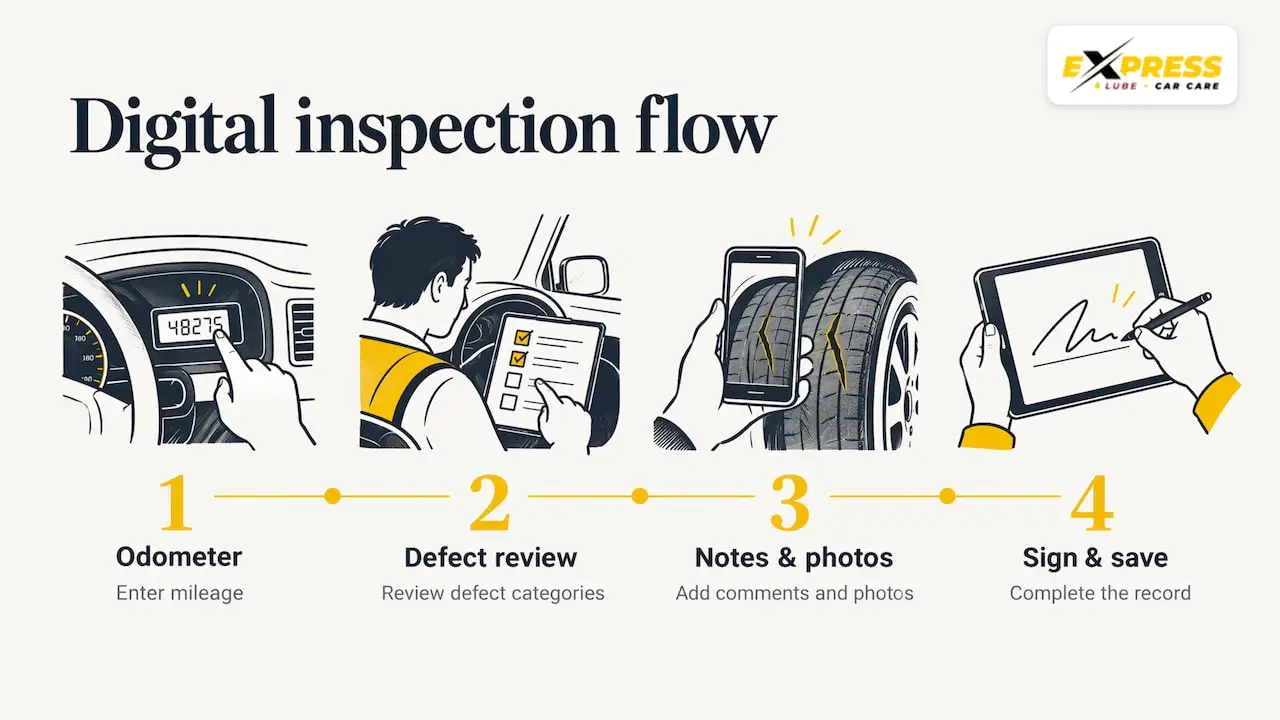
Either works if the record is complete and retrievable. The FMCSA’s electronic DVIR walkthrough shows a sensible digital flow: enter the odometer, review the defect categories, add comments and photographs, then sign and save. Photos are the real advantage. A picture of a cracked sidewall tells a technician more than the words “tire looks bad.” We use the same principle in our own digital vehicle inspections, where the customer receives photos and technician notes.
Which rules apply
Rules depend on what you operate. Here is the picture for a Texas fleet.
Federal rules for motor carriers
For motor carriers within their scope, 49 CFR Part 396 sets the framework. According to the eCFR text of Part 396:
- Section 396.3 requires systematic inspection, repair and maintenance, with records.
- Section 396.11 sets the driver’s vehicle inspection report requirements and three-month retention.
- Section 396.13 requires the driver to review the last report and acknowledge it.
- Section 396.17 requires an inspection at least every 12 months.
- Section 396.21 requires periodic inspection records to be kept for 14 months.
The same regulation says no written report is required when no defect or deficiency is found or reported. Also, the driver must be satisfied the vehicle is safe before driving and may use electronic reports. Whether Part 396 covers a particular vehicle depends on its weight, use and whether it crosses state lines, so confirm with the FMCSA or a compliance professional if you are unsure.
Texas inspection rules
Texas changed its program recently. Under House Bill 3297, non-commercial vehicles no longer need a safety inspection before registration as of January 1, 2025. The Texas Department of Public Safety also states that emissions tests are separate and still required for vehicles registered in emissions counties, and that all commercial vehicles in all counties still need a passing safety inspection.
So, in plain terms:
- Commercial vehicles: an annual state safety inspection is still required.
- Ordinary passenger vehicles: no annual safety inspection, though emissions testing may apply depending on the county of registration. Check the DPS page for your county.
- Any fleet: your own inspection routine is what keeps vehicles safe between state requirements. The law sets a floor, not a maintenance plan.
We offer Texas emissions and commercial inspections as one of our services, along with the repairs that often follow them.
What to do when an inspection finds a defect
Set the rule before you need it: a defect likely to affect safe operation takes the vehicle out of service until it is fixed. For motor carriers, §396.11 requires that a reported defect likely to affect safe operation be repaired, or certified as unnecessary to repair, before the vehicle is operated again, with the certification on the DVIR.
The Texas Department of Transportation’s maintenance guide suggests a useful way to triage. It recommends sorting defects into safety, mechanical, elective mechanical and cosmetic categories, and states that a vehicle with a safety defect cannot be released until repaired. That guide dates from 2003, so treat it as a sorting model rather than current regulation.
A practical version for a small fleet:
| Category | Examples | Action |
|---|---|---|
| Safety | Weak or pulling brakes, steering play, bald or damaged tires, inoperative lights | Park the vehicle, repair before use |
| Mechanical | Leak that is slow, check engine light, rough idle | Schedule diagnosis soon, monitor |
| Elective mechanical | Worn but functional parts, comfort items | Plan into the next service window |
| Cosmetic | Dents, paint, trim | Fix when convenient |
If you have any doubt about whether something is a safety item, treat it as one and have a technician look at it.
Our perspective on fleet inspections
We see the same pattern with fleet customers. The vehicles that give trouble are rarely the ones with a dramatic fault. They are the ones where a small warning was noticed on Tuesday, mentioned to no one, and became a roadside call on Friday.
That is why we think of inspection and repair as one workflow, not two. A driver’s report is only as good as the speed at which someone can act on it. Our shop takes vehicles without an appointment, and most services are completed the same day, so a flagged vehicle does not have to sit for a week waiting for a slot.
Our technicians are ASE-certified, and our digital vehicle inspections put photos and technician notes in your hands, so a fleet manager can see what we saw and decide on priorities. That record also feeds your own files. Repairs that qualify are backed by our 24-month/24,000-mile limited warranty, whichever comes first. Eligibility, limitations and exclusions apply.
Intervals and needs differ by vehicle, so we start from the manufacturer’s recommendations and what the inspection actually shows, not from a one-size-fits-all package.
Express Lube & Car Care
Building a simple inspection program
You do not need software to start. You need a routine people follow.
- Make a list of every vehicle with unit number, plate, VIN and the manufacturer’s maintenance schedule.
- Adopt one daily form. Use the field list above and keep it to one page.
- Define who can ground a vehicle. Drivers should not need permission to report a safety defect.
- Set the scheduled inspection. Tie it to oil changes or other service visits so it actually happens. Our routine maintenance checklist shows which services commonly belong together.
- Keep records. Retain forms and repair records at least as long as any rule that applies to you requires, and file repair confirmations next to the original defect report.
- Review monthly. Repeated defects on the same vehicle or the same item across vehicles point to a root cause, such as a tire pressure habit or an aging battery group.
For a wider view of what a technician checks, our vehicle safety inspection checklist is a good companion. And if downtime is your biggest cost, read why fleet oil changes reduce downtime and costs.
Fleet inspections and repairs in Plano
We handle fleet maintenance and repair for vehicles in Plano and around Collin County: oil changes and preventive maintenance, brakes, tires, batteries, A/C, suspension, diagnostics, engine and transmission work, and Texas emissions and commercial inspections. No appointment is needed, and you can see how we work with business accounts on our fleet management page.
If a driver has flagged something, bring the vehicle in with the report. We will inspect it, send photos and notes, and tell you what is a safety item and what can wait. Browse everything we do on our services page, or start with brake repair and service when the defect involves stopping power. Suspension repairs that qualify may also carry our Lifetime Suspension Warranty. Eligibility, limitations and exclusions apply to all of our warranties.
FAQ
How often should a fleet vehicle be inspected?
Drivers should inspect before and after each trip or shift. Technicians should inspect on a schedule based on the manufacturer’s recommendations and how hard the vehicle works. Federal rules for motor carriers within their scope require a full inspection at least every 12 months under 49 CFR §396.17.
Does a Texas passenger vehicle need a safety inspection?
No. Since January 1, 2025, ordinary non-commercial vehicles do not need a state safety inspection, though emissions testing may still apply by county. Commercial vehicles still need one, according to the Texas DPS.
What should a fleet inspection form include?
At minimum: date, driver, vehicle ID, odometer, a checklist of safety systems, a description of each defect, the driver’s signature and a repair record showing who fixed it and when. The FMCSA’s sample DVIR is a good model to adapt.
What do I do if my driver finds a brake or steering problem?
Keep the vehicle out of service and have a qualified technician inspect it before it goes back on the road. Brake and steering defects are safety items, and they should be written on the report and signed off once repaired.
Is an inspection the same as maintenance?
No. An inspection finds problems and documents condition. Maintenance replaces and services parts on a schedule. Fleets need both, and the inspection often tells you when to move a maintenance item up.
Sources
- Section 2: Driving Safety, Georgia Department of Driver Services
- Vehicle Management Handbook, FTA 5310
- Pre-Trip Inspection guide, Arizona Transit Association
- Class 4 trip inspection, SGI
- Driver’s Vehicle Inspection Report, FMCSA
- ELD instruction manual for drivers, FMCSA
- 49 CFR Part 396, eCFR
- 49 CFR §396.13 Driver inspection
- Vehicle Safety Inspection Program Changes, Texas DPS
- Maintenance Management and Safety Guide, TxDOT
- The Role of Battery in Engine Management Systems