

Changing your own engine oil is one of the most fundamental and rewarding maintenance tasks you can perform on your vehicle. The procedure itself is straightforward: you safely elevate the vehicle, drain the old, contaminated oil, replace the oil filter, and refill the engine with fresh, clean oil to the correct level.
Mastering these four key stages will empower you to handle this essential service for the life of your vehicle.
Why Is Changing Your Own Oil an Important Skill?
Learning how to change engine oil at home is a valuable skill that goes beyond just saving money on service fees. It provides a direct, hands-on understanding of your vehicle's inner workings. Taking personal responsibility for this critical maintenance task builds confidence and gives you direct control over your engine's health and longevity.
This guide is designed to demystify the process and provide a clear, educational roadmap. We will cover every step, from material selection to final safety checks, enabling you to approach the task with knowledge and assurance.
You're Part of a Growing Trend in Vehicle Maintenance
If you're considering performing your own oil changes, you are part of a significant movement. The do-it-yourself (DIY) auto maintenance sector has been expanding at a rate of nearly 6% annually since 2020. This is not merely a niche hobby but a substantial shift in how car owners approach vehicle care.
A recent survey revealed that 29% of car owners transitioned from professional services to DIY oil changes primarily for economic reasons. By performing this task yourself, you not only reduce labor costs but also gain complete control over the quality of the components used, from the specific formulation of synthetic oil to the efficiency of the oil filter. You can explore these consumer auto maintenance trends to understand the broader context of this shift.
The primary benefit of a DIY oil change is not merely the monetary savings. It is the practical knowledge you acquire about your vehicle and the confidence you build in your own mechanical abilities—assets that provide value for years to come.
What This Guide Covers
This guide will systematically walk you through each critical step to ensure your oil change is performed safely, cleanly, and correctly. Here is an overview of the topics we will address:
- Preparation and Material Selection: We will begin with a comprehensive checklist of all necessary tools and supplies, ensuring you are fully prepared before starting.
- The Core Procedure: You will receive clear, step-by-step instructions for draining the used oil, replacing the filter correctly, and refilling the engine to the precise manufacturer-specified level.
- Finalizing the Task: We will cover the crucial concluding steps, including the proper, environmentally responsible disposal of used oil and how to avoid the common errors that can lead to problems.
By following this guide, you will be equipped to perform this vital maintenance task correctly, ensuring your engine operates smoothly and efficiently for thousands of miles.
Gathering Your Gear and Choosing the Right Oil
Before any work begins, proper preparation is essential for a successful oil change. This initial phase, much like a chef's mise en place, involves organizing all your tools and materials. A well-prepared workspace makes the entire process more efficient, safer, and far less prone to error.
Thorough preparation is the difference between a seamless 30-minute task and a prolonged, frustrating ordeal. It's not enough to have a wrench; you must have the correct one. For instance, using a six-point socket that fits the drain plug perfectly significantly reduces the risk of stripping the bolt head—a costly and time-consuming mistake.
Assembling Your Essential Toolkit
Performing this task correctly requires a specific set of tools. While many are standard garage equipment, some are specialized for this job. Here is what you will need:
- Wrench Set: A socket wrench with the correct size socket (metric or standard) for your vehicle's oil drain plug is essential. Your owner's manual or a quick online search for your specific model will provide the exact size.
- Oil Filter Wrench: These are available in several designs, such as a cap-style or claw-type wrench. Oil filters are often tightened securely and become slippery with oil, making them very difficult to remove by hand.
- Oil Drain Pan: Select a pan with a capacity of at least 6 quarts; a larger capacity is preferable. A low-profile design with a built-in spout facilitates easier placement under the vehicle and cleaner pouring of the used oil.
- Funnel: A clean, long-necked funnel is indispensable for adding the new oil to the engine without spillage.
- Jack and Jack Stands: This is a critical safety requirement. Never work under a vehicle supported only by a jack. A pair of robust jack stands is necessary to safely bear the vehicle's weight. Prioritizing your safety is paramount.
- Gloves and Safety Glasses: Used motor oil contains harmful contaminants. Nitrile gloves provide excellent protection for your skin. Safety glasses will protect your eyes from any accidental drips or splashes.
Decoding Your Engine's Needs: The Right Oil and Filter
Selecting the correct oil is the most critical decision in this process. Using an incorrect type of oil is akin to providing the wrong blood type—it will not properly protect your engine's internal components. The most reliable source for this information is your vehicle’s owner’s manual.
You need to identify two key specifications:
- Oil Viscosity: This is represented by a code such as 5W-30 or 0W-20. The number preceding the "W" (for winter) indicates the oil's flow characteristics at cold temperatures, while the second number indicates its viscosity (thickness) when the engine is at operating temperature.
- Oil Type: The manual will specify whether your engine requires conventional, synthetic blend, or full synthetic oil. Most modern engines, particularly those with turbochargers, require full synthetic oil for its superior performance and protective qualities under high heat and pressure.
Adhering to the manufacturer's oil specification is not merely a suggestion; it is a requirement for maintaining engine health and preserving your vehicle's warranty. The wrong oil can lead to increased friction, reduced fuel efficiency, and accelerated engine wear.
The subject of engine oil can be complex. To learn more, you can consult our detailed guide on the differences between synthetic vs. conventional oil, which explains the science behind manufacturer recommendations.
Once you have identified the correct oil, selecting the filter is straightforward. Provide your vehicle's make, model, year, and engine size to an auto parts professional, and they will provide the correct part. Investing in a high-quality filter is advisable, as it is the component responsible for trapping harmful contaminants.
Executing the Perfect Oil Change Step by Step
With your tools and materials assembled, you are ready to begin the procedure. Your careful preparation will now ensure a smooth, efficient, and clean process.
Think of this process like a scientific experiment—each step must be followed in the correct sequence for a successful outcome. Adhering closely to these instructions will allow you to perform an oil change with professional-level competence.
Preparing Your Vehicle for Surgery
Properly setting up your vehicle and workspace is a non-negotiable first step that prevents significant problems later on.
First, warm the engine slightly. Operating it for just two to three minutes is sufficient. The objective is not to make the engine hot, but to warm the oil, reducing its viscosity. This allows it to flow more freely and drain more completely, carrying more contaminants with it. Cold, thick oil drains slowly and leaves behind a significant amount of old sludge.
Next, park the vehicle on a perfectly level surface. An incline will prevent the oil pan from draining completely. The most critical safety step follows: raising the vehicle. Use a jack at the manufacturer's specified lift points, and then immediately secure the vehicle with jack stands. Never place any part of your body under a vehicle supported solely by a jack.
Locating Your Targets
With the car securely supported, it's time to identify the necessary components underneath the engine. Using a flashlight, locate the oil drain plug and the oil filter. The drain plug is a single bolt located at the lowest point of the engine's oil pan.
The oil filter is a cylindrical canister—typically black, blue, or white—that is threaded into the engine block. Its location can vary significantly between models. If it is not immediately visible, a quick online search for your vehicle's specific make and model will provide its location.
Pro Tip: Before proceeding, perform a "dry run." Position your drain pan under the plug and visualize the oil's trajectory. The stream will almost always exit at an angle, not straight down, especially initially. Misjudging this can result in a significant oil spill.
The Draining Process
With the drain pan correctly positioned, it is time to remove the old oil. Place your socket wrench on the drain plug and turn it counter-clockwise. Once it breaks loose, you can typically unscrew it the rest of the way by hand.
As you reach the final threads, maintain slight upward pressure on the plug to prevent oil from seeping out prematurely. Once it is free, pull it away quickly and allow the oil to drain into the pan. This process can take between five and twenty minutes to complete.
While the oil drains, you can address the filter. Reposition the drain pan beneath the filter, as it will also drip oil. Use your oil filter wrench to loosen it (also counter-clockwise). Once loose, finish unscrewing it by hand. It will be full of oil, so handle it carefully. Lower it and empty the remaining oil into the drain pan.
This flowchart walks you through how to choose the right supplies, from checking the manual to picking the correct viscosity and filter.
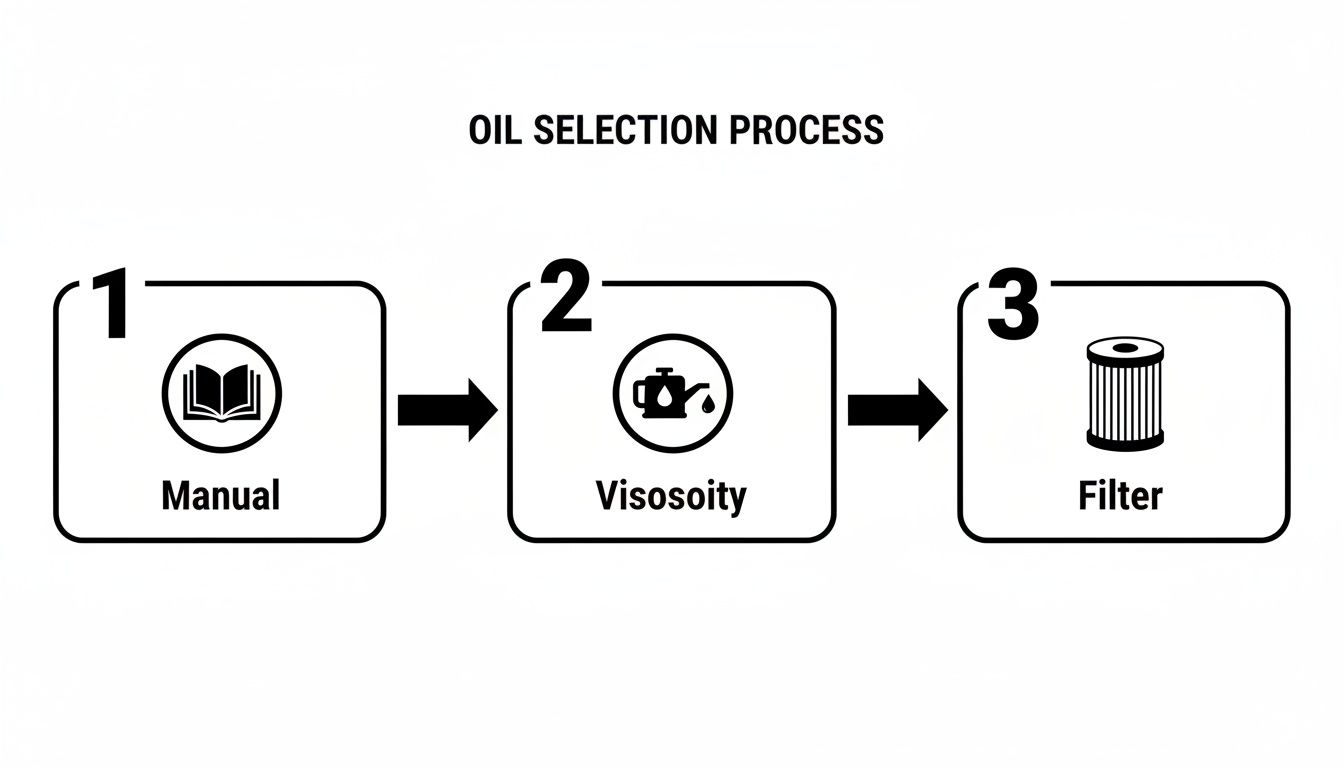
As you can see, a great oil change starts with making the right choices before you even open your toolbox.
Installing the New Filter and Plug
With the old oil and filter removed, it is time to install the new components. Correct technique here is essential for preventing leaks.
- Prep the New Filter: Dip a clean fingertip into your new engine oil and apply a thin film to the rubber gasket on the new filter. This critical step lubricates the gasket, allowing it to form a perfect, leak-free seal without twisting or tearing.
- Hand-Tighten First: Carefully thread the new filter onto its mounting point. Always tighten the oil filter by hand. Turn it until the gasket makes contact with the engine block, then tighten it an additional three-quarters of a turn. Over-tightening with a wrench can damage the gasket and cause leaks. Proper filter replacement is a hallmark of professional service.
- Replace the Drain Plug: Wipe the drain plug opening clean. Install a new crush washer on your drain plug. This single-use component is vital for creating a reliable seal. Thread the plug back in by hand to prevent cross-threading, then use a torque wrench to tighten it to the exact specification listed in your owner’s manual.
Using a torque wrench is highly recommended. Over-tightening can strip the threads in the oil pan (an expensive repair), while under-tightening will result in a leak.
Refilling and Final Checks
This is the final stage: replenishing the engine with clean oil. Place a funnel in the oil filler opening and begin pouring. Do not add the entire amount at once. Consult your manual for the exact oil capacity (e.g., 5.3 quarts) and pour in about a half-quart less than that to start.
Allow a minute for the oil to settle in the pan, then check the level with the dipstick. Remove the dipstick, wipe it clean, fully reinsert it, and remove it again for an accurate reading. The oil level should be between the "MIN" and "MAX" markings. Add small amounts of oil, rechecking the dipstick each time, until the level reaches the "MAX" line. Do not overfill.
With the oil at the correct level, replace the oil filler cap securely and lower the vehicle off the jack stands. Start the engine and let it run for about one minute. This circulates the new oil and fills the new filter.
Shut off the engine, wait a few minutes for the oil to settle, and perform a final dipstick check. The level may have dropped slightly as the filter filled with oil; top it off if necessary. Finally, conduct a visual inspection under the car for any leaks from the drain plug or filter area. If there are no drips, the job is complete.
Avoiding Common Mistakes for a Flawless Finish

