

A dead battery shows up at the worst time. You load the kids in, turn the key, and get a click. Or the dash lights flicker, the engine drags once, and then everything goes quiet.
That moment feels expensive. It is not always a tow truck problem, and it does not necessarily mean you need a new battery.
In Plano, I frequently see this pattern once the heat starts doing its work. A battery that seemed fine last month cannot deliver enough power to crank the engine. Sometimes the battery is worn out. Sometimes the problem is corrosion, a loose terminal, a bad cable, an alternator issue, or a drain that killed the battery overnight.
Knowing how to fix car battery problems starts with not guessing. A good driveway check can tell you whether you need a jump, a cleaning, a charge, or a proper replacement.
That Dreaded Silence When You Turn the Key
You head out for work in Plano, turn the key, and the car answers with a click, a weak crank, or dead silence. In the shop, that sound pattern usually means one thing first. Start with the battery and its connections before you assume the starter, alternator, or something expensive failed.
North Texas heat is hard on batteries. I see plenty of batteries make it through winter and then quit once the temperature climbs and the internal capacity drops off. If you want a clearer picture of what that looks like locally, this guide on how long car batteries last in Texas conditions lays it out well.
The first symptom points you in a direction. It does not give you a full diagnosis.
What this usually looks like in a driveway
A few no-start patterns show up over and over:
- It drove fine yesterday, then will not start this morning. The battery may be weak, or the car may have a parasitic draw that pulled it down overnight.
- It cranked slower each day before finally giving up. That usually points to a battery losing reserve capacity.
- The dash lights come on, but the engine barely turns. Low voltage, corrosion, or a loose cable connection are all common causes.
- A jump-start works, then the problem comes right back. The battery still needs to be tested, and the charging system may need attention too.
That last one trips up a lot of drivers. A jump-start only proves the engine can run with outside help. It does not prove the battery is healthy.
If the problem showed up all at once, hold off on buying parts. Check the terminals, look for corrosion, and test voltage first. A calm process prevents you from replacing a good battery when the underlying issue is just sitting on the terminals.
Safety First and Tools You Will Need
Before touching the battery, get set up correctly. Car batteries contain corrosive acid, and they can spark if you handle the terminals carelessly.
I tell drivers to slow down at this stage. Most battery mistakes happen before the test starts.
Start with protection and a clear setup
Use:
- Safety glasses to protect your eyes from corrosion dust or splashes
- Insulated gloves for handling cables and clamps
- A flashlight if you are working in a garage, under shade, or around a side-post battery
- A stable parking setup with the vehicle off, keys removed, and the parking brake set
Keep metal tools away from both terminals at the same time. Accidentally bridging them can create an instant short.
If the battery case looks swollen, cracked, or wet, stop. That is no longer a simple driveway cleanup job.
Know which terminal is which
The positive terminal is marked with a + sign. The negative terminal is marked with a – sign.
That sounds obvious until you are leaning over a crowded engine bay with faded cable covers and dirt on the battery top. Clean the top enough to see the marks clearly before you connect jumper cables or a charger.
One of the most preventable mistakes is reverse polarity. A brief visual check of cable routing and terminal markings can prevent hooking a battery up backwards, which typically means replacing a major fuse or fusible link and can lead to $200 to $500 in electrical repair costs (reverse polarity warning).
The basic tool kit that helps
You do not need a full shop cart. You need the right few items.
- Digital multimeter for checking battery voltage
- Socket wrench set for loosening terminal clamps and hold-downs
- Wire brush or battery terminal brush to remove corrosion
- Baking soda and water for neutralizing terminal buildup
- Clean rags or paper towels for wiping residue away
A conductance tester is useful if you own one, but a multimeter gets most drivers much closer to the truth than guesswork.
Disconnect in the correct order
If you need to remove the battery cables, the safe sequence matters.
- Disconnect the negative terminal first
- Remove the positive terminal second
- When reinstalling, connect the positive terminal first
- Connect the negative terminal last
That order reduces the chance of sparks and accidental short circuits while your wrench is near grounded metal.
If you are not completely sure which cable is which, stop and verify before loosening anything. Battery work is simple when the basics are right, and costly when they are not.
A careful start prevents the kind of electrical damage that turns a quick fix into a much bigger repair.
How to Diagnose the Actual Battery Problem
Replacing a battery before testing it is one of the most common money-wasting mistakes I see in the shop. In Plano, summer heat speeds that mistake up. Texas heat shortens battery life, but heat is not the only reason a car will not start. Loose terminals, a weak alternator, starter trouble, or a parasitic draw can create the same symptom.
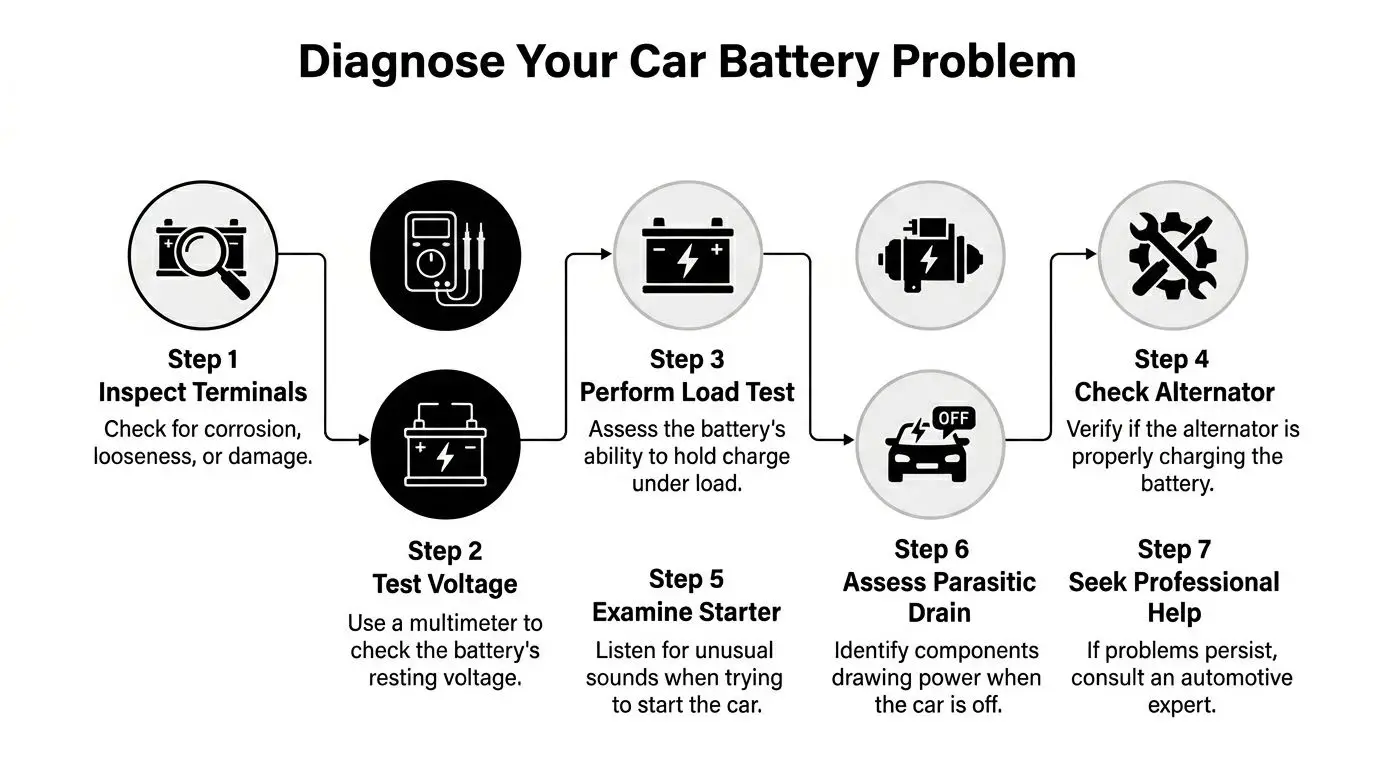
Look before you test
Start with what you can see and touch.
Check the battery case, terminal ends, and cable insulation for signs that point to the underlying problem:
- Blue or green corrosion on the terminals
- Loose clamps that twist by hand
- Frayed or damaged cable ends
- A swollen battery case
- Wetness or acid residue around the battery
Corrosion creates resistance. The battery may still hold charge, but the current cannot move cleanly through a dirty or loose connection. A swollen case is a bigger red flag in North Texas because extreme heat can damage the battery internally. If you see bulging, leakage, or a cracked case, skip DIY charging and replacement attempts until the battery is handled safely.
Test resting voltage the right way
Use a digital multimeter set to DC volts. Touch the red lead to the positive post and the black lead to the negative post.
Before checking voltage, turn the headlights on for about 15 seconds, then switch them off. That removes surface charge and gives you a more honest reading. Fleet maintenance guidance on battery replacement diagnostic method uses this same approach because voltage checks are more useful when the battery has settled a bit.
Use these readings as a practical baseline:
- About 12.6 volts usually means the battery is fully charged
- Around 12.4 volts suggests it is partly discharged
- Below 12.2 volts points to a low state of charge and calls for more testing
- Much lower than that often means the battery needs charging first, then retesting
Voltage is only the first check. A battery can show decent voltage and still fall flat under load.
If you want help interpreting the number on your meter, this battery voltage chart for common car battery readings makes the ranges easier to sort out.
Check how it behaves during crank
Numbers matter, but symptoms matter too.
Turn the headlights on, then try to start the engine. Watch and listen closely:
- Headlights dim hard during crank points to a weak battery or high resistance at the cables
- A rapid click or a single click can mean low battery power, bad terminal contact, or starter circuit trouble
- A heavy clunk with no crank leans more toward a starter problem
- Normal dash lights with no strong crank often means the battery is not the only suspect
This quick check will not replace a shop-grade load test, but it helps separate a discharged battery from a connection issue or a failing starter.
Rule out the charging system
If the car starts with a jump and then dies again after driving, the battery may not be getting recharged. Testing before replacement prevents this mistake.
That is a common pattern here in Plano, especially after long hot stretches when batteries and alternators are both working harder. If you can get the car running, pay attention to whether it restarts later the same day or goes dead again after a short stop. A battery that will not stay charged may be worn out, but it may also be living behind a charging problem.
If you need to get the car started first, follow a proven process for how to jump-start a car battery safely before you assume the battery itself is done.
Watch for parasitic drain
Some batteries test fine, charge fine, then go dead after the car sits overnight. That usually points somewhere else.
Look for patterns like these:
- The car starts normally after a drive but is weak the next morning
- The problem shows up after sitting, not during regular daily use
- You recently added accessories
- Interior, trunk, or glovebox lights stay on longer than they should
Modern vehicles have more modules, more standby loads, and more ways to drain a battery. Finding that drain at home can take time and patience because it often means checking fuses, waiting for modules to go to sleep, and measuring current draw correctly.
Do not mix up the battery under the hood with the battery in the key fob
Push-button vehicles can throw people off. A weak fob battery can cause key detection problems, but it does not make the starter crank slowly or dim the headlights.
If the engine does not recognize the key but the battery tests well, look at the fob separately. If the engine cranks slowly, clicks, or loses electrical power, stay focused on the 12-volt system first.
A good diagnosis starts simple and stays methodical. Inspect the battery and cables, check resting voltage, watch what happens during crank, and pay attention to what happens after a jump or after the car sits. If the results do not line up cleanly, that is usually the point where a professional battery and charging-system test saves time and avoids buying the wrong part.
Immediate Fixes to Get You Back on the Road
In Plano, this usually happens in the worst place and at the worst time. You come out to a hot car in a parking lot, turn the key, and get a click, a slow crank, or nothing at all. If you already know the battery is low or the connection is poor, two fixes solve a lot of these no-starts. Jump-start it the right way, or clean the terminals so current can flow again.
Both jobs are manageable at home. Both can also injure you or damage the vehicle if you rush.
How to jump-start it safely
Set both vehicles in park. Shut both ignitions off and set the parking brakes. Keep the clamps from touching each other or any painted surface.
Connect the cables in this order:
- Red clamp to the dead battery positive terminal
- Red clamp to the donor battery positive terminal
- Black clamp to the donor battery negative terminal
- Black clamp to a solid metal ground on the dead car, not the dead battery terminal
This last step reduces the risk of sparks near the battery.
Start the donor vehicle and let it idle for a minute. Then try to start the dead vehicle. If it does not crank normally after a couple of attempts, stop there. Repeated cranking can overheat the starter and cables.
If it starts, let it run and keep the headlights, A/C blower, seat heaters, and charger cords off for the first few minutes. For a more detailed walkthrough, see this guide on how to jump-start a car battery safely.
After a successful jump, drive long enough to put some charge back in the battery. In Texas heat, I do not assume that means the battery is fixed. A battery that barely recovers after a jump often fails again on the next hot afternoon.
Here is a visual walkthrough if you prefer to watch the process:
How to clean corroded battery terminals
White, blue, or green buildup on the terminals can block current enough to cause a no-start, even when the battery itself is still usable. I see this a lot on cars that spend their lives outside through Plano summers.
Clean the terminals this way:
- Disconnect the negative cable first, then the positive
- Mix a small amount of baking soda and water
- Apply it carefully and scrub the posts and cable ends with a terminal brush or wire brush
- Wipe everything dry
- Reconnect the positive cable first, then the negative
Wear gloves and eye protection. If the corrosion is heavy, the terminal feels loose, or the cable end is swollen under the insulation, cleaning may not be enough. The connection may need parts, not just a brush.
A light coat of battery terminal protectant helps slow future corrosion. Do not smear grease between the metal contact surfaces. Clean metal-to-metal contact matters more than anything you spray on afterward.
What works and what does not
These quick fixes work best when the battery was drained by a light left on, a door not fully closed, or terminal corrosion that added resistance.
They can buy time when the battery is only mildly discharged.
They do not solve a weak alternator, an internally failing battery, a swollen battery case, or a car that keeps draining the battery overnight. They also will not overcome a battery that has been cooked by repeated Texas heat cycles and is at the end of its service life.
A jump-start is a recovery step, not proof that the battery is healthy.
If the car starts and keeps running, that is useful information. If it dies again later that day or the next morning, stop guessing. That is usually the point where a proper battery and charging-system test at Express Lube & Car Care saves time, money, and one more tow.
Should You Charge It or Replace It
Plano drivers run into this call all the time. The car starts after a jump, everything seems fine, then the next hot afternoon it gives you the same weak crank or dead silence. Texas heat is hard on batteries, so a battery that still takes a charge is not always a battery worth trusting.
I tell people to make the decision based on pattern, not hope.
A battery that was drained once by a light left on can often be recharged and put back into service. A battery that has been acting tired for a while, especially through a North Texas summer, usually costs you more in lost time than it saves in replacement cost.
Read the battery's history along with today's test result
Charging makes sense if the problem has a clear cause and the battery still behaves normally afterward. That usually means the battery is not very old, the case is in good shape, and it holds its charge after being properly recharged.
Replacement is the better call when the battery keeps slipping back into the same problem. If it slow-cranks in the morning, needs another jump a few days later, or drops voltage again after charging, its useful life is usually near the end.
Heat changes the math in Plano. Batteries here often age from the inside out. I have seen plenty that looked decent from the top but failed under load because repeated heat cycles had already weakened the plates.
Charge it and keep using it if these points line up
- the battery was discharged by a one-time mistake, like a light left on or accessory use with the engine off
- the battery is still in the earlier part of its service life
- the case is flat, clean, and free of leaks or swelling
- it takes a full charge and the car starts normally over the next several starts
- the charging system and cable connections check out
Replace it if these signs show up
- the battery is older and has already had more than one weak-start episode
- it loses charge again soon after being recharged
- cranking stays slow even when connections are clean and tight
- the case is swollen, cracked, or leaking
- battery testing shows poor cranking performance even after charging
Decision guide
| Factor | Better case for charging | Better case for replacement |
|---|---|---|
| Battery history | One clear discharge event | Repeated weak starts or no-starts |
| Age | Relatively newer battery | Older battery in regular Texas heat |
| Case condition | No swelling, cracks, or leakage | Swollen, damaged, or leaking case |
| After charging | Holds charge and starts reliably | Drops back down or struggles again |
| Cranking behavior | Normal crank speed returns | Slow or uneven cranking continues |
| Cause of failure | Obvious one-time drain | No clear cause, problem keeps returning |
Repairs that may buy time
Sometimes the battery is fine and the problem is around it. Terminal service, cable-end repair, or correcting a charging issue can extend the life of a battery that still tests well.
Desulfation chargers can help in limited cases on some serviceable flooded batteries, but I would not count on that as a cure for an older daily-driver battery in Plano heat. For a commuter car, reliability matters more than squeezing out one more month.
If you are deciding between another charge and a new battery, ask a simple question. Would you trust this battery to start the car three mornings in a row after sitting outside in August? If the answer is no, replacement is usually the smarter move.
When to Call the Plano Experts at Express Lube
Some battery jobs stop being good DIY projects once the obvious fixes fail.
If the terminals are clean, the battery has been charged or jumped, and the car still does not start reliably, it is time for better tools and a wider test. Starting problems often live in the gap between the battery, cables, starter, and charging system. That is where shop-grade diagnostics matter.
Problems that usually need a professional
A few examples come up often in Plano bays:
- Battery goes dead repeatedly even after a proper recharge
- Cables are frayed or heavily corroded near the terminal ends
- The car starts sometimes and not others
- You suspect a parasitic drain
- You are not comfortable disconnecting or testing the battery safely
Many starting issues are not the battery itself but the connections. Transmission Digest notes that while cleaning terminals is a simple fix, badly frayed or corroded battery cables may need professional repair or replacement, which can be a cost-effective alternative when the battery is still healthy (battery cable repair guidance).
What a shop can confirm that driveway checks cannot
A professional battery and charging system inspection can answer questions that are hard to settle at home:
- Is the battery weak, or is the alternator undercharging it?
- Are the cable ends creating hidden resistance under load?
- Is the starter pulling more current than it should?
- Is a module staying awake and draining the battery overnight?
That matters because the wrong repair wastes both time and money. A fresh battery will not solve a hidden drain. A jump-start will not fix a cable that is corroded inside the insulation.
Why local conditions matter
Plano heat is rough on batteries and cable connections. Under-hood temperatures speed up wear, dry things out, and expose weak parts faster than mild weather does.
A shop that sees the same local driving patterns every day will spot common heat-related failures faster than a one-size-fits-all internet checklist.
If you are stuck between “maybe this battery can be saved” and “I need the car dependable tomorrow,” that is exactly the point where having it tested by ASE-certified technicians makes sense.
Frequently Asked Car Battery Questions
Most battery questions sound simple until you are standing in a Plano driveway with a car that will not crank and the heat already building. These are the answers I give drivers who want a straight call on what they can handle themselves and what deserves a proper test.
How long should I drive after a jump-start
Plan on a solid drive, not a quick lap around the block. A longer run with the headlights, AC blower, seat heaters, phone chargers, and other extra loads kept to a minimum gives the charging system a fair shot at putting energy back into the battery.
Even then, a jump-start only proves the car started. It does not prove the battery is healthy.
Does a click always mean I need a new battery
No. A clicking sound can point to low battery charge, loose terminal connections, corroded cables, or a starter problem.
I see this a lot in North Texas. Drivers hear one click, buy a battery, and still have the same problem because the actual fault was resistance at the cables or a weak starter drawing too much current.
Can Texas heat shorten battery life that much
Yes. Plano heat is hard on batteries. High under-hood temperatures speed up internal wear, and a battery that seemed fine in spring can show its age fast during a long Texas summer.
That is why local driving conditions matter. Short trips, heavy AC use, and heat soak in parking lots can push an older battery over the edge sooner than drivers expect.
Can I just clean the terminals and keep driving
Sometimes. If the corrosion was causing the voltage drop and the battery still tests well, cleaning the terminals may solve the problem.
If it cranks slowly again, needs another jump, or the corrosion returns quickly, stop guessing. The battery, cables, or charging system needs more than a quick cleanup.
What voltage should a healthy battery show
As a rule of thumb, a fully charged battery at rest should be in the mid-12-volt range. A lower reading can mean the battery is discharged, worn out, or both.
Voltage alone is not the whole story. I trust a voltage reading more when it is paired with a load test or charging-system test.
Is it okay to keep jump-starting the car every few days
No. Repeated jump-starts are a warning sign.
At that point, the smart question is not how to keep jumping it. The smart question is why it keeps going dead. The cause is usually a failing battery, a charging issue, or an electrical draw while the car is parked.
Can modern electronics drain a battery overnight
Yes. A module that stays awake, an interior light that does not shut off, an aftermarket accessory, or a charging port that keeps pulling power can drain a battery overnight.
That is one of the cases where DIY gets tougher fast. Finding a parasitic draw takes patience, a meter, and a methodical process. If you need the car dependable tomorrow, that is usually the point where a shop test saves time.
If the battery is old but still starts the car, should I replace it
If it is an older battery and you are already seeing slow cranking, repeated jump-starts, or inconsistent starts in hot weather, replacement is usually the practical move for a daily driver.
Waiting for total failure rarely helps. It usually turns a planned repair into a tow, a missed appointment, or a no-start in a Plano parking lot.
If you want the battery, alternator, and starting system checked without guesswork, schedule a visit with Express Lube & Car Care. Plano drivers can stop in for honest battery diagnostics, professional replacement, and a clear answer on whether the battery can be saved or needs to go.