

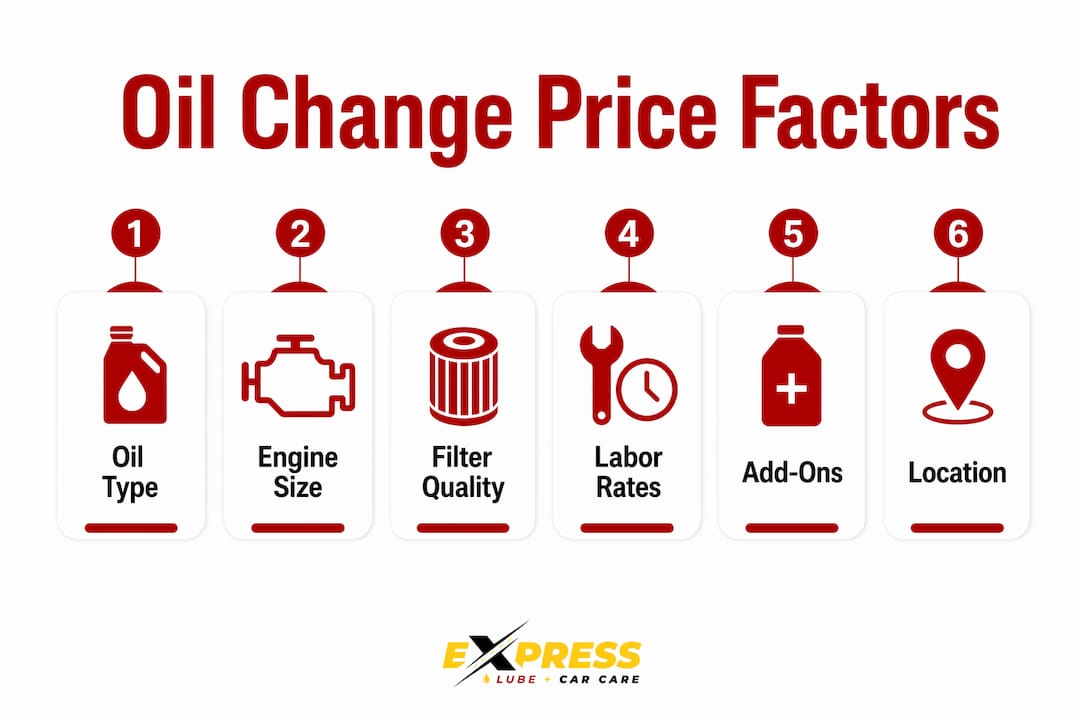
Oil change pricing is determined by six core variables: oil type, engine size, filter quality, labor rates, service add-ons, and geographic location. In 2026, U.S. oil change prices range from $25 to $125 depending on these factors, with dealerships consistently charging more than independent shops. Understanding the oil change price factors explained in this guide gives you the knowledge to budget accurately, avoid unnecessary upsells, and choose the right service for your vehicle. The industry term for this analysis is an oil change cost breakdown, and it applies whether you drive a compact sedan or a full-size truck.
What are the main oil change price factors explained?
Oil type is the single largest driver of what affects oil change price. Conventional oil sits at the low end, typically $25 to $55 per service, while synthetic blend runs $45 to $70, and full synthetic reaches $65 to $125. That price gap exists because synthetic oil uses a more refined base stock and advanced additive packages that protect engine components under higher stress and temperature. The higher upfront cost is real, but the longer service interval changes the annual math significantly.
Engine size compounds the oil type cost because larger engines simply hold more oil. A four-cylinder engine typically requires 4 to 5 quarts, while a V8 engine uses 7 to 8 quarts. Larger engines raise parts cost by approximately $5 to $15 per service compared to smaller engines using the same oil grade. For a truck owner running full synthetic in a V8, that difference adds up to $60 or more per year before any other variables enter the picture.

Pro Tip: Always confirm how many quarts your engine holds before comparing quotes. A shop quoting $65 for full synthetic on a four-cylinder is not the same value as $65 on a six-cylinder that requires two extra quarts.
The table below shows how oil type affects both per-visit cost and annual expense based on typical service intervals.
| Oil type | Typical price range | Service interval | Estimated annual cost (2 visits) |
|---|---|---|---|
| Conventional | $25–$55 | 3,000–5,000 miles | $50–$110 |
| Synthetic blend | $45–$70 | 5,000–7,500 miles | $60–$140 |
| Full synthetic | $65–$125 | 7,500–15,000 miles | $65–$125 |
The annual cost column reveals something most drivers miss. Full synthetic costs more per visit but often requires only one service per year for drivers with average mileage. That makes it the most cost-effective option for many vehicles, not the most expensive.
How do oil filters and labor affect your service bill?
The oil filter is the second line of defense in your engine after the oil itself, and filter quality directly affects both parts cost and labor time. OEM-spec or premium filters add $8 to $15 to the parts cost compared to a basic aftermarket filter. That difference buys you a filter with a higher micron rating, better anti-drainback valve performance, and materials rated to last the full synthetic interval without bypass failure. Skipping the upgrade to save $10 on a $100 synthetic service is a poor trade.
Filter style also determines how much labor time the job requires. Spin-on filters thread onto a threaded boss and take under two minutes to swap. Cartridge-style filters, common on European vehicles and many newer domestic models, require removing a filter housing cap, extracting the old cartridge, installing a new one, and torquing the housing to spec. That process adds 10 to 15 minutes of labor time, which translates directly into a higher service fee at any shop charging by the hour.
Here is what drives labor cost variation across shops and locations:
- Technician certification level. ASE-certified technicians command higher shop rates than uncertified staff, and that expertise shows in proper torque specs on the drain plug and filter housing.
- Shop overhead. A dealership service bay in a high-rent commercial district carries higher overhead than a neighborhood quick-lube shop, and that overhead is priced into labor rates.
- Vehicle accessibility. Trucks and SUVs with high ground clearance are easier to access without a lift. Sports cars and low-profile sedans require more setup time.
- Drain plug condition. A stripped or cross-threaded drain plug from a previous service adds repair time and parts cost to your visit.
Pro Tip: Ask specifically whether the quoted price includes an OEM-spec filter or a basic aftermarket unit. For vehicles still under manufacturer warranty, using an oil filter that meets OEM specifications protects your coverage. You can review synthetic vs conventional oil differences to understand how filter compatibility ties into oil type selection.
How do add-ons and location change the total oil change expense?
Service add-ons represent the most variable portion of your average oil change expense. Tire rotations, cabin air filter replacements, engine flushes, and fuel system treatments are commonly offered during oil change visits. These upsells can add $20 to $100 or more to a single visit, which can more than double the base service cost. Some of these services are genuinely needed at certain mileage intervals. Others are offered regardless of your vehicle’s actual condition.
The numbered list below shows how to evaluate each common upsell before agreeing to it:
- Tire rotation. Check your odometer against the last rotation date. Most manufacturers recommend rotation every 5,000 to 7,500 miles. If you are within that window, the service is legitimate.
- Cabin air filter. Inspect the filter yourself if the technician removes it to show you. A visibly clogged filter warrants replacement. A slightly dusty one does not.
- Engine flush. This service is rarely necessary on a well-maintained engine following regular oil change intervals. It is most appropriate when buying a used vehicle with an unknown service history.
- Fuel system treatment. Verify this against your owner’s manual. Most modern fuel-injected engines do not require additive treatments at routine oil change intervals.
Geographic location creates price variation that surprises many drivers. The average oil change in Houston runs about $35, while the same service in New York City averages around $55. That 57% price difference reflects local labor costs, real estate overhead, and competitive market density. A driver relocating from a lower-cost market to a major metropolitan area should recalibrate their expectations for oil change pricing rather than assuming they are being overcharged.
| City | Average conventional oil change | Average full synthetic | Price difference |
|---|---|---|---|
| Houston, TX | ~$35 | ~$75 | Baseline |
| New York, NY | ~$55 | ~$110 | +57% |
Understanding this regional variation also matters when comparing quick lube vs dealership pricing in your specific market. A dealership in Houston may charge less than a quick-lube shop in Manhattan for an identical service.
Why do oil change intervals affect your annual cost more than price per visit?
The owner’s manual is the authoritative source for oil change frequency, and most drivers ignore it in favor of the outdated 3,000-mile rule. Modern full synthetic oils are engineered to protect engines for 7,500 to 15,000 miles per interval, and many manufacturers specify these longer intervals in their maintenance schedules. Following the manual rather than a generic sticker can cut your annual service visits nearly in half, saving $130 to $200 per year compared to unnecessary 3,000-mile changes.
The financial logic becomes clear when you calculate annual cost rather than per-visit cost. A driver paying $90 for full synthetic every 10,000 miles spends $90 to $180 per year depending on total mileage. The same driver following a 3,000-mile conventional oil schedule at $40 per visit spends $160 to $240 annually, and that figure does not account for the time spent at the shop. Budgeting by annual cost rather than sticker price per visit is the clearest way to evaluate synthetic oil’s value.
Frequent oil changes also increase your exposure to upsell opportunities at every visit. A driver making four oil change visits per year faces four opportunities to be sold tire rotations, air filter replacements, and fluid top-offs. A driver on a synthetic schedule making two visits per year faces half that exposure. The owner’s manual oil specifications also define the required viscosity grade and API performance rating, such as API SP or ILSAC GF-6, which must be matched to maintain warranty compliance. Using the wrong oil grade, even at the correct interval, can void powertrain warranty coverage.
Pro Tip: Review your oil change intervals by mileage guide to confirm what your specific vehicle requires. Driving conditions like towing, stop-and-go traffic, or extreme temperatures may shorten the recommended interval even for synthetic oil.
Key takeaways
Oil change pricing is controlled by oil type and engine size above all other factors, with location, filter quality, labor, and service add-ons layering additional cost on top.
| Point | Details |
|---|---|
| Oil type sets the baseline | Full synthetic costs $65–$125 per visit but often requires only one or two services annually. |
| Engine size raises parts cost | V8 engines use 7–8 quarts versus 4–5 for four-cylinders, adding $5–$15 per service. |
| Filter quality affects both parts and labor | OEM-spec filters add $8–$15 but protect the engine through the full synthetic interval. |
| Location creates a 57% price gap | Houston averages $35 versus New York’s $55 for comparable conventional oil changes. |
| Annual cost beats per-visit price | Following manufacturer intervals saves $130–$200 per year compared to 3,000-mile schedules. |
The real cost conversation most shops skip
At Express Lube & Car Care, we see a consistent pattern: drivers walk in focused on the per-visit price and walk out without understanding what they actually paid for. A $45 conventional oil change and a $45 synthetic blend quote are not the same service, and treating them as equivalent is how drivers end up overpaying year after year.
The comparison that actually matters is annual cost calculated against your real driving habits. If you drive 12,000 miles per year in a vehicle that specifies full synthetic at 10,000-mile intervals, you need one service per year. A driver in the same situation following a 3,000-mile conventional schedule makes four visits. At $40 per visit, that is $160 spent on a service schedule the manufacturer never asked for.
The upsell conversation deserves equal scrutiny. Not every service offered during an oil change visit is unnecessary, but every recommendation should be verified against your owner’s manual and your actual mileage log. DIY cost comparisons also require honest accounting. Used oil is regulated under RCRA 40 CFR Part 279, not as universal waste, which means disposal fees, proper storage containers, and transport to a recycling facility are real costs that most DIY calculators undercount. When you factor in disposal compliance, the savings gap between DIY and a professional service narrows considerably.
Price-shopping works best when you confirm oil type, quart count, filter grade, and included services before comparing numbers. Two shops quoting $75 for full synthetic may be offering very different value depending on what filter they install and how they handle the drain plug torque spec.
— Express Lube & Car Care
See current oil change specials at Express Lube & Car Care
Express Lube & Car Care makes oil change pricing transparent and straightforward, with no appointment needed and certified technicians handling every service. Whether your vehicle calls for conventional, synthetic blend, or full synthetic oil, the team uses the correct oil grade and OEM-compatible filters to protect your engine and maintain your warranty.
Current oil change and service specials are available online, including deals on full synthetic services and additional maintenance packages. Military personnel and healthcare providers receive special discounts as part of Express Lube & Car Care’s commitment to the community. Check the oil change specials in Plano page for the latest pricing before your next visit, and drive in when it fits your schedule.
FAQ
How much does an oil change cost in 2026?
Oil change costs in 2026 range from $25 to $55 for conventional oil, $45 to $70 for synthetic blend, and $65 to $125 for full synthetic, with dealerships typically charging more than independent shops.
What is the biggest factor in oil change pricing?
Oil type is the primary cost driver, followed by engine size. Full synthetic oil costs significantly more per visit than conventional but requires fewer annual services, often making it less expensive over a full year.
Does engine size affect how much I pay for an oil change?
Yes. Larger engines like V8s require 7 to 8 quarts of oil compared to 4 to 5 quarts for four-cylinder engines, raising parts cost by $5 to $15 per service depending on the oil grade used.
Why do oil change prices vary so much by location?
Regional labor costs, shop overhead, and local market competition create significant price differences. Houston averages around $35 for a conventional oil change while New York City averages around $55 for the same service, a 57% gap.
How often should I actually change my oil?
Follow your owner’s manual, not the generic 3,000-mile rule. Most vehicles using full synthetic oil have manufacturer-specified intervals of 7,500 to 15,000 miles, which can cut annual service visits in half and reduce total yearly costs by $130 to $200.