

Your car usually gives you some warning before a cooling problem turns into a breakdown. The trouble is that many drivers are busy, the symptom seems minor, and the car still runs well enough to get through the day. Then one hot commute, one long light, or one slow crawl through traffic is all it takes for a small coolant issue to become a major engine problem.
Coolant has one job you never want it to stop doing. It carries heat away from the engine so parts can stay in a safe operating range. When the level drops, the system can't do that job well. You might see a warning light. You might notice steam. You might just smell something sweet and odd, or find yourself topping off the reservoir again and again with no puddle on the ground.
That last situation matters more than many drivers realize. Low coolant doesn't always mean an obvious external leak. Some vehicles lose coolant internally, which can point to combustion-related problems, a blown head gasket, or even a cracked cylinder head. The warning signs can be subtle at first, and that gap is one reason articles about signs of low coolant in car problems often leave people unprepared.
If you're in Plano and your car spends a lot of time in stop-and-go traffic, this is worth taking seriously. Heat loads build fast when the cooling system isn't at full strength. The eight signs below will help you spot trouble early, do a safe check at home, and know when it's time to hand the car to a professional.
1. Dashboard Warning Light (Temperature or Coolant Symbol)
Sometimes the first sign is the simplest one. A light comes on, and the car is telling you the cooling system needs attention.
A coolant or temperature warning may look like a thermometer, waves under a symbol, or a message in the driver display. Different vehicles show it differently, but the meaning is the same. The car has detected a temperature problem, a coolant level issue, or both.
What causes it
Modern vehicles use sensors to watch coolant temperature and, in some models, coolant level. If the system sees a reading outside the safe range, it turns the warning on.
That can happen because the coolant is low, the engine is already overheating, or the system isn't circulating coolant correctly. A stuck thermostat, weak water pump, or bad sensor can also trigger a warning. The light tells you there is a problem. It doesn't tell you which part failed.
A common real-world example is the driver who starts the morning commute, sees the light for a minute, then watches it go away. That doesn't mean the issue fixed itself. It may just mean the temperature changed enough for the sensor reading to drop for the moment.
Safe checks you can do
If the warning comes on while driving, treat it seriously.
- Pull over safely: Find a safe place off traffic as soon as you can.
- Shut the engine off: Let the engine cool before checking anything under the hood.
- Check the owner's manual: Your manual shows exactly what your warning symbol means.
- Look at the overflow tank only when cool: If the reservoir is translucent, you may be able to see whether the level is below the marked range.
Practical rule: A coolant warning light is never a "watch it later" light.
Do not remove the radiator cap while the engine is hot. Hot coolant is pressurized and can cause severe burns.
When to visit a professional
Go in as soon as possible if the warning light stays on, returns repeatedly, or appears with any other symptom like a sweet smell, rough running, steam, or a rising temperature gauge. If you're repeatedly adding coolant, especially with no visible leak, you need diagnosis rather than guesswork. Hidden internal coolant loss can keep getting worse while the outside of the engine looks dry.
2. Engine Overheating (Rising Temperature Gauge)
If the temperature gauge starts climbing toward hot, the engine is losing its safety margin.
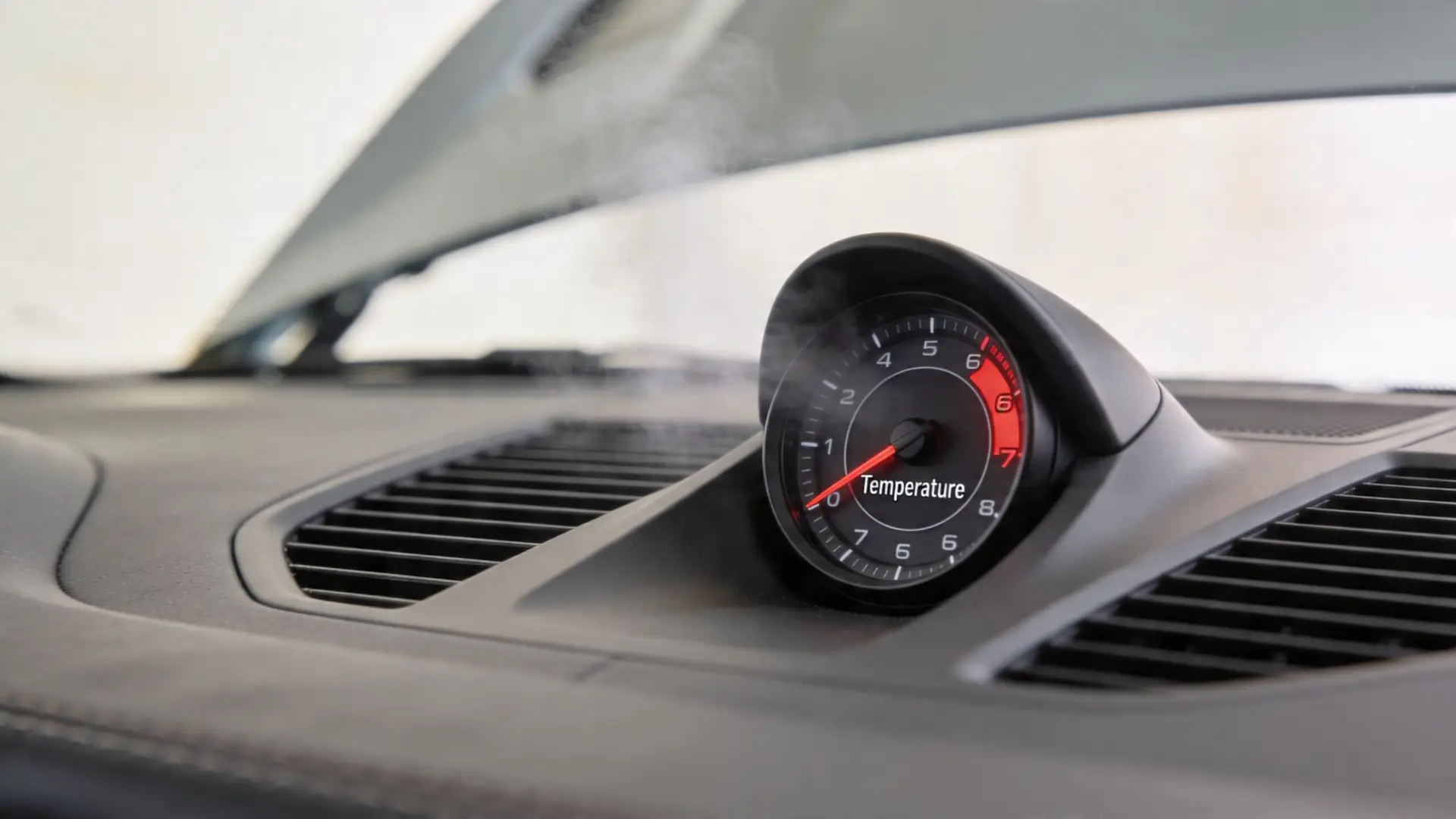
A healthy gauge usually stays around its normal operating range once the car warms up. When the needle starts creeping upward, especially in traffic or at idle, low coolant is high on the list of possible causes.
Here’s what that often looks like on the dash:
What causes it
Coolant absorbs heat from the engine and releases it through the radiator. If the level is low, the system may circulate less effectively. Air can enter the system, hot spots can develop, and the gauge rises.
This often shows up in everyday situations. A driver may be fine on the freeway where airflow helps the radiator, then the gauge climbs when they hit a long red light. Older vehicles, cars with weak water pumps, and vehicles that already have a cooling system issue are especially vulnerable.
If you want a broader look at related causes, this overview of what causes overheating in cars is a useful next read.
Safe checks you can do
Act quickly, but calmly.
- Turn off the A/C: This reduces load on the engine.
- Turn the heater on: It’s uncomfortable, but it can help pull heat away from the engine.
- Get off the road: Exit or pull over somewhere safe.
- Let the engine cool fully: Wait before inspecting the coolant reservoir.
Don't keep driving to "see if it settles down." Overheating can warp engine components and damage gaskets. The verified guidance for this topic warns that repeatedly topping off coolant without repairing the underlying issue can lead to warped components or hydrolock, and that kind of damage gets expensive fast. In the same verified data, preventing escalation can avoid repairs of $2,000+ through timely diagnostics and pressure testing at a qualified shop (https://www.koeppelhyundai.com/blog/2025/november/10/identifying-common-low-coolant-symptoms-of-a-car-a-service-guide-by-koeppel-hyundai.htm).
After the engine has cooled, this quick visual explanation may help you understand what you saw on the road.
When to visit a professional
Immediately. An overheating event isn't something to postpone. Even if the gauge returns to normal after a cooldown, the underlying fault is still there. Have the cooling system pressure-tested and inspected before you rely on the car again for daily driving.
3. Sweet-Smelling Odor (Ethylene Glycol Smell)
A sweet smell under the hood or through the vents is one of the most recognizable signs of low coolant in car trouble.
Drivers often describe it as syrupy, fruity, or chemical-sweet. If you notice that odor after parking, while idling, or when the heater is running, coolant should be on your radar.
What causes it
Coolant has a distinct sweet smell. When it leaks onto a hot engine part, hose connection, or the radiator area, it can evaporate and send that odor into the air. A small seep may not leave a big puddle, but your nose can catch it early.
This is common with aging hoses, loose clamps, worn seals, and water pump leaks. You may notice it only after a drive, when the engine bay is hot and the coolant is under pressure.
One common local scenario is the school pickup or commute line. The car sits idling, heat builds, and a small leak starts giving off odor before the driver ever sees steam.
Safe checks you can do
Start simple.
- Notice the timing: Is the smell strongest after shutdown, at idle, or with the heater on?
- Look around the reservoir and hose connections: Only after the engine is cool.
- Check for residue: Dried coolant can leave a crusty or stained area around clamps or fittings.
If you smell coolant more than once, assume the system is losing fluid somewhere.
Don't ignore a smell just because the car still "feels normal." A small leak can become a large one without much warning.
When to visit a professional
Schedule an inspection if the smell repeats, gets stronger, or appears with a dropping reservoir level. A pressure test is often the fastest way to locate a slow leak. This is especially important if there is no visible puddle, because the loss may be happening in places you can't easily see.
4. White or Colored Steam from Under the Hood
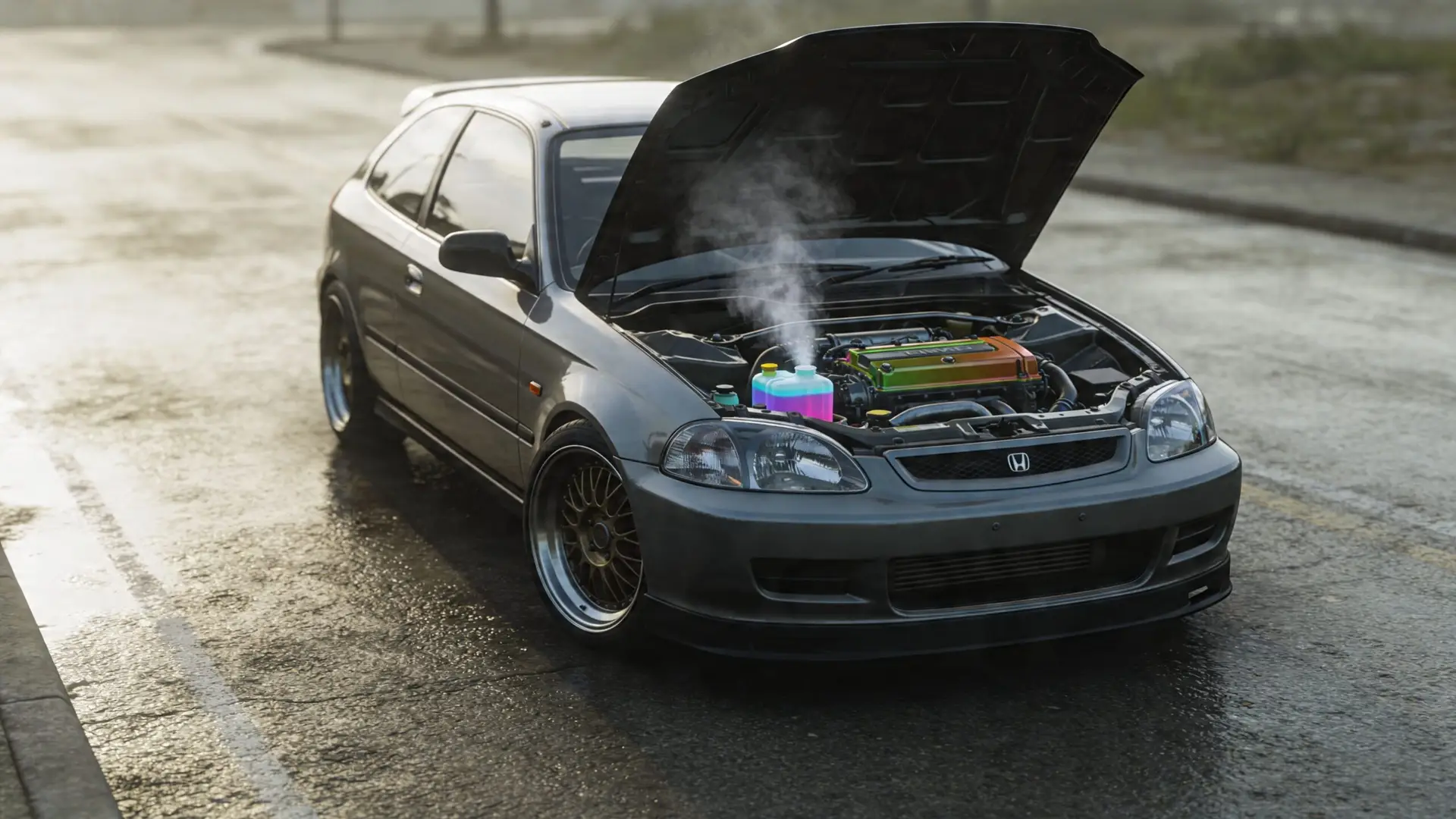
Steam from under the hood is the sign nobody wants to see. By the time it appears, the problem has usually moved beyond "keep an eye on it."
Steam may be white, grayish, or lightly tinted depending on the coolant and what it's contacting. It often appears after a hose failure, a severe leak, or an overheating event in traffic.
What causes it
Steam forms when coolant escapes onto very hot engine components or when the cooling system gets hot enough to boil over. A split hose, failed radiator, bad cap seal, or pump issue can trigger it quickly.
In real driving, this often happens in heavy traffic. The car may have been running a little warm already. Then airflow drops, pressure rises, and the weak point gives out.
Some radiator-related warning signs overlap with this problem. If you want to compare them, this guide to signs of radiator problems can help you separate one cooling issue from another.
Safe checks you can do
Safety matters more than diagnosis here.
- Stop driving immediately: Continuing to drive can turn an overheating event into engine damage.
- Turn on hazard lights: Make yourself visible.
- Stay clear of the hood area at first: Escaping steam can burn you.
- Do not remove the radiator cap: Not while hot. Not "just to peek."
"If the car is steaming, your first job is to protect yourself, not to play mechanic on the shoulder."
Let the engine cool fully before anyone inspects it. If steam was heavy or the temperature gauge was high, towing is usually the smart move.
When to visit a professional
Right away, and often by tow rather than by driving it in. Steam means active overheating or active coolant loss. Both need prompt diagnosis before the vehicle goes back into regular use.
5. Puddles or Drips Under the Parked Vehicle
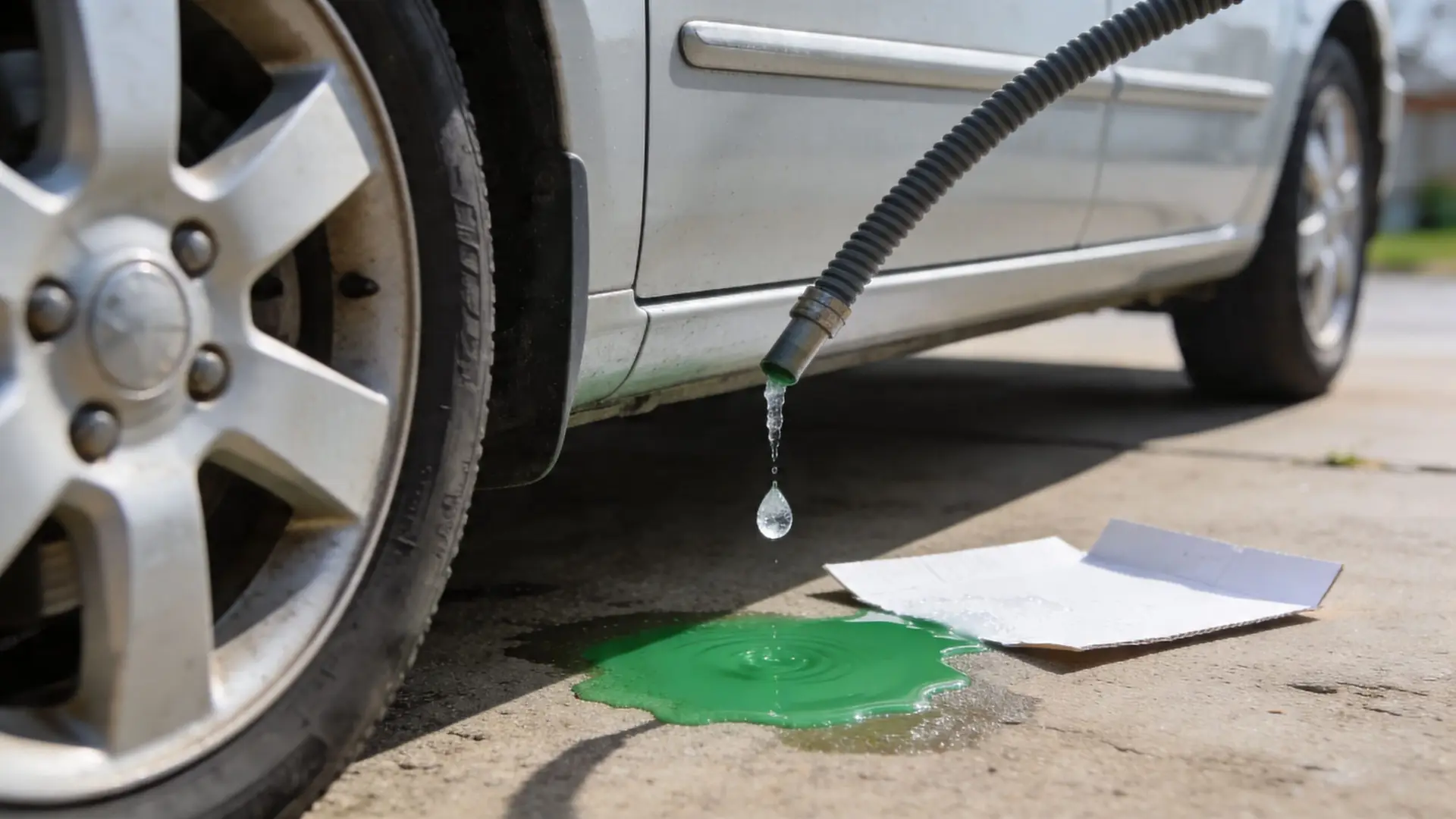
This is often the sign drivers anticipate. You park, come back later, and see colored fluid under the front of the car.
Coolant can appear green, pink, orange, or blue depending on the type used in the system. It usually has that same sweet smell mentioned earlier. It doesn't look like dark engine oil, and it doesn't behave like clear A/C condensation.
What causes it
External leaks can come from radiator hoses, the radiator itself, the water pump area, the thermostat housing, or the overflow tank. Some leaks drip only when the engine is hot and the system is pressurized, so the puddle may show up after the drive is over.
Drivers often mistake coolant for water from the A/C. The easiest difference is color and feel. A/C condensation is clear and odorless. Coolant is usually colored and has that sweet chemical smell.
Safe checks you can do
This is one place where a little observation helps the repair process.
- Use white cardboard overnight: It helps you see the color and amount of the drip.
- Check the location: A puddle near the front center may point to a different source than one near a wheel area.
- Note the color and smell: That can help confirm whether it’s coolant.
If you park in the same spot regularly, changes become easier to notice. A small stain that becomes a larger puddle over a few days tells you the leak is progressing.
When to visit a professional
As soon as you confirm it's coolant. Don't wait for the puddle to become dramatic. Cooling systems are sealed systems, so repeated external loss means something needs repair. If the reservoir keeps dropping but there's no puddle, that matters too. Low coolant isn't always from an external leak. Verified background for this topic notes that low coolant may not indicate a visible leak and can reflect hidden causes such as cracked cylinder heads where coolant burns in the engine without external evidence.
6. Visible Coolant Level Drop in Overflow Tank
One of the easiest checks most drivers can do is also one of the most useful. Look at the overflow reservoir when the engine is cold.
The tank is usually translucent and marked with minimum and maximum lines. If the level keeps dropping over time, the cooling system is telling you something.
What causes it
Coolant doesn't usually disappear for no reason. If the level falls, the system is losing fluid through a leak, a pressure problem, or an internal engine issue.
This is the overlooked sign. Many drivers don't see steam, don't find a puddle, and never get an obvious overheat. They just keep adding coolant every few weeks. That's not normal maintenance.
The verified data for this topic highlights an underserved point that many drivers miss. Low coolant levels can happen without visible leaks or obvious overheating, often because of internal consumption tied to problems like blown head gaskets or combustion issues. It also notes that mechanic anecdotes place 30-40% of low coolant calls in the non-leak category (https://www.koeppelhyundai.com/blog/2025/november/10/identifying-common-low-coolant-symptoms-of-a-car-a-service-guide-by-koeppel-hyundai.htm).
Safe checks you can do
Check the level the right way.
- Check only on a cold engine: That's the safe and accurate time to read the tank.
- Watch the trend: A single reading matters less than repeated drops.
- Stay within the marked range: Overfilling can create its own issues.
If you want a maintenance baseline, this article on how often to change coolant can help you understand service timing and fluid condition.
Shop-floor advice: If you're topping off the reservoir more than once and you don't know why, stop guessing and get the system tested.
When to visit a professional
Go in when the level drops repeatedly, even if the car isn't overheating. In such cases, pressure testing and inspection matter most. A hidden internal coolant loss can stay subtle until it suddenly isn't.
7. Discolored or Milky Coolant Appearance
Healthy coolant should look clean and consistent in color. If it looks rusty, cloudy, sludgy, or milky, something is wrong.
This isn't just about old fluid. Appearance can point to contamination, corrosion, or mixing of fluids that should never mix.
What causes it
Coolant breaks down over time. Corrosion inside the system can discolor it. Mixing the wrong coolant types can also create problems.
The milky look is especially concerning. It can suggest internal engine trouble, including a head gasket problem, where coolant and oil contamination may be involved. Rust-colored coolant often points to corrosion inside the system or repeated overheating that has stressed the components.
A real-world example is the driver who opens the reservoir on a cold engine expecting bright coolant and instead sees brownish fluid with a murky look. The car may still be drivable in that moment, but the cooling system is no longer in healthy condition.
Safe checks you can do
Keep this inspection visual and cautious.
- Compare what you see to the normal coolant color for your vehicle: Your owner's manual can help.
- Look for cloudiness or oily film: Either one deserves attention.
- Avoid mixing random top-off fluids: Use only the correct coolant type for your vehicle.
Don't rely on color alone to identify coolant type if previous service history is unclear. Different manufacturers use different formulas, and mixing them can create trouble.
When to visit a professional
Promptly, especially if the coolant looks milky or contaminated. This often calls for more than a simple top-off. The shop may need to inspect for internal leaks, corrosion, or failed components before deciding whether a flush alone is enough.
8. A Note on Safety: Sweet Taste and Pet/Child Exposure
This isn't one of the mechanical signs of low coolant in car systems. It's a safety warning every driver should know.
Coolant's sweet smell is one reason leaks are dangerous beyond the engine bay. Pets and children can be drawn to spilled fluid in a driveway, garage, or parking area.
Why this matters
A small puddle under the car isn't just a clue that the vehicle needs service. It's also a hazard on the ground.
This matters most when drivers delay repairs because the leak "isn't that bad yet." A slow drip under the same parking spot can create repeated exposure risk. The danger gets worse if someone does a messy DIY top-off or fluid change and leaves residue behind.
Safe steps to take right away
Treat every spill like a cleanup job, not an inconvenience.
- Clean spills immediately: Use soap and water and remove contaminated materials safely.
- Keep pets and children away from the area: Don't let them investigate the smell.
- Store automotive fluids securely: Use sealed, labeled containers out of reach.
- Dispose of old coolant properly: Never pour it onto the ground or down a drain.
If you suspect a pet or child has been exposed, seek emergency medical or veterinary help immediately.
When to visit a professional
The answer is simple. If the vehicle is leaking coolant anywhere accessible to pets or children, fixing the leak becomes urgent. Even if the car seems to run fine, the safety risk alone is enough reason to schedule repair right away.
Signs of Low Coolant: 8-Point Comparison
| Indicator | Implementation Complexity 🔄 | Resource Requirements ⚡ | Expected Outcomes 📊 | Ideal Use Cases 💡 | Key Advantages ⭐ |
|---|---|---|---|---|---|
| 1. Dashboard Warning Light (Temperature/Coolant) | Low, automated sensor-driven alert | Minimal, onboard sensors and dashboard wiring | Early detection of cooling issues; enables safe stop if acted on | Daily driving; vehicles with modern diagnostics | Immediate alerting; low driver effort; prevents catastrophic damage |
| 2. Engine Overheating (Rising Temperature Gauge) | Low, relies on functioning gauge/sensor | Minimal, temperature sensor and gauge | Clear severity signal; possible existing engine damage | High-load driving, stop-and-go traffic, older vehicles | Highly visible urgency indicator; prompts rapid action |
| 3. Sweet-Smelling Odor (Ethylene Glycol) | Very low, human sensory detection | None to low, requires driver awareness | Early identification of slow leaks before performance loss | Routine inspections, after stops, when parked | Detects leaks early; no tools required; actionable before overheating |
| 4. White or Colored Steam from Under Hood | Low to observe, indicates emergency state | None, visible evidence; needs immediate response | Confirms active coolant loss/boiling; likely severe damage | While driving or parked with visible steam | Unambiguous emergency indicator; demands immediate stop/tow |
| 5. Puddles or Drips Under Parked Vehicle | Very low, visual inspection | Minimal, visual check, optional cardboard or drip tray | Tangible proof of leak; helps estimate severity/location | Routine checks, overnight parking, before trips | Easy to spot; helps locate source; enables proactive repair |
| 6. Visible Coolant Level Drop in Overflow Tank | Very low, owner check of translucent tank | Minimal, access to reservoir for readings | Trackable indicator of gradual coolant loss | Monthly maintenance checks, fuel stops | Quantifiable trend monitoring; early warning without tools |
| 7. Discolored or Milky Coolant Appearance | Low, visual fluid inspection | Minimal, access to reservoir; may need sample testing | Indicates contamination, corrosion, or internal leaks; needs flush/diagnostics | Periodic fluid service, post-overheating inspections | Reveals internal issues (e.g., head gasket); prompts preventive service |
| 8. Safety: Sweet Taste & Pet/Child Exposure | Low to identify but high consequence | Immediate containment, cleanup, and emergency care | Protects health; forces urgent leak remediation | Driveways, garages, homes with pets/children | Emphasizes public-safety urgency; compels immediate professional repair |
Drive with Confidence: Your Next Step for a Healthy Engine
Low coolant problems rarely stay small if they're ignored. The good news is that your car usually gives you clues first. A warning light. A rising gauge. A sweet smell. A drip on the driveway. A reservoir that keeps dropping even though you never see a leak. Once you know what those signs mean, you can act before the engine pays the price.
The biggest mistake drivers make is assuming that no puddle means no real problem. That isn't always true. Some cooling issues are external and easy to spot. Others are internal, and those can be the ones that do the most damage while everything looks normal from the outside. If you're adding coolant repeatedly, if the heater acts strangely, or if the car runs hot in traffic, don't keep topping it off and hoping for the best.
Safety comes first every time. Check coolant only when the engine is cold. Never open a hot radiator cap. If the car is overheating or steaming, pull over and shut it down. If you aren't sure whether the car is safe to drive, don't gamble with the engine. Have it inspected or towed.
For Plano drivers, this matters even more during long commutes, school runs, and stop-and-go traffic where heat builds fast. A cooling system that's only "a little low" can stop being manageable very quickly in those conditions.
If you've noticed any of these signs, a professional inspection is the smartest next step. Express Lube & Car Care in Plano, TX offers cooling system diagnostics, coolant service, radiator work, and leak inspection. Their ASE-certified technicians handle both routine maintenance and more advanced repairs, and the shop accepts walk-ins without an appointment. They also offer ongoing savings for military, first responders, healthcare workers, and Ladies Day Wednesday.
The goal isn't just to stop a warning light. It's to protect the engine, keep your car dependable, and make sure a simple coolant problem doesn't turn into a much larger repair. Catch it early, fix the cause, and you'll drive with a lot more confidence.
If your car is showing any signs of low coolant in car operation, stop by Express Lube & Car Care in Plano for a cooling system inspection. Their team can check for leaks, inspect the radiator and hoses, and help you find the cause before it turns into a bigger engine problem.