

An oil change sticker reminder is a small adhesive label placed on your windshield or door jamb that displays the mileage and date when your next oil change is due. Mechanics apply it immediately after completing your service, making it a physical record of what was done and when you need to return. Unlike a phone notification you can swipe away, this label sits directly in your line of sight every time you drive. For car owners who want to protect their engine without memorizing service schedules, understanding the oil change sticker meaning is the first step toward smarter vehicle maintenance.
What is an oil change sticker reminder and what does it show?
An oil change reminder sticker is a small adhesive label placed inside the windshield or on the door jamb showing when the next oil change is due by date or mileage. It functions as a physical record of your last service and a forward-looking prompt for the next one. Most drivers glance at it without thinking, but knowing how to read it correctly turns a simple sticker into a reliable maintenance tool.
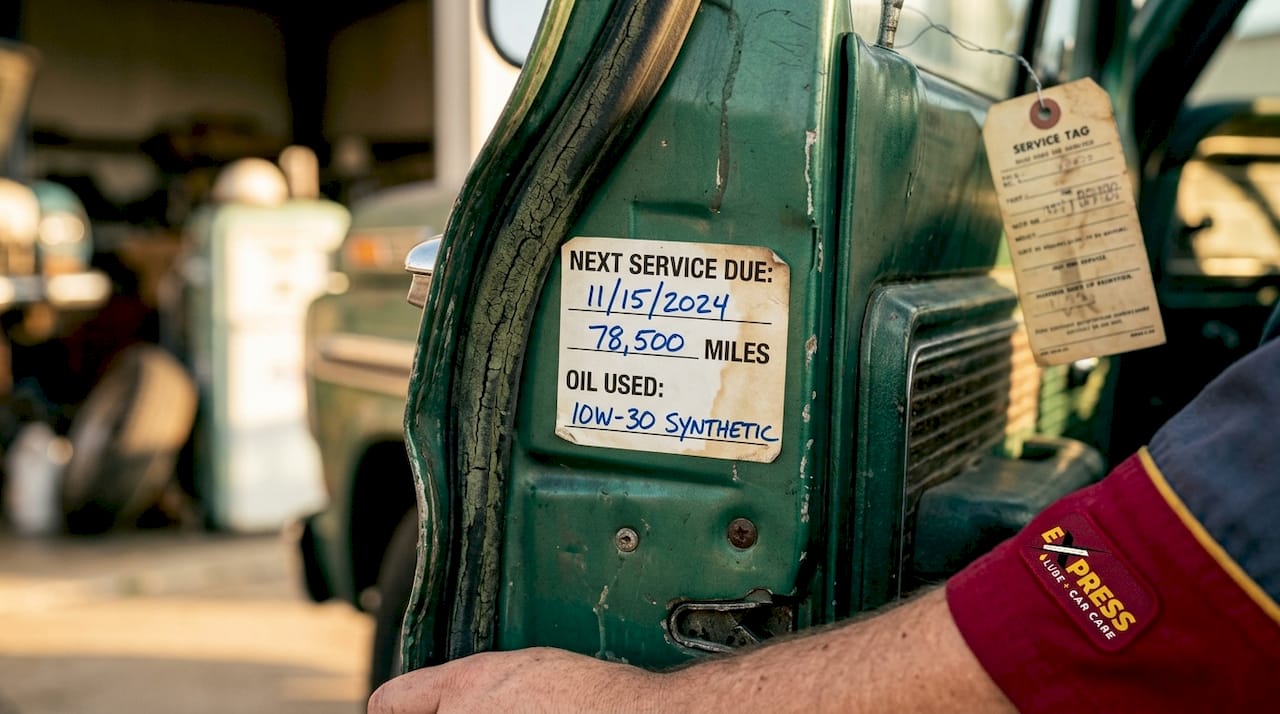
The key details printed on every sticker
Most oil change stickers include the next due mileage and date of the next recommended service, sometimes noting the oil type used. Here is what each field means:
- Current odometer reading: The mileage recorded at the time of your last oil change. This is your baseline.
- Next service mileage: The odometer reading at service plus a target interval, typically 3,000 miles for conventional oil or 5,000 to 7,500 miles for synthetic blends.
- Next service date: A calendar date, usually three to six months out, whichever comes first.
- Oil type or brand: Some shops note whether they used conventional, synthetic blend, or full synthetic oil. This matters when you need a top-off between services.
- Shop name and contact: Identifies who performed the service, which helps if you have questions later.
The mileage field is the most misread part. The number printed is not how many miles you have left. It is the odometer reading you need to reach before returning. If your car showed 42,000 miles at service and the sticker reads 47,500, you drive until your odometer hits 47,500, not until you have driven 47,500 miles total.
| Sticker Field | What It Means |
|---|---|
| Last service mileage | Odometer reading when oil was changed |
| Next due mileage | Target odometer reading for next change |
| Next due date | Calendar deadline, whichever comes first |
| Oil type noted | Grade or brand used, helpful for top-offs |
| Shop contact | Who performed the service |
Some service shops use thermal printers for stickers to print details automatically, ensuring uniformity and legibility, while others write details by hand. Handwritten stickers are more prone to reading errors, so always confirm the numbers match your receipt before leaving the shop.
How stickers work alongside your car’s oil-life monitor
Modern vehicles from manufacturers like GM, Ford, and Honda include an oil-life monitoring system that calculates remaining oil life as a percentage displayed on the dashboard. This system does not measure oil directly. It uses an algorithm that factors in engine temperature, RPM, load, and driving patterns to estimate when oil degradation reaches a service threshold.
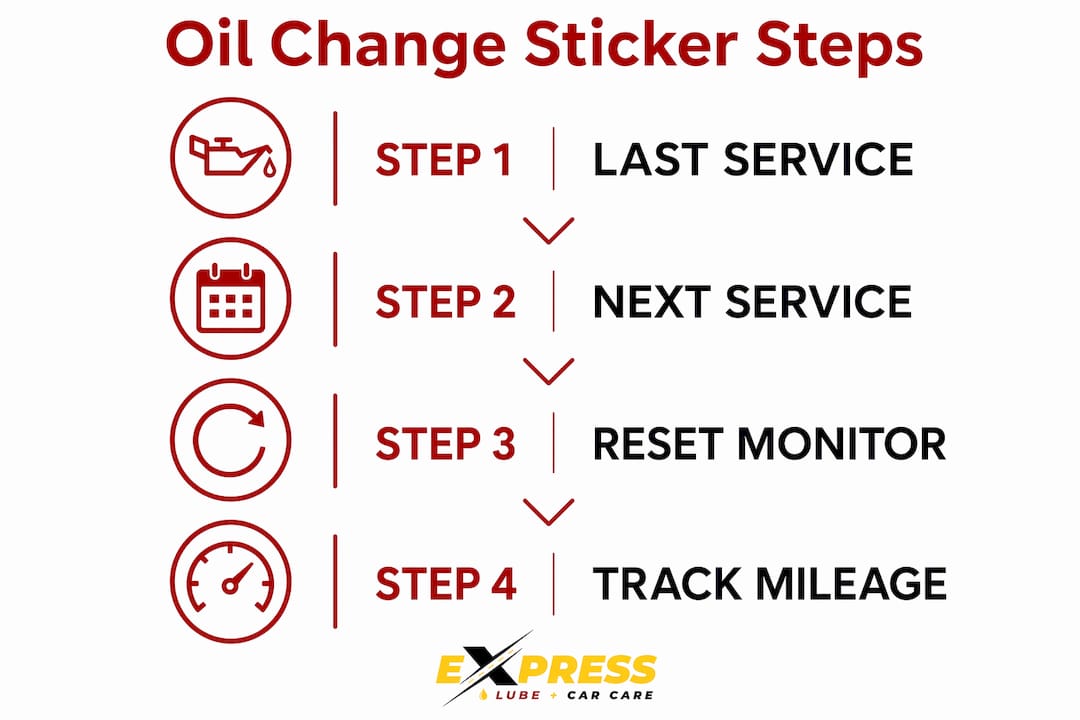
Oil change stickers serve as a backup reminder alongside the vehicle’s oil-life monitoring system, which varies by driving condition. Two cars with the same mileage can have very different oil-life readings depending on whether they were driven mostly on highways or in stop-and-go city traffic. The sticker gives you a fixed reference point, while the monitor gives you a condition-based one. Using both together is the most reliable approach.
Sticker intervals are typically mileage and date targets, but oil-life systems adapt based on driving conditions, so owners should treat both as complementary. If your sticker says you are due at 50,000 miles but your oil-life monitor hits 15% at 48,500 miles, trust the monitor and schedule service early. The sticker is a floor, not a ceiling.
Pro Tip: Resetting the vehicle’s oil-life monitor after service is essential for accurate next service calculation. Failing to reset it means the percentage reading becomes inaccurate and will not align with your actual oil condition. Ask your technician to confirm the reset before you leave.
What are the real benefits of oil change sticker reminders?
The benefits of oil change stickers go beyond simple convenience. They create a system of accountability between you, your vehicle, and your service provider. Here is why that matters in practice.
“A well-applied, accurate sticker reduces confusion for car owners by showing the next service due at a glance and building trust between service providers and customers.” — Cobra Systems
Oil change stickers help avoid driving past recommended intervals, reducing engine wear and costly repairs. Skipping oil changes allows combustion byproducts to accumulate in the oil, turning it into a thick sludge that accelerates wear on the crankshaft, camshaft, and bearings. Repairs to those components can run into thousands of dollars. A sticker that costs pennies to produce can prevent that outcome.
The oil change reminder system also improves communication between car owners and mechanics. When you bring your vehicle in, the technician can see at a glance when the last service occurred and what oil was used. That context speeds up the service process and reduces the chance of using an incompatible oil grade. It also gives you a quick way to verify that the work was actually done if you purchase a used vehicle.
Oil change stickers function as a visual trigger you cannot easily ignore, unlike phone reminders. A phone alert disappears with one tap. A sticker stays on your windshield until the next service. That constant presence in your direct line of sight is what makes the oil maintenance reminder tip so effective. Knowing when your car needs an oil change is easier when the answer is literally in front of you every time you start the car.
- Prevents overdue oil changes by providing a fixed, visible deadline
- Reduces engine wear by encouraging timely service before oil degrades
- Builds maintenance habits through consistent visual reinforcement
- Improves mechanic-to-owner communication by documenting service history at a glance
- Supports resale value by demonstrating a consistent maintenance record
Common mistakes drivers make with oil change stickers
Knowing how to use oil change stickers correctly means knowing where the system can break down. Several common errors lead drivers to either service their vehicle too early or, more dangerously, too late.
-
Trusting an unverified sticker. A sticker without confirmed accuracy can cause mistimed oil changes. Always verify the sticker information against your service receipt and odometer reading before relying on it. If the numbers do not match, the sticker is wrong.
-
Ignoring a missing or unreadable sticker. If the sticker is missing or faded, do not guess based on memory. Use your maintenance records or consult your owner’s manual for the manufacturer’s recommended interval. Your owner’s manual is the authoritative source for oil change intervals by mileage and driving conditions.
-
Applying a one-size-fits-all interval. The old rule of 3,000 miles no longer applies to most modern vehicles using full synthetic oil. If your shop applies a sticker based on a 3,000-mile interval but your manufacturer recommends 7,500 miles for synthetic oil, you are spending money on unnecessary service. Check your manual and ask your technician to match the sticker to the correct interval.
-
Forgetting to reset the oil-life monitor. The sticker and the dashboard monitor must stay synchronized. Resetting the oil-life monitor after each change is essential. Without the reset, the percentage reading drifts out of sync with actual oil condition, making the monitor unreliable.
-
Not adjusting for driving conditions. Severe driving conditions, including frequent short trips under five miles, towing, dusty environments, or extreme temperatures, shorten oil life faster than the sticker interval assumes. If your driving fits that profile, schedule service earlier than the sticker indicates.
Pro Tip: Keep a small maintenance log in your glove box. Each time you get an oil change, write down the date, mileage, and oil type. If a sticker ever goes missing or becomes unreadable, your log gives you an accurate backup without any guesswork.
Key takeaways
An oil change sticker reminder is the simplest and most reliable visual tool a driver has for staying on top of engine maintenance, but it works best when paired with your owner’s manual and dashboard oil-life monitor.
| Point | Details |
|---|---|
| Sticker definition | A small adhesive label showing next service mileage and date, placed where drivers see it daily. |
| Reading the mileage | The number shown is the target odometer reading, not miles remaining until service. |
| Sticker plus monitor | Use both the sticker and dashboard oil-life percentage together for the most accurate service timing. |
| Reset after service | Always confirm the oil-life monitor is reset after each oil change to keep readings accurate. |
| Verify before trusting | Cross-check sticker details against your receipt and owner’s manual before relying on them. |
What we have learned from years of applying oil change stickers
At Express Lube & Car Care, we apply oil change stickers to every vehicle we service, and over the years we have noticed something consistent: customers who pay attention to their sticker come in closer to the right interval than those who rely on memory or phone reminders alone. That is not a coincidence. The sticker is always there. It does not get buried in a notification drawer.
What surprises most drivers is how often the sticker they arrive with does not match their actual service history. We regularly see vehicles where the sticker mileage was filled in incorrectly, either because it was written by hand in a hurry or because the technician used a default interval that did not match the oil type used. That is why we take the time to confirm the odometer reading, the oil grade, and the manufacturer’s recommended interval before printing the sticker. An inaccurate sticker is worse than no sticker at all because it creates false confidence.
Our honest advice: treat the sticker as a starting point, not the final word. Cross-reference it with your owner’s manual and watch your dashboard oil-life percentage. When those three sources agree, you have a maintenance schedule you can trust. When they disagree, ask your technician to explain why. A good shop will always have a clear answer.
— Express Lube & Car Care
Stay on schedule with professional oil change service
At Express Lube & Car Care, every oil change includes a properly filled sticker applied to your windshield before you leave, so you always know exactly when to return.
No appointment is needed. Our certified technicians confirm your oil type, record your current mileage, and set the correct interval based on your vehicle’s manufacturer specifications, not a generic default. We also reset your oil-life monitor as part of every service. Whether you drive a daily commuter or a work truck, our oil change service specials make it easy to stay current without disrupting your schedule. Military personnel and healthcare providers receive special discounts as our way of giving back to the community. Stop in at our Plano location and leave with a sticker you can actually trust.
FAQ
What is an oil change sticker reminder?
An oil change sticker reminder is a small adhesive label placed on your windshield or door jamb after a service visit, showing the next recommended oil change date and odometer mileage. It acts as a constant visual cue to help drivers maintain their service schedule without relying on memory.
How do I read the mileage on an oil change sticker?
The mileage printed on the sticker is the odometer reading you need to reach before your next oil change, not the number of miles you have left to drive. For example, if the sticker reads 52,000 miles, schedule service when your odometer hits 52,000.
Do I still need a sticker if my car has an oil-life monitor?
Yes. The oil-life monitor adapts to driving conditions and gives a percentage-based estimate, while the sticker provides a fixed mileage and date reference. Using both together gives you the most complete picture of when service is actually due.
What should I do if my oil change sticker is missing or unreadable?
Check your maintenance records or service receipts for the last oil change date and mileage. If those are unavailable, consult your owner’s manual for the manufacturer’s recommended interval and schedule service based on that guidance.
Does the oil-life monitor need to be reset after every oil change?
Resetting the oil-life monitor after each oil change is required for accurate readings. Without a reset, the system continues counting down from the previous service point, making the percentage display unreliable for future maintenance planning.