

You've probably heard the old rule: "change your oil every 3,000 miles." While once standard advice, this is one of the most persistent myths in automotive maintenance. For most modern vehicles, especially those using full synthetic oil, this guidance is outdated. Today, it's common for cars to safely travel between 7,500 and 10,000 miles between services.
So, what's the correct interval? The most reliable sources are your vehicle's owner's manual and its built-in oil life monitoring system. Let's explore the science behind this important maintenance task.
The Modern Reality of Oil Change Intervals
The 3,000-mile recommendation originates from an era when engine technology and oil formulations were far less advanced. Decades ago, vehicles relied on basic conventional oils that broke down quickly under the high-stress conditions inside an engine. Thanks to significant advancements in engine design and the superior chemical engineering of modern synthetic oils, today's vehicles can go much further without compromising engine health.
To understand why, it's helpful to think of engine oil as the lifeblood of your vehicle. It performs three critical functions:
- Lubrication: It forms a protective film over moving parts, preventing the immense friction and wear that would otherwise occur between metal components.
- Cooling: It absorbs and transfers heat away from high-temperature areas like the pistons and cylinder walls, preventing overheating.
- Cleaning: It suspends and carries away contaminants—such as dirt, microscopic metal particles, and combustion byproducts—to the oil filter, keeping the engine clean.
Over time, oil degrades from heat and oxidation and becomes saturated with these contaminants, losing its ability to perform these jobs effectively. This is why oil changes are necessary.
Debunking the 3,000-Mile Myth
The 3,000-mile guideline was established in the 1950s for carbureted engines running on non-detergent conventional oils that degraded rapidly. Technology has evolved dramatically since then. By the 1980s, engineering studies confirmed that modern oils could easily last 7,500 to 10,000 miles in a well-maintained engine. For a deeper dive into the history, Men's Journal did a great piece on the 3,000-mile myth.
Adhering to a 3,000-mile interval today often results in unnecessary expense and the disposal of perfectly good oil. The correct interval is a function of the vehicle, the specific oil used, and its operating conditions.
This table illustrates the evolution from outdated advice to modern, data-backed recommendations.
Oil Change Intervals Old Rule vs. Modern Reality
| Oil Type | Outdated Interval (The 3,000-Mile Myth) | Modern Recommended Interval |
|---|---|---|
| Conventional Oil | 3,000 miles | 5,000 – 7,500 miles |
| Synthetic Blend Oil | 3,000 miles | 6,000 – 8,000 miles |
| Full Synthetic Oil | 3,000 miles | 7,500 – 15,000 miles |
As shown, modern oil formulations are engineered for superior longevity, saving you both time and money.
Your Car's Onboard Computer Knows Best
One of the most valuable innovations in modern vehicles is the Oil Life Monitoring System (OLMS). This is not a simple mileage timer; it's a sophisticated algorithm that analyzes your specific driving patterns to determine the remaining useful life of your oil.
Instead of relying on a fixed mileage, the system considers factors like engine temperature, trip duration, and engine load to calculate when a change is truly needed. For drivers in Plano, trusting this system is key to an efficient and effective maintenance schedule. If you are ever unsure about a dashboard warning, the professionals at Express Lube Plano can check it out for you to ensure your vehicle receives the correct service.
Decoding What Really Impacts Your Oil Change Schedule
Determining how often to change your oil involves more than just tracking mileage. A vehicle's actual needs are dynamic, influenced by several key factors that dictate when service is required.
Think of engine oil as a resource that is consumed at different rates depending on the demands placed upon it. Understanding these variables is the key to creating an intelligent maintenance plan that protects your engine without wasting resources. Let's break down the five most important factors.
Your Oil Type and Vehicle Age
The type of oil in your engine is the single most significant factor in determining its change interval.
Conventional oil is a refined petroleum product. It provides adequate lubrication under normal conditions but is more susceptible to thermal breakdown, requiring changes every 5,000 to 7,500 miles. In contrast, full synthetic oil is chemically engineered with precisely uniform molecules and advanced additives that resist degradation, clean the engine more effectively, and perform better at extreme temperatures. This allows most modern cars to safely extend their intervals to 7,500 to 15,000 miles.
A vehicle's age is also a crucial consideration. Older engines, particularly those with high mileage, may experience more "blow-by" (combustion gases leaking past piston rings), which contaminates oil faster. They may benefit from more frequent changes. Newer engines are built with tighter tolerances and are specifically designed to leverage the long-life properties of synthetic oils.
This flowchart provides a helpful visual starting point.
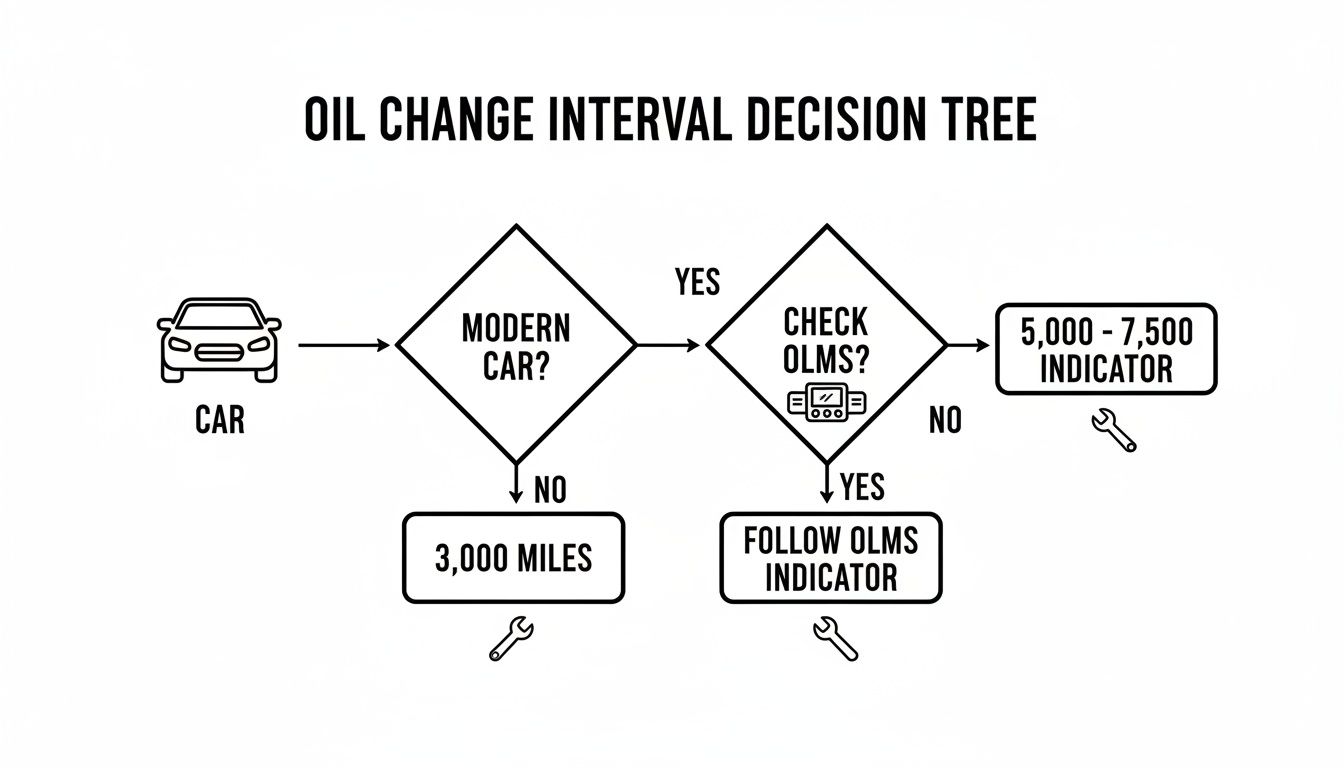
As you can see, modern cars equipped with an Oil Life Monitoring System (OLMS) provide direct guidance. For older vehicles without one, a schedule based on mileage and oil type is appropriate.
Driving Habits and Operating Conditions
Your driving patterns have a direct and significant impact on your oil's lifespan. A long highway cruise is far less demanding on oil than stop-and-go city traffic.
- Severe Driving: This category includes common habits like frequent short trips (under 10 miles), driving in heavy traffic, or operating in dusty environments. These conditions prevent the engine from reaching an optimal temperature long enough to burn off moisture and fuel contaminants, accelerating oil degradation.
- Normal Driving: This typically refers to longer trips at consistent highway speeds, which is much easier on the engine and its oil.
The automotive industry's definition of "severe" driving conditions often describes the typical daily commute for many people. If your routine involves heavy traffic and short distances, your vehicle operates under severe conditions and requires more frequent oil changes.
Towing heavy loads or operating in extreme temperatures also places significant stress on the engine. The intense Plano summer heat, for example, forces oil to work harder to cool and lubricate engine components. Learn more in our guide on why regular oil changes matter in the Texas heat. This added thermal stress breaks down oil much faster than a gentle highway drive, making timely service essential.
Conventional vs. Synthetic Oil: What’s Really in Your Engine?
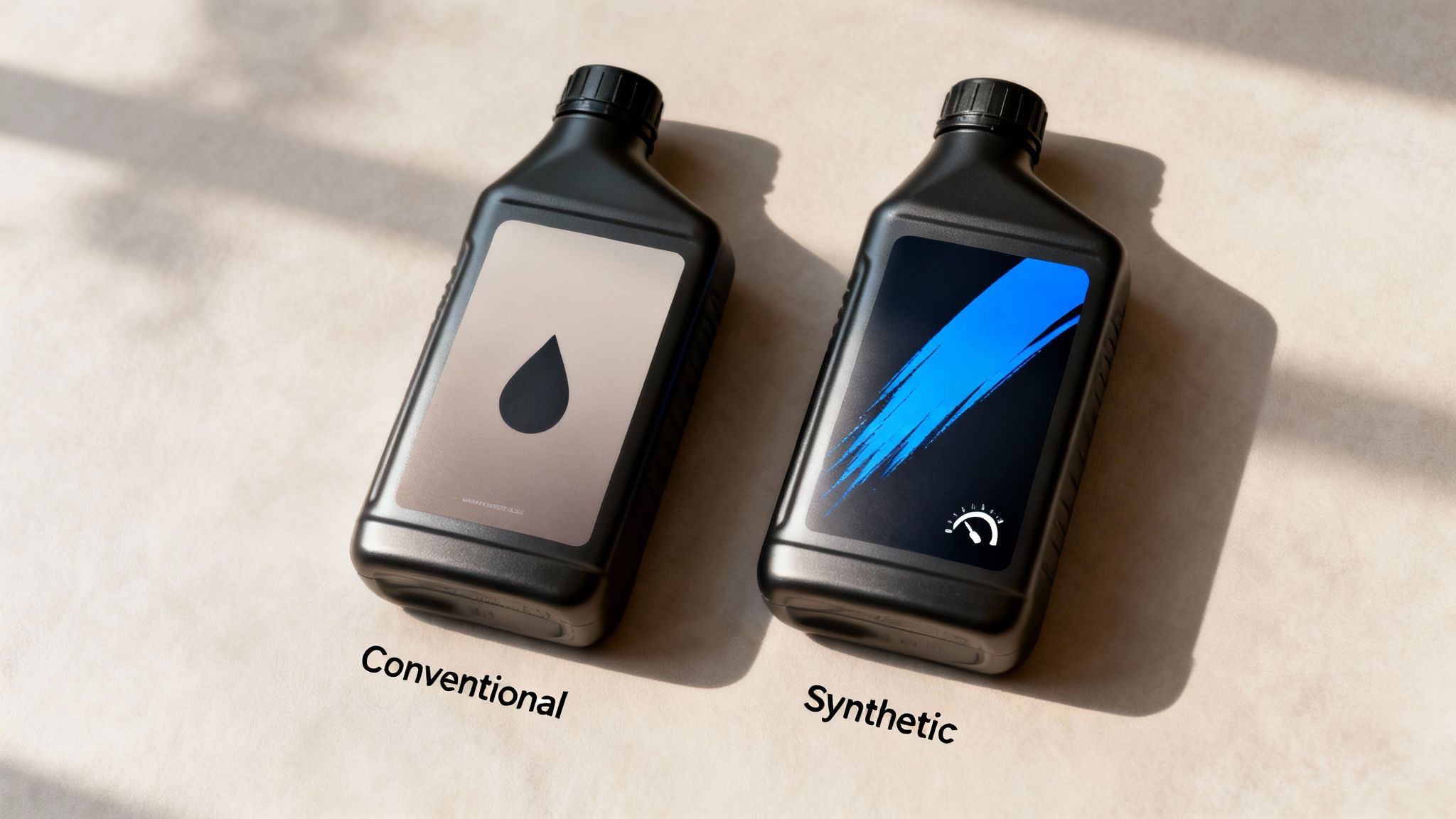
The choice of motor oil is a critical decision for your engine's long-term health and is the primary factor determining your service frequency. This choice directly influences performance, protection, and overall cost of ownership.
A simple analogy: conventional oil is like a basic, reliable tool. Synthetic oil is a high-precision instrument. Both can perform the required task, but one is specifically engineered for superior performance under extreme stress.
The Clear Advantage of Synthetic Oil
Conventional motor oil is derived directly from crude oil through a refining process. It provides adequate lubrication for many engines under normal operating conditions. However, its molecules are irregular in size and shape, making it more vulnerable to breaking down at high temperatures. This is why it requires more frequent changes, typically every 5,000 to 7,500 miles.
Synthetic oil, by contrast, is engineered in a laboratory. Scientists break down petroleum molecules and rebuild them into pure, uniform structures, eliminating the impurities found in conventional oil.
This advanced process gives synthetic oils several key advantages:
- Superior Engine Protection: Synthetics maintain their viscosity (flow characteristics) better across a wide range of temperatures. They flow readily on a cold morning and don't thin out excessively in the Plano summer heat, ensuring constant protection.
- Enhanced Engine Cleanliness: They are formulated with advanced detergents and dispersants that prevent the formation of sludge and deposits, keeping internal engine components clean.
- Extended Service Life: Due to its robust chemical stability, synthetic oil resists oxidation and thermal breakdown far better, allowing for service intervals of 10,000 miles or more in many applications.
For a more detailed technical comparison, explore our guide to synthetic vs. conventional oil.
While synthetic oil has a higher upfront cost per quart, its extended drain intervals often make it the more economical choice over the long term, requiring fewer services over the life of the vehicle.
The automotive industry has embraced this technology. While a surprising 75% of U.S. drivers may still cling to the outdated 3,000-mile myth, the global trend is clear. With 65% global adoption of synthetic oil, drivers are safely extending intervals to 10,000 miles and experiencing engine wear reductions of up to 50%.
Unsure which oil is right for your vehicle? Our ASE-certified technicians at Express Lube Plano can provide an expert recommendation based on your car's specifications and your driving habits.
Understanding Your Car's Oil Life Monitoring System
Most modern vehicles are equipped with a feature designed to eliminate the guesswork from oil changes: the Oil Life Monitoring System (OLMS). Understanding and trusting this system is the most effective way to know precisely when your car requires service.
It's important to recognize that the OLMS is not a simple mileage counter. It's a sophisticated algorithm that functions like a real-time diagnostic tool for your engine's oil, analyzing actual operating conditions to calculate its remaining life with remarkable accuracy.
How Your OLMS Works
Instead of relying on a predetermined mileage, the OLMS computer continuously monitors a range of variables that reflect how you drive your vehicle.
These data points often include:
- Engine Revolutions: A measure of the total work the engine has performed.
- Engine Temperature: Crucial for determining if contaminants like moisture are being burned off.
- Trip Duration: The system can distinguish between short, stressful city trips and less-demanding highway miles.
- Driving Conditions: The algorithm can even account for factors like towing or extended periods of idling.
Based on this data, the system calculates the percentage of remaining oil life, providing a dynamic and accurate service schedule tailored specifically to you.
Learning to trust your car's OLMS allows you to follow a precise, data-driven maintenance schedule. This is a significant advancement over outdated, one-size-fits-all advice and prevents unnecessary expenditures on premature oil changes.
Why You Can Trust the Technology
This technology is not new or unproven; it represents a major leap forward in vehicle maintenance. Today, 92% of new vehicles utilize these electronic monitoring systems. This technology has been proven to reduce oil waste by 30-50% by recommending service only when it is functionally necessary.
Across major global markets, where over 80 million cars are sold annually, this technology has dramatically reduced the number of premature oil changes, saving consumers an estimated $1.5 billion each year. To learn more about how automotive technology has evolved, you can explore more insights on global vehicle production trends.
The OLMS and Visual Checks
While the OLMS is an incredibly intelligent system, it cannot physically check the oil level in your crankcase. Although a sensor may trigger a warning if the level becomes critically low, it is still an excellent practice to manually check your dipstick about once a month.
This simple visual inspection is your best defense against detecting potential leaks or oil consumption issues early, ensuring your engine always has the proper amount of oil for protection.
Clear Warning Signs Your Car Needs an Oil Change Now
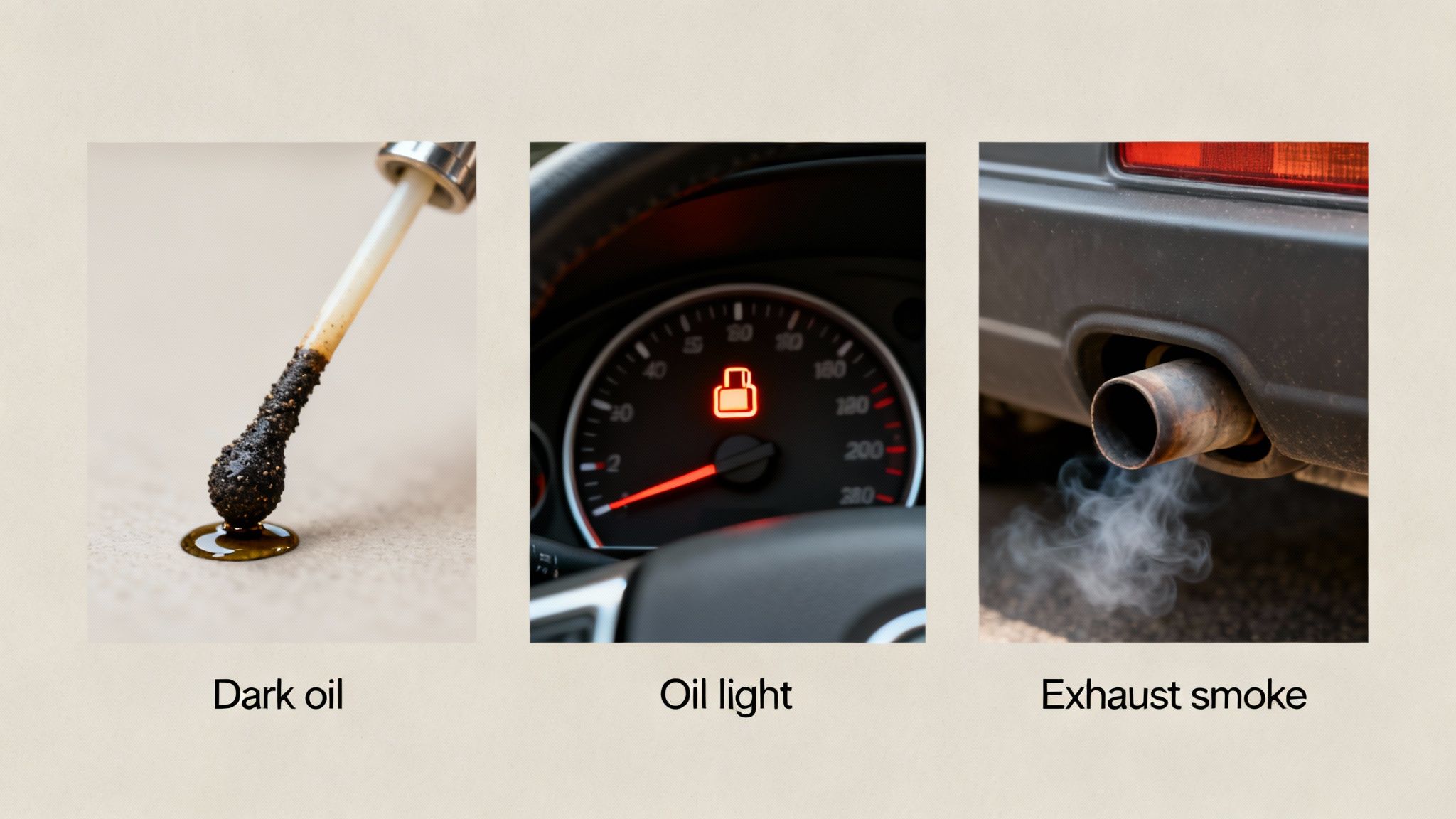
While following a maintenance schedule is ideal, you should never ignore the direct signals your vehicle provides when its oil is failing. These are critical warnings that a small maintenance issue could escalate into a major, expensive repair.
Ignoring these warnings allows degraded oil to cause significant harm to your engine. Learning to recognize these symptoms is an essential skill for any driver. They indicate that it's time to seek immediate professional service.
What to Watch For
If you observe any of the following signs, it's a clear indication that your oil is low, excessively dirty, or no longer providing adequate protection. Do not wait for your next scheduled service—take action immediately.
Dashboard Warning Lights: The most urgent sign is the oil pressure warning light (often shaped like an oil can). This light indicates a loss of normal oil pressure, a condition that can cause severe engine damage very quickly. The check engine light can also be triggered by oil-related issues.
Dark and Gritty Oil: Fresh engine oil has a clean, translucent amber color. As it circulates, it collects contaminants and darkens. If you check the oil and it appears black, opaque, and feels gritty between your fingers, it is saturated with contaminants and has lost its lubricating properties. Our guide on how to check the oil in your car explains this simple but vital procedure.
Using dirty oil is analogous to cleaning a surface with a dirty cloth—it primarily redistributes the grime. When oil is saturated with contaminants, it can no longer form a protective barrier for your engine’s moving parts.
What to Listen and Smell For
Sometimes, the first indications of an oil problem are auditory or olfactory. Pay close attention to any new or unusual changes in your vehicle's operation.
Unusual noises from under the hood are a serious symptom. If you hear knocking, rumbling, or ticking sounds, it often means the oil is not providing sufficient lubrication, allowing metal components to make contact.
Another serious red flag is the smell of burning oil inside the cabin or visible blue or grey smoke from the exhaust pipe. This often points to an oil leak where oil is dripping onto hot engine or exhaust components. If you experience these symptoms, visit Express Lube Plano immediately for a professional diagnosis to prevent catastrophic engine failure.
Finding a Partner for Honest Oil Changes in Plano
Knowing when to change your oil is the first step. The second is finding an automotive service center that respects your understanding and prioritizes your vehicle's specific needs. For drivers in Plano, Express Lube is that partner. We provide honest, data-driven advice tailored to your vehicle, not an outdated industry myth.
We believe in empowering our customers with knowledge. Our ASE-certified technicians will not recommend a generic 3,000-mile service for a vehicle engineered to go 10,000 miles. Instead, we will explain the readings from your Oil Life Monitoring System, discuss your driving habits, and help you determine the optimal service interval. Our goal is smart, efficient maintenance, not upselling unnecessary services.
Expertise You Can Actually Trust
At Express Lube Plano, our service model is built on professional expertise and customer convenience. We understand your time is valuable, which is why our oil changes are efficient and do not require an appointment. We get you back on the road quickly without compromising quality, using only premium oils and filters that meet or exceed your vehicle's manufacturer specifications.
An oil change is not just a routine task—it is the single most important piece of preventative maintenance you can perform to ensure your engine's longevity. We treat it with the seriousness it deserves, ensuring it is done correctly every time.
Real Savings for Our Plano Neighbors
As a proud member of the Plano community, we believe that proper vehicle care should be accessible and affordable. We offer transparent pricing and valuable discounts to help our neighbors save.
Check out our current offers:
- First-Time Customers: Get $20 off your first oil change with us.
- Community Heroes: We offer special discounts for military personnel and first responders as a thank you.
- Ladies Day Wednesdays: Every Wednesday, ladies get $25 off their oil change service.
When your vehicle needs an oil change, you need a team founded on honesty and expertise. Drive with confidence knowing Express Lube Plano is dedicated to keeping your car running smoothly for years to come.
A Few Final Questions We Hear Around the Shop
Even with a detailed explanation, a few questions often remain. These are some of the most common inquiries we receive from drivers in Plano, and we're happy to address them.
Can I Really Go 10,000 Miles Between Oil Changes?
Yes, for many modern vehicles, this is entirely safe and appropriate, provided two conditions are met: you must use a high-quality full synthetic oil, and your vehicle's manufacturer must approve that extended interval.
Driving habits also play a role. If your driving is classified as "severe" (frequent towing, lots of short trips), you will need to shorten the interval. The best practice is to consult your owner’s manual first, then discuss your specific driving patterns with a trusted technician to determine the ideal schedule.
What Happens If I Wait Too Long for an Oil Change?
Postponing an oil change is one of the most detrimental things you can do to an engine. As oil ages and becomes saturated with contaminants, its fundamental properties degrade. It can no longer lubricate, clean, or cool effectively.
This leads directly to increased friction, the formation of damaging engine sludge, and elevated operating temperatures. This accelerated wear can cause severe damage and, in worst-case scenarios, complete engine failure. It transforms a simple, inexpensive maintenance task into a potentially catastrophic and costly repair.
Topping off low oil is a necessary short-term measure, but it is never a substitute for a complete oil change. Adding fresh oil does not remove the sludge, metal particles, and other contaminants already circulating within the old oil.
Is Topping Off My Oil Enough?
No, it is not a sufficient long-term solution. While you should always add oil if the level is low to maintain proper lubrication, this only addresses the quantity, not the quality.
The primary problem with old oil is the presence of harmful contaminants. Only a complete service—draining the old oil, replacing the filter, and refilling with fresh oil—can remove these damaging particles from your engine.
Does My Older Car Need More Frequent Service?
Generally, yes. Vehicles with higher mileage—especially those exceeding 75,000 miles—often benefit from more frequent oil changes.
As engine components wear, clearances can increase, leading to greater oil contamination. Shortening the service interval to the 5,000 to 7,500-mile range, even with synthetic oil, is a wise preventative measure. Using a "high-mileage" oil formulation can also be beneficial, as these oils contain additives designed to condition older seals and gaskets, helping to prevent leaks.
When you need service you can count on, the team at Express Lube & Car Care is here to help you drive with confidence. Schedule your next service with us today!