

Most vehicles need an oil change every 5,000 to 10,000 miles, depending on oil type, or at least once a year, whichever comes first. Skip the guesswork: check your owner’s manual or your oil life monitor first.
TL;DR:
- Most vehicles should have an oil change based on the manufacturer’s recommended mileage or time limit, whichever comes first, with full synthetic oils lasting up to 10,000 to 15,000 miles.
- Driving in severe service conditions, such as short trips, towing, or extreme temperatures, can shorten oil change intervals by up to half and should trigger more frequent service.
- Relying solely on the oil life monitor is safer than fixed mileage reminders, but drivers should treat 15% to 20% oil life remaining as an alert to plan for service.
- Conventional oils require more frequent changes around 3,000 to 5,000 miles, while synthetic oils can often go twice that distance under normal driving conditions.
- It is essential to address dashboard warnings, oil discoloration, engine knocking, or burning smells promptly to prevent accelerated engine wear and potential damage.
Table of Contents
- How Long Does an Oil Change Interval Actually Last?
- What Driving Habits Push Your Oil Change Sooner?
- Synthetic vs. Conventional: Which Oil Buys You More Time?
- Can You Trust the Oil Life Monitor?
- Why Does Time Matter as Much as Mileage?
- What Are the Warning Signs You’ve Waited Too Long?
- What Happens During a Standard Oil Change?
- How Express Lube & Car Care Applies These Rules
- Our Take: Stop Trusting the 3,000-Mile Habit
- Ready for Your Next Oil Change?
- Sources
- FAQ
How Long Does an Oil Change Interval Actually Last?
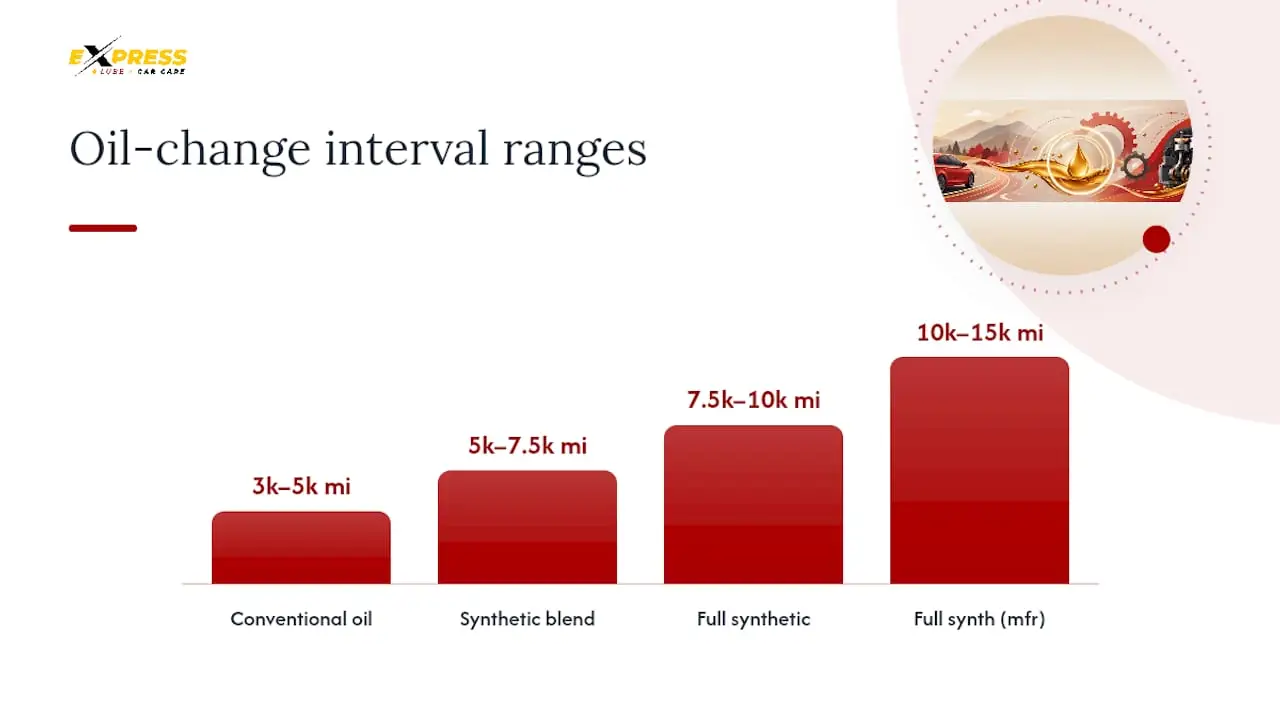
The honest answer depends on what’s in your crankcase and how your manufacturer built the engine. Full synthetic oil generally supports intervals of 7,500 to 10,000 miles, and some manufacturer maintenance schedules stretch that to 10,000 to 15,000 miles under normal driving. Conventional oil breaks down faster and still calls for changes closer to 3,000 to 5,000 miles. Synthetic blends land in between, typically good for 5,000 to 7,500 miles.
Mileage isn’t the only clock running. Almost every manufacturer also sets a 12-month limit regardless of how few miles you’ve driven, because oil degrades chemically over time even when it’s just sitting in the pan.
Here’s the quick reference most drivers need:
- Full synthetic: 7,500 to 10,000 miles, or up to 15,000 on some manufacturer schedules
- Synthetic blend: roughly 5,000 to 7,500 miles
- Conventional oil: 3,000 to 5,000 miles
- Time limit: 12 months, no matter how little you’ve driven
- Severe service (see below): cut all of the above by roughly a third to a half
One rule matters more than any of these numbers: your owner’s manual and your car’s oil life monitor outrank generic intervals every time. A rule of thumb is a starting point, not a substitute for what the manufacturer engineered your specific engine to handle.
What Driving Habits Push Your Oil Change Sooner?
Engineers write oil change intervals for what they call “normal service.” A lot of daily driving doesn’t qualify. If your routine matches several of the patterns below, you’re in what manufacturers label severe service, and it changes the math.
- Frequent short trips. Drives under five minutes never let the engine reach full operating temperature, so moisture and combustion byproducts stay trapped in the oil instead of evaporating out, which speeds up sludge formation.
- Towing or hauling heavy loads. Extra strain raises oil temperature and accelerates thermal breakdown.
- Extended idling or stop-and-go traffic. Long idle periods generate heat without the airflow that helps cool the system.
- Dusty or unpaved roads. Airborne particulates work past filtration and act like fine sandpaper inside the engine.
- Extreme heat or cold. Both ends of the temperature range stress oil’s viscosity and additive package.
- High-mileage engines. Once an engine passes roughly 75,000 miles, fuel dilution and increased blow-by past aging piston rings accelerate oil degradation, which is worth factoring in even if the odometer alone doesn’t trigger a warning.
The mechanism behind all of these is the same: heat, moisture, and contaminants break down oil’s additive package faster than clean highway miles do. A reasonable adjustment is to shorten your interval by 30% to 50% if two or more of these apply regularly, and to default to the severe-service schedule printed in your owner’s manual rather than the standard one.
Pro Tip: If your daily commute is under 10 minutes each way, you’re a textbook severe-service driver even if your car never sees a dirt road. Treat your interval like a shorter one from the start rather than waiting for a dashboard warning to tell you.
Synthetic vs. Conventional: Which Oil Buys You More Time?
Full synthetic oil is engineered with a more uniform molecular structure and a stronger additive package, which is why it resists breakdown far longer than conventional oil and supports those 7,500 to 10,000 mile intervals. Conventional oil, refined directly from crude with fewer synthetic additives, still does the job for older engines and simpler driving patterns, but it oxidizes faster and needs attention closer to every 3,000 to 5,000 miles. Synthetic blends split the difference, giving some of synthetic’s durability at a lower price point.
- Choose full synthetic if: you drive a turbocharged engine, tow regularly, or want the longest safe interval
- Choose conventional if: you drive an older, naturally aspirated engine under light use and want to keep costs down
- Choose a blend if: you want better protection than conventional without the full synthetic price
Turbocharged engines deserve a specific note. The oil lubricating turbo bearings runs at much higher thermal stress, and degraded oil can coke inside the turbo, a buildup that shortens the turbo’s life. If you drive a turbocharged vehicle, paying more for full synthetic isn’t optional. Read more about how synthetic and conventional oil compare before your next fill.
Can You Trust the Oil Life Monitor?
Your oil life monitor, or OLM, is smarter than a fixed mileage sticker. Instead of counting miles alone, it runs an algorithm that tracks engine temperature, trip length, idle time, and RPM patterns to estimate how much useful life remains in the oil. That’s a meaningfully better approach than “change every 3,000 miles,” because it actually reflects how you drive, not an average from decades ago.
It’s also, by design, conservative. Independent testing has found OLMs tend to trigger earlier than strictly necessary, building in a safety margin rather than cutting oil life to the exact chemical limit. Real-world oil sampling has backed this up: analysts have found usable life remaining in oil even after the monitor called for a change.
That margin is a feature, not a flaw. The OLM doesn’t measure metal wear or catch a failing seal, so it’s not a complete diagnostic. Use it this way:
- Treat 15% to 20% remaining as your window to schedule service, not the day you must drop everything
- Don’t ignore a dashboard oil light waiting for the percentage to hit zero
- Remember the OLM estimates chemical oil life, not mechanical engine health
For commuters wondering how this plays out on their specific mileage pattern, our oil change interval guide for commuter vehicles walks through it in more detail.
Why Does Time Matter as Much as Mileage?
Oil doesn’t just wear out from friction. It oxidizes chemically over time, absorbing moisture from condensation and slowly breaking down even while your car sits in the driveway. That’s why manufacturers commonly set a 12-month limit regardless of how few miles you’ve logged. A car that’s driven 2,000 miles a year still needs that annual service.
This matters most for low-mileage owners: retirees, second-car households, seasonal drivers. It’s tempting to assume light use means the oil is basically fresh. It isn’t. Moisture accumulation over a year of short trips and long idle stretches can lead to sludge buildup even without the mileage to show for it.
- Mark your calendar for an annual oil change regardless of odometer reading
- Check oil level and color between changes if the car sits for weeks at a time
- Don’t let a low-mileage year talk you out of the 12-month mark
What Are the Warning Signs You’ve Waited Too Long?
Some signals are impossible to miss, and some are easy to explain away until they get expensive.
- Dashboard warnings. An oil pressure light or an OLM reading at 0% means stop deferring and schedule service.
- Dark, gritty oil on the dipstick. Fresh oil is amber and translucent; oil that’s black and thick has lost its ability to lubricate properly.
- Engine noise or knocking. Ticking or knocking sounds often mean oil has thinned to the point it’s no longer protecting moving parts.
- Burning smell or visible smoke. Both point to oil breaking down under heat faster than it should.
Delaying service briefly won’t destroy an engine, but going thousands of miles past due accelerates wear, promotes sludge buildup, and on turbocharged engines risks coking that shortens turbo life. If you’re seriously overdue, don’t try to “catch up” gradually. Get an oil change and a quick inspection to check for accumulated damage. Our guide to signs your car needs an oil change covers the full list of dashboard and physical cues worth knowing.
What Happens During a Standard Oil Change?
A typical visit follows a set sequence: drain the old oil, replace the oil filter, refill with the correct grade and volume, reset the oil life monitor, and often include a quick check of fluid levels, tire pressure, and belts. Many shops also do a visual inspection for leaks while the car is up.
Plan on 20 to 45 minutes for the appointment itself. The low end applies to a straightforward conventional oil change; the high end covers full synthetic fills, specialty filters, or vehicles that need extra access time under the hood.
Cost mainly comes down to three factors:
- Oil type, with full synthetic commanding a premium over conventional
- Filter type, especially on vehicles requiring specialty or OEM-specific filters
- Vehicle specifics, since some engines need more oil volume or harder-to-reach filter housings
How Express Lube & Car Care Applies These Rules
We don’t hand every customer the same mileage number and call it a day. Our ASE-certified technicians look at your owner’s manual specs, your current OLM reading, and how you actually drive before recommending an interval, then note it on your digital inspection so you have a record for next time. No-appointment service means you can act on a dashboard warning the same day you see it, backed by our 24 month, 24,000 mile warranty. We also offer discounts for military and healthcare workers. Fleet managers juggling multiple vehicles can find more on scheduling by usage data in our fleet oil change guide.
Our Take: Stop Trusting the 3,000-Mile Habit
The 3,000-mile rule persists because it’s simple, not because it’s accurate for most cars on the road today. It made sense decades ago with thinner conventional oils and less precise engines. It doesn’t reflect what a modern full synthetic fill or a well-calibrated oil life monitor can actually deliver. For most drivers, following that old habit means paying for oil changes you don’t need yet.
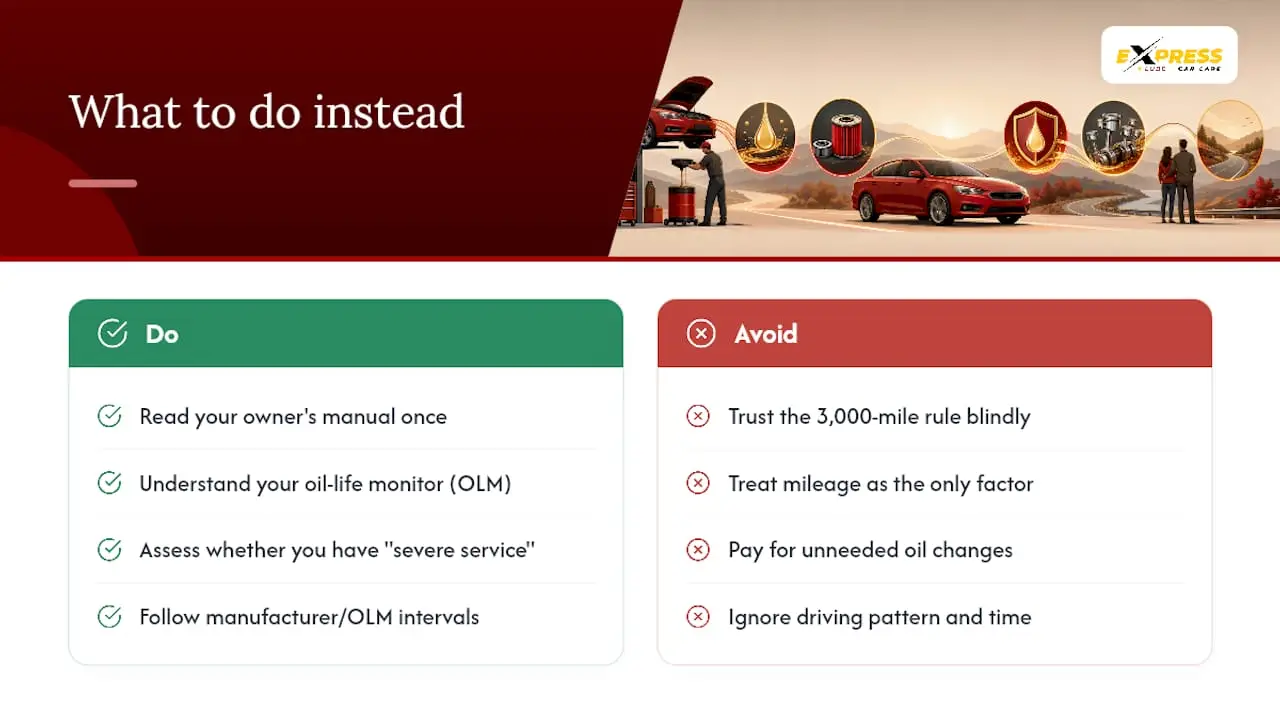
Where conventional advice really falls short is treating mileage as the only variable. Time matters just as much, and driving pattern matters more than raw distance. A low-mileage retiree and a stop-and-go commuter can log the same odometer numbers in a year and need completely different service schedules.
If you take one thing from this: read your owner’s manual once, understand what your OLM is telling you, and be honest with yourself about whether your driving qualifies as severe service. That combination beats any generic interval, synthetic or not, every time.
— Express Lube & Car Care
Ready for Your Next Oil Change?
Express Lube & Car Care skips the appointment book entirely, so whether your dashboard light just came on or your OLM is sitting at 15%, you can drive in the same day instead of waiting on a scheduling slot. That matters most when your oil life monitor catches you off guard on a Tuesday and you can’t afford to plan a week ahead.
Our ASE-certified technicians will check your owner’s manual specs and OLM reading against your actual driving pattern, then walk you through exactly what your vehicle needs, no upsell script required. Military personnel and healthcare workers receive a discount on service. Check our current oil change and service specials and stop in for service on your schedule, not ours.
Sources
For deeper reading, see Consumer Reports on oil change basics, How-To Geek on OLM accuracy, and SlashGear’s oil life monitor testing.
- The truth about your oil life monitor: How it works and when to really change your oil
- Oil life indicators: accuracy explained
FAQ
How often do you realistically need an oil change?
Most drivers on full synthetic oil can go 7,500 to 10,000 miles or 12 months, whichever comes first, while conventional oil needs attention closer to every 3,000 to 5,000 miles.
Is $100 normal for an oil change?
A full synthetic oil change with a premium filter can reasonably land near that range depending on your vehicle and local pricing, while conventional oil changes are typically less expensive; the exact number depends on oil type and filter.
Is two months too soon for an oil change?
Yes, in most cases, unless you’ve already logged several thousand miles, driven mostly in severe-service conditions, or your OLM or dashboard light is telling you otherwise.
How late can you do an oil change?
There’s no hard failure point, but going thousands of miles past your interval or past the 12-month mark accelerates wear and sludge buildup, so treat an overdue oil light as something to act on within days, not weeks.