

Most cases of an AC compressor not engaging trace back to one of three things: a tripped low-pressure safety switch from low refrigerant, a blown fuse or bad relay in the compressor circuit, or a worn clutch with too much air gap. Check the fuse and relay first, then the refrigerant pressure. If the pulley wobbles, grinds, or smokes, stop driving and get it looked at before anything else.
TL;DR:
- Low refrigerant levels often trip the low-pressure switch, preventing compressor engagement and requiring proper leak detection before recharging.
- Electrical faults, including blown fuses, faulty relays, or wiring issues, account for most cases where the compressor clutch does not activate.
- A worn clutch with an excessive air gap or a seized pulley bearing can physically block engagement, with symptoms like wobbling, grinding, or pulley wobble indicating mechanical failures.
- Safety concerns arise when pulley wobble, grinding, or smoke occur, requiring immediate stop and professional repair; otherwise, a slipping clutch usually does not pose a hazard.
- Systematic diagnosis starting with visual inspection, electrical testing, refrigerant pressure check, and advanced diagnostics ensures accurate troubleshooting and avoids unnecessary parts replacement.
Table of Contents
- Why Is My AC Compressor Off? How the Clutch System Works
- Could Low Refrigerant Be Stopping Compressor Engagement?
- Are Fuses, Relays, or Coil Wiring Causing the Problem?
- Is a Worn Clutch or Seized Pulley Bearing the Culprit?
- What’s the Safest Order to Troubleshoot an AC Compressor?
- What DIY Fixes and Tools Actually Work Here?
- When Should You Stop Driving and Call a Professional?
- How Express Lube & Car Care Diagnoses a Clutch That Won’t Engage
- Get Your AC Compressor Diagnosed the Right Way
- Sources
- FAQ
Why Is My AC Compressor Off? How the Clutch System Works
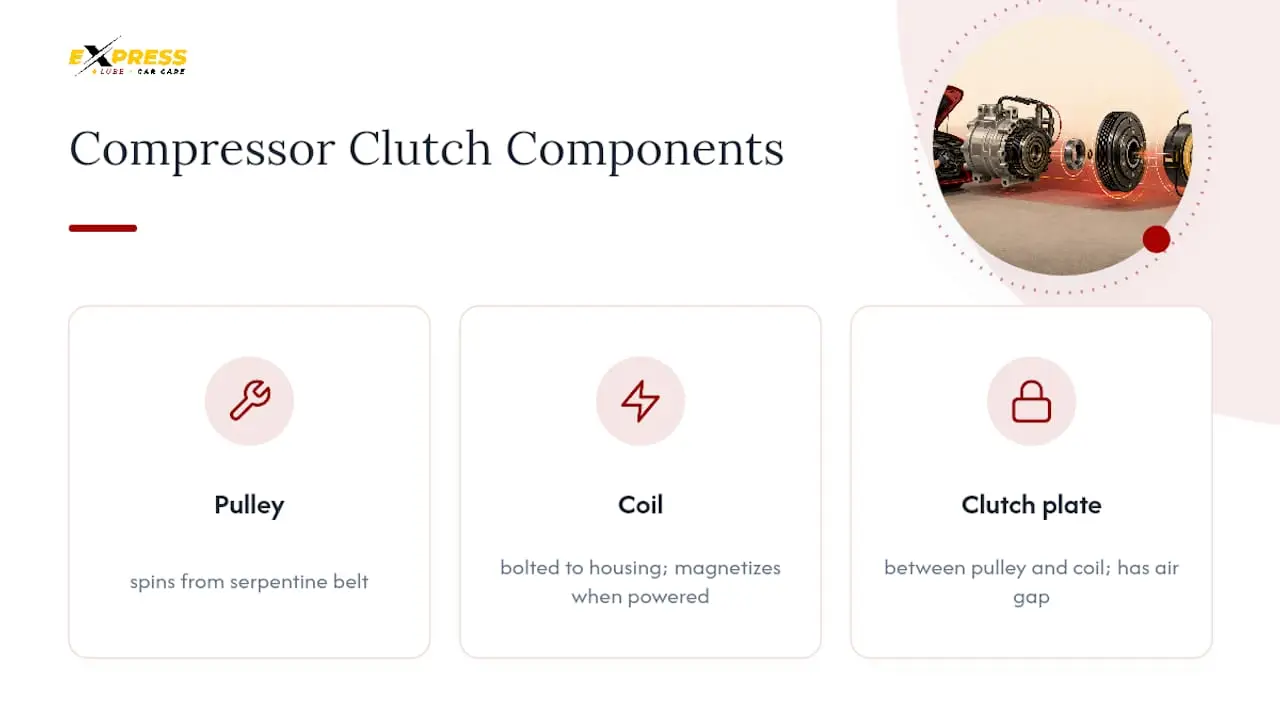
The compressor clutch is a simple electromagnetic switch bolted to the front of the compressor. It has three main pieces: a pulley that spins constantly off the serpentine belt, an electromagnetic coil bolted to the compressor housing, and a clutch plate (sometimes called the hub) that sits between them with a small gap, known as the air gap.
When you press the AC button, that request travels through the HVAC control module to the body control module, then to the powertrain or engine control module, which fires a relay that sends power to the clutch coil. The coil magnetizes, pulls the clutch plate against the spinning pulley, and the two lock together to drive the compressor.
Here’s the part most drivers don’t expect: the system is designed to refuse that request under certain conditions. Low and high pressure switches sit in the refrigerant lines specifically to interrupt the coil circuit and prevent the compressor from engaging when doing so could damage it. That’s not a malfunction. It’s the system protecting itself, and it’s often the very first thing worth ruling out.
Could Low Refrigerant Be Stopping Compressor Engagement?
Low refrigerant is one of the most common reasons an AC compressor won’t engage, and it’s by design. The compressor relies on refrigerant to carry oil through its internal moving parts. Run it dry, and you risk scoring the compressor’s internals within seconds. The low-pressure cutout switch exists to prevent exactly that, so if refrigerant has leaked out, the switch opens the circuit and keeps the clutch from engaging no matter what else is working correctly.
Checking this properly requires a manifold gauge set connected to the low and high side service ports. Static pressure with the system off and warm should sit in a predictable range for the ambient temperature; running pressure tells you whether the system is actually cycling refrigerant once (and if) the compressor kicks on.
- A static reading near zero usually means the system has lost its charge through a leak somewhere.
- UV dye visible under a blacklight at fittings, hose ends, or the condenser often pinpoints where refrigerant is escaping.
- Oily residue on a line or connector is a classic visual sign of a slow leak, even without dye.
- A system that reads low but not empty may still trip the low-pressure switch intermittently, causing the compressor to cycle oddly rather than stay off completely.
Pro Tip: Never add refrigerant to “test” whether the compressor engages when you already suspect a leak. Topping off a leaking system without proper vacuum and leak repair just wastes refrigerant and can mask a bigger problem underneath.
Leak detection with dye, vacuum pull down, and a proper recharge are shop-level jobs. A full AC recharge also confirms the system holds pressure afterward, which a DIY top-off can’t verify.
Are Fuses, Relays, or Coil Wiring Causing the Problem?
If refrigerant pressure checks out fine, the fault is almost certainly electrical. A systematic test from the fuse to the coil will tell you whether the problem sits on the control side (the module and relay commanding the circuit) or the compressor side (the coil and wiring itself), and current-clamp or voltage-drop testing helps separate the two.
Work through it in this order:
- Locate and inspect the AC-related fuse(s) in the under-hood or interior fuse box using your owner’s manual diagram. A visibly blown fuse is an obvious win, but a fuse can also fail intermittently under load, so a continuity test with a multimeter is more reliable than a glance.
- Swap the AC relay with an identical relay from another circuit in the same fuse box, ideally one with matching internal construction. Mixing relays with different internal diodes can send unexpected voltage spikes back through the wiring, so only swap known-identical parts.
- Test for 12 volts and a solid ground at the compressor connector with the AC requested on. Power with no ground, or neither, points upstream toward the relay or module rather than the coil itself.
- Measure clutch coil resistance across its terminals with the connector disconnected. A healthy clutch coil typically reads a few ohms, commonly in the 3 to 5 ohm range; an “OL” or infinite reading means the coil has failed open and needs replacement, while an unusually low reading suggests internal shorting.
- Use a low-amp clamp on the coil feed wire while the AC is requested. Normal low current with no engagement points toward a wiring or coil fault; no current at all points back to the relay or control module not sending the signal in the first place.
A single misreporting sensor, like a pressure transducer feeding bad data to the control module, can also block engagement even when every wire and connector tests healthy. That’s one reason a scan tool capable of commanding the compressor directly is such a useful shortcut when it’s available, since it bypasses the sensor inputs and tests the coil and relay in isolation.
Is a Worn Clutch or Seized Pulley Bearing the Culprit?
Mechanical wear inside the clutch itself is the third major category, and it’s often the most physically obvious once you know what to look for. The air gap is the small space between the clutch plate and the pulley face, and it’s tight for a reason: too much space and the magnetic coil can’t pull the plate in with enough force to lock the assembly together.
Wear on the clutch faces over years of engagement cycles gradually widens that gap past the manufacturer’s tolerance. The fix for this specific failure is straightforward once you’ve confirmed it.
- Perform the tap test: with the AC requested and the engine running, gently tap the center of the clutch plate with a screwdriver handle or similar tool while watching for engagement.
- If tapping makes the clutch grab and spin the compressor, the coil is energizing correctly and the air gap is simply too wide, which usually calls for removing the clutch plate and adding shims behind it to close the gap.
- Listen for grinding, squealing, or rhythmic knocking coming from the pulley itself, since that points to a failing pulley bearing rather than the clutch mechanism.
- Watch for visible wobble in the pulley as it spins, which is a mechanical red flag distinct from anything electrical.
Pro Tip: A seized or failing pulley bearing can shred the serpentine belt in seconds if it locks up while the belt is still turning it. That’s a drivability and safety issue, not just an AC problem.
Shops typically address this with re-shimming for a simple air-gap issue, or full clutch coil and hub replacement when the plate or bearing itself is worn beyond spec. Replacing the coil or hub rarely requires recovering refrigerant, since these are external components on most vehicles, but the job does call for correct snap-ring tools to avoid damaging the pulley hub.
What’s the Safest Order to Troubleshoot an AC Compressor?
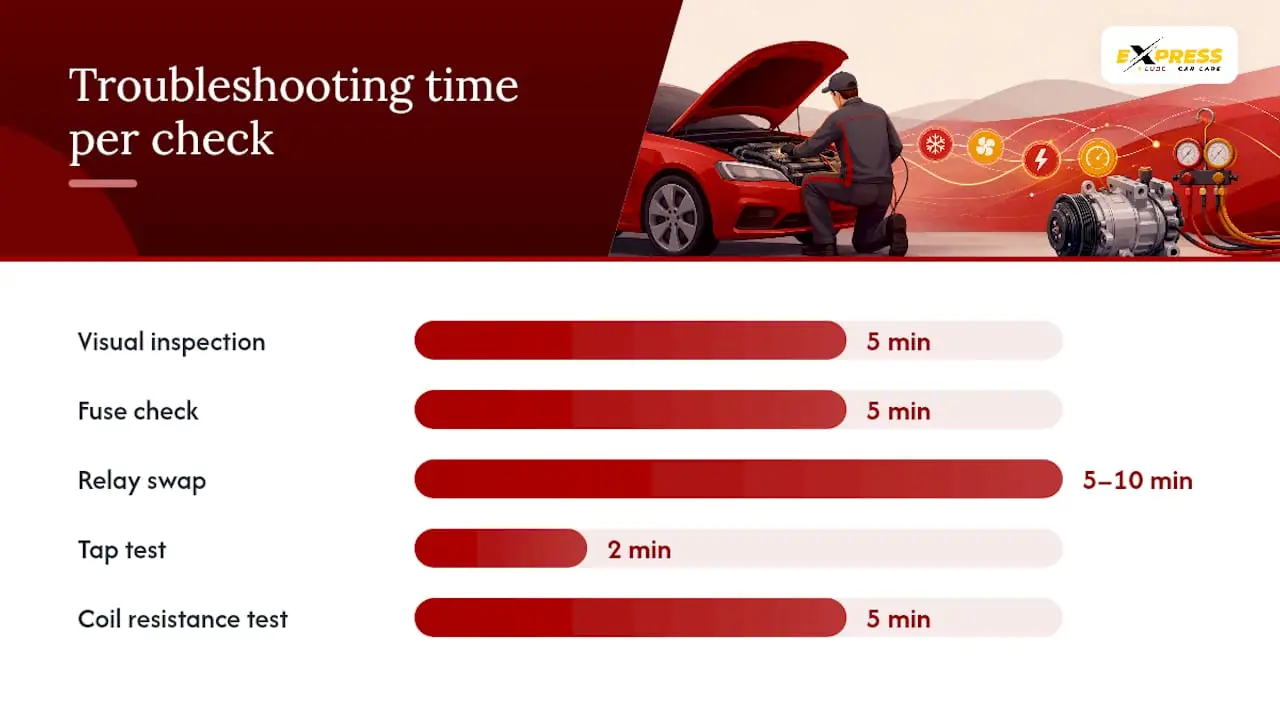
Jumping straight to parts swapping wastes money and time. A visual then electrical then pressure then advanced diagnostics sequence catches the easy, cheap fixes before you ever touch anything expensive.
Before starting any electrical test, gather a digital multimeter, a fused jumper wire or 12V power probe, a manifold gauge set if you have access to one, and a set of feeler gauges for the air gap. If you’ll be probing near the battery or working around wiring harnesses for an extended period, disconnecting the battery first is good practice for avoiding accidental shorts.
- Visual inspection (5 minutes): Check the belt, look at the clutch and pulley for obvious damage, and scan wiring for chafing or corrosion at the compressor connector.
- Fuse check (5 minutes): Pull and test the AC-related fuses with a multimeter or simple continuity tester.
- Relay swap (5 to 10 minutes): Substitute a known-identical relay from elsewhere in the fuse box and retest.
- Tap test (2 minutes): With AC requested, tap the clutch plate to check whether wide air gap is preventing engagement despite a live coil.
- Coil resistance test (5 minutes): Disconnect the connector and measure across the coil terminals.
- Voltage and ground test at the connector (10 minutes): Confirm the coil is actually receiving 12 volts and a solid ground when AC is requested.
- Current measurement with a low-amp clamp (15 minutes, if available): Distinguishes a healthy relay signal from an open coil circuit.
- Manifold gauge pressure check (15 to 20 minutes): Confirms whether low refrigerant is tripping the pressure switch.
- Scan-tool bidirectional command (varies): Lets a technician command the compressor directly and rule out sensor or module faults.
- Steps 1 through 5 are realistic for most DIYers with basic tools and under 30 minutes.
- Steps 6 through 9 require more specialized equipment and experience reading the results correctly.
- If the coil tests open, the pressure reads near zero, or the pulley shows mechanical wobble, that’s your signal to stop testing and start planning a shop visit rather than guessing at parts.
What DIY Fixes and Tools Actually Work Here?
Plenty of this troubleshooting is genuinely safe and reasonable for a driveway mechanic with the right tools on hand. Replacing a blown fuse, swapping a relay, running the tap test, and measuring coil resistance all fall well within normal DIY territory, and documenting what you find saves real diagnostic time if you end up needing a shop anyway.
A basic toolkit for this job includes a digital multimeter, a fused jumper wire or dedicated 12V power probe, a manifold gauge set for pressure checks, feeler gauges for the air gap, and a clutch-holding tool if you’re going as far as removing the plate. A puller for the clutch hub is worth having only if you’ve done this kind of teardown before.
- Never intentionally vent refrigerant to the atmosphere to “test” the system; it’s both wasteful and environmentally irresponsible.
- Only ever use relays that are electrically identical when swap-testing, since mismatched internal diodes can send stray voltage spikes into the wiring harness.
- Use a fused jumper wire for any bypass testing, never a bare wire straight to the battery.
- Take photos of your multimeter readings, the fuse box layout, and any visible leaks or corrosion before your shop visit.
Pro Tip: A short written log of what you tested and what you found, even something as simple as “fuse good, relay good, coil reads OL,” turns a 30-minute diagnostic conversation into a 5-minute confirmation for the technician.
When Should You Stop Driving and Call a Professional?
Some symptoms mean pull over now, not “get to it this weekend.” Grinding or squealing from the pulley area, visible wobble in the clutch assembly, a burning rubber smell, or actual smoke from the front of the engine are all signs that a seized pulley bearing or mechanical failure has become a real safety risk, and continued driving risks a shredded belt and the loss of power steering or charging that often rides on the same belt.
A compressor clutch that simply won’t engage while the pulley itself spins freely and quietly is inconvenient, not dangerous. That one can wait for a scheduled visit.
- Grinding, squealing, or knocking from the pulley: stop driving immediately.
- Visible wobble or misalignment in the clutch or pulley: stop driving immediately.
- Burning smell or visible smoke near the compressor: stop driving immediately.
- Clutch simply not engaging with a smooth, quiet, spinning pulley: safe to schedule a visit.
When you do bring it in, a shop will typically run a full pressure and leak test, check the electrical circuit with a scan tool and current clamp, and replace whatever combination of coil, pulley bearing, or compressor turns out to be at fault. Common signs of a failing compressor include unusual noise, weak cooling, visible leaks, and erratic cycling, and having your own test notes and photos ready cuts down how long that diagnosis takes.
How Express Lube & Car Care Diagnoses a Clutch That Won’t Engage
We run the same logic in the bay that you just read: visual inspection first, then electrical testing through the fuse, relay, and coil, and then pressure checks on the refrigerant system. It’s a sequence built to find the real fault instead of guessing at parts.
Our A/C repair service covers everything from a simple relay replacement to a full leak repair and recharge, and no-appointment service means you can get timely help to restore your AC. If you’ve already run some of the checks above, bring your notes and photos. It genuinely speeds things up.
— Express Lube & Car Care
Get Your AC Compressor Diagnosed the Right Way
Express Lube & Car Care offers a faster, affordable next step than guessing your way through relay swaps and coil tests in a hot parking lot. You can walk in to get a real diagnosis from technicians who run the exact fuse-to-pressure sequence covered above.

If your compressor clutch still won’t engage after the DIY checks, or if you’d rather skip the troubleshooting entirely, our A/C repair service handles everything from a blown fuse to a full leak repair and recharge. Curious about the broader system behind your dashboard vents? Our guide to your car’s cooling system covers the bigger picture. Check out current oil change and service specials while you’re at it, and stop by Express Lube & Car Care in Plano for a same-day, no-appointment AC check.
Sources
FAQ
What would cause an AC compressor not to engage?
The three most common causes are low refrigerant tripping the low-pressure safety switch, an electrical fault somewhere between the fuse and the clutch coil, and a worn clutch with too much air gap. Testing the fuse and relay first, then checking refrigerant pressure, narrows it down quickly.
How do I get my AC compressor clutch to engage?
Start by checking the AC fuse and relay, since a simple electrical fault is one of the most common culprits. If those test fine, a manifold gauge check on refrigerant pressure and a tap test on the clutch plate will usually reveal whether the issue is low refrigerant or a worn clutch with excessive air gap.
How do you reset an AC compressor?
There’s no dedicated “reset” for a compressor clutch; it’s not a fault code you clear. Fixing the underlying cause, whether that’s a blown fuse, low refrigerant, or a wide air gap, restores normal engagement once the root problem is resolved.
Why is my AC running but the compressor not kicking on?
The blower and fan can run through their own circuit independent of the compressor, so air still moves even when the clutch never engages. That points toward one of the electrical, pressure, or mechanical causes covered above rather than a total system failure.
Is it safe to keep driving with the AC compressor not engaging?
Yes, if the pulley itself spins freely and quietly without noise or wobble, since that’s an inconvenience rather than a safety issue. Stop driving immediately if you hear grinding or squealing, see the pulley wobbling, or notice smoke or a burning smell near the compressor.