

A pulsating brake pedal that you feel every time you press the brake is the most reliable sign of a rotor problem, and it almost always points to disc thickness variation rather than a rotor bent by heat. Pair that pulse with a shaking steering wheel and you’re likely looking at a front rotor issue; feel it through the seat instead, and the rear rotors are the more probable cause. Grinding or squealing noises can ride along with either. The rest of this guide breaks down what to test yourself and what a shop measures to confirm it.
TL;DR:
- Most brake pulsation results from disc thickness variation or lateral runout, not actual rotor warping caused by heat.
- Feel for pulsing through the pedal indicates front rotor issues; vibration through the seat suggests rear rotor problems, with noise patterns helping identify underlying causes.
- Proper diagnosis involves measuring disc thickness variation and lateral runout, with typical tolerances being about 0.001 inches for DTV and under 0.002 inches for LRO.
- Cleaning the hub face, torquing lug nuts in a star pattern, and properly bedding pads can prevent and resolve many pulsation issues without rotor replacement.
- Urgent brake issues like grinding noise or a sinking pedal require immediate professional inspection, as ignoring them risks safety and further damage.
Table of Contents
- Warped Rotors Symptoms: What You’ll Feel and Hear
- Common Causes and Lookalikes: What Drivers Call “Warped” but Often Isn’t
- How to Test and Confirm What’s Actually Wrong
- Fixes, Prevention, and Your Next Steps
- When to Stop Driving and Call a Professional
- How Our Technicians Approach “Warped Rotor” Complaints
- Get a Same-Day Brake Inspection at Express Lube & Car Care
- Sources
- FAQ
Warped Rotors Symptoms: What You’ll Feel and Hear
Most drivers notice the problem in the brake pedal first. It pulses, throbs, or pushes back against your foot in a steady rhythm every time you brake, and that rhythm typically gets worse as the brakes heat up during a longer stop or a downhill run. This pulsation is different from a soft or sinking pedal, which usually points to a hydraulic issue rather than a rotor problem.
Where you feel the shake tells you which end of the car to suspect. A steering wheel that shimmies under braking usually traces back to the front rotors, since the front brakes handle most of the vehicle’s stopping force and any thickness variation there transmits straight through the steering column. Vibration through the seat or the floor, without much steering wheel movement, points more toward the rear rotors instead.
Noise adds another layer of detail:
- A squeal that changes pitch with speed is often just a wear indicator tab doing its job, not a rotor problem.
- A low growl can mean a pad has worn down to its backing plate or debris is caught behind the rotor.
- Grinding, metal-on-metal sound means the pad material is gone and needs immediate attention.
One useful clue for ruling rotors out entirely: if you feel a pulse or vibration even when you’re not braking, or it shows up at a constant highway speed regardless of pedal pressure, you’re probably dealing with a tire, wheel, or driveline issue rather than a brake rotor at all.
Common Causes and Lookalikes: What Drivers Call “Warped” but Often Isn’t
Here’s something that surprises most drivers: modern rotors rarely warp from heat the way the word implies. What actually causes the pulsation is disc thickness variation, pad-material transfer, or mounted lateral runout, not a rotor that’s been bent out of shape.
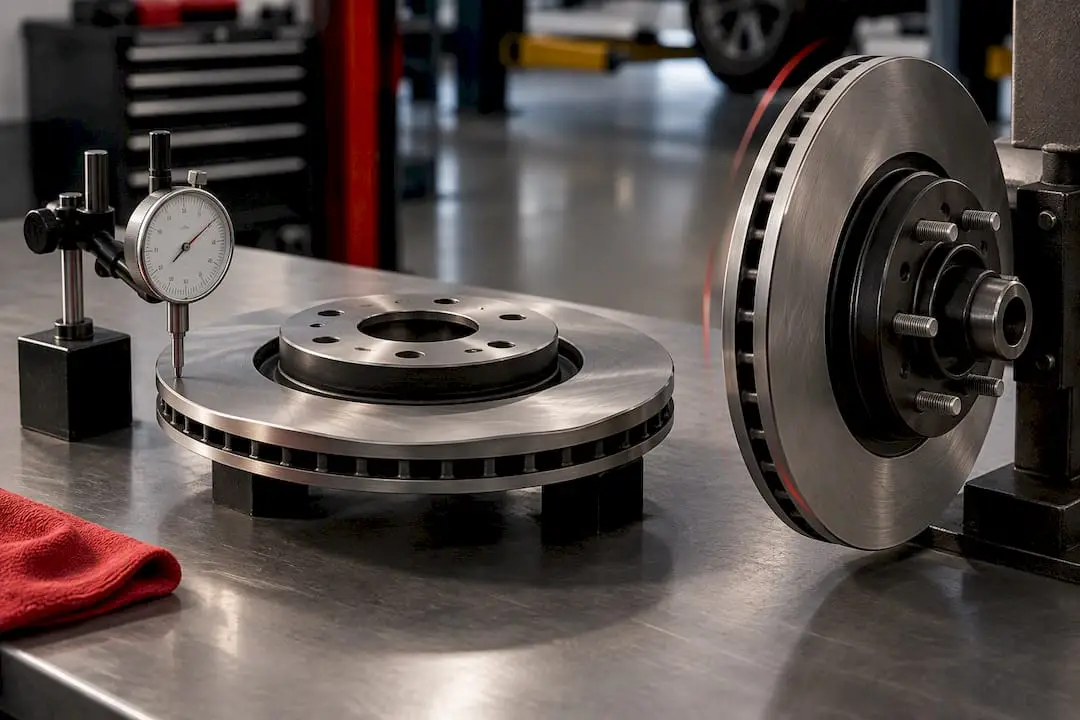
Disc thickness variation (DTV) means the rotor’s surface has thinned unevenly in spots, often just a few thousandths of an inch, but enough to create a pulse you can feel through the pedal. Mounted lateral runout (LRO) describes how much the rotor wobbles side to side as it spins once it’s bolted onto the hub, which is a separate problem from the rotor’s thickness.
Pad-material transfer is another frequent culprit. When hot pads sit against the rotor at a stop, they can leave an uneven deposit that acts like a high spot, mimicking the feel of a warped rotor without any structural damage at all. A sticking caliper or dragging slide pin produces the same kind of uneven wear over time.
Several other issues get blamed on rotors when they’re really something else:
- Rust buildup on the hub flange can throw off how flat the rotor sits once it’s torqued down.
- Uneven or over-torqued lug nuts distort the rotor even when the part itself is fine.
- A worn wheel bearing, a suspension component, or an out-of-balance tire can all produce vibration that feels similar but behaves differently.
The timing usually separates these causes. Brake-specific pulsation shows up only when you press the pedal, while a bearing or tire issue tends to show up at speed regardless of braking. Technical breakdowns of warranty and repair claims consistently show that hub-flange rust, poor lug-torque practice, and stuck caliper hardware are the highest-value root causes shops find once they actually measure the parts instead of guessing.
How to Test and Confirm What’s Actually Wrong
Before anyone replaces a rotor, there’s a logical order of checks worth running, starting with the simplest and safest.
- Try a controlled rebedding drive. On a straight, empty road, bring the vehicle up to speed and brake firmly several times without coming to a complete stop, letting the brakes cool between applications. This can redistribute pad material and remove a fresh imprint high spot if that’s the actual cause.
- Run the hot-pedal imprint test. Come to a warm stop, hold the brake for 30 to 60 seconds, then drive off. If a new low-frequency pulse appears that wasn’t there before, you’re likely looking at fresh pad transfer rather than a structural problem.
- Look for a stuck caliper or slide pin. Uneven pad wear from one side of the rotor to the other, or a car that pulls to one side under braking, often means a caliper isn’t releasing evenly.
A shop takes the diagnosis further with tools most driveways don’t have. A technician mounts a dial indicator against the rotor’s face to measure LRO while it spins on the hub, and takes rotor-thickness readings at multiple points around the disc to calculate DTV. AutoZone notes that drivers can typically feel pulsation once lateral runout reaches around 0.002 inches, which is a fraction of the width of a human hair.
| Measurement | Typical shop tolerance | What it suggests |
|---|---|---|
| Disc thickness variation (DTV) | Around 0.001 in | Pad transfer or uneven wear; may respond to rebedding or resurfacing |
| Mounted lateral runout (LRO) | Under 0.002 in | Hub-face debris, rust, or improper seating; often fixed by cleaning and re-torquing |
Pro Tip: If a shop replaces your rotors and the shudder comes right back within days, ask whether the hub face was cleaned to bare metal and whether the lug nuts were torqued in a star pattern with a torque wrench rather than an impact gun. Stacked runout from a dirty hub or uneven torque is a known cause of new rotors shuddering on day one.
For readers who want to see the full inspection checklist before booking a visit, Express Lube & Car Care’s rotor inspection guide walks through what a thorough visual check looks like.
Fixes, Prevention, and Your Next Steps
Not every symptom means new rotors. If the cause is pad-material transfer, rebedding the pads correctly often clears the pulsation without replacing a single part, as long as the rotor is still within its thickness limits. This is worth trying before anyone reaches for a grinder or a parts shelf.
When the rotor itself has worn unevenly, a shop has two paths: machine it to true the surface, or replace it outright. Machining only works if enough material remains above the rotor’s minimum thickness, which is stamped on the rotor itself. Because many modern rotors ship thinner than older designs to save weight, there’s often little margin left to cut, and replacement ends up being the more practical choice.
The repair steps that actually prevent the problem from returning matter more than which rotor brand you buy:
- Clean the hub face to bare metal before mounting any rotor, removing rust and old debris that cause stacked runout.
- Index the rotor against the hub so it seats flat and true.
- Torque every lug nut in a star pattern with a calibrated torque wrench, never an impact gun set to guess.
- Lubricate caliper slide pins so the caliper releases evenly and doesn’t drag one pad harder than the other.
- Bed in new pads with a proper break-in drive before subjecting them to hard stops.
Pro Tip: If you tow, haul, or drive in stop-and-go traffic often, ask about heavy-duty pad compounds designed for higher heat tolerance. Standard pads that overheat repeatedly are more prone to leaving transfer deposits that mimic warped rotor symptoms. For more on how uneven wear develops in the first place, see this guide on what causes uneven brake pad wear.
When to Stop Driving and Call a Professional
Grinding metal-on-metal noise, a brake pedal that sinks toward the floor, or a car that pulls hard to one side under braking are not wait-and-see situations. Get the vehicle to a shop right away.
For less urgent pulsation, write down when it happens (cold stops, after highway driving, only on hard braking) and where you feel it (pedal, wheel, seat). That detail, plus a phone photo of any visible pad wear or rust on the rotor, helps a technician skip straight to the right measurements instead of guessing.
How Our Technicians Approach “Warped Rotor” Complaints
Technicians measure the rotors before recommending replacement, and cleaning the hub face is part of proper brake service. Every inspection comes with digital photos and notes so you see exactly what we found and why. Choosing a shop that shows you the numbers, not just a verdict, is what keeps you from paying for the same repair twice.
— Express Lube & Car Care
Get a Same-Day Brake Inspection at Express Lube & Car Care
Express Lube & Car Care gives Plano drivers a faster path to an answer than guessing at home or waiting days for a scheduled slot elsewhere. Our ASE-certified technicians measure disc thickness variation and lateral runout on the spot, document everything with a digital inspection complete with photos, and handle most brake repairs the same day, with no appointment required.

Bring your notes on when the pulsation happens and where you feel it. That detail speeds up the diagnosis considerably. Right now, you can also save on service with our $30 off brakes coupon. Head to our brake repair page to see the full scope of what we check, or stop by the shop today for a measurement-based diagnosis instead of a guess.
Sources
Technical references used in this guide include Rick’s Free Auto Repair Advice about rotor warp causes and BrakeTireGuide on measurement-based repair procedures. For safe hub and rotor cleaning practices, see Diamond Brite’s guide to removing brake dust.
- Brake rotor warp myth: What causes brake pedal pulsation — Rick’s Free Auto Repair Advice
- Signs of a warped brake rotor — AutoZone DIY
- Warped brake rotor repair — BrakeTireGuide
- Nuts & Bolts: Warped rotor myth — MotorTrend
FAQ
What Does Driving With Warped Rotors Feel Like?
It usually feels like a rhythmic pulse or throb in the brake pedal every time you press it, often paired with a shaking steering wheel if the front rotors are affected or vibration through the seat if it’s the rear. The sensation tends to get stronger the harder or longer you brake.
What Happens if You Keep Driving With Warped Rotors?
The pulsation itself won’t strand you, but ignoring it lets uneven wear or pad transfer get worse, which can extend stopping distances and wear pads unevenly. If you ever hear grinding, that means pad material is gone and the vehicle needs immediate service.
How Long Should Rotors Last Before Warping?
Rotor life varies widely based on driving style, pad quality, and towing habits, so there’s no single mileage number that applies to every vehicle. What actually determines longevity is whether the hub was cleaned and lug nuts were torqued correctly at the last brake job, since poor installation practice is a leading cause of premature rotor shudder.
How Do I Fix Warped Rotors?
If the cause is pad-material transfer, a controlled rebedding drive can sometimes clear the pulsation without replacing parts. If the rotor has worn below its minimum thickness or has measurable runout beyond tolerance, machining or replacement is needed, followed by a clean hub face and properly torqued lug nuts to prevent the shudder from coming back. Technicians measure both disc thickness variation and lateral runout before recommending repair options.