

There is no single federal minimum brake pad thickness for passenger cars, but the practical answer is consistent: most manufacturers and repair shops treat about 3 mm (roughly 1/8 inch) of remaining friction material as the point to replace pads, and many want them changed earlier. New pads typically start around 12 mm. Some state inspection rules tolerate pads as thin as 1/32 inch (under 1 mm), but that is a legal floor, not a safe target. Your vehicle’s own service limit is the number that counts.
Below, we explain how to read pad thickness in millimeters and inches, what the rules say, and how to tell when a pad that still has some material left needs attention anyway.
TL;DR
- New pads are usually around 12 mm thick, and replacement is generally advisable at about 3 mm.
- There is no federal safety standard for passenger-car pad thickness. State inspection floors run from about 0.8 mm to 1.6 mm, and manufacturers set their own limits.
- Texas no longer requires safety inspections on non-commercial vehicles, so no inspection will catch worn pads for you. Your own checks matter more.
- Thickness is only part of the picture. Uneven wear, glazing, cracks and noise can mean replacement is due even above 3 mm.
- If you hear grinding or feel a soft pedal, stop driving and have the brakes inspected.
Table of Contents
- What is the minimum brake pad thickness?
- Is there a legal minimum brake pad thickness?
- What brake pad thickness is safe?
- How to check pad thickness
- Thickness is not the only thing to check
- How long do brake pads last?
- Our perspective: ask for the number, not just a verdict
- Replacing pads at the right time in Plano
- Fleet vehicles and commercial units
- Next steps if your pads are low
- FAQ
- Sources
What is the minimum brake pad thickness?
Brake pad thickness refers to the friction material only, the part that presses against the rotor. It does not include the steel backing plate. That distinction explains much of the confusion online, because some drivers measure the whole pad and some measure just the lining.
Here is how the numbers line up:
| Remaining friction material | Approx. inches | What it generally means |
|---|---|---|
| 10-12 mm | 3/8 to 1/2 in | New or nearly new pad |
| 7 mm | 1/4 in | Good time for an inspection, especially if it has been a while |
| 4-6 mm | 5/32 to 15/64 in | Start planning replacement |
| 3 mm | 1/8 in | Common replacement point |
| 2 mm | 5/64 in | Many manufacturers call this the limit or already worn out |
| 1.6 mm or less | 1/16 in | At or below some state inspection floors |
| Under 1 mm | 1/32 in | Legal floor in some states, far too thin for daily driving |
This is a general guide, not a specification. Pad compounds, rotor design and caliper design differ, and the service manual for your vehicle is the final word.
How thick are new brake pads?
Haynes puts new pads at around 12 mm of material. Actual figures vary by vehicle. A 2010-2011 Jaguar XFR workshop manual, for example, lists nominal friction thickness of 13 mm in front and 10.8 mm in the rear, with a 2 mm minimum. Rear pads are often thinner than front pads from the factory, so a rear pad reading of 7 or 8 mm is not automatically a sign of heavy wear.
Why the manufacturer number beats any chart
A Mazda service bulletin filed with NHTSA treats 2 mm as 0% remaining for the covered models and tells technicians to use model-specific minimum specifications. That is the right approach. A pad that is acceptable at 3 mm on one vehicle may be at its limit on another, and a heavy SUV or a truck that tows will stress its pads differently than a compact commuter car.
Is there a legal minimum brake pad thickness?
For ordinary passenger cars in the United States, there is no nationwide rule. Consumer Reports notes that the federal government sets performance standards for new-vehicle brake systems, but there are no government regulations covering replacement brake pads. What exists instead is a patchwork of state inspection rules and federal rules for commercial vehicles.
State inspection floors
States that inspect brakes set a very low bar:
- California: the Bureau of Automotive Repair manual requires friction material to meet the manufacturer’s service limit or, if that is unavailable, be at least 1/32 inch for bonded linings, or 1/64 inch above rivet heads for riveted linings.
- Virginia: inspection rules reject linings or disc pads below 2/32 inch (1/16 inch, about 1.6 mm) at any point, not counting manufactured slots.
- Washington: state law requires at least 1/32 inch over rivet heads, or the equivalent bonded-pad thickness, and the material must be securely attached and free of specified cracks or breaks.
These are the thinnest pads a car can have and still pass, not the point at which stopping performance is good. Goodyear Brakes makes the same distinction, noting that some state programs allow bonded linings down to 1/32 inch while it recommends considering replacement at roughly 4-6 mm.
Commercial vehicles are different
Federal rules do set numbers, but for commercial motor vehicles. Under 49 CFR 393.47, the minimum depends on brake type and axle: steering-axle air-disc pads may not be below 3.2 mm, while hydraulic or electric linings on steering axles may not be below 1.6 mm. If you manage a fleet, those figures apply to your commercial units, and we cover that below. They are not a universal passenger-car rule.
What Texas requires
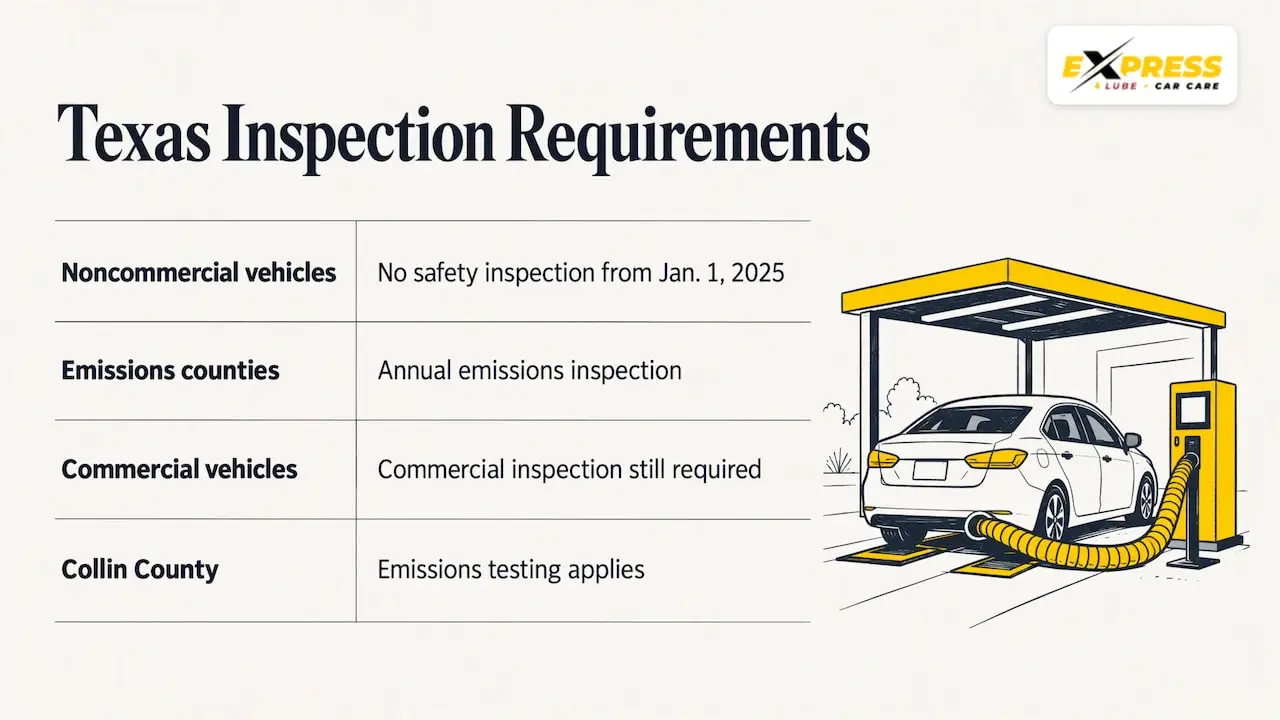
Texas changed its rules recently. According to the Texas Department of Public Safety, as of January 1, 2025, the state no longer requires a safety inspection on non-commercial vehicles. Vehicles registered in an emissions county still need an annual emissions inspection, and commercial vehicles still need a commercial inspection. Collin County is among the counties where emissions testing applies, but confirm your own requirement with DPS or at registration.
The practical result is that nobody checks your brake pads on a schedule unless you do. A pad can wear down to the backing plate without any state inspection stepping in.
What brake pad thickness is safe?
Legal and safe are different questions. Use these ranges as a conversation starter with your technician, then defer to your vehicle’s specification.
Is 7 mm okay?
Yes, in most cases. Bridgestone suggests that friction material below about 1/4 inch (7 mm) should prompt a brake inspection, particularly if it has been a long time since the last one. That is an inspection cue, not a discard point. If you are at 7 mm and your last brake check was two years ago, book one.
Is 4 mm okay?
For now, usually. At 4 mm you have a limited amount of life left, and how much depends on how you drive. In stop-and-go traffic, a few millimeters can disappear in a matter of months. Plan the replacement rather than waiting for a warning.
Is 3 mm okay?
This is where most guidance lands on replacement. Haynes calls about 3 mm the generally advisable replacement point, and heavy-duty air-disc pads on commercial trucks follow a similar number: Bendix specifies replacement at 0.125 inch (3.2 mm) for the pads it covers. Driving on 3 mm pads is possible, but you have very little margin for uneven wear or a long downhill stop.
Can you drive with 2 mm pads?
We would not recommend it. Some manufacturers set 2 mm as the service limit, and the Mazda bulletin above treats it as fully worn. A pad at 2 mm can still stop the car in ordinary conditions, but heat tolerance and stopping consistency drop, and the rotor is at risk. Some vehicles have even lower limits. A Polaris Slingshot inspection document, for example, lists replacement at 1.5 mm for standard pads. That is the point: limits are model-specific.
How to check pad thickness
A thorough check requires seeing the pad, and that usually means removing the wheel. California’s inspection manual says all wheels must be removed for a complete brake inspection, with an exception for certain motorcycle disc brakes. Looking through the spokes gives you a hint, not a measurement.
What a proper measurement involves
ALLDATA’s guidance describes the approach: measure the pad material at both ends, check for uneven wear and signs of overheating or glazing, look at wear indicators, and compare the result with the manufacturer’s minimum. In practice a technician will:
- Remove the wheel and look at the inboard and outboard pads on each caliper.
- Measure the friction material with a brake pad gauge or caliper, excluding the backing plate.
- Compare the leading and trailing edges of each pad to spot taper.
- Compare left to right and front to rear.
- Check the rotor surface and thickness, the caliper and slide pins, and the brake fluid condition.
One thing to know if you have aftermarket wheels or accessories: clearance around the caliper matters when wheels come off and go back on, and add-ons such as lighting kits need specific caliper clearance so they do not interfere with the brake hardware. Mention any wheel accessories to your technician.
Why the inside pad matters
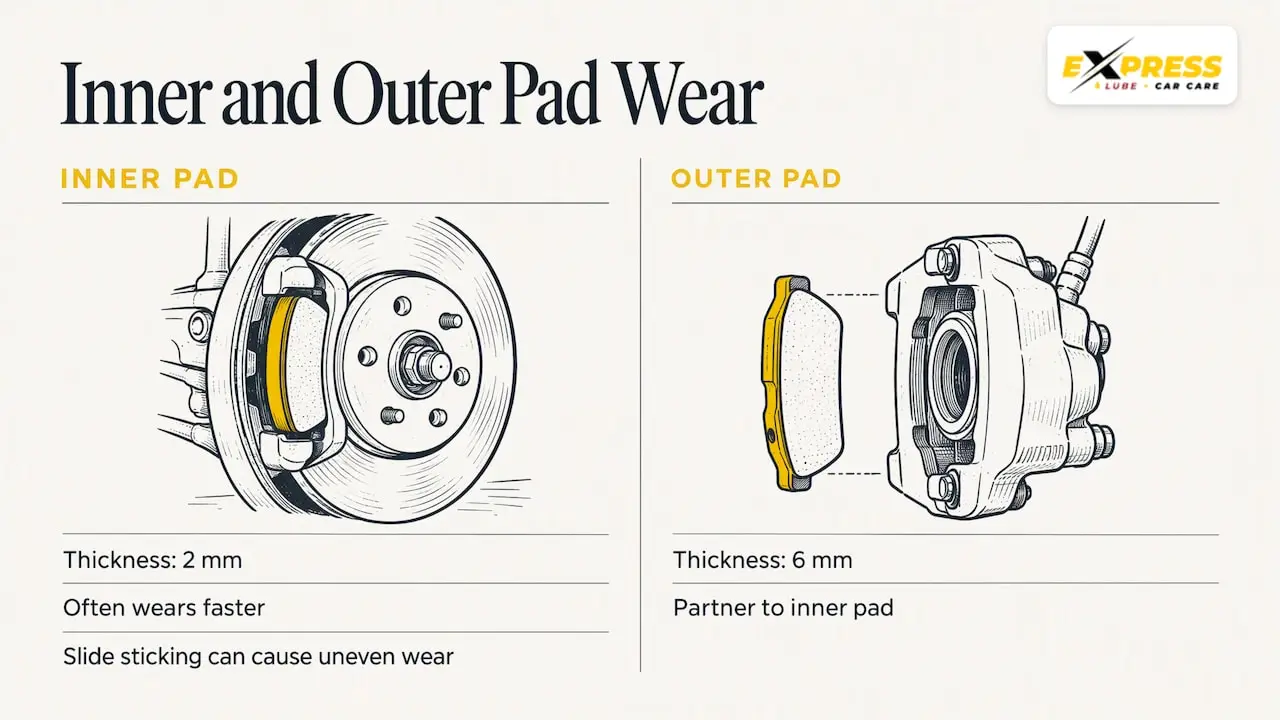
The inner pad on a disc brake is hard to see from outside the wheel, and it often wears faster than the outer pad if a caliper slide is sticking. Our guide to what causes uneven brake pad wear explains why one pad can be at 2 mm while its partner still reads 6 mm.
Thickness is not the only thing to check
A pad at a healthy thickness can still be unfit, and California’s inspection guidance reflects this: thickness alone is not enough, and contamination, cracking, overheating and secure attachment must also be checked. A good inspection, like a good pre-sale review of any vehicle, looks at condition and not only a single number. For an example of how thorough inspection thinking works elsewhere, a dealer inspection checklist for classics shows why condition matters as much as measurements.
On brakes, look and listen for:
- Cracked or crumbling friction material, or pad material separating from the backing plate.
- Glazing, a hard, shiny surface left by overheating.
- Oil or brake fluid contamination, often from a leaking seal or caliper.
- Uneven wear across a pad, or between the inner and outer pads.
- Squealing, which on many pads comes from a built-in wear indicator. See our explanation of the brake pad wear indicator.
- Grinding, which usually means the friction material is gone. Bridgestone says fully worn pads can expose the backing plate, leading to metal-to-metal contact, long stopping distances and damage to discs or drums.
- Pulsation through the pedal, which points to rotor problems. See warped rotor symptoms.
- A pull to one side or a soft pedal, which can indicate a caliper or hydraulic problem. Our list of signs of bad brake calipers covers those.
If any of these show up, do not wait for the pad to reach a specific number. Have the brakes inspected the same day.
How long do brake pads last?
There is no fixed mileage. Bridgestone gives a rough picture: pads are generally considered good for about 30,000-35,000 miles in urban driving and 80,000 miles or more in light-traffic highway driving. Those figures are a wide range, and you should treat them as that.
What shortens pad life:
- Frequent stop-and-go driving, such as a commute on busy suburban arterials.
- Heavy vehicles. SUVs and trucks carry more momentum to stop.
- Towing or hauling loads.
- Aggressive braking and following too closely.
- A sticking caliper or slide pin, which keeps a pad dragging.
Drivers in a suburban area like Plano who split time between short errands and highway commuting often land in the middle of that range, but your own pattern is what counts. The simplest habit is to have the pads measured at every oil change or tire rotation, and ask for the number in millimeters.
Our perspective: ask for the number, not just a verdict
We see the same misunderstanding regularly: a driver is told the pads are “fine” or “getting low,” with no figure attached. A verdict without a measurement is hard to trust, and hard to track over time.
Our approach is to measure, record and show you. Our digital vehicle inspections come with photos and technician notes, so you can see the pad and read what was measured. That lets you compare this visit with the last one and judge how fast your pads are wearing. If a pad reads 5 mm today and 8 mm a year ago, you can plan a repair around your schedule instead of reacting to a grinding noise.
We also treat the state minimum as irrelevant to your decision. Because Texas does not require a safety inspection for non-commercial vehicles, the legal floor is not what protects you. Your vehicle’s manufacturer specification, and the condition of the pad, rotor and caliper together, are what protect you. Pads are a wear item, and replacing them on time usually costs less than replacing pads, rotors and a caliper after the pads wear through.
— Express Lube & Car Care
Replacing pads at the right time in Plano
If your pads are near 4 mm or you have not had a brake check in a while, our technicians can inspect them, measure the friction material and explain the result. Our brake repair service covers pads, rotors and ABS service, and we work without appointments, with same-day turnaround on most services. Check the brake coupon page for any current offer, and see our full list of services.

Repairs carry a 24-month/24,000-mile limited warranty on qualifying work, whichever comes first, and qualifying suspension repairs carry a Lifetime Suspension Warranty. Eligibility, limitations and exclusions apply to both, so ask us for the details that apply to your repair.
Fleet vehicles and commercial units
If you run work trucks or vans, the commercial rules above matter. Texas still requires commercial inspections, and federal minimums apply to many commercial vehicles, with different numbers by brake type and axle. Because fleet vehicles tend to brake more often and carry heavier loads, we suggest measuring pads on a regular schedule instead of waiting for an annual inspection. Our fleet maintenance service can build that into your routine.
Next steps if your pads are low
- Find your specification. Check the owner’s manual or ask us for the service limit for your vehicle.
- Get a measurement in millimeters, for every wheel, not just the front.
- Look at the rotors. Our guide to pad versus rotor thickness and runout explains what to ask for.
- Check the fluid. Brake fluid ages too. See the brake fluid change interval guide.
- Act on warning signs immediately. Grinding, a soft pedal or a pull to one side are reasons to stop driving and call a professional.
FAQ
Is 4 mm brake pad thickness okay?
Usually, for a short time. Many guides suggest starting to plan replacement at around 4-6 mm, because wear accelerates in stop-and-go driving. Ask for a measurement on every wheel, since the thinnest pad is the one that matters.
Can I drive with 2 mm brake pads?
We advise against it. Some manufacturers consider 2 mm to be the end of the pad’s life, and the rotor can be damaged if wear continues. Have the brakes inspected and replaced promptly.
Is there a legal minimum brake pad thickness in Texas?
There is no federal passenger-car minimum, and Texas no longer requires safety inspections for non-commercial vehicles as of January 1, 2025. Commercial vehicles are subject to federal and state rules. Because no inspection will flag worn pads, use the manufacturer’s limit as your guide.
How often should I check my brake pads?
Checking at every oil change or tire rotation is a sensible habit, and sooner if you hear noise or feel changes in the pedal. Intervals depend on the vehicle and how it is driven, so follow your owner’s manual and the advice of a technician.
Is 7 mm on brake pads okay?
Yes, in most cases there is plenty of life left. It is a good moment for a brake inspection if you have not had one recently, particularly on a heavy SUV or truck.
Sources
- Brake Pad Thickness Guide, Haynes
- 2010-2011 Jaguar XFR Workshop Manual, Brake System
- Mazda service bulletin, NHTSA
- Polaris Slingshot brake inspection, NHTSA
- Bendix air disc brake guide, NHTSA
- Consumer Reports, Brake Pads
- California Vehicle Safety Systems Inspection Manual
- Virginia 19VAC30-70-80, Service brakes
- Washington RCW 46.37.360
- 49 CFR 393.47, eCFR
- Texas DPS, Inspection Items for the Annual Inspection
- Goodyear Brakes FAQ
- Bridgestone, When to Replace Brake Pads
- ALLDATA DIY, Guide to Brake Inspection Part 2