

If your vehicle's performance has recently declined, a small but critical component called the oxygen sensor could be the cause. The most common bad O2 sensor symptoms include an illuminated check engine light, a noticeable decrease in fuel economy, rough engine operation, and sometimes a distinct "rotten egg" odor from the exhaust.
These indicators are your vehicle's way of communicating that its engine management system is not receiving the correct data to maintain an efficient air-fuel mixture.
Interpreting Your Vehicle's Warning Signs
Functionally, the oxygen (O2) sensor operates as a monitor for your engine's exhaust stream. Its primary role is to measure the concentration of unburned oxygen in the exhaust gases and relay this information to the vehicle's central computer, the engine control unit (ECU). This continuous feedback loop allows the ECU to maintain the ideal stoichiometric air-to-fuel ratio, which is approximately 14.7 parts air to one part fuel.
When an O2 sensor fails, the ECU receives inaccurate or no data. This is analogous to a chemist attempting to create a precise formula without a functioning scale. The ECU can no longer accurately meter fuel, so it often defaults to a pre-programmed "rich" fuel mixture—adding more fuel than necessary as a failsafe. This imbalance disrupts the entire combustion process, leading to a cascade of issues that negatively impact fuel costs, engine performance, and environmental emissions.
The Immediate Diagnostic Indicators
When any of the following symptoms appear, it is crucial to address them promptly. Ignoring these early warnings can lead to more significant and costly damage to other components, particularly the catalytic converter.
- Check Engine Light Activation: This is the most frequent initial alert. The ECU detects that the O2 sensor's signal is outside its expected range, logs a diagnostic trouble code (DTC), and illuminates the warning light.
- Reduced Fuel Economy: A noticeable increase in fuel consumption is a direct result of the ECU compensating for faulty sensor data by enriching the fuel mixture.
- Degraded Engine Performance: The engine may exhibit rough idling, hesitation during acceleration, or a general lack of power due to the inefficient combustion caused by the imbalanced air-fuel ratio.
A malfunctioning O2 sensor can reduce your vehicle's fuel efficiency by as much as 15%. This seemingly minor sensor issue can become a significant financial drain if not addressed.
Early detection of these symptoms is the most effective way to prevent long-term damage, especially to the catalytic converter—a component that is substantially more expensive to replace.
Quick Reference Chart of Common Symptoms
This table outlines the most common indicators of a failing O2 sensor, their observable effects, and the underlying technical reasons.
| Symptom | Observable Effect | Technical Cause |
|---|---|---|
| Check Engine Light | An amber or yellow warning light illuminates on the dashboard. | The Engine Control Unit (ECU) has detected an abnormality in the O2 sensor's readings. |
| Poor Fuel Economy | You refuel your vehicle more frequently under normal driving conditions. | The engine operates with a "rich" fuel mixture due to incorrect sensor feedback. |
| Rough Idle or Stalling | The engine runs unevenly, shakes, or shuts off while stationary. | The air-fuel mixture is imbalanced, leading to inconsistent combustion cycles. |
| Sluggish Acceleration | The vehicle feels underpowered or slow to respond to throttle input. | The engine is not receiving the optimal fuel mixture required for efficient power delivery. |
| "Rotten Egg" Odor | A distinct sulfur-like smell is emitted from the exhaust. | Excess unburned fuel is superheating the catalytic converter, reacting with sulfur in the fuel. |
| Failed Emissions Test | The vehicle does not meet state-mandated emissions standards. | The sensor can no longer regulate the air-fuel ratio, causing high levels of pollutants. |
If one or more of these symptoms are present, it is a strong indication that your O2 sensor requires professional inspection.
Why Fuel Economy and Performance Suffer

Among the most tangible bad O2 sensor symptoms are those that affect your vehicle's operational costs and driving experience. A sudden decline in miles per gallon (MPG) is often one of the first things a driver will notice.
Simultaneously, the vehicle may feel unresponsive or sluggish. These are not mere annoyances; they are direct signs that the engine is operating under stress and inefficiency.
The Consequences of Inaccurate Data
Imagine a laboratory technician trying to create a precise chemical solution with a faulty measuring instrument. To avoid an under-dosed mixture, they might add extra of a key ingredient. Your vehicle's ECU behaves similarly when its O2 sensor fails.
Without accurate oxygen measurements, the ECU cannot verify the air-fuel mixture's composition. It reverts to a default "rich" mixture, injecting more fuel than necessary to prevent a lean condition that could cause engine damage. This strategy, while protective, is highly inefficient.
This rich fuel mixture is the direct cause of poor performance and increased fuel consumption. It wastes fuel, reduces power output, and can lead to expensive damage to other exhaust system components over time.
This explains why you may find your fuel gauge dropping faster than usual, even with no change in your driving patterns. A faulty O2 sensor can increase fuel consumption by up to 15% before other symptoms become severe.
How Performance Is Impacted
When an engine consistently runs on an overly rich fuel mixture, the consequences extend beyond fuel costs. This imbalance directly degrades the vehicle's on-road performance.
Key performance issues include:
- Hesitation on Acceleration: A noticeable delay between pressing the accelerator and the engine's response, making the vehicle feel underpowered.
- Rough Idling: When stationary, the engine may sputter, vibrate, or sound uneven as it struggles to maintain stable combustion with an incorrect fuel mixture.
- Engine Misfires: In some cases, the imbalanced mixture can lead to incomplete combustion in one or more cylinders, causing a stumbling or jerking sensation while driving.
These performance issues are clear indicators that the engine is operating outside its designed parameters, often stemming from a problem within the fuel system. Promptly replacing a faulty O2 sensor restores proper engine function and prevents this fuel imbalance from causing further, more severe damage.
Decoding the Check Engine Light and Associated Error Codes
The malfunction indicator lamp—commonly known as the check engine light—is your vehicle's primary method for reporting a detected fault. While its illumination is an unmissable warning, it provides no specific information about the nature of the problem.
When this light activates, it signifies that the engine control unit (ECU) has stored a Diagnostic Trouble Code (DTC) in its memory. The check engine light is the alert; the DTC is the specific message explaining the fault. These codes are not visible on the dashboard but can be retrieved using an OBD-II (On-Board Diagnostics) scanner.
Common O2 Sensor-Related Error Codes
A significant percentage of check engine light illuminations are related to the emissions control system, with the O2 sensor being a frequent cause. If you are already observing other bad O2 sensor symptoms, retrieving the DTCs can provide diagnostic confirmation.
Here are some of the most common codes associated with a failing oxygen sensor:
- P0130 (O2 Sensor Circuit Malfunction): A generic code indicating a fault in the circuit for the "Bank 1, Sensor 1" O2 sensor. This is the primary upstream sensor responsible for measuring the air-fuel ratio immediately after combustion.
- P0135 (O2 Sensor Heater Circuit Malfunction): Modern O2 sensors contain an internal heating element to bring them to optimal operating temperature quickly. This code indicates the heater has failed, impairing the sensor's function during cold starts.
- P0171 (System Too Lean): While not exclusively caused by an O2 sensor, a faulty sensor is a common trigger. This code means the sensor is incorrectly reporting an excess of oxygen in the exhaust. The ECU attempts to compensate by adding more fuel, which results in poor fuel economy.
This screenshot illustrates the interface a technician uses with an OBD-II code reader connected to a vehicle's computer.
This tool allows them to view specific fault codes, monitor live sensor data, and access other diagnostic information to accurately identify the root cause of an issue.
The Diagnostic Value of Error Codes
Understanding what these codes signify empowers you as a vehicle owner. Instead of simply accepting a "P0135 fault" diagnosis, you'll know it refers to the sensor's heating element. This knowledge enables you to ask more informed questions and feel more confident about the recommended repairs.
Retrieving the specific error code is the first step in an accurate diagnosis. It transforms a vague warning light into actionable data, helping to prevent misdiagnosis and unnecessary repairs.
However, it is critical to remember that a DTC is a starting point, not a final diagnosis. For example, a P0171 "lean" code could be caused by a faulty sensor, but it could also result from a vacuum leak or a failing fuel pump. For a complete understanding of what causes a check engine light, a professional diagnosis is necessary to confirm the root cause before replacing any parts.
Odors and Emissions Test Failure: The Critical Red Flags
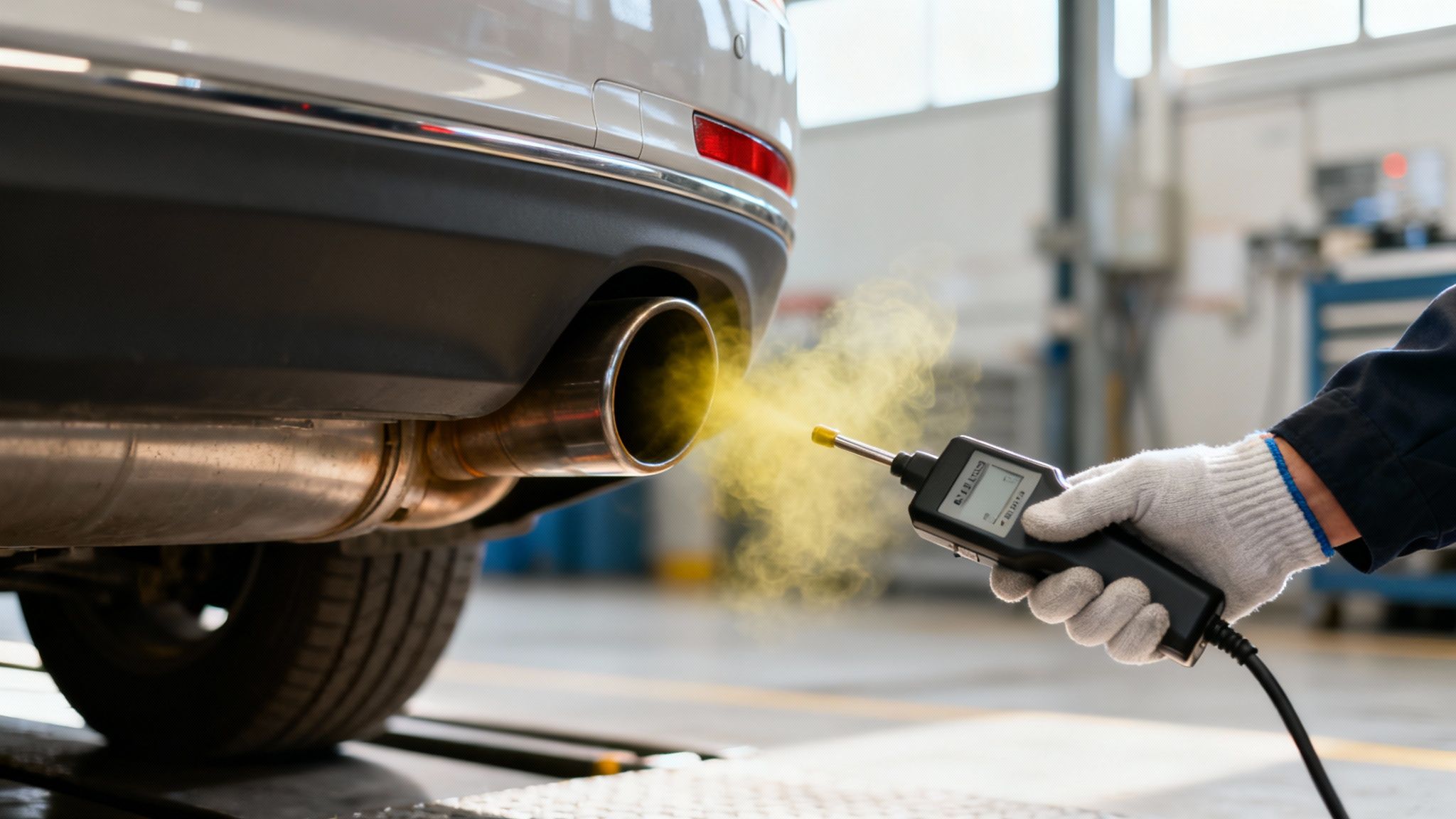
Beyond performance issues and warning lights, a couple of other bad O2 sensor symptoms demand immediate attention: olfactory warnings and regulatory failures. A "rotten egg" or sulfurous smell from your exhaust is a significant red flag.
This unpleasant odor is a direct byproduct of the rich fuel mixture discussed earlier. When a faulty O2 sensor causes the ECU to inject excessive fuel, the unburned gasoline travels into the exhaust system. There, it enters the extremely hot catalytic converter, which attempts to burn it off. This process, combined with trace amounts of sulfur present in gasoline, produces hydrogen sulfide—the source of the foul smell.
Why This Odor Is a Serious Warning
The sulfur smell is more than just an inconvenience; it's a clear indication that your catalytic converter is overheating and operating under extreme stress. The converter is engineered to process trace amounts of pollutants, not to incinerate large quantities of raw fuel.
An overheating catalytic converter, caused by a prolonged rich fuel condition from a bad O2 sensor, can lead to irreversible internal damage. Replacing a catalytic converter can cost thousands of dollars, making a timely O2 sensor replacement one of the most cost-effective preventative repairs.
Failing a Mandated Emissions Test
An equally significant consequence of a bad O2 sensor is failing a state-mandated emissions inspection. The O2 sensor is a cornerstone of the vehicle's emissions control system. Without its proper function, the ECU cannot regulate pollutants, resulting in an automatic failure at a testing facility.
A defective sensor can cause a dramatic increase in harmful emissions. Research indicates that O2 sensor failure rates increase with vehicle age and mileage. For vehicles with over 50,000 miles, the failure rate can be as high as 9%. When these sensors fail, pollution levels rise exponentially. One study found that every vehicle with a failed sensor exceeded hydrocarbon standards by an average of 300% of the legal limit. You can review the specifics in the EPA's vehicle testing data.
This turns a minor component failure into a regulatory issue. A failed emissions test prevents registration renewal until the vehicle is repaired and passes a re-inspection, adding cost and inconvenience that all stem from a single faulty part. Addressing O2 sensor problems promptly ensures your vehicle remains compliant, clean, and operates efficiently.
What Causes an O2 Sensor to Fail?
You have identified some of the classic bad O2 sensor symptoms, which is an important diagnostic step. However, understanding the root cause of the failure is essential for preventing a recurrence.
These sensors operate in a harsh environment, exposed to extreme temperatures and corrosive exhaust gases. Several factors can lead to their malfunction and cause them to send inaccurate data to the ECU.
A primary cause of failure is simple operational lifespan. Most O2 sensors are designed for 60,000 to 100,000 miles of service. Over time, their chemical reactivity diminishes, and their response time slows, reducing their accuracy. This is considered normal wear and tear.
However, premature failure is often caused by contamination. When foreign substances coat the sensor's porous ceramic tip, its ability to accurately measure oxygen is compromised.
Common Contaminants and Failure Modes
The contaminants that foul an O2 sensor almost always originate from within the engine itself, often as part of a chain reaction of other issues.
- Carbon Buildup: An engine running rich produces excessive soot (carbon). This carbon can clog the sensor's protective shield and contaminate the sensing element.
- Silicone Contamination: Using non-sensor-safe sealants during engine repairs can release silicone vapors. These vapors can poison the sensor's platinum electrodes, rendering it useless.
- Fluid Leaks: Internal engine leaks, such as a failing head gasket allowing coolant into the exhaust or worn piston rings allowing oil to burn, leave behind harmful deposits that can permanently damage the sensor.
The primary danger of ignoring a bad O2 sensor is the cascade of damage it can initiate. A simple sensor failure often leads to the destruction of the catalytic converter—a repair that can easily exceed $2,000.
The Expensive Consequences of Neglect
Postponing an O2 sensor replacement does more than just increase fuel costs; it actively damages other critical and expensive components. A failed sensor often causes the engine to run excessively rich, dumping unburned gasoline directly into the exhaust system.
This raw fuel then ignites inside the catalytic converter, raising its internal temperature to destructive levels. This extreme heat can melt the precious metal catalysts within the converter, making it completely ineffective.
What begins as a relatively inexpensive repair can quickly escalate into a catastrophic and costly failure. This is why addressing bad O2 sensor symptoms immediately is not just about restoring performance—it is about protecting your vehicle from thousands of dollars in subsequent damage.
Diagnosis and Next Steps
Recognizing the signs of a faulty O2 sensor—such as decreased fuel economy, rough engine operation, or an illuminated check engine light—is the first step toward a solution. However, it is crucial to avoid assuming the sensor is the sole problem.
Several other engine issues can mimic the symptoms of a failing O2 sensor. A vacuum leak, a malfunctioning fuel injector, or a severely restricted air filter can all cause similar performance problems. Therefore, a professional diagnosis is essential. A qualified technician uses a systematic approach and specialized tools to identify the true cause, ensuring you only pay for necessary repairs.
What to Expect During a Professional Inspection
When you bring your vehicle to a service center, a technician will perform several key diagnostic tests to confirm whether the O2 sensor is the root cause of the issue. A diagnosis should never be based on the error code alone.
- Code Retrieval: The first step is connecting an advanced OBD-II scanner to retrieve the specific Diagnostic Trouble Codes (DTCs) stored by the ECU.
- Live Data Analysis: Next, the technician will monitor the O2 sensor's voltage signal in real-time. This data shows whether the sensor is responding correctly to changes in the air-fuel mixture or if its readings are slow, erratic, or static.
- System Inspection: A thorough diagnosis includes checking for related problems, such as exhaust leaks or damaged wiring, which could affect the sensor's readings and trigger a false code.
An accurate diagnosis saves you time, money, and frustration. While symptoms may point to the O2 sensor, professional testing identifies the actual root cause, preventing the unnecessary replacement of functional parts.
This methodical diagnostic process is the only way to guarantee an effective and lasting repair. It distinguishes a simple sensor replacement from a more complex issue requiring a different solution. What may appear to be a sensor problem could be one of the classic signs your car needs a tune-up. By clearly communicating the observed symptoms to your mechanic, you contribute to an efficient and accurate repair plan.
Common Questions About O2 Sensors
Even after understanding the symptoms and causes, vehicle owners often have further questions. Here are answers to some of the most common inquiries we receive about O2 sensors.
This decision tree provides a visual representation of the diagnostic process, from symptom identification to the formulation of a repair plan.
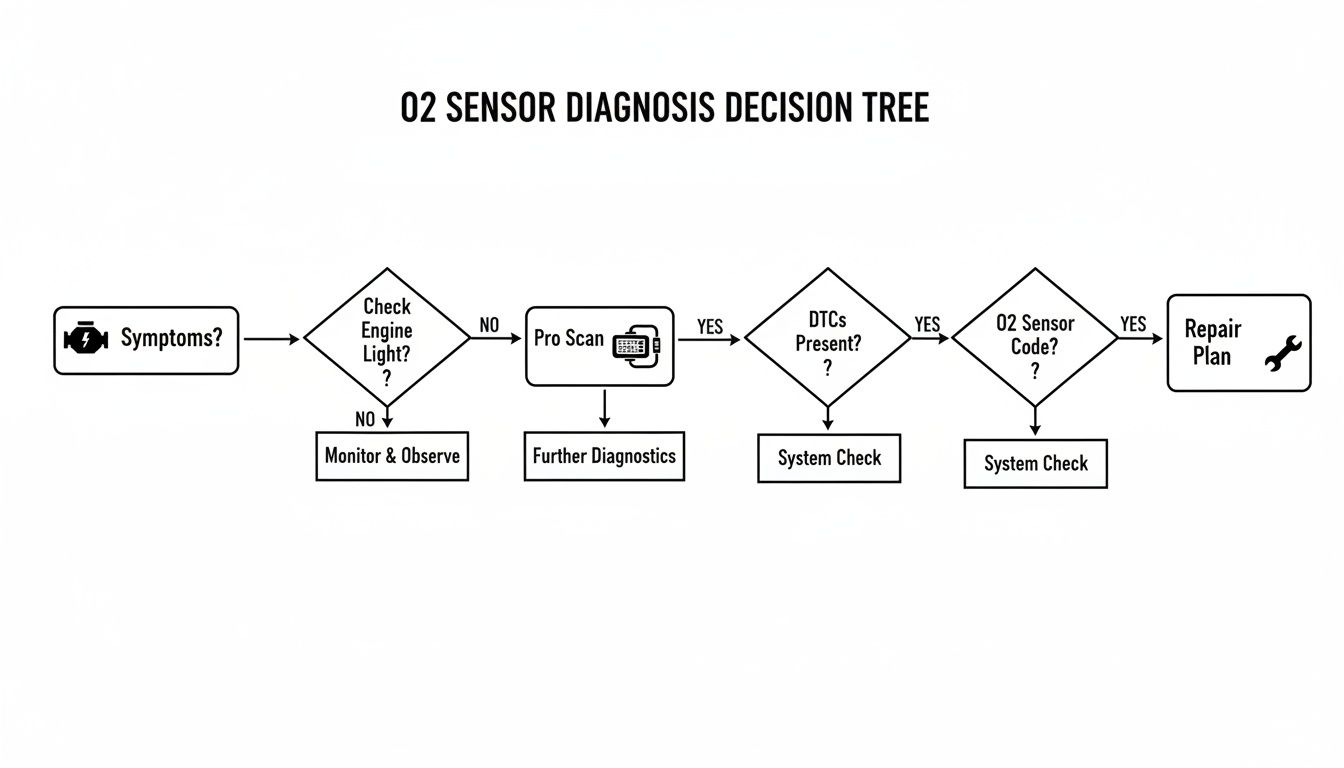
The primary takeaway is that while symptoms provide valuable clues, only professional diagnostics can confirm the root cause. This step is crucial for avoiding costly guesswork.
How Long Can I Drive with a Bad O2 Sensor?
While your vehicle may remain operational, continuing to drive with a known bad O2 sensor is strongly discouraged. You will experience significantly increased fuel consumption and higher emissions. Engine performance will be noticeably degraded.
The most significant risk is causing irreversible damage to your catalytic converter, a repair that can cost thousands of dollars. It is far more cost-effective and safer to have the O2 sensor replaced as soon as a problem is identified.
How Much Does It Cost to Replace an O2 Sensor?
The total cost varies depending on the vehicle's make and model and the sensor's location. The part itself typically costs between $50 and $150.
Labor charges usually add another $50 to $150. Some sensors are easily accessible, while others are located in difficult-to-reach areas of the exhaust system, requiring more time and effort to replace.
Can I Replace an O2 Sensor Myself?
For an experienced home mechanic with the proper tools, this is a feasible task. You will need a specialized O2 sensor socket, a ratchet, and likely a penetrating lubricant to loosen the old sensor from the high-temperature environment of the exhaust pipe.
However, if you are not comfortable working on your vehicle, this job is best left to a professional. A technician will ensure the correct part is installed and, critically, will verify that the new sensor has resolved the underlying issue.
Important Note: An O2 sensor-related error code does not always mean the sensor itself is faulty. The problem could be damaged wiring, an exhaust leak, or another engine management issue. This is why professional diagnostics are vital—they prevent you from purchasing parts you don't need.
The only way to be certain of the cause is through a comprehensive diagnostic inspection by a qualified professional.
If you are experiencing any of these bad O2 sensor symptoms in the Plano, Texas area, don't allow a small issue to become a major expense. The ASE-certified technicians at Express Lube & Car Care utilize advanced diagnostic equipment to pinpoint the exact cause of your vehicle's problem. Visit us for prompt, professional service to restore your vehicle's performance and efficiency. Learn more at https://www.expresslubeplano.com.