

The answer to how often you should change your rear differential fluid isn’t a single number; it’s based on your vehicle and how you drive it. For most vehicles under normal conditions, the recommended interval is typically between 60,000 and 100,000 miles. However, this can change significantly based on your driving habits and the demands you place on your vehicle.
How Often Should You Change Differential Fluid: Understanding Its Importance
Think of your car’s rear differential as a complex mechanical joint. Its primary function is to allow your vehicle’s wheels to rotate at different speeds, which is essential for making smooth turns. The differential fluid (also known as differential oil) is a specialized, heavy-duty lubricant that ensures the intricate gears inside this system operate without grinding against each other. Differential oil not only lubricates but also cools and protects the differential’s internal components, playing a crucial role in overall performance and longevity.
Without clean and effective fluid, the gears generate immense friction and heat, leading to premature wear and eventual failure. A rear differential fluid change is a critical, yet often overlooked, maintenance task. Neglecting it is akin to forcing a vital mechanical component to operate without any lubrication, which is a direct path to costly damage. Unlike motor oil, which is used in the engine and typically has a filter or oil filter to trap debris, the differential does not have a filter. This means contaminants like metal shavings can circulate freely and cause damage if the fluid is not changed regularly. While both motor oil and differential fluid serve to lubricate, differential fluid is specifically formulated to meet the unique demands and pressures within the differential system. Understanding the proper service interval for your specific use case is fundamental to your vehicle’s long-term health.
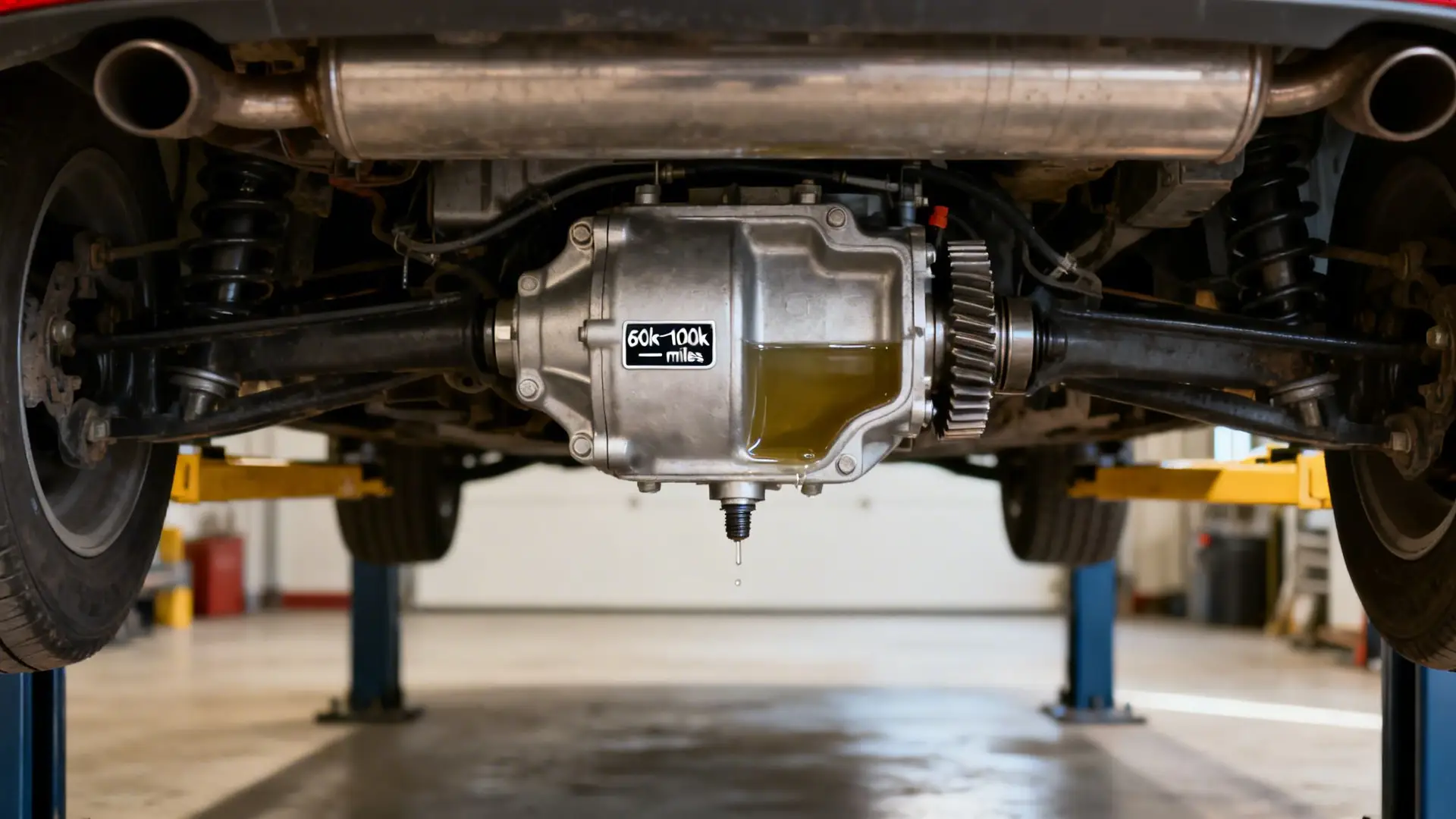
The depth of the differential fluid’s role becomes especially apparent in high-pressure situations, as it provides comprehensive protection and function within the entire differential system.
Why Driving Conditions Are the Most Important Factor
Not all driving creates the same level of stress on a vehicle’s components. A daily highway commute, for example, is far less demanding than towing a heavy trailer. Modern trucks, in particular, place significant strain on their differentials.
Consider this evolution in engineering: in 1996, a Ford F-250 could tow up to 10,500 lbs with a rear differential holding 3.75 quarts of fluid. Today, comparable trucks can haul over 15,000 lbs with a differential that holds only 3.3-3.5 quarts. This means more work is being done by less fluid, leading to higher operating temperatures and faster fluid degradation, which causes the fluid to break down more quickly.
This intense mechanical strain generates massive heat, causing the lubricant to lose its protective properties much more quickly. That’s why a fluid that might last the “lifetime” of the vehicle for one driver could be completely ineffective after just 30,000 miles for another.
Recommended Rear Differential Fluid Change Intervals
To simplify this, we’ve created a table outlining recommended service intervals based on driving conditions. Most manufacturers recommend these intervals, especially for vehicles that tow or haul heavy loads frequently, to ensure optimal performance and longevity. Match your typical driving habits to find your vehicle’s ideal schedule.
|
Driving Condition |
Typical Vehicle Use |
Recommended Change Interval |
Expert Insight |
|---|---|---|---|
|
Normal Service |
Daily highway commuting, light city driving |
60,000 – 100,000 Miles |
Even under normal conditions, the fluid level and condition should be inspected every 30,000 miles. |
|
Severe Service |
Heavy stop-and-go traffic, frequent short trips |
30,000 – 50,000 Miles |
City driving is harder on fluids due to constant acceleration, deceleration, and turning. |
|
Heavy Duty / Towing |
Hauling trailers, boats, or other heavy loads |
15,000 – 30,000 Miles |
This is a non-negotiable interval for any vehicle used for towing. Delaying service is not advised. |
Following these guidelines is an excellent starting point for vehicle maintenance. For a complete overview of how this service fits into your car’s overall health, review our guide on creating a car maintenance schedule by mileage. Proactive maintenance is the most effective strategy for ensuring your vehicle runs reliably for years.
The Role of the Rear Differential in Your Vehicle
Have you ever wondered how your car executes a smooth turn without the rear wheels skipping or dragging? This is the work of the rear differential. It’s a gearbox located on the rear axle that enables the outside wheel to spin faster than the inside wheel during a turn. The differential transfers power from the driveshaft to the wheels through the ring and pinion gears, ensuring efficient movement and proper handling.
Imagine walking around a corner—your outside foot must travel a longer path than your inside foot. The differential performs the same function for your car’s wheels, compensating for the different distances and preventing unnecessary stress on your tires and drivetrain components.
The Fluid That Enables This Process
Inside the differential is a specialized gear oil that performs under extreme conditions. This isn’t just any oil; it has two critical jobs: to provide high-performance lubrication and to dissipate heat. The gears operate under constant, intense pressure, which generates significant friction and heat.
This fluid creates a thin, protective film between the metal gear teeth, preventing them from making direct, damaging contact. The differential fluid is responsible for protecting the gears and bearings by providing proper lubrication and cooling, especially under high-stress conditions. It also functions as a coolant, absorbing heat from the gears and transferring it to the differential’s outer housing to cool down.
What Happens When Differential Fluid Degrades
Over time, this hard-working fluid breaks down. It becomes contaminated with microscopic metal particles from normal gear wear and loses its ability to protect the moving parts. Ignoring this degradation can lead to significant mechanical problems.
Without a clean film of fluid, the gears begin to grind. This causes severe friction, which leads to loud whining or howling noises, overheating, and eventually, catastrophic failure. A seized differential is not only a dangerous failure—it’s also one of the most expensive repairs a vehicle owner can face.
This is why understanding how often to change rear differential fluid is so critical for your vehicle’s health. A timely fluid change is a small, preventative investment that can help you avoid a repair bill that could easily run into the thousands. It’s one of the most effective ways to protect a vital and expensive part of your car.
What Are Severe Driving Conditions?
Most people consider themselves “normal” drivers. A daily commute and running errands may seem standard, but your vehicle’s manufacturer might classify this activity as “severe service.” Understanding which category your driving habits fall into is the key to determining the correct rear differential fluid change interval.
Think of it this way: normal driving is like a steady jog on a cool day—it’s low-stress. Severe driving, in contrast, is like a series of intense sprints in the Texas summer heat. This places significantly more strain on your vehicle’s components, causing fluids like your gear oil to degrade much faster.
This flowchart provides a visual guide to help you determine if your driving habits are more demanding on your vehicle than you might think.
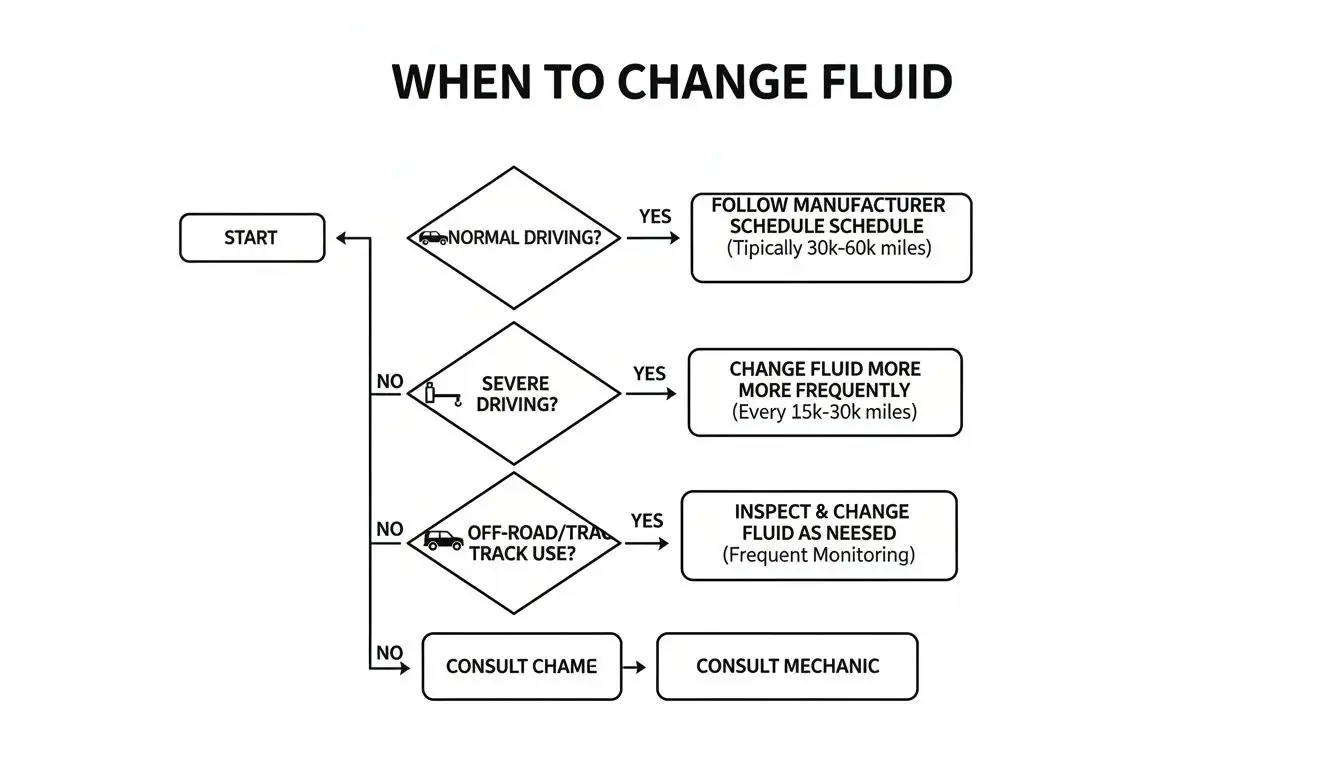
As the chart illustrates, activities like towing immediately place your vehicle on a much shorter service schedule compared to a standard commute. Following the recommended differential fluid change intervals helps maximize your vehicle’s performance and longevity, especially under severe conditions.
Defining Severe Driving
What kind of driving actually pushes your vehicle into the severe service category? It’s not just about extreme off-roading. Many common driving habits are surprisingly hard on your differential fluid.
-
Frequent Short Trips: If your typical drive is less than 10 miles, your differential fluid may not reach a high enough temperature to evaporate accumulated condensation. This moisture contaminates the fluid and compromises its lubricating properties.
-
Stop-and-Go City Traffic: The constant accelerating and braking in heavy traffic places continuous pressure on your differential gears, causing the fluid to heat up and degrade.
-
Driving in Extreme Temperatures: Both hot summers and cold winters force your gear oil to operate outside its optimal temperature range, accelerating its breakdown.
-
Towing or Hauling Heavy Loads: This is the most demanding activity for a differential. Pulling a trailer or carrying heavy cargo generates extreme heat and dramatically shortens your gear oil’s lifespan.
When you tow or haul, manufacturer claims of “lifetime fluid” no longer apply. For severe use, they will often recommend a fluid change as often as every 30,000 miles. In temperatures over 100°F, the pressure on the gears is immense. The fluid gets sheared down, loses viscosity, and the rate of wear can increase by up to . We frequently see work trucks and vehicles used for towing come in with fluid that is black and gritty at only 20,000 miles.
Ignoring these severe service intervals has documented consequences. In fleet vehicles, for example, skipping severe service differential changes is linked to a 40% increase in component failures. Being proactive can reduce potential repair costs by 60-70%. You can learn more about how different driving styles affect your fluids from trusted automotive sites
Simply recognizing that your daily drive might be more demanding on your car than you realize is the first step toward proper maintenance. This proactive mindset can save you significant money and prevent major mechanical issues.
Recognizing the Warning Signs of Old Differential Fluid
A vehicle rarely fails without providing some warning. Long before a catastrophic breakdown occurs, it will exhibit signs—some subtle, some obvious—that indicate a problem. Learning to recognize these symptoms is key to avoiding major repairs, and this is especially true for your differential fluid.
Ignoring the manufacturer’s recommended service schedule is a risk, but ignoring unusual noises from your vehicle is a near guarantee of future problems. The most common symptom of worn-out gear oil is a distinct whining or howling sound from the rear of the vehicle. This noise often gets louder or changes in pitch as you accelerate, indicating that the gears are not being properly lubricated and are starting to grind.
Sounds and Sensations That Indicate a Problem
Beyond a general whine, some specific sounds can point directly to a fluid-related issue. Pay close attention to how your car behaves, particularly when turning.
-
Chattering or Grinding When Turning: If you hear a chattering or grinding noise only when you take a corner, the fluid has likely broken down. This is a classic sign in vehicles with a limited-slip differential (LSD), which requires special friction modifiers in the oil to function correctly.
-
Vibrations from the Rear: A rumbling or vibration that feels like it’s originating from the rear axle can indicate excessive wear on the gears or bearings, often caused by poor lubrication.
-
A Burning Smell: A sharp, pungent odor after driving, especially after towing or a long highway trip, could mean the differential fluid has overheated and is no longer able to protect the internal components.
By the time you hear obvious symptoms like loud grinding, some degree of damage to the differential’s gears may have already occurred. This is precisely why proactive fluid changes are so important. Addressing the issue early transforms an inexpensive fluid service into a preventative measure that saves you from a repair that could cost thousands.
A Simple Visual Inspection
You can also identify problems through a visual check. Look for any dark, oily fluid leaks on the pavement directly under your rear axle. The differential is a sealed unit, so any sign of a leak is a definite red flag that requires attention.
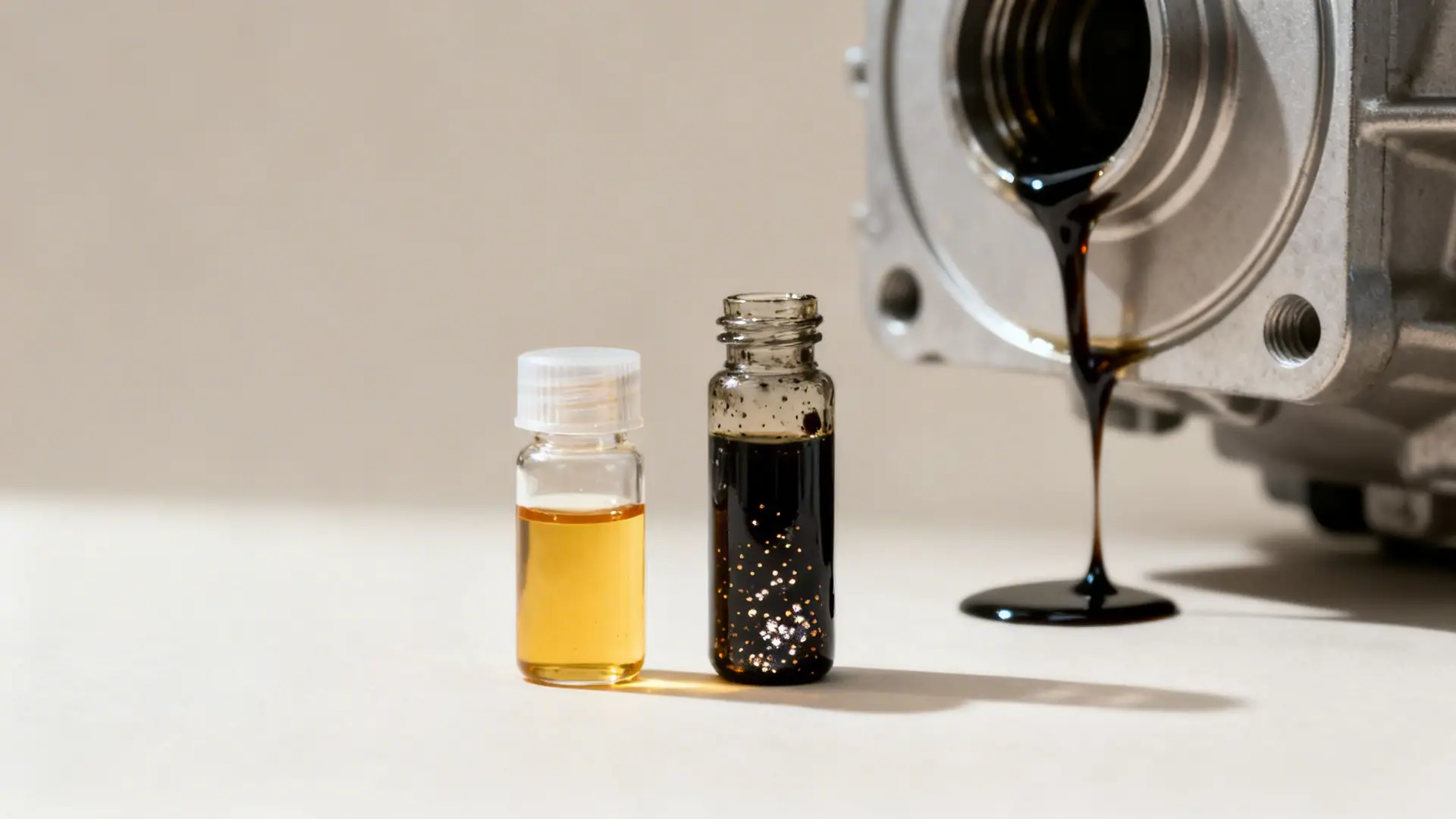
The condition of the fluid itself is another clear indicator. Healthy differential fluid is typically translucent and has a honey-amber color. Worn-out fluid, however, tells a different story:
-
It will appear dark brown or black.
-
It may be thick and sludgy in consistency.
-
It often contains tiny metallic specks, which are physical evidence of your gears being worn away by friction.
If you notice any of these signs, it’s a clear signal that your differential is operating without adequate protection. At that point, knowing how often to change rear differential fluid becomes an immediate priority.
Choosing Between Conventional and Synthetic Gear Oil
When it’s time to service your differential, you will typically be presented with two main options: conventional and synthetic gear oil. The choice you make has a significant impact on your vehicle’s long-term health and the frequency of future services.
Conventional gear oil is a petroleum-based lubricant that has been the industry standard for decades. It provides adequate protection for gears under normal driving conditions and is a cost-effective option for drivers who do not place their vehicles under high stress. Reputable manufacturers conduct rigorous tests on their gear oils to ensure high performance and reliability under real-world conditions.
The Superior Performance of Synthetic Gear Oil
Synthetic gear oil, by contrast, is a chemically engineered lubricant designed for maximum performance, particularly under demanding conditions. If you engage in any towing, haul heavy loads, or frequently drive in stop-and-go traffic, synthetic oil offers a significant upgrade in protection.
Key advantages include:
-
Superior Thermal Stability: Synthetics resist breaking down or “cooking” at extreme temperatures. This prevents the formation of sludge that can damage a differential.
-
Enhanced Lubrication: The uniform molecular structure of synthetic oil creates a stronger, more consistent protective film over the gears, reducing friction and wear.
-
Extended Service Life: Due to their durability, synthetics can often go longer between changes, which helps offset the higher initial cost with fewer service visits over time.
Investing a little more in a premium synthetic fluid is one of the wisest decisions a vehicle owner can make. The superior protection it provides can be the difference between a simple fluid swap and a four-figure repair bill for a failed differential.
Conventional vs. Synthetic Gear Oil: A Comparison
To help you decide, here is a direct comparison of the two fluid types. This table should clarify which is the right fit for your vehicle, driving style, and budget.
|
Feature |
Conventional Gear Oil |
Synthetic Gear Oil |
|---|---|---|
|
Performance Under Heat |
Breaks down more quickly at high temperatures. |
Excellent thermal stability; resists breakdown. |
|
Friction & Wear Protection |
Good protection for normal driving conditions. |
Superior protection; minimizes friction and wear. |
|
Service Interval |
Requires more frequent changes. |
Allows for longer service intervals. |
|
Cost |
Lower upfront cost per quart. |
Higher upfront cost but offers better long-term value and protection. |
Ultimately, the choice of gear oil is similar to the choice you make for your engine oil. To learn more about the broader benefits, see our guide on synthetic vs. conventional oil for your entire vehicle.
The Value of a Professional Differential Fluid Service
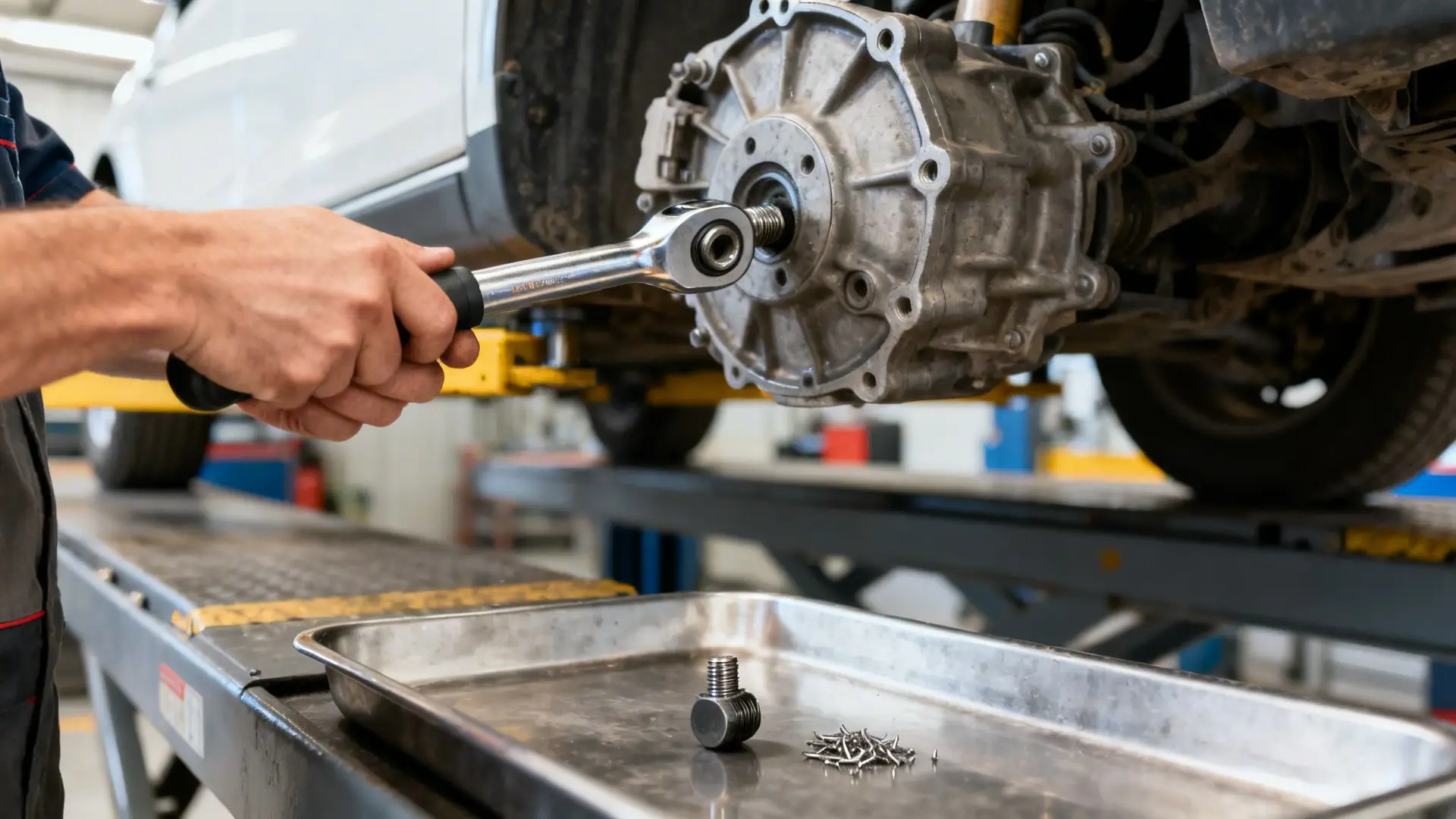
While some vehicle maintenance tasks are suitable for a DIY approach, a differential fluid change is often best left to professionals. It is a messy and surprisingly technical job where small errors can lead to expensive damage. Entrusting this service to a professional ensures it is done correctly, protecting one of your vehicle’s most critical and costly components.
A professional service involves more than just draining and refilling fluid. The process begins by placing the vehicle on a proper lift to ensure it is level and to provide clear access for a thorough job. Technicians then fully drain the old, contaminated fluid. If you can’t locate your owner’s manual, there’s no need to worry—professional technicians can access the necessary specifications and information to ensure a worry-free service.
More Than Just a Fluid Swap
This is where a professional service demonstrates its true value. Most differentials are equipped with a magnetic drain plug, which is designed to capture the fine metal particles that naturally wear off the gears over time.
A certified technician doesn’t just wipe this plug clean; they carefully inspect the collected metal shavings. The amount and size of these particles serve as a diagnostic indicator of the differential’s internal health. Detecting excessive wear early on can be the difference between a routine fluid change and a catastrophic gear failure down the line.
This inspection transforms a standard maintenance task into a proactive health assessment for your drivetrain. It helps answer not only how often to change rear differential fluid, but also if a more significant problem is developing.
The Professional Guarantee of Precision
After cleaning and inspection, the job requires precision. A professional service guarantees two critical elements that are easy to get wrong in a home garage: using the correct fluid type and filling it to the exact specified level.
Using the wrong fluid, especially in a limited-slip differential (LSD), can cause immediate and irreversible damage, leading to chattering, grinding, and eventual failure. Technicians use manufacturer-specific fluids to ensure compatibility. Just as importantly, they fill the differential to the precise factory-specified level—both overfilling and underfilling can lead to leaks, overheating, and pressure-related problems.
You can learn more about this and other expert maintenance services by reviewing our full list of fluid exchange services
Ultimately, a professional service provides more than just fresh fluid. It offers peace of mind, knowing your vehicle’s drivetrain is properly protected and prepared for the road ahead.
Your Top Questions About How to Change Differential Fluid
Even with a thorough understanding of the process, you may still have questions. Here are clear answers to the most common inquiries we receive from drivers.
Q: What is the role of the transmission in relation to the differential?
A: The transmission is a key component of your vehicle’s drivetrain system. It transfers power from the engine to the driveshaft, and then the differential distributes that power to the wheels. In front-wheel drive (FWD), rear-wheel drive (RWD), and all-wheel drive (AWD) vehicles, the transmission (or transaxle) works closely with the differential to ensure smooth and efficient power delivery to the wheels.
What Is the Average Cost to Change Rear Differential Fluid?
A professional differential fluid service typically costs between $100 and $250, depending on the vehicle and the specific type of fluid it requires.
Consider it a small, preventative investment to avoid a potential four-figure repair bill for a failed differential.
What Happens If I Use the Wrong Type of Differential Fluid?
This is one area where using the correct product is non-negotiable. Using the wrong gear oil can cause serious and almost immediate damage, particularly if your vehicle is equipped with a limited-slip differential (LSD). These systems require a special fluid containing friction modifier additives to function properly.
An incorrect fluid choice is a recipe for failure. Using the wrong fluid in an LSD can cause loud chattering and grinding noises during turns and will quickly destroy the internal clutch packs. A professional service eliminates this guesswork and guarantees your vehicle receives the exact fluid specified by the manufacturer.
Is Changing the Front and Rear Differential Fluid the Same Thing?
If you own a four-wheel drive (4WD) or all-wheel drive (AWD) vehicle, the maintenance is more comprehensive. These vehicles have a front differential and often a transfer case, each requiring its own specific fluid and adhering to its own service schedule.
It is a common mistake to assume one type of fluid works for all drivetrain components. Always consult your owner’s manual or a trusted technician. Servicing each component correctly is essential for preventing costly damage to your vehicle’s drivetrain.
Navigating your car’s maintenance schedule doesn’t have to be complicated. For expert service and honest advice you can count on, bring your vehicle to . Our ASE-certified technicians will ensure the job is done right so you can drive with confidence. Schedule your visit today at