

You walk out to the driveway in Plano, coffee in hand, and see a dark spot under your car. Or maybe there’s no puddle at all, just that sharp burnt-oil smell after a stoplight on Parker Road and a nagging feeling that something isn’t right. That’s usually how engine oil leaks announce themselves. Subtly at first, then all at once when the oil light flickers or smoke starts curling from under the hood.
Most oil leaks start as a maintenance problem, not a death sentence for the engine. The trouble is that oil travels. It runs along covers, drips off crossmembers, and gets blown backward while you drive, so the spot on the ground often isn’t the true source. If you guess wrong, you can spend money on the wrong repair or keep driving long enough to turn a manageable leak into a seized engine.
This guide is built for that exact moment. It gives you a practical way to assess what you’re seeing, what you can safely check at home, what temporary fixes are worth trying, and when the smartest move is to stop driving and get the car properly diagnosed.
Decoding the Drip Common Causes and Symptoms of Engine Oil Leaks
A lot of drivers think an oil leak means one dramatic failure. Usually, it’s more ordinary than that. Engine oil leaks frequently stem from deteriorated gaskets and seals, especially as heat, age, and mileage harden rubber parts that used to stay flexible. According to this engine oil leak overview, oil from a failing valve cover gasket can drip onto the hot exhaust manifold, producing acrid smoke or even sparking a fire, and these leaks are a top cause of engine deterioration because lubrication loss snowballs into bigger internal damage.
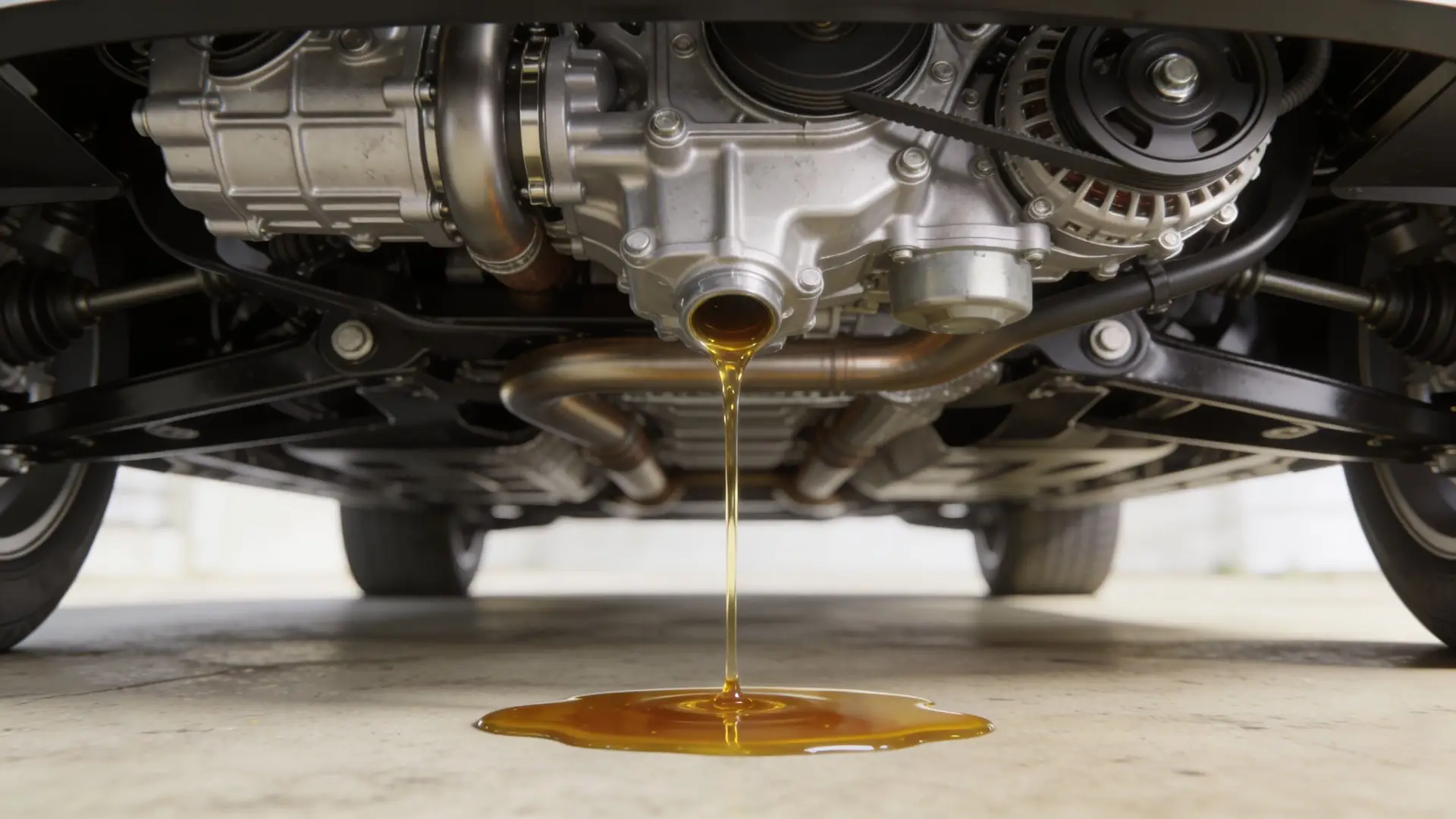
Plano drivers deal with conditions that don’t help. Summer heat bakes seals. Stop-and-go traffic keeps under-hood temperatures up. Rough pavement, road debris, and long commutes add vibration and grime. Rubber parts don’t fail overnight, but they do get less forgiving.
The usual leak points
Three areas cause most of the oil leak stories drivers bring into a shop.
- Valve cover gaskets often leak from the top of the engine. When they fail, oil runs downward and can land on hot components. That’s why some people smell burning oil before they ever see a drip.
- Oil pan gaskets or drain plug areas leak from the bottom. Sometimes the gasket is tired. Sometimes the drain plug threads were damaged or the plug wasn’t seated correctly at a prior service.
- Main seals, especially the rear main seal, leak from the back of the engine where it meets the transmission. Those can be harder to spot and more labor-intensive to repair.
A simple service issue can mimic a major repair. A loose oil filter, a dirty drain plug seat, or cross-threaded hardware can leave oil where it shouldn’t be. That’s why a good diagnosis matters more than a quick guess.
Oil on the ground tells you there’s a problem. It doesn’t tell you where the problem started.
Symptoms that matter more than the puddle
The puddle gets your attention, but other symptoms tell you how urgent the situation may be.
Here’s what to watch for:
| Symptom | What it often suggests |
|---|---|
| Burning oil smell | Oil may be contacting a hot engine or exhaust surface |
| Smoke from under the hood | The leak may be landing on very hot components |
| Oil spots after parking | The leak is active enough to drip when the engine sits |
| Low oil level or warning light | The engine may be losing oil faster than you realize |
| Greasy buildup on the engine | A slower leak may have been there for a while |
Blue-tinged smoke from the exhaust points to a different possibility. That can mean the engine is consuming oil rather than leaking it externally. I’ll address that in the FAQ section because it confuses a lot of people.
Why the source often looks wrong
Oil is sneaky. A valve cover leak can coat the side of the engine and make the oil pan look guilty. Airflow under the car can push fresh oil toward the rear, so the drip lands nowhere near the original leak. That’s why a driveway spot is just a clue, not a diagnosis.
If your car also has coolant loss, overheating, or milky contamination, don’t assume every fluid issue is an oil leak. A separate problem such as a head gasket issue can create overlapping symptoms, and this guide on bad head gasket warning signs can help you sort out those differences.
Severity comes down to two questions
When I look at engine oil leaks, I’m trying to answer two things fast:
- How quickly is the engine losing oil?
- Where is the oil going?
A slow seep from an aging gasket is one kind of problem. Oil dripping onto the exhaust, soaking a belt area, or dropping the oil level between checks is a different kind of problem. Same fluid, very different risk.
If you smell it, see it, or keep topping off oil, don’t shrug it off. Oil is the engine’s lifeblood. A leak is the engine telling you the closed system isn’t closed anymore.
Your At-Home Inspection How to Safely Diagnose an Oil Leak
Engine seals work like the lid on a good food container. When the seal is healthy, everything stays inside even when the contents get hot and slosh around. When the seal gets hard, cracked, or pinched, it may not fail dramatically. It starts with a film, then a damp spot, then a drip.
You can learn a lot in your own driveway without special tools. The goal isn’t to confirm the exact failed part. The goal is to gather clean, useful clues and avoid making the mess worse.
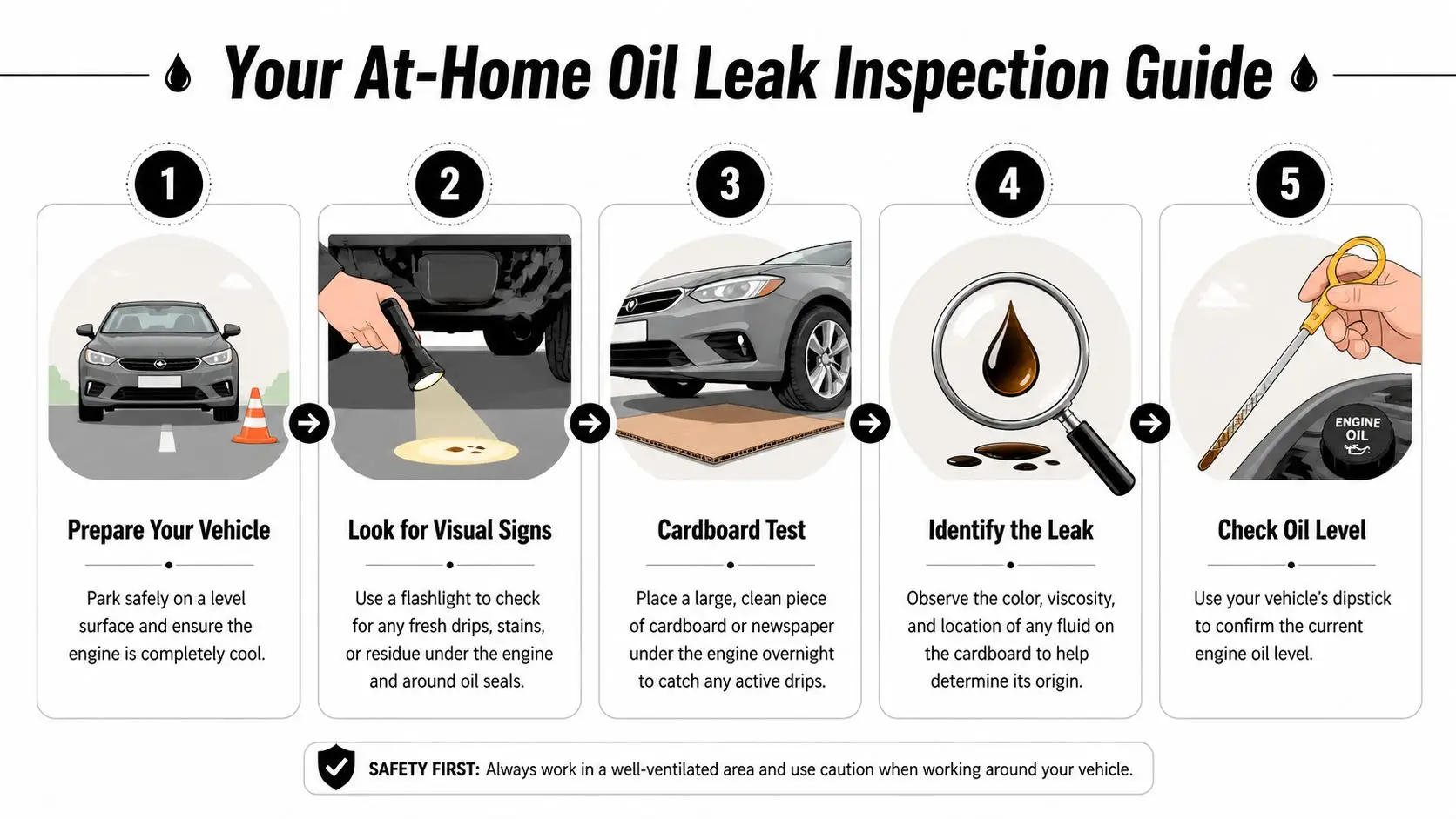
Start with safety and setup
Do this only when the engine is completely cool and the car is parked on level ground.
- Park and let it cool. Hot exhaust parts and hot oil can burn you fast.
- Grab basic supplies. Use a flashlight, gloves, paper towels, and a clean piece of cardboard.
- Don’t crawl under an unsupported car. If you can’t see something from the side or from above, leave it for a shop.
That’s enough to do a smart first inspection.
What to look for first
Open the hood and look for fresh wet oil versus old baked grime. Fresh leaks usually look shiny. Older leaks collect dust and turn into sticky black buildup.
Focus on areas you can see:
- Top of the engine around the valve cover
- Around the oil filter housing and nearby surfaces
- Lower edge of the engine where oil may run down
- Near the drain plug area if you can see it from the front or side
Wipe one suspicious area with a paper towel. Engine oil will usually look brown to black and feel slick. Coolant tends to be more watery and colorful. Transmission fluid often has a different tint and smell. Water from the A/C is just water.
For a more detailed refresher on the basics, this guide on how to check oil on a car is worth reviewing before you inspect anything else.
Use the cardboard test the right way
A big sheet of cardboard under the engine overnight is one of the simplest and most useful checks you can do. It won’t tell you the exact failed gasket, but it helps you answer whether the leak is active and roughly where it’s landing.
Use it like this:
- Place it under the engine area, not just under the bumper.
- Leave it overnight after a normal drive.
- Mark front and rear on the cardboard so you know orientation in the morning.
- Look at color and position, not just size.
If the drip shows up near the middle or rear, don’t assume the leak started there. Airflow can push oil backward while driving.
Practical rule: The drip location is evidence, not the verdict.
Check the dipstick and record what you find
A leak matters because of what it does to the oil level. Pull the dipstick, wipe it clean, reinsert it fully, then pull it again and read the level. If your vehicle uses an electronic monitor, follow the manufacturer procedure on level ground with the engine condition it requires.
Write down what you see:
| Check | What to note |
|---|---|
| Oil level | Full, low, or below safe range |
| Oil appearance | Clean amber, dark, gritty, or foamy |
| Smell | Normal oil smell or strong burnt odor |
| Leak pattern | Overnight drips, only after driving, or no visible drips |
This helps if the problem changes over the next few days.
A short visual demonstration can help if you’re more of a watch-it-than-read-it person.
What not to do in the driveway
Tracing oil leaks can make DIY checks go sideways. A pro-level method uses brake cleaner and top-down degreasing to trace the source, but this diagnostic breakdown notes that cleaning from the bottom up misleads 45% of the time because gravity hides the true source, and inadequate drying leads to false negatives in 30% of attempts.
So skip the “spray everything and hope” approach unless you know exactly what you’re doing. Don’t hose down electrical connectors. Don’t scrub a hot engine. Don’t assume the lowest wet spot is the source.
When your inspection has done its job
An at-home inspection is successful if you can answer these questions:
- Is the oil level safe right now?
- Is the leak active or just residue from an older problem?
- Do you see signs of oil burning on hot parts?
- Does the car need immediate attention, or can it be moved carefully for service?
If you can answer those, you’ve done enough. The next step isn’t more guessing. It’s deciding whether this is a monitor-it issue, a get-it-checked-soon issue, or a shut-it-down issue.
Temporary Fixes and When to Stop Driving Immediately
Drivers usually ask the same question when they discover engine oil leaks. Can I just add oil, pour in a stop-leak product, and keep going for a while? Sometimes you can buy a little time. Sometimes that decision ruins the engine.
That’s the trade-off. Temporary measures can reduce symptoms. They do not reverse worn parts, torn seals, or damaged threads.
What stop-leak can and cannot do
Some oil stop-leak products work by conditioning or swelling old seals slightly. That can help with a minor seep from aging rubber. It may slow a drip enough to get you through a short period before repair.
It won’t fix these problems:
- A split gasket
- A loose or damaged drain plug
- A bad oil filter seal
- Mechanical wear that creates an opening oil can pass through
- A leak that’s already reaching hot exhaust parts
According to this explanation of oil leak fixes and risks, stop-leak products can be effective for minor cases, but they do not fix mechanical damage.
The only temporary step that always makes sense
If the oil level is low, topping it off with the correct oil is smart. That protects the engine while you arrange repair. Think of it as stabilizing the patient, not curing the illness.
A couple of practical moves help in the short term:
- Top off carefully using the correct oil grade for your vehicle.
- Recheck the level often if you must drive a short distance before service.
- Keep the trip short and avoid heavy acceleration or long idling if the leak seems active.
- Watch for new symptoms such as smoke, smell, or warning lights.
That said, there’s a point where continued driving becomes the expensive choice.
Stop driving if you see any of these
This is a mandatory list. Shut the engine off and arrange a tow if any of these happen:
| Red flag | Why it matters |
|---|---|
| Oil pressure warning light comes on or flickers | The engine may not be getting proper lubrication |
| Smoke from under the hood | Oil may be contacting the exhaust or another hot surface |
| Rapid dripping or a growing puddle | Oil loss may be too fast to manage safely |
| Strong burning smell that gets worse | The leak may be reaching dangerous areas |
| Knocking, ticking, or harsh engine noise | Oil level or oil pressure may already be too low |
Driving with insufficient oil can cause the engine to seize, and the fire risk goes up significantly if leaking oil reaches hot exhaust parts, as noted in the same oil leak risk reference. Once you’re in that territory, “just one more trip” is how people turn a gasket repair into an engine replacement.
If the oil warning light is on, the question isn’t whether the car still moves. The question is whether the engine is being damaged while it moves.
The cheap move versus the smart move
The cheap move feels like stretching things one more week. The smart move is preventing secondary damage.
A valve cover gasket may be annoying. A soaked ignition area, burned oil on the exhaust, or a dry crankcase is something else. If the leak is small and stable, you may have time to plan. If the leak is active and the car is telling you it’s unhappy, stop testing your luck.
Professional Repair Options and Expected Costs
A good shop doesn’t start with parts. It starts with proof. That matters because engine oil leaks love to impersonate each other. Oil from high on the engine can run down and make a lower gasket look guilty. If a technician skips that step, you can pay for a repair and still leave with the leak.
What a professional diagnosis looks like
The best non-invasive method is UV dye testing. According to EuroX’s UV dye leak diagnosis guide, this method has a detection success rate over 90%, can identify leaks as small as 1 to 2 drops per hour, and resolves 85% of leak issues without costly engine disassembly, potentially saving $500 to $2000.
That’s why experienced shops like it. It answers the hard question. Where is the oil starting from?
A typical process looks like this:
- Clean the engine surfaces so old residue doesn’t confuse the test.
- Add UV dye to the oil in the proper amount.
- Run the engine and, if needed, road test it so the dye circulates under normal pressure.
- Inspect with a UV light to trace the glow back to the source.
- Confirm suspicious areas before recommending a repair.
For hidden areas, a technician may also use mirrors, a borescope, or another confirmation step before quoting work.
Common repairs and why labor varies so much
The part that leaks is often inexpensive. The labor is what changes the bill.
A valve cover gasket sits near the top of the engine and is generally more accessible. A rear main seal sits between the engine and transmission, which means the transmission often has to come out to reach it. That’s why two oil leaks can both involve “just a seal,” but one is a routine repair and the other is a major job.
Here are the repairs drivers most commonly hear about:
- Valve cover gasket replacement for leaks from the top of the engine
- Oil pan gasket or drain plug repair for leaks from the bottom
- Oil filter or filter housing sealing issues when oil appears around the service area
- Rear main seal replacement when oil leaks from the engine-transmission junction
- Camshaft or timing area sealing repairs when oil spreads across the front of the engine
Common Engine Oil Leak Repair Costs & Timelines
Because labor rates, engine layouts, and parts access vary by vehicle, there isn’t one universal price list that stays honest. The most transparent way to discuss costs is by range and difficulty.
| Repair Type | Estimated Cost Range | Estimated Repair Time |
|---|---|---|
| Valve cover gasket replacement | Lower to moderate | Usually shorter than major seal jobs |
| Oil drain plug or oil filter sealing issue | Lower | Often quick once confirmed |
| Oil pan gasket repair | Moderate to higher | Moderate to extensive depending on access |
| Oil filter housing or similar upper-engine sealing repair | Moderate | Moderate |
| Rear main seal replacement | Higher | Extensive due to transmission removal |
| Camshaft or timing cover related leak repair | Moderate to higher | Moderate to extensive |
If you want a broader sense of how shops think about labor, parts, and engine-related repairs in general, this guide on how much engine repair costs gives useful context.
What works and what wastes money
The repair that works is the one tied to the confirmed source. The repair that wastes money is replacing the wettest-looking part without tracing the leak.
Here’s the practical difference:
| Approach | Likely result |
|---|---|
| Diagnose first, repair second | Higher confidence, fewer repeat visits |
| Replace parts based on guesswork | Old leak may remain, new parts may not solve it |
| Clean and verify after repair | You can tell if the fix held |
| Skip cleanup after repair | Old residue can look like a fresh failure |
A proper oil leak repair includes verification. If the engine isn’t cleaned and rechecked, old residue can fool everyone.
How to approve the right repair
Before saying yes, ask the shop to explain three things in plain language:
- Where is the leak starting?
- How did they confirm it?
- What other parts are affected by the leak path?
That last one matters. Oil on belts, hoses, or electrical connectors can change the repair plan. The best estimate isn’t just a parts list. It’s a diagnosis with a reason behind it.
How to Prevent Engine Oil Leaks Before They Start
Most engine oil leaks don’t begin as a dramatic event. They begin as neglected maintenance, aging seals, or a tiny seep nobody caught because nobody looked. Prevention is cheaper, less stressful, and far easier on your schedule than chasing an active leak after the driveway starts telling on you.
The maintenance habits that actually help
Routine oil changes matter for more than clean lubrication. Fresh oil helps the engine run at the condition it was designed for, and regular service creates repeated chances to spot wet gaskets, loose filters, and early seepage before it gets messy.
A few habits make the biggest difference:
- Use the correct oil for your vehicle and driving conditions. Wrong viscosity choices can create problems instead of solving them.
- Stick to a consistent service schedule so a technician sees the car before small issues turn obvious.
- Have the filter and drain plug checked carefully at every oil service. Tight enough matters. Overtightened can be just as troublesome as loose.
- Pay attention to smell changes after service or long drives. Burning oil smell is often an early warning.
Why a clean engine is easier to protect
You don’t need a show-car engine bay. You do need one that isn’t coated in old grime.
A reasonably clean engine makes new seepage stand out fast. On a dirty engine, fresh oil disappears into old residue and you lose the ability to tell what’s new. That delays diagnosis and makes every future inspection harder than it needs to be.
Small checks save big repairs
If your car has some miles on it, make oil level checks part of your routine. It takes a minute and gives you an early warning before the leak becomes a low-oil problem.
For drivers trying to manage maintenance costs, the practical move is still the same. Keep up with oil changes, use discounts when available, and treat inspections as protection, not as an upsell. Express Lube & Car Care offers ongoing savings such as $20 off oil change and additional services for military, first responders, and healthcare workers, $20 off batteries with the Express Lube Signature battery service, and $25 off oil changes on Ladies Day every Wednesday. Those savings make preventive maintenance easier to keep on the calendar.
Preventive maintenance doesn’t feel urgent. That’s why it saves money.
Frequently Asked Questions About Engine Oil Leaks
Why is my car losing oil but I don’t see any drips
That’s common. Not all oil loss comes from external engine oil leaks. Some engines consume oil internally through worn piston rings, worn valve seals, or a failed PCV system. According to this oil consumption overview, in high-mileage engines, up to 1 quart per 1,000 to 2,000 miles can be normal, and a failed PCV valve can force oil into the intake to be burned. The same source notes that NHTSA complaints for oil consumption in modern turbocharged engines are up 15% year-over-year.
You can also lose oil without seeing a puddle because a small external leak burns off on hot parts before it reaches the ground. That usually comes with smell.
Is it safe to drive with a minor oil leak
Sometimes, for a short distance, if the oil level is full, there’s no warning light, and there’s no smoke or strong burnt smell. But “minor” is easy to misjudge. A leak that seems small in the driveway can become more active at highway temperature.
If you know a leak exists, check the oil often and don’t ignore changes in smell, drip size, or engine behavior. The moment the warning light flickers or smoke appears, driving is no longer the safe choice.
Will thicker oil stop an oil leak
Sometimes thicker oil can reduce how quickly oil seeps past worn seals in an older engine. It can mask symptoms. It doesn’t repair the failed part.
There’s a trade-off. Using a viscosity your engine wasn’t designed for can create its own problems, especially on cold starts. That decision should be based on the manufacturer recommendation and the engine’s actual condition, not driveway folklore.
Do synthetic oils cause leaks
Synthetic oil doesn’t cause a healthy engine to start leaking. The issue is that synthetic oil can expose existing weaknesses in aging seals because it flows better into places damaged gaskets already allow oil to pass. That’s why some drivers switch oils and suddenly notice a leak that was already on the way.
How often should I check my oil if I suspect a leak
Check it more often than you think you need to. If you’ve noticed engine oil leaks, active drips, or oil loss between services, don’t wait for the next scheduled interval. Check on level ground, with the correct procedure for your vehicle, and keep a small log of what you add and when.
That pattern tells a technician much more than “it seems low sometimes.”
What’s the most accurate way to confirm the source
Professional UV dye testing is the best non-invasive method when the source isn’t obvious. It’s especially helpful when oil has spread over multiple surfaces and made several areas look suspicious.
If you’ve reached the point where you’re guessing between the valve cover, oil pan, rear main seal, or “somewhere around the filter,” you’re past the point where random parts replacement makes sense.
If you’re in Plano and want a straight answer without the runaround, Express Lube & Car Care can help you pin down engine oil leaks, check oil loss safely, and recommend the appropriate repair for the source. Their ASE-certified team handles fast maintenance, diagnostics, and major repairs under one roof, with no appointment needed for many services. If your car is leaking, smoking, or just making you top off oil more than it should, get it checked before a small seal problem turns into a major engine problem.