

You're probably here because your car is doing something that feels random. The headlights dip when you stop at a light. The battery warning light comes and goes. The engine starts fine for a week, then suddenly cranks slow on a busy morning when you're already late.
That kind of problem makes people suspect the battery first, and sometimes they're right. But a lot of these headaches start with alternator charging voltage, which is one of the clearest clues to whether your charging system is healthy or struggling.
The tricky part is that charging voltage isn't as simple as many people have been told. A lot of drivers have heard one magic number and assume any reading above or below it means something is broken. On an older vehicle, that shortcut worked better. On many newer vehicles, it can send you in the wrong direction.
Your Car's Electrical Heartbeat
Think about a night drive home in light traffic. You stop at a red light, and the headlights seem to soften for a second. The blower fan changes tone a little. Maybe the dash glows normally one minute, then looks slightly different the next. Nothing has failed yet, but the car feels unsettled.
That's often how charging problems begin. Not with a dramatic breakdown. With small electrical oddities that are easy to dismiss until the day the battery doesn't have enough reserve to crank the engine.
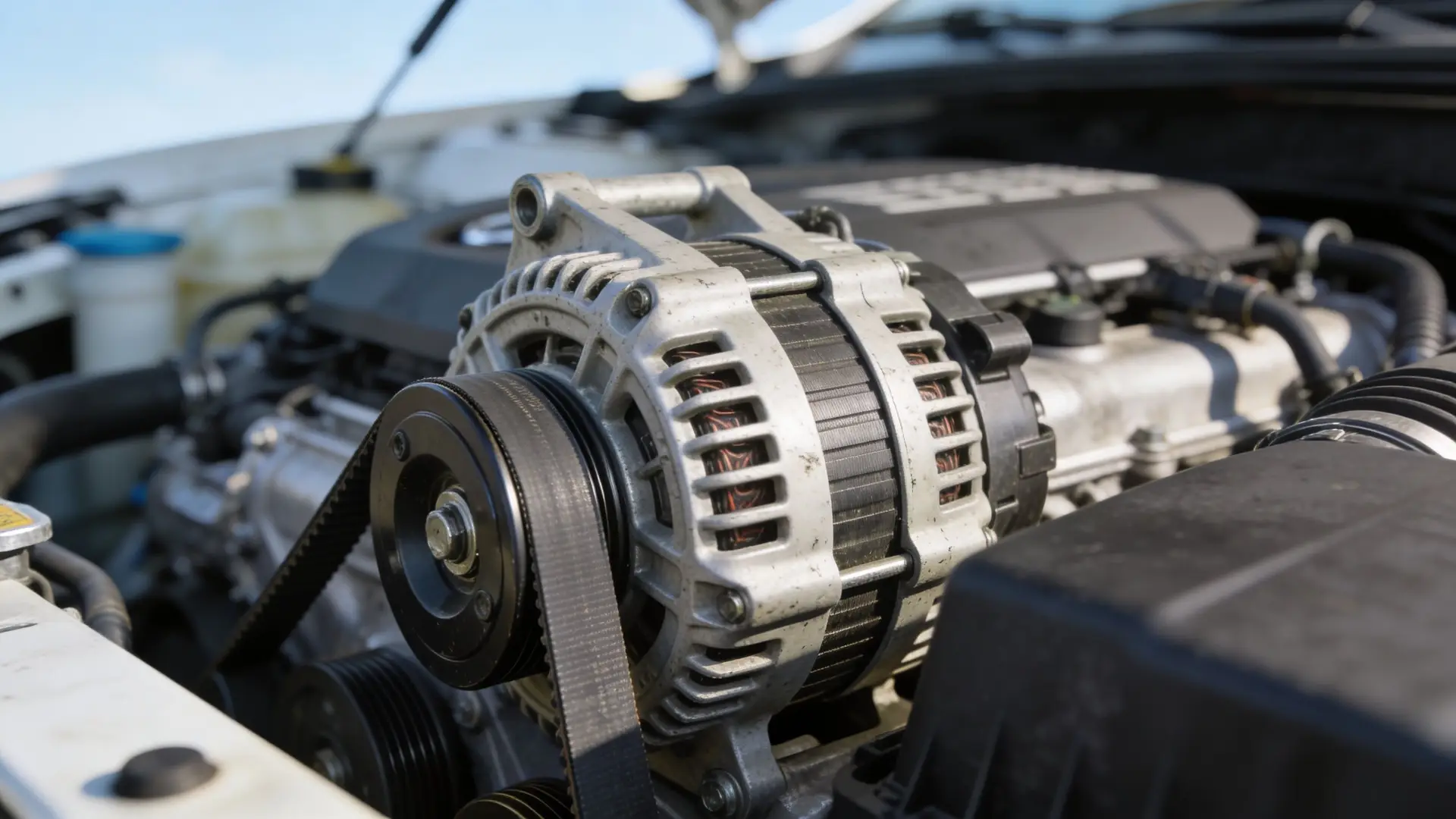
The alternator is the part doing the heavy lifting once the engine is running. It powers the vehicle's electrical needs and replenishes the battery after starting. The charging voltage is the reading that tells you how hard that system is working and how it's being managed.
Practical rule: If a vehicle has flickering lights, recurring battery trouble, or a battery warning light, don't assume the battery is the whole story.
Many car owners get confused because the car can still run with a weak charging system for a while. The battery acts like a backup tank. It can cover for the alternator temporarily, but only until that stored energy runs down. Then the symptoms pile up fast.
What matters is learning how to read the clues in context. A voltage number by itself can help, but only if you understand what the car is trying to do at that moment.
Understanding Alternator Charging Voltage
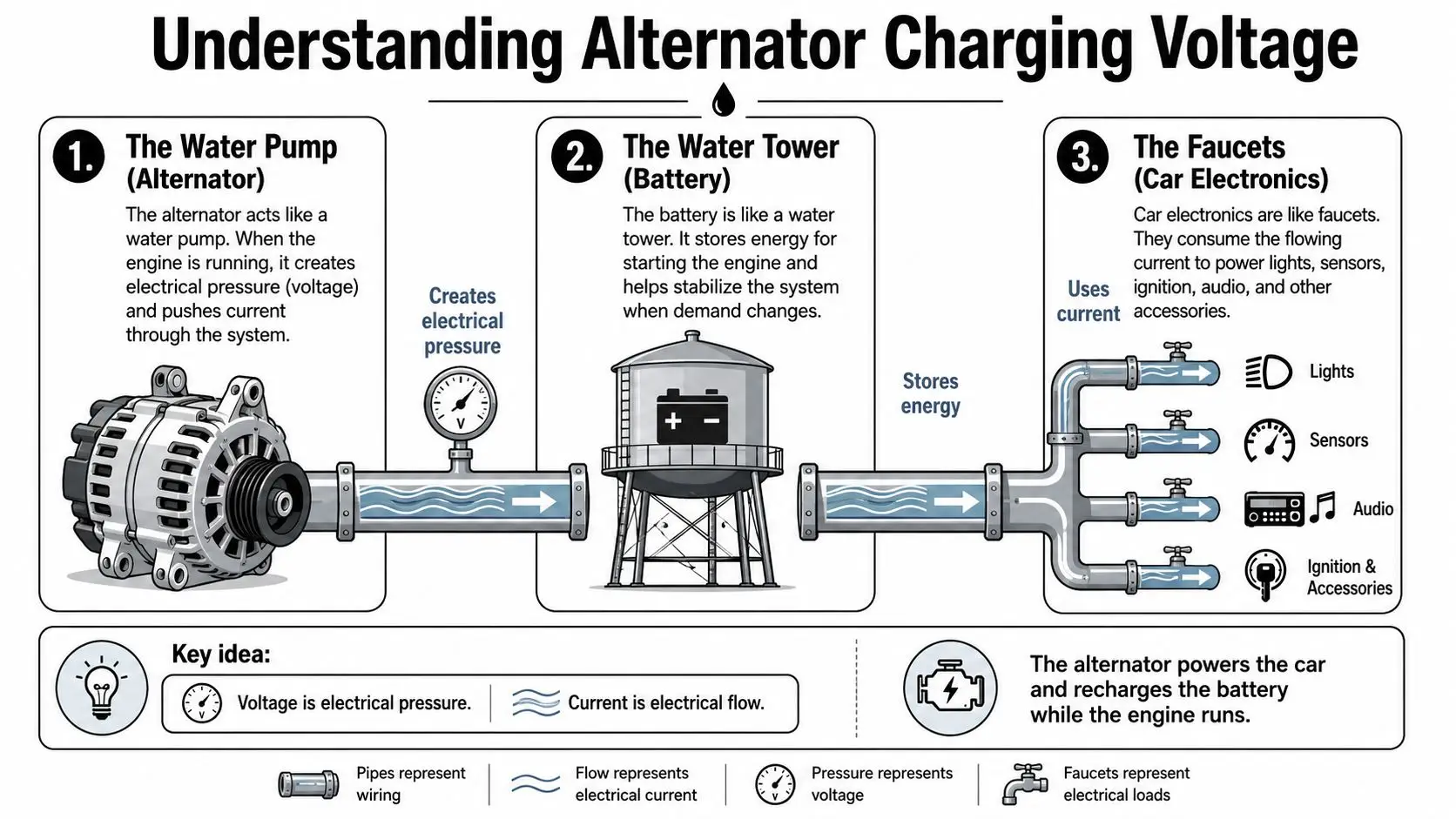
Alternator charging voltage is the electrical pressure the charging system sends through the car while the engine is running. The easiest way to picture it is with plumbing.
The alternator is the pump. The battery is the water tower that stores supply. Your lights, radio, fuel pump, modules, and other electronics are the faucets using that flow. In that analogy, voltage is pressure.
Why voltage matters
If pressure is too low, electrical parts may not get what they need. The battery may not recover after each start. If pressure is too high, the system can stress the battery and electronics.
That's why people talk about charging voltage so much. It's one of the quickest windows into charging system behavior.
For a battery by itself, a separate resting check can be useful. If you want a simple baseline before the engine is started, this battery voltage chart helps explain what different battery readings mean.
Why there isn't one perfect number
Contrary to much online advice, modern alternator charging voltage is not a single fixed number. It can change with temperature, battery location, and vehicle control strategy. In major-market vehicles, a typical regulated range is about 14.8 to 13.5 volts, and some systems may legitimately stay as low as 13.0 volts or as high as 16.0 volts for extended periods, according to Tomorrow's Technician guidance on alternator and battery testing.
That same guidance notes that under normal operating conditions an alternator should maintain about 14.2 volts at 70°F ambient air temperature, but that doesn't mean every healthy car will sit there all the time.
Here's why. Many late-model vehicles use computer-controlled charging. The engine computer can command the alternator to charge harder, back off, or change strategy based on conditions. That helps reduce engine drag and support fuel economy.
A simple comparison makes this easier:
| Situation | What the voltage might mean |
|---|---|
| Cold start on a cool day | The system may charge more aggressively |
| Warm engine with a topped-up battery | The system may reduce output |
| Heavy electrical load | The system may respond differently than it does at cruise |
| Different vehicle makes and designs | The same voltage can be normal in one car and suspicious in another |
A constant 13.6 volts can point to a fault in one vehicle and be completely normal in another.
That's the big takeaway. Don't chase one number. Read the voltage in context, with the engine condition, weather, load, and vehicle design in mind.
Symptoms of Incorrect Charging Voltage
When charging voltage is wrong, the car usually tells you. The problem is that the signs can look like other issues, especially battery trouble. It helps to sort them into undercharging and overcharging.
Signs of undercharging
Undercharging means the system isn't keeping up well enough. Sometimes that happens all the time. Sometimes it only shows up at idle, with accessories on, or when the engine bay is hot.
Common clues include:
- Dimmer lights at idle that brighten when engine speed rises
- Slow cranking after the car has been parked
- A battery that keeps going dead even after it was charged
- A battery or ALT warning light
- Electrical accessories acting weak or inconsistent
- Voltage sag in traffic when the blower, lights, or rear defrost are on
These symptoms happen because the battery starts carrying more of the load than it should. The vehicle may still run for a while, but the reserve gets used up.
Signs of overcharging
Overcharging is less common, but it can be harder on parts. Too much charging pressure can overwork the battery and stress bulbs and electronics.
Watch for signs like these:
- Bulbs that seem unusually bright or burn out often
- A strong rotten-egg smell near the battery
- A battery case that looks swollen or stressed
- Erratic electrical behavior that appears after the engine starts
If you smell sulfur near the battery or see the battery case swelling, stop treating it like a minor annoyance. That's a safety issue.
Why symptoms can fool you
A weak battery, poor cable connection, or slipping belt can mimic a bad alternator. That's why symptom spotting is just the starting point.
A good example is the driver who notices dim lights only in stop-and-go traffic. That doesn't automatically mean the alternator has failed. It may mean the charging system struggles most at low engine speed, with heat buildup and accessories turned on. The symptom is real, but the root cause still needs testing.
How to Check Your Alternator Voltage Safely
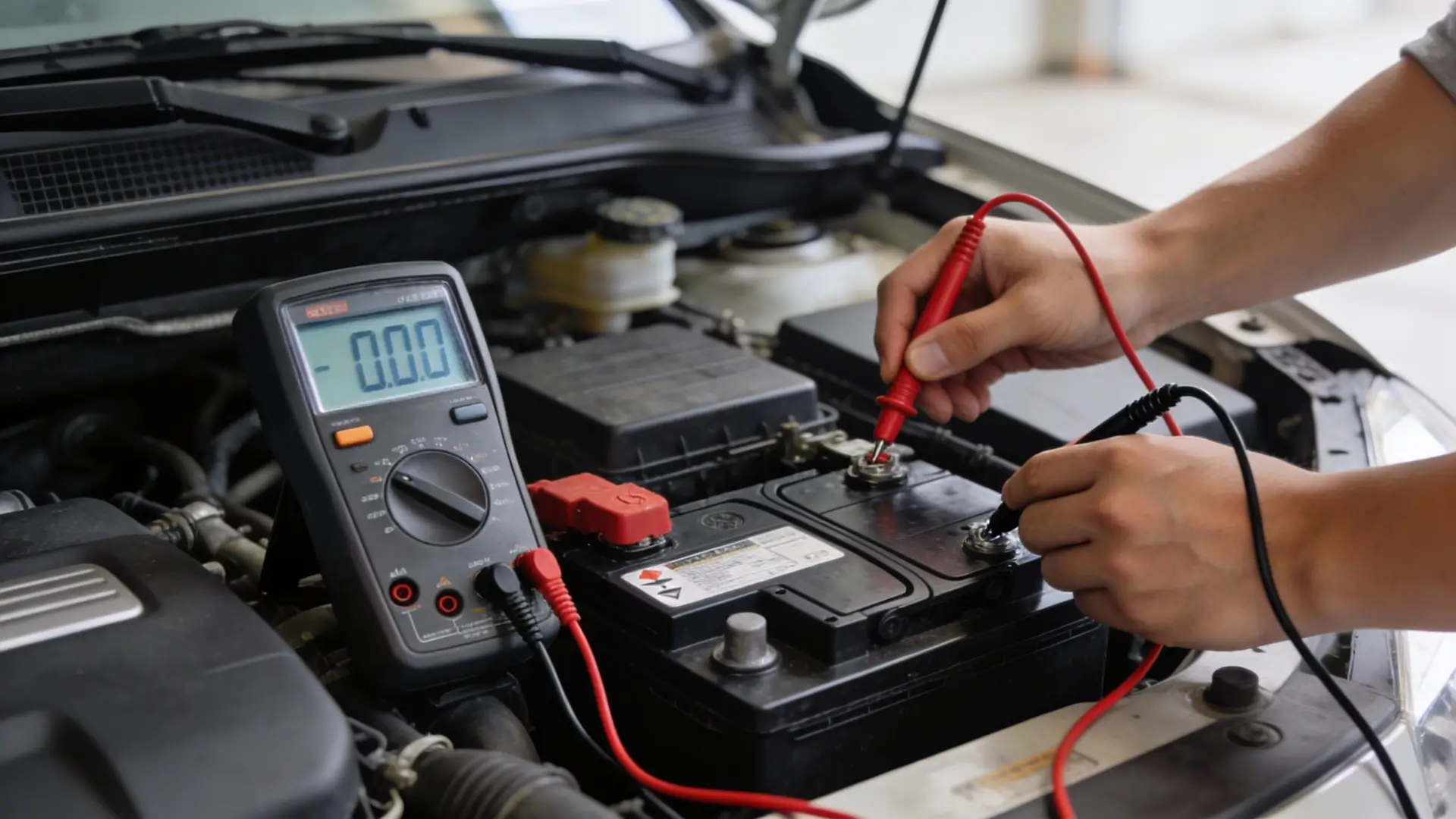
You can learn a lot with a digital multimeter, but do it carefully. You'll be working around a running engine, a battery, and moving belts.
Use eye protection, keep loose clothing away from the serpentine belt, and don't let the meter leads touch each other while connected to the battery.
Test one with the engine off
Set the meter to DC volts. Touch the red lead to battery positive and the black lead to battery negative.
This first reading is your baseline. It tells you what the battery has available before the alternator gets involved. If the battery is already weak, that can affect everything else you see.
If the terminals are crusty or dirty, clean them before trusting your results. Corrosion can distort readings and cause real charging issues. This guide on cleaning car battery terminals is a good refresher if the connections look rough.
Test two at idle
Start the engine and check the battery again. The reading should rise above battery-only voltage at some point while the engine is running.
But don't lock onto one universal target. Many late-model vehicles use computer-controlled charging and can reduce alternator output intermittently. Standard charging-system checks increasingly include both voltage and current under load, and if the alternator can't maintain rated charging voltage at lower RPM, the battery can discharge under heavy accessory loads, as explained in Underhood Service's alternator testing guidance.
What you're looking for at idle is behavior, not just one number:
- Does the voltage rise when the engine starts?
- Does it stay stable or wander strangely?
- Does it seem low only when the engine is hot?
Test three under load
This is the part many DIY checks skip, and it's one of the most useful. Turn on major electrical loads such as headlights, cabin blower, and rear defrost if equipped. Then watch the reading at idle and with a small increase in engine speed.
A healthy system should respond in a controlled way. A weak one may sag noticeably and struggle to recover.
Here's a helpful walkthrough if you want to see the process in action:
What your results actually mean
Use this quick interpretation guide:
| Reading pattern | What it suggests |
|---|---|
| Engine-off voltage seems weak | Battery condition may be part of the problem |
| Voltage rises when started, then changes around | May be normal smart charging behavior |
| Voltage drops badly under accessories at idle | Alternator output, belt drive, or wiring may be struggling |
| Voltage seems excessively high and stays there | Regulator or control issue needs prompt attention |
Don't put your hands near the belt path with the engine running, even for a “quick check.” The test isn't worth a hand injury.
Common Causes for Charging System Faults
A charging complaint doesn't always mean the alternator itself has failed. That's one of the most expensive assumptions people make.
Sometimes the alternator is fine, but another part of the system is preventing the battery from getting what it needs.
The usual suspects
Start with the big four:
- Voltage regulator problems. If regulation is wrong, the alternator may charge too little or too much.
- Battery condition issues. A weak or aging battery can confuse diagnosis because it won't store energy properly.
- Belt or pulley trouble. If the serpentine belt slips or the pulley setup isn't right, the alternator may not spin fast enough.
- Cable and ground problems. Resistance in the wiring can rob the battery of charging current even when the alternator appears to be working.
If you want a broader symptom guide before testing, this article on how to tell if an alternator is bad can help you compare what you're seeing.
The hidden problem called voltage drop
This is one of the most missed causes. The alternator can produce what looks like normal output, but the battery still undercharges because the electricity loses pressure on the way through the cables and grounds.
Technical guidance recommends checking the drop from alternator B+ to battery positive and from alternator case to battery negative. If that drop is above 0.40V, the wiring path should be inspected and repaired, according to Remy technical guidance on voltage drop testing.
That's a real-world example of why “the alternator tested good” doesn't always settle the issue.
A fault tree that makes sense
When I explain this in the shop, I usually break it down like this:
Can the battery accept and hold energy?
If not, the rest of the system can look guilty.Can the alternator spin properly?
Belt slip, tension issues, or pulley problems matter more than many people realize.Can the charge reach the battery?
Corroded terminals, damaged cables, and poor grounds can block it.Is the vehicle commanding charging normally?
On newer cars, the control side matters as much as the hardware.
A normal-looking alternator voltage reading at one point in the system doesn't prove the battery is receiving that same voltage under load.
Your Troubleshooting Plan and When to Visit a Pro
If your car has charging symptoms, keep the process simple. Start with the basics and avoid guessing.
A smart driveway checklist
- Look at the battery terminals. If they're dirty or loose, fix that first.
- Inspect the belt. A glazed, cracked, or slipping serpentine belt can create charging complaints.
- Check voltage with the engine off and running. A digital multimeter can show whether the system is responding.
- Test with accessories on. Headlights, blower motor, and defroster can reveal a weak system that looks okay with no load.
- Pay attention to patterns. Trouble only at idle, only when hot, or only in traffic points toward a more specific issue.
When DIY testing reaches its limit
Some charging problems need more than a voltage check. Real-world current output can drop sharply even when voltage regulation is correct due to heat soak or low RPM. That's one reason drivers notice dim lights or voltage sag in stop-and-go traffic. Professional diagnosis involves testing at idle and higher RPM with loads applied, and checking belt tension, pulley condition, and alternator temperature, based on Balmar's alternator output curve guidance.
That kind of testing is where a lot of home diagnosis stops. You may need an amp clamp, scan data, load testing, and a technician who knows how your vehicle's charging strategy is supposed to behave.
A reasonable next move
If your readings are confusing, the battery light is on, or the symptoms come and go, it's time for a full charging system check instead of more parts swapping. Shops that handle starting and charging diagnostics can test the battery, alternator, cables, grounds, and control strategy as a system. In Plano, that includes Express Lube & Car Care, which offers starting and charging system service along with battery, starter, and alternator diagnostics.
The main goal is simple. Confirm the cause before replacing anything. A weak battery, bad cable, belt issue, control problem, and worn alternator can all produce similar symptoms, but the fix is different for each one.
If your car has a battery light, repeated dead battery, dim lights at idle, or electrical problems that don't add up, Express Lube & Car Care can perform a charging system inspection with ASE-certified technicians and modern diagnostic equipment. You can stop by without an appointment, get the battery, alternator, and related components checked, and find out whether the issue is voltage control, wiring, belt drive, or a failing part before spending money on the wrong repair.