

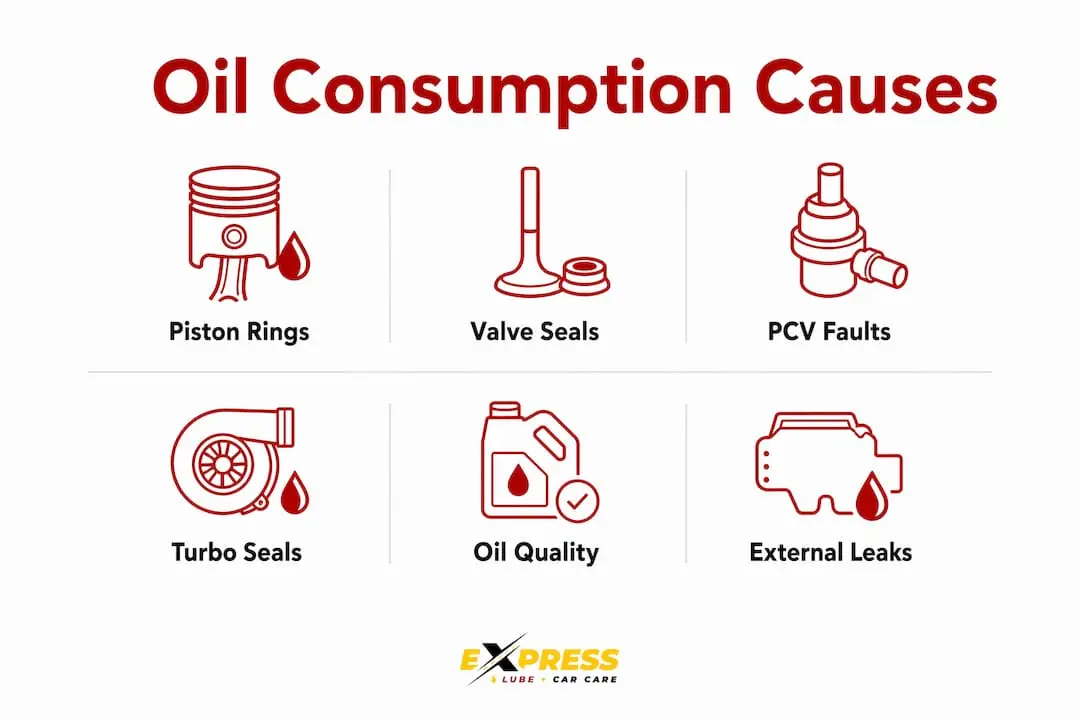
In most vehicles, an increase in oil consumption means oil is entering the combustion chamber or being drawn into the intake as vapor — typically from worn piston rings, failing valve stem seals, a malfunctioning PCV system, turbocharger seal failure, or the wrong oil for the engine. The fix depends entirely on which system is failing, so the first step is always narrowing down the cause before spending money on repairs.
Start here — check these first:
- Pull the dipstick cold and again after a warm drive; record the level and note any burnt smell or dark, gritty texture
- Watch the tailpipe: blue smoke on startup or during hard acceleration is the clearest sign of internal oil burning
- Park on clean concrete overnight and check for drips under the engine (oil pan area, valve covers, rear of the engine)
- Check spark plugs if accessible — oil-fouled plugs with a dark, oily deposit confirm combustion-chamber intrusion
- Note how many miles you drove between the two dipstick readings; this rate-of-loss figure is what a shop needs first
Valvoline and independent shop guidance both point to the same short list of culprits. The sections below map each cause to its symptoms, the tests that confirm it, and the realistic repair cost.
Table of Contents
- What causes oil consumption increase: a system-by-system breakdown
- How to tell if your engine is burning oil or leaking it
- Diagnostic tests mechanics use to find the root cause
- How much oil consumption is actually normal?
- Repair options and realistic U.S. cost ranges
- Maintenance habits that keep oil consumption in check
- When to stop waiting and see a professional
- Key Takeaways
- The shop’s honest perspective on oil consumption cases
- Oil consumption diagnosis and repair at Express Lube & Car Care in Plano
- Useful sources
- FAQ
What causes oil consumption increase: a system-by-system breakdown
Oil doesn’t simply disappear. It either burns inside the engine or escapes outside it, and the system responsible tells you everything about the repair ahead.
Piston rings and cylinder wall wear
Piston rings are the primary oil-control mechanism in any engine. Their job is to scrape oil off the cylinder wall on the downstroke and leave only a microscopic film for lubrication. When rings wear, lose tension, or become stuck with carbon deposits (a condition called “carbon jacking”), they can no longer scrape effectively — and oil slips past into the combustion chamber where it burns. Ring-pack deposits and cylinder liner wear are among the most frequently cited root causes in both gasoline and diesel engines.
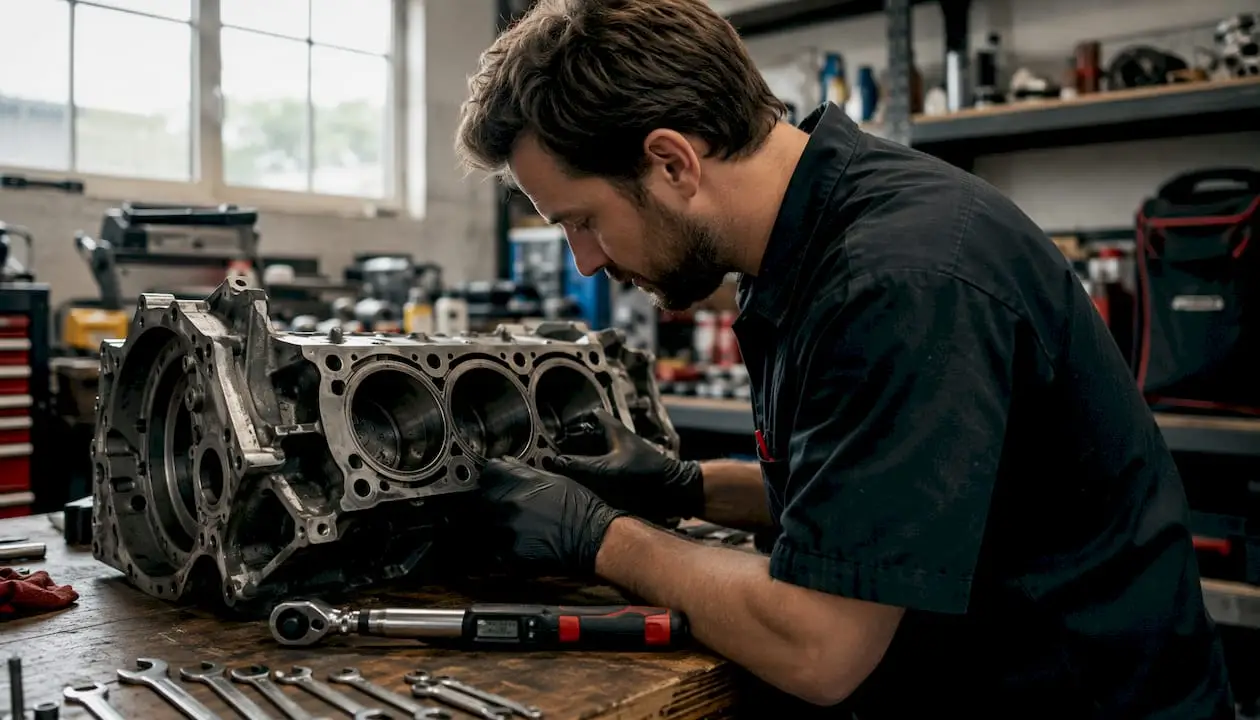
Modern engines use lower ring tension to reduce friction, which is good for fuel economy but means assembly precision and oil quality matter more than they did in older designs. As rings age, their oil-scraping ability drops gradually — which is why consumption often creeps up rather than appearing suddenly.
Pro Tip: At low engine loads, most oil enters the combustion chamber mechanically past the ring-pack. At high loads and speeds, liner evaporation becomes a major contributor — sometimes the largest single source. Hard highway driving or sustained towing accelerates oil loss through both pathways simultaneously.
Valve guide and valve stem seal failure
Intake valves operate under vacuum during the intake stroke. When valve stem seals harden, crack, or wear, that vacuum pulls oil down the valve guide directly into the cylinder. Worn valve guides make the problem worse because the increased clearance allows more oil to migrate. Intake-side guides typically wear faster than exhaust-side guides for exactly this reason.
The tell-tale sign is a puff of blue smoke at cold startup — oil that pooled on the intake valves overnight burns off immediately when the engine fires. Compression readings often stay normal even with severe valve seal wear, which is why this cause gets misdiagnosed as a ring problem.
PCV system faults and crankcase pressure
The Positive Crankcase Ventilation system routes blow-by gases from the crankcase back into the intake manifold. A clogged PCV orifice, stuck valve, or missing non-return valve disrupts this balance. PCV restrictions can raise crankcase pressure, forcing oil vapor into the intake and past gaskets and seals. In the opposite failure mode, an unrestricted PCV draws excessive oil mist into the intake along with the gases.
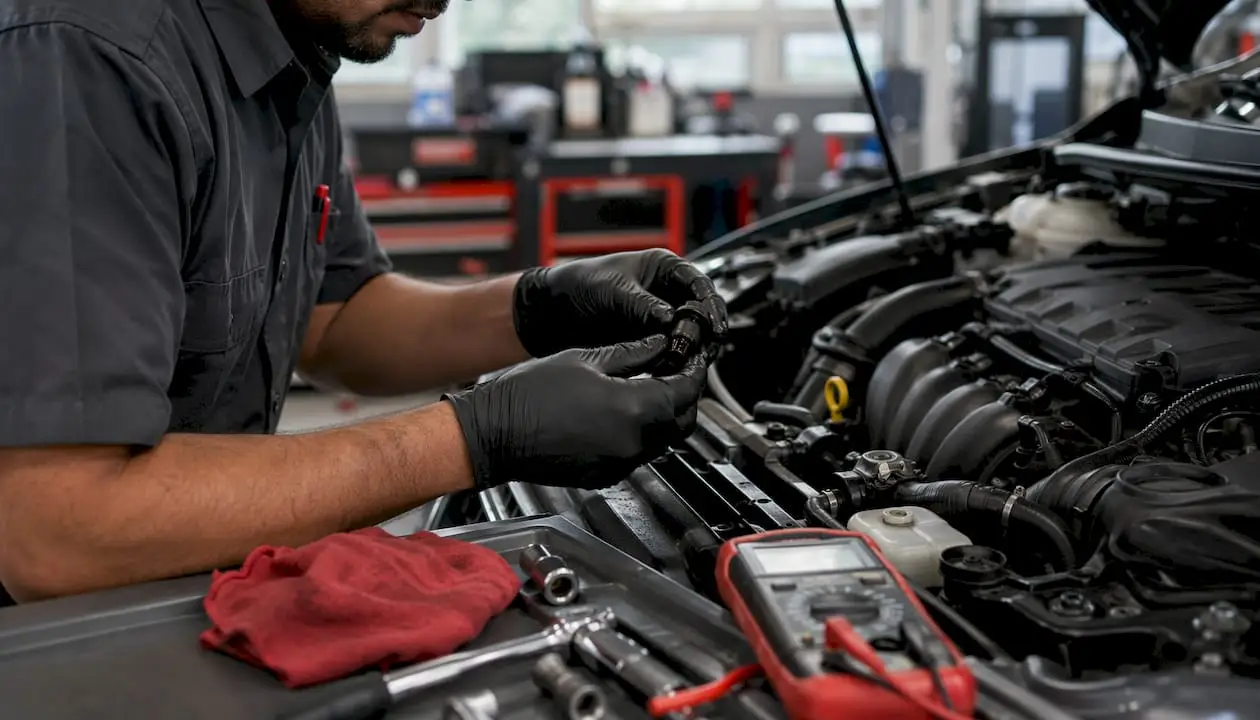
This is one of the most repairable causes on the list. A $15–$25 PCV valve replacement and an induction cleaning often resolve the problem entirely on high-mileage vehicles where the PCV has never been serviced.
Turbocharger oil seal failure
Turbocharged engines add one more potential leak point: the turbo shaft seals. These seals keep pressurized oil inside the bearing housing. When they wear, oil gets pushed into the compressor side (burning in the intake) or the turbine side (burning in the exhaust). Turbo seal failure often produces blue smoke under boost — during acceleration — rather than at idle, which helps distinguish it from valve seal issues.
A high-mileage commuter car with a small turbo four-cylinder is a common scenario. The turbo runs hot, oil change intervals get stretched, and the bearing seals wear faster than the rest of the engine.
Wrong viscosity, poor oil quality, and overfilling
Oil viscosity directly affects how well it stays on cylinder walls and how much evaporates under heat. Lighter, more volatile oils lose their lighter molecular fractions first as the engine runs, changing the oil’s behavior mid-interval. Oil volatility, measured by the NOACK evaporation test, is a real factor in total consumption — especially in engines that run hot or at sustained high loads.
Overfilling is a less obvious culprit. When oil level sits above the full mark, the crankshaft can contact and aerate the oil, creating foam that the ring-pack cannot control. The result is increased consumption and accelerated wear. Staying within the manufacturer’s specified range matters as much as the oil grade itself. For high-mileage vehicles, oil type and change intervals play a direct role in how quickly consumption climbs.
External leaks that look like consumption
Not every oil loss is internal. Rear main seals, valve cover gaskets, oil pan gaskets, and oil cooler lines can all leak slowly enough that no puddle forms on the driveway — the oil burns off on hot exhaust components instead. This mimics internal consumption perfectly on a dipstick check. Ruling out external leaks is always the first diagnostic step before assuming the rings or valves are the problem.
How to tell if your engine is burning oil or leaking it
Separating internal burning from external leaking saves you from chasing the wrong repair. Most of this you can do at home before ever visiting a shop.
Home inspection checklist:
- Dipstick tracking: Check oil level on a flat surface with a cold engine. Record the mileage, date, and level. Recheck at 500-mile intervals. A consistent drop without any visible drips points to internal burning.
- Smoke color: Blue or blue-gray smoke from the tailpipe means oil is burning. White smoke suggests coolant intrusion (head gasket concern). Black smoke indicates a rich fuel mixture, not oil.
- Startup vs. acceleration smoke: Blue smoke only at cold startup points to valve stem seals. Blue smoke under hard acceleration or at highway speed points to ring-pack or turbo seals.
- Spark plug condition: Pull one or two plugs if you can. An oil-fouled plug — dark, wet, or with a sooty oily deposit — confirms oil is reaching the combustion chamber.
- Tailpipe residue: Run a white paper towel around the inside of the tailpipe. An oily, dark residue (not just dry carbon) supports internal oil burning.
- Under-hood and ground check: Park on clean cardboard overnight. Drips under the oil pan, near the valve covers, or at the back of the engine block indicate external leaks. Check the oil filter base and drain plug area after every oil change.
When the dipstick shows consistent loss but the cardboard stays clean and the tailpipe residue is oily, you are almost certainly dealing with internal burning. That’s when mechanic-level testing becomes necessary.
Diagnostic tests mechanics use to find the root cause
A thorough shop diagnosis follows a specific sequence. Knowing what to expect helps you ask the right questions and evaluate whether the shop is being thorough.
| Test | What it measures | Normal range / result | Abnormal result and likely cause |
|---|---|---|---|
| Compression test | Cylinder sealing pressure | Manufacturer spec, cylinders within 10% of each other | Low or uneven readings: worn rings, damaged valves, or head gasket failure |
| Wet compression test | Ring condition specifically | Compression rises significantly when oil added to cylinder | Rise confirms worn rings rather than valve or head gasket issue |
| Leak-down test | Percentage of air escaping past rings/valves | Under 10% leakage per cylinder | Over 20%: worn rings or valve seats; air heard at intake = valve; at crankcase = rings |
| Crankcase pressure | Blow-by and ring seal integrity | -11 to -18 inches H2O at hot idle | 0 to -10 in H2O: severe blow-by, likely broken ring lands; requires teardown |
| PCV flow check | PCV valve and orifice function | Valve rattles freely; no oil pooling in intake tract | Stuck valve, blocked orifice, or oil in intake: PCV system repair first |
| Borescope inspection | Visual ring-pack, liner, and valve condition | Clean liner surface, intact ring grooves | Carbon deposits, glazed liner, or damaged ring lands visible |
| Oil analysis | Wear metals, viscosity, fuel dilution | Low wear metals; viscosity within spec | High iron/aluminum: liner or ring wear; fuel dilution: short-trip or injector issue |
OEM diagnostic guidance recommends recording crankcase pressure and cleaning induction components before authorizing any major parts replacement. A shop that skips straight to a rebuild quote without running these tests is skipping steps.
How much oil consumption is actually normal?
The answer depends on who you ask, and the gap between manufacturer claims and independent shop expectations is wider than most drivers realize.
| Consumption rate | Assessment | Notes |
|---|---|---|
| — | Excellent | What independent experts expect from a properly running modern engine |
| — | Acceptable for most engines | Monitor; investigate if rate increases |
| 1 qt per 1,000–2,000 miles | Investigate now | OEM guidance flags ≥1 qt per 2,000 miles as excessive |
| 1 qt per 500–700 miles | Significant problem | Some manufacturers have cited quart-per-few-hundred-miles consumption claims as “normal” — independent shops disagree |
| 1 qt per 500 miles or faster | Urgent | Likely mechanical failure; professional diagnosis required immediately |
Independent shop guidance is direct: a properly assembled modern engine should consume noticeably less than half a quart between standard oil change intervals. Manufacturer “normal” ranges — sometimes as broad as 1 quart per 600–700 miles — reflect what the warranty department will accept, not what a healthy engine actually does.
Tracking template: Note the date, odometer reading, and dipstick level at each check. After three or four data points, you have a reliable consumption rate in quarts per 1,000 miles. That number is what your shop needs. For commuter vehicles, tracking oil use between services is one of the simplest ways to catch a developing problem early.
Repair options and realistic U.S. cost ranges
The repair cost follows directly from the diagnosis. There is no shortcut here — the right fix for valve seals is not the right fix for worn rings.
- PCV valve replacement and induction cleaning: $80–$200 parts and labor. Often the first repair attempted when crankcase pressure is abnormal. Fast, low-risk, and frequently effective on high-mileage engines that have never had PCV service.
- Valve stem seal replacement: $400–$1,200 depending on engine access and cylinder count. Labor-intensive on overhead-cam engines because the camshafts must come off. Parts themselves are inexpensive; the bill is almost entirely labor.
- Turbocharger rebuild or replacement: $800–$2,500 for a single turbo, depending on whether the unit is rebuilt or replaced with a remanufactured unit. OEM turbos on European vehicles push toward the top of that range.
- Piston ring replacement (re-ring): $1,500–$3,500 for a typical four-cylinder; more for V6 and V8 engines. Requires engine removal, machining the cylinder bores, and reassembly. This is a significant job.
- Short-block or long-block engine replacement: $3,000–$7,000+ depending on engine size, parts sourcing (OEM vs. remanufactured), and labor rates. Often the pragmatic choice when the engine has high mileage and multiple worn systems.
When to repair versus replace comes down to vehicle value and the scope of wear. A $1,200 valve seal job on a vehicle worth $18,000 makes clear sense. The same job on a vehicle worth $3,500 with 180,000 miles and worn rings deserves a harder look. A shop that runs a full diagnostic before recommending a path gives you the information to make that call clearly.
Maintenance habits that keep oil consumption in check
Prevention is straightforward, but it requires consistency. The engines that develop consumption problems earliest are almost always the ones with stretched drain intervals, incorrect oil grades, or ignored PCV systems.
Follow the manufacturer’s specified viscosity grade without substituting a lighter oil to improve fuel economy. A 5W-30 engine running 0W-20 will show increased consumption as the thinner oil film evaporates faster off hot cylinder walls. For high-load use — towing, sustained highway driving, or Texas summer heat — a slightly higher-viscosity oil within the manufacturer’s approved range can reduce evaporation-driven loss. Oil changes in high-heat conditions deserve extra attention because thermal stress accelerates the evaporation of lighter oil fractions.
Keep drain intervals honest. Long-drain synthetic oils are genuinely capable of extended intervals, but fuel dilution, short-trip driving, and towing all shorten effective oil life regardless of what the label says. Oil change intervals should reflect actual driving conditions, not just the maximum the manufacturer lists for ideal conditions.
Pro Tip: For fleet vehicles or any engine past 100,000 miles, periodic oil analysis through a service like Blackstone Laboratories gives you wear-metal data that catches ring and bearing wear months before it becomes a consumption problem. It costs roughly $30–$35 per sample and is one of the highest-value diagnostic tools available to owners.
Check the PCV system at every major service. A stuck or clogged PCV valve costs almost nothing to replace and is one of the most overlooked causes of gradual consumption increases. Keeping the intake tract clean — particularly on direct-injection engines that accumulate carbon deposits on intake valves — also reduces the conditions that accelerate valve guide wear.
Driving habits matter more than most owners expect. Sustained high-RPM driving, aggressive towing, and hard acceleration all increase both mechanical oil transport past the ring-pack and liner evaporation. Allowing the engine to reach operating temperature before hard use, and letting a turbocharged engine idle for 60 seconds before shutdown, reduces heat-soak damage to turbo seals. Good car maintenance practices extend well beyond oil alone, but consistent oil habits are the foundation.
When to stop waiting and see a professional
Some consumption rates and symptoms call for professional diagnosis without delay. Watchful waiting is reasonable at low consumption rates with no other symptoms. It is not reasonable when any of the following apply.
Go to a shop when:
- Consumption exceeds 1 quart per 2,000 miles, which OEM guidance treats as the threshold for formal investigation
- Blue smoke appears consistently at startup or under acceleration, not just on a cold morning
- Spark plugs show oil fouling on inspection
- Crankcase pressure at hot idle falls between 0 and -10 inches H2O rather than the normal -11 to -18 in H2O range
- The oil level drops noticeably between weekly checks with no visible external leak
Pro Tip: Bring a written log to the shop: dates, mileage at each dipstick check, oil level recorded, and any smoke or smell observations. A shop that sees three or four data points can confirm the consumption rate immediately rather than asking you to come back after a monitoring period. That log cuts diagnostic time and keeps the bill lower.
What a certified shop will do: start with a visual leak inspection and dipstick history review, then run compression and leak-down tests, measure crankcase pressure, inspect the PCV system, and use a borescope to examine the cylinder bores and ring-pack condition. Oil analysis and borescope inspection allow technicians to separate causes without an immediate teardown. The shop should provide you with a written report — ideally with photos from the digital inspection — before recommending any repair.
At Express Lube & Car Care, ASE-certified technicians perform engine diagnostics including compression testing, crankcase pressure checks, and digital vehicle inspections with photos and technician notes. No appointment is needed, and all engine repair work is backed by a 24-month/24,000-mile warranty.
Key Takeaways
Increased oil consumption almost always traces back to one of six mechanical or maintenance causes — and a structured diagnostic approach identifies which one before any money is spent on repairs.
| Point | Details |
|---|---|
| Primary causes | Worn piston rings, valve stem seal failure, PCV faults, turbo seal leaks, wrong oil, and external leaks account for nearly all cases. |
| Consumption benchmark | Less than 0.5 qt per oil change interval is expected by independent experts; ≥1 qt per 2,000 miles is the OEM threshold for formal investigation. |
| Diagnostic sequence | Compression test, leak-down, crankcase pressure (-11 to -18 in H2O is normal), PCV inspection, and borescope before any teardown. |
| Prevention priority | Correct viscosity, honest drain intervals, and PCV service are the three habits that most reliably prevent consumption increases. |
| Express Lube & Car Care | ASE-certified technicians provide engine diagnostics, digital inspection reports, and engine repair with a 24-month/24,000-mile warranty — no appointment needed. |
The shop’s honest perspective on oil consumption cases
The most common mistake we see is owners waiting too long. A driver notices the dipstick is low, tops it off, and repeats that cycle for six months before coming in. By the time the car arrives at the shop, what might have been a $200 PCV repair has become a conversation about ring wear.
The second most common issue is misdiagnosis — specifically, assuming worn rings when the actual cause is valve stem seals. These two problems have overlapping symptoms, but the repair cost difference is substantial. Valve seals on many engines can be replaced without removing the engine; a re-ring job cannot. A proper leak-down test and a crankcase pressure reading separate them clearly. Skipping those tests and going straight to a rebuild recommendation is a red flag.
Customers who bring a written oil-level log get faster, more accurate diagnoses. A shop can confirm a consumption rate in minutes when the data is already recorded. Without it, the shop has to ask you to return after a monitoring period, which delays the repair and sometimes lets a manageable problem worsen.
One more thing worth saying plainly: manufacturer “normal” consumption ranges are not the same as healthy engine consumption. Some OEM specifications allow rates that independent technicians would treat as a problem worth investigating. If a dealer tells you that burning a quart every 700 miles is normal and no repair is needed, you are entitled to a second opinion.
Oil consumption diagnosis and repair at Express Lube & Car Care in Plano
If your dipstick is dropping faster than it should, Express Lube & Car Care gives you a direct path to answers — no appointment required. Walk in and an ASE-certified technician will start with a digital vehicle inspection that includes photos and written technician notes, so you see exactly what the engine shows rather than taking anyone’s word for it.
The shop handles the full diagnostic sequence: compression and leak-down testing, crankcase pressure measurement, PCV inspection, and engine repair from valve seal replacement through full engine rebuilds. For drivers whose consumption points to something simpler, oil change service specials are available with the correct viscosity grade for your specific engine. For those whose diagnosis points to deeper mechanical work, the engine repair and diagnostics service covers the full scope. All repair work carries a 24-month/24,000-mile warranty. Military personnel and healthcare providers receive additional discounts. Schedule online or walk in at 2840 in Plano — same-day service is the standard, not the exception.
Useful sources
- Understanding How Engines Consume Oil — Machinery Lubrication: Technical breakdown of how piston rings, valve guides, and PCV systems contribute to oil loss; useful for understanding the mechanical pathways.
- Burning Oil: Why Engines Consume Their Own Oil — EngineLabs: Covers ring-pack deposits, liner evaporation, turbo seal failure, and oil volatility (NOACK); strong technical depth for enthusiasts and shop professionals.
- What Every Motorist Should Know About Engine Oil Consumption — AA1Car: Independent shop perspective on consumption benchmarks and valve guide wear; practical guidance for owners deciding whether to repair or monitor.
- PIP5197E OEM Diagnostic Procedure — NHTSA/OEMDTC: OEM service bulletin defining excessive consumption thresholds, crankcase pressure norms, and the prescribed diagnostic sequence before parts replacement.
- The Contribution of Different Oil Consumption Sources — ASTM/TMC SAE Paper: Research quantifying how oil transport, liner evaporation, and blow-by each contribute to total consumption across load conditions.
- Excessive Oil Consumption — Valvoline Global: Consumer-facing summary of primary causes and visual symptoms; useful as a starting reference for owners new to the topic.
FAQ
What is the most common cause of oil consumption?
Worn or stuck piston rings are the most frequently cited mechanical cause, but a failing PCV system is often the most overlooked — and the least expensive to fix. Valve stem seal failure is the second most common internal cause and is frequently misidentified as a ring problem.
Is burning 1 quart of oil every 1,000 miles normal?
At that rate, most independent technicians would recommend a professional diagnosis. OEM guidance treats consumption of 1 quart or more within 2,000 miles as the threshold for formal investigation, and independent shop standards expect less than half a quart per standard oil change interval.
Why is my engine losing oil but I see no leaks?
If the ground is clean and no external drips are visible, the engine is almost certainly burning oil internally. Blue smoke from the tailpipe, oil-fouled spark plugs, or a consistent dipstick drop without external evidence all point to internal consumption from worn rings, valve seals, or a PCV fault.
How do you fix excessive oil consumption?
The fix depends on the cause: PCV valve replacement and induction cleaning for ventilation faults ($80–$200); valve stem seal replacement for seal failure ($400–$1,200); turbo rebuild or replacement for turbo seal failure ($800–$2,500); or engine re-ring or replacement for severe ring wear ($1,500 and up). Express Lube & Car Care’s ASE-certified technicians run compression, leak-down, and crankcase pressure tests to identify the cause before recommending any repair path.