
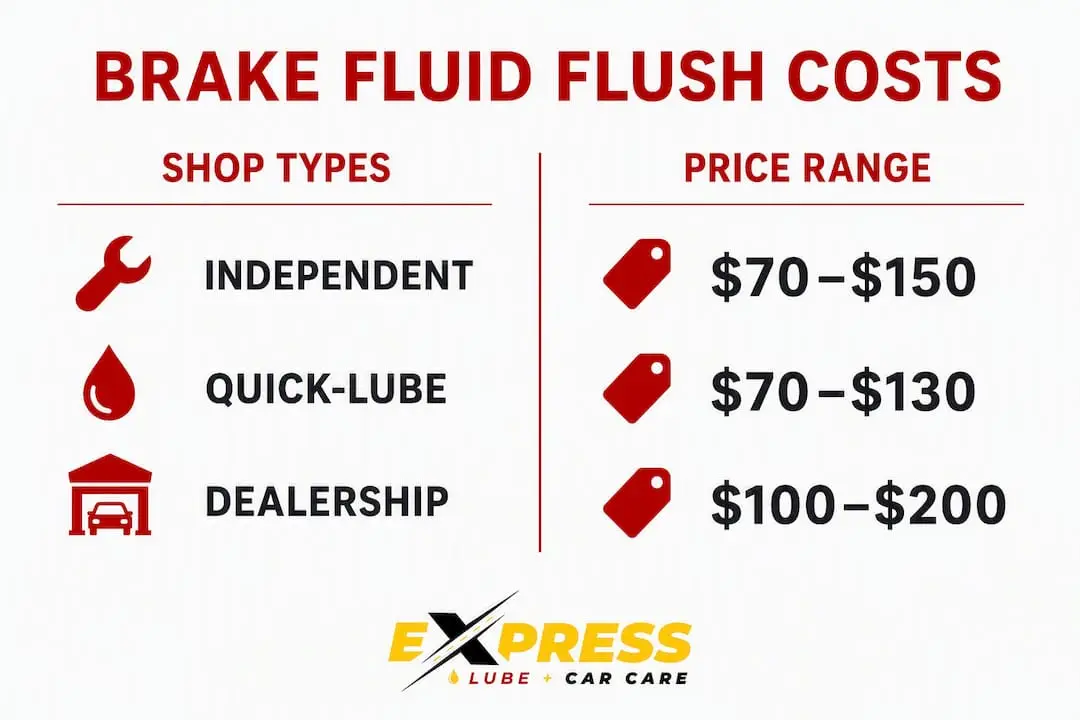
A full brake fluid flush at a U.S. shop typically costs $70–$150 at independent shops, $70–$130 at quick-lube chains, and $120–$225 at dealerships, according to national pricing data. Luxury dealers in metro areas can quote from $400 up to $680 for the same procedure on European vehicles. The fluid itself costs only a modest amount per quart; what you’re really paying for is skilled labor and the right equipment to bleed all four corners of the system.
Here’s what to take away before reading further:
- Most drivers pay $70–$150 for a complete four-wheel flush at a reputable independent shop.
- Labor accounts for roughly 70–75% of the total bill, so shop labor rates matter far more than fluid brand.
- A quote above $200 for a mainstream vehicle is worth a second opinion from an ASE-certified independent shop.
- Next step: Ask any shop for a written line-item breakdown, or contact Express Lube & Car Care for a transparent quote with no surprises.
Table of Contents
- How much does a brake fluid flush actually cost by shop type?
- What drives the price difference on your estimate?
- Which brake fluid type does your car need, and does it change the price?
- Flush vs. bleed vs. reservoir swap: why the difference matters
- How often should you flush your brake fluid?
- Signs your brake fluid needs replacing — and what happens if you skip it
- DIY vs. professional service: when each makes sense
- What Express Lube & Car Care includes for a brake fluid flush
- How to get a fair price and avoid low-value services
- Key Takeaways
- Why professional brake fluid service is worth the cost
- Get your brake fluid flush done today at Express Lube & Car Care
- Useful sources
- FAQ
How much does a brake fluid flush actually cost by shop type?
Pricing varies more by shop category than most drivers expect. The table below reflects realistic U.S. sample estimates based on vehicle tier and shop type, including what each price typically covers.
| Shop Type | Economy/Compact | Mid-Range Sedan | Truck/SUV | Luxury/European | Service Time | Typically Includes |
|---|---|---|---|---|---|---|
| Independent shop | ranges typical for the categories | time about half an hour to an hour | Labor, fluid, visual inspection | |||
| Quick-lube chain | prices generally vary within a range similar to independents | time generally less than an hour | Labor, fluid (verify full flush) | |||
| Dealership | prices tend to be higher than independents and quick-lubes | time about three quarters of an hour or less | Labor, OEM fluid, multi-point inspection |
A genuine four-corner flush takes 30–60 minutes at most shops. If a quick-lube quotes you a 15-minute service, ask specifically whether all four bleed screws are opened — a 15-minute job is almost always a reservoir swap, not a full flush.
What drives the price difference on your estimate?
Several factors explain why two shops can quote $80 apart for what sounds like the same job.
- Labor rate and billed hours. Shops bill by the hour, and rates vary by region and shop type. A dealer in a high-cost metro area may charge $150/hour; an independent in a smaller market may charge $90. Even a 30-minute difference in estimated time adds up fast.
- DOT fluid specification. Your vehicle’s owner’s manual specifies DOT 3, DOT 4, or DOT 5.1. The fluid itself is inexpensive, but shops that stock OEM-branded or high-performance fluid charge a markup.
- ABS and electronic stability control systems. Most routine flushes on ABS-equipped vehicles don’t require a scan tool. However, if the hydraulic control unit (HCU) runs dry or is replaced, a scan-tool commanded bleeding sequence is necessary, adding labor time and shop equipment cost.
- Shop type markup. Dealers carry higher overhead and charge OEM fluid prices. Independent shops and quick-lube chains pass lower overhead to the customer, though quality varies. European vehicles that require DOT 4 and specific ABS bleeding sequences can legitimately justify dealer pricing.
- Discovered repairs. A technician opening bleed screws on a high-mileage vehicle may find seized calipers, leaking bleeders, or corroded fittings. These add real cost, and a shop that does a thorough inspection is more likely to catch them than one that skips it.
Pro Tip: When quoted labor significantly exceeds 60 minutes for a standard passenger car, ask the shop to itemize the added tasks. Legitimate complications exist, but a vague “extra labor” line is worth questioning.
Which brake fluid type does your car need, and does it change the price?
The DOT rating on your fluid cap is not just a label. It defines the fluid’s boiling point, chemical composition, and compatibility with your brake system’s seals and components.
- DOT 3 is glycol-based, the most common fluid in older domestic vehicles, and the least expensive at roughly $5–$10 per quart at retail.
- DOT 4 has a higher dry boiling point and is standard on most European vehicles and many modern domestic models. It costs slightly more and is what most shops stock as a default upgrade.
- DOT 5.1 is also glycol-based with performance similar to DOT 4 but with a higher wet boiling point. It’s used in some performance and heavy-duty applications.
- DOT 5 is silicone-based, not glycol-based, and is not compatible with systems designed for DOT 3/4/5.1. It’s used in specialty and military vehicles. Mixing DOT 5 with glycol-based fluids causes serious damage.
| Fluid Type | Base | Typical Retail Cost/Qt | Common Use | Flush Cost Impact |
|---|---|---|---|---|
| DOT 3 | Glycol | ~$5–$10 | Older domestic vehicles | Lowest |
| DOT 4 | Glycol | $5–$10 | European, modern domestic | Moderate |
| DOT 5.1 | Glycol | ~$10–$20 | Performance, heavy-duty | Moderate |
| DOT 5 | Silicone | $10–$30 | Specialty/military only | Varies; rare |
When a shop quotes you a brake fluid change, confirm the DOT spec on the invoice matches your owner’s manual. Using DOT 3 in a system that calls for DOT 4 is a common cost-cutting shortcut that degrades braking performance.
Flush vs. bleed vs. reservoir swap: why the difference matters
These three terms get used interchangeably at service counters, but they describe very different procedures with very different outcomes.
A brake fluid flush replaces all fluid throughout the entire hydraulic system, including the calipers, wheel cylinders, and lines. It removes moisture-laden fluid from every corner of the system and is the correct service for routine maintenance intervals.
A brake bleed removes trapped air from the lines, typically after a caliper replacement, brake line repair, or any time the system is opened. It’s not a substitute for a flush because it doesn’t replace all the old fluid.
A reservoir swap drains and refills only the master cylinder reservoir. It takes 10–15 minutes and replaces a small fraction of the total system fluid. Some quick-lube chains perform this and call it a flush. It is not.
Pro Tip: When booking service, ask specifically: “Will you open all four bleeder valves and flush until clean fluid runs clear at each wheel?” That one question separates a full flush from a reservoir swap.
The procedure choice also affects what you pay. A full flush billed at 30–60 minutes of labor is worth the cost. A reservoir swap billed at the same price as a flush is not.
How often should you flush your brake fluid?
Many European manufacturers recommend a brake fluid flush every two years regardless of mileage, because brake fluid absorbs moisture from the air over time. Domestic manufacturers vary, with some recommending every 45,000–60,000 miles and others leaving it to inspection results.
The mileage-only approach misses the real issue. Brake fluid is hygroscopic, meaning it pulls moisture from the atmosphere through microscopic permeation in rubber hoses and reservoir caps. That moisture lowers the fluid’s boiling point, which increases the risk of brake fade under hard use.
The most reliable method is a boiling-point test. A shop-grade tester measures the fluid’s actual boiling point: a reading below 284°F for DOT 3 or below 311°F for DOT 4 indicates the fluid needs immediate replacement. Some shops also use moisture-content test strips, which give a quick percentage reading.
Practical rule: If your vehicle is more than two years old and you have no record of a brake fluid change, schedule a boiling-point test. The test itself is inexpensive, and the result tells you whether the flush is urgent or can wait.
Signs your brake fluid needs replacing — and what happens if you skip it
Degraded brake fluid doesn’t always announce itself with a warning light. These are the symptoms worth paying attention to:
- Spongy or soft brake pedal that requires more pressure than usual to stop
- Increased stopping distance, especially noticeable in repeated hard stops
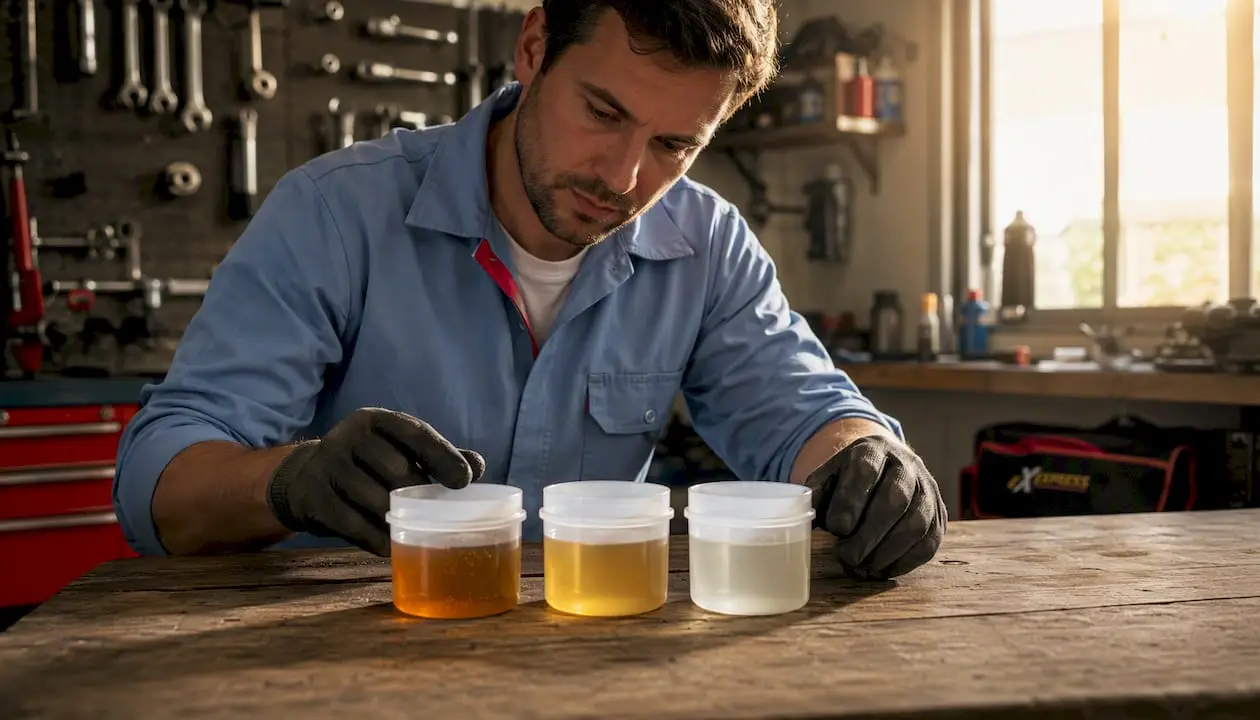
- Dark or brownish fluid visible in the reservoir (fresh fluid is nearly clear to light yellow)
- ABS or brake warning lights that appear without an obvious mechanical cause
- Brake fade during extended downhill driving or track use
The consequences of ignoring degraded fluid go well beyond a soft pedal. Moisture absorption leads to internal corrosion and can cause ABS modulator failures and hydraulic component damage that cost far more to repair than a routine flush. Seized calipers from internal corrosion can run $200–$400 per corner to replace. ABS modulator repairs often exceed $1,000.
A $100 brake fluid flush is one of the most cost-effective preventive services on a modern vehicle. The hydraulic components it protects cost ten to twenty times more to replace.
You can check brake fluid color and level yourself between service visits, but a color check alone doesn’t tell you the boiling point. Dark fluid is a clear sign; clear fluid with high moisture content is the hidden risk.
DIY vs. professional service: when each makes sense
DIY brake fluid flushing is possible on many vehicles, but the decision depends on your car’s complexity and your comfort level with brake system work.
DIY cost breakdown:
- Brake fluid (1–2 quarts): $10–$30
- Vacuum bleeder or one-person bleeder kit: $20–$60
- Total parts cost: roughly $30–$90
- Time required: 1–2 hours, or longer on first attempt
Professional service cost breakdown:
- Labor (30–60 minutes at shop rate): $50–$130
- Fluid: $10–$30
- Total: $70–$150 at most independent shops
- Includes: pressure bleeding equipment, inspection, warranty on the service
| DIY | Professional | |
|---|---|---|
| Typical price | $30–$90 | $70–$150 at independent shops, $70–$130 at quick-lube chains, and $120–$225 at dealerships |
| Service time | 1–2 hours | 30–60 min |
| Fluid type used | Your choice (verify DOT spec) | Shop-specified per vehicle |
| Inspection included | No | Yes (visual at minimum) |
| Warranty/guarantee | None | Varies; ASE shops often offer one |
Pressure bleeding at 10–15 psi using a pressurized reservoir adapter is the standard shop method for a clean, efficient one-person flush. Exceeding 15 psi risks reservoir seal damage, which is one reason professional equipment matters.
Pro Tip: If your vehicle has an electronic parking brake, an ABS system that has been opened or run dry, or a hydraulic handbrake, skip the DIY route. These systems require scan-tool commanded bleeding sequences that a hand bleeder kit cannot replicate.
What Express Lube & Car Care includes for a brake fluid flush
Express Lube & Car Care performs brake fluid flushes with a level of transparency and thoroughness that matters when you’re trusting someone with your vehicle’s stopping power.
Here’s what the service includes:
- Four-wheel bleeder valve flush until clean fluid runs clear at each corner
- Correct DOT fluid per your vehicle’s specification (confirmed before service begins)
- Digital vehicle inspection with photos and technician notes sent directly to you
- ASE-certified technicians on every job, no exceptions
- 24-month/24,000-mile warranty on the service
For vehicles with ABS systems that require scan-tool commanded bleeding, the team has the diagnostic equipment to handle it correctly. Pricing is itemized on the invoice so you can see exactly what you paid for, including fluid spec, labor time, and any additional findings from the inspection.
Warranty callout: Express Lube & Car Care backs brake fluid flush service with a 24-month/24,000-mile warranty. At checkout, ask the service advisor to confirm the DOT spec used and that all four bleed screws were opened.
No appointment is needed. You can drive in, and the service typically completes within the standard 30–60 minute window for most passenger vehicles.
Pro Tip: Before you leave the shop, ask for the digital inspection report. It includes photos of your brake components and fluid condition, giving you a documented baseline for your next service interval.
How to get a fair price and avoid low-value services
A few targeted questions before authorizing service can save you $50–$100 and protect you from paying for a reservoir swap when you need a full flush.
Questions to ask before authorizing:
- Will you open all four bleeder valves, or just the reservoir?
- What DOT fluid will you use, and does it match my owner’s manual spec?
- How long will the labor take, and what is your hourly rate?
- Does the price include a visual inspection of calipers and brake lines?
- Is there a warranty on the service?
How to compare two written quotes fairly:
- Confirm both quotes describe the same procedure (four-wheel flush, not reservoir swap).
- Compare labor hours multiplied by the shop’s hourly rate, not just the total.
- Check whether the fluid brand and DOT spec are listed, or just “brake fluid.”
- Look for inspection notes — a shop that inspects while flushing adds real value.
- Ask whether the price changes if a bleeder screw is seized or a caliper needs attention.
When a quote for a mainstream, non-luxury vehicle exceeds $200, call at least one independent ASE-certified shop for comparison. Differences of $80–$120 for the same stated procedure are common. Dealer pricing is justified when your vehicle genuinely requires OEM fluid or a scan-tool bleeding sequence — but that should be stated explicitly on the estimate, not assumed.
A low price is a red flag when the service time quoted is under 20 minutes, the fluid spec isn’t listed, or the shop can’t tell you whether all four corners will be bled.
Key Takeaways
A brake fluid flush costs $70–$150 at most U.S. independent shops, with labor accounting for the majority of the bill, and skipping it risks hydraulic component damage that costs far more to repair.
| Point | Details |
|---|---|
| National price range | Most drivers pay $70–$150 at independent shops, $70–$130 at quick-lube chains, and dealerships typically charge $120–$225. |
| Labor is the main cost driver | Fluid costs $10–$20 per quart; labor accounts for roughly 70–75% of the total bill. |
| Full flush vs. reservoir swap | A genuine four-wheel flush takes 30–60 minutes; a 15-minute service is almost always a partial swap. |
| Flush interval | Every two years is a common European manufacturer recommendation; a boiling-point test confirms urgency. |
| Express Lube & Car Care | Offers four-wheel flushes with ASE-certified technicians, digital inspection photos, and a 24-month/24,000-mile warranty, no appointment needed. |
Why professional brake fluid service is worth the cost
There’s a tendency to treat a brake fluid flush as an upsell, and that skepticism is understandable. Shops do sometimes recommend services that aren’t urgent. But brake fluid is one of the few maintenance items where the cost of skipping it is genuinely asymmetric.
The hydraulic components that degrade when moisture-laden fluid is left in the system — ABS modulators, calipers, wheel cylinders — are expensive to replace and often fail without obvious warning. A $100 service that prevents a $1,200 ABS modulator repair isn’t an upsell. It’s math.
What the team at Express Lube & Car Care prioritizes is transparency: showing customers the digital inspection photos, explaining what the boiling-point test revealed, and itemizing the invoice so nothing is a surprise. That approach builds the kind of trust that makes a routine maintenance visit feel like a consultation rather than a transaction. Drivers who understand what they’re paying for and why make better decisions about their vehicles, and that’s good for everyone.
Get your brake fluid flush done today at Express Lube & Car Care
Drivers in Plano and Collin County who need a brake fluid flush don’t have to schedule days in advance or wonder what they’ll be charged. Express Lube & Car Care handles the full four-wheel flush with ASE-certified technicians, the correct DOT fluid for your vehicle, and a digital inspection report you keep.
The service is backed by a 24-month/24,000-mile warranty, and the shop runs on a no-appointment-needed model, so you can come in when it fits your schedule. Military personnel, first responders, and healthcare professionals receive special discounts. Check current service specials and bundled offers before your visit, or head directly to the brake repair service page to see the full scope of brake services available. When you’re ready, pull in or book online — the team will handle the rest.
Useful sources
These are the primary sources used to verify cost ranges, procedural definitions, and technical specifications throughout this guide.
- Brake Fluid Flush Cost — What You Should Actually Pay (Budget Seniors) — national price ranges by shop type, timing estimates, and second-quote thresholds
- Brake Fluid Service: DOT Ratings and Flush Procedures (Apex Technation) — boiling-point test thresholds, pressure bleeding specifications, and flush vs. bleed procedural definitions
- Your Brake Fluid Is Breaking Down: Why a Flush Isn’t Just an Upsell (HowToGeek) — moisture absorption mechanics and downstream corrosion risk
- Brake Fluid Flush Cost (AutOwner) — labor cost breakdown and fluid cost data
- Brake Fluid Flush Costs (Kelley Blue Book) — average cost reference and vehicle-specific pricing context
FAQ
Is a brake fluid flush really necessary?
Yes. Brake fluid absorbs moisture over time, which lowers its boiling point and can cause internal corrosion in calipers and ABS components. Replacing degraded fluid protects hydraulic components that cost significantly more to repair than the flush itself.
What are the most common signs I need a brake fluid flush?
A spongy brake pedal, increased stopping distance, dark or brownish fluid in the reservoir, and ABS warning lights are the most common indicators. A boiling-point test below 284°F (DOT 3) or 311°F (DOT 4) confirms the fluid needs replacement.
How long does a brake fluid flush last?
A properly performed four-wheel flush typically lasts two years under normal driving conditions, which is the interval many European manufacturers specify. Vehicles driven in extreme heat or with heavy towing may need more frequent testing.
How can I make sure I’m getting a full flush and not just a reservoir swap?
Ask the service advisor to confirm that all four bleeder valves will be opened and that fluid will be flushed until clean fluid runs clear at each wheel. Express Lube & Car Care performs this as standard procedure and documents it in the digital inspection report.