

Most brake squeaks trace back to one of a handful of causes: worn pads triggering the wear indicator, surface rust after overnight parking, glazed rotors, or dry caliper hardware. Whether the sound is urgent depends on when it happens and what else you notice.
Here is what to do right now:
- Listen for grinding. A metal-on-metal scraping sound means the friction material may be gone. Stop driving and arrange a tow or immediate inspection.
- Try a few normal stops. If the squeak only happens on the first 1–3 stops after parking overnight, surface rust is the likely culprit and the noise usually clears on its own.
- Check your dashboard. A brake warning light alongside any noise moves the situation from “monitor” to “act today.”
- Avoid improvised fixes. Do not spray WD-40 or any household lubricant on rotors or pads. It contaminates the friction surface and makes braking less effective.
If the squeak persists beyond a short drive, or if you notice longer stopping distances or a pulsing pedal, bring the car to Express Lube & Car Care in Plano for a same-day brake inspection by ASE-certified technicians.
Pro Tip: A squeak that appears on every stop, not just the first one in the morning, is your brake system asking for attention. Catching it at the pad-wear stage costs far less than waiting until the rotor is scored.
Key Takeaways
Brakes squeaking on every stop, not just the first one in the morning, almost always signals worn pads or a hardware issue that needs attention before rotor damage raises the repair cost.
| Point | Details |
|---|---|
| Morning squeak vs. persistent squeal | A squeak that clears after 1–2 stops is usually surface rust; one that continues every stop points to worn pads or hardware. |
| Safe DIY first steps | Drive to clear rust, spray brake cleaner, lubricate slide pins with brake-specific grease, and check pad thickness against the ~1/8" threshold. |
| Never use WD-40 on brakes | WD-40 on rotors or pad friction surfaces contaminates the pad and reduces stopping power. |
| Red flags: stop driving | Grinding, longer stopping distances, pedal pulsation, or a brake warning light all require immediate professional service. |
| Express Lube & Car Care | Same-day brake inspection and repair in Plano, ASE-certified technicians, 24-month/24,000-mile warranty, and a $30-off brake coupon available now. |
Table of Contents
- What your brake noise is probably telling you
- Common reasons brakes squeak and how to read each one
- Safe DIY fixes to try before calling a shop
- When you should see a mechanic right away
- What brake repairs typically cost in the U.S.
- How Express Lube & Car Care approaches a brake squeak diagnosis
- Get a brake inspection at Express Lube & Car Care today
- Sources
- FAQ
What your brake noise is probably telling you
The table below maps the most common sound patterns to their likely causes and how urgently each one needs attention, drawing on seven well-documented causes of brake squeal.
| Sound pattern | Probable cause | DIY or shop? | Urgency |
|---|---|---|---|
| Squeak only on first 1–3 stops after parking | Surface rust on rotors | DIY: drive normally | OK to drive |
| Constant squeal on every stop | Worn pads / wear indicator | Shop | See shop soon |
| Squeal + steering wheel vibration | Warped rotor or uneven pad wear | Shop | See shop soon |
| Grinding / metal scraping | Pads fully worn, backing plate on rotor | Stop driving | Urgent: tow or immediate visit |
| Squeak only at low speed | Glazing, debris, or dry slide pins | DIY first, then shop | Monitor closely |
| Noise from new brakes | Bedding-in period | DIY: follow bedding procedure | OK to drive briefly |
| Squeal + longer stopping distance | Seized caliper or severely worn pads | Shop | Urgent |
Stop driving immediately if you hear grinding, notice the car pulling to one side under braking, feel pedal pulsation, or see the brake warning light. These signals indicate a condition that can compromise vehicle control. Learn more about grinding brake noise and what it means structurally.
Common reasons brakes squeak and how to read each one
Understanding the root cause helps you decide whether to drive a few more miles or call a shop. Brake squeal commonly comes from worn pads, glazing, moisture, trapped debris, dry caliper slide pins, or loose hardware — and each cause has a distinct pattern.
- Worn pads / wear indicator. Most pads include a small metal tab that contacts the rotor when friction material drops to roughly 1/8" (2–3 mm). The resulting squeal on every stop is an intentional warning signal.
- Surface rust. Cast-iron rotors develop a thin rust layer overnight or after rain. This squeak clears after 1–2 normal stops and is almost always harmless.
- Glazing. Repeated light braking at highway speeds, or overheating, can harden the pad surface. Glazed pads produce a high-pitched squeal and reduced bite.
- Bedding-in (new brakes). New pads and rotors squeak during the initial bedding period as a transfer layer forms on the rotor. Noise that persists beyond a few hundred miles points to an installation issue or incompatible parts.
- Pad vibration / missing hardware. Without shims or anti-squeal compound on the backing plate, pads vibrate at high frequency against the caliper bracket. The sound is sharp and consistent.
- Stuck or seized caliper. A caliper that does not release fully keeps the pad dragging on the rotor, generating heat, uneven wear, and squeal. See the full picture of bad caliper symptoms.
- Loose hardware. Worn or missing pad clips let pads shift slightly under braking, producing a rattle-squeal combination.
- Debris. A small stone or road grit trapped between pad and rotor creates a sharp, intermittent scraping sound that often resolves on its own after a few stops.
Pro Tip: To tell a wear indicator from glazing, note when the noise occurs. A wear indicator squeals on nearly every stop regardless of speed. Glazing tends to squeal more at moderate speeds and may feel slightly grabby. A stuck caliper often adds a burning smell after driving.
Safe DIY fixes to try before calling a shop
Most squeaks that are not caused by fully worn pads can be addressed with a few careful steps. Work through these in order before booking a repair.
- Drive and brake normally to clear rust. If the squeak started after rain or overnight parking, a short drive with several light stops usually removes the rust layer within a minute or two.
- Inspect visually for debris. Look through the wheel spokes at the rotor face. A stone or grit wedged against the pad is often visible and can sometimes be dislodged by driving.
- Spray brake cleaner on the rotor. With the wheel on, spray a brake-specific cleaner (not WD-40) directly onto the rotor face to remove dust, light oil contamination, and debris. Let it dry completely before driving.
- Check pad thickness. If you can see the pad through the wheel, the friction material should be thicker than roughly 1/8". Pads at or below that threshold need replacement. For a detailed rotor and pad check, follow a structured brake rotor inspection process.
- Lubricate caliper slide pins and pad backing plates. Dry or corroded slide pins cause uneven pad contact and persistent squeal. Apply brake-specific grease (not general-purpose grease) to the slide pins and the non-friction edges of the backing plate. Lubricant must never touch the rotor face or the pad’s friction surface.
- Install shims if pads lack them. Shims dampen high-frequency vibration between the pad and caliper bracket. They are inexpensive and often overlooked after a pad swap.
What to avoid: WD-40 on disc rotors or pad friction surfaces is not recommended — it can damage rubber seals, contaminate the pad, and reduce stopping power. The same applies to penetrating oils, cooking sprays, or any product not rated for brake hardware.
Stop DIY attempts and move to professional inspection if: the squeak continues after a full drive cycle, you hear grinding at any point, the pedal feels soft or pulsates, or the brake warning light is on.
When you should see a mechanic right away
Some brake conditions are beyond a quick DIY fix. Run through this checklist before deciding to keep driving.
Inspection checklist:
- Pad thickness at or below 1/8" (visible through the wheel)
- Rotor surface showing deep grooves or scoring
- Caliper slide pins that feel stiff or are visibly corroded
- Brake fluid that is dark, cloudy, or showing a low level in the reservoir
- Brake warning light illuminated on the dashboard
Red flags that require immediate service or towing:
- Grinding or metal-on-metal scraping sound
- Noticeably longer stopping distances
- Pedal pulsation or a soft, spongy feel
- Vehicle pulling to one side under braking
- Visible fluid leak near any wheel
When you arrive at the shop, tell the technician exactly what you heard (squeal, grind, rattle), when it happens (first stop of the day, every stop, only at low speed), and how long it has been going on. That information cuts diagnostic time significantly. For a broader list of symptoms that signal pad replacement, see signs your vehicle needs new brakes.
Pro Tip: If you are unsure whether the noise is a squeal or a grind, record a short video with your phone’s audio while braking in a quiet parking lot. A technician can often identify the cause from the recording before the car even goes on the lift.
What brake repairs typically cost in the U.S.
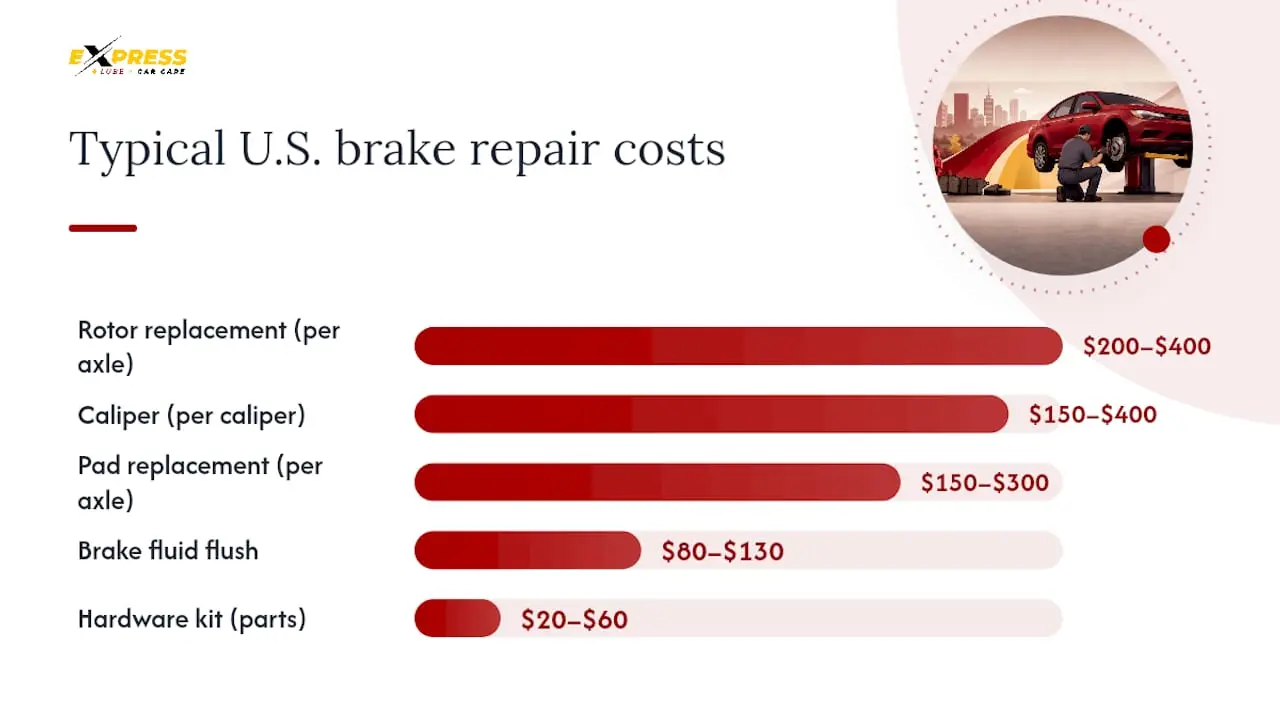
Brake repair costs vary by vehicle, region, and what the inspection reveals. These are realistic U.S. ranges for common services.
Typical service costs:
- Brake pad replacement (per axle): $150–$300, parts and labor included
- Rotor replacement (per axle): $200–$400 depending on rotor type and vehicle
- Hardware kit (clips, shims, pins): $20–$60 in parts, often bundled with a pad job
- Caliper rebuild or replacement: $150–$400 per caliper, depending on severity
- Brake fluid flush: $80–$130
Replacing pads and rotors together on the same axle is generally the better call when rotors are scored or below minimum thickness. Machining a rotor costs less upfront, but a rotor that is already near its minimum thickness will need replacement sooner anyway. For a detailed look at what a front brake pad replacement involves, the process covers parts selection, hardware, and rotor measurement.
A standard brake service at a reputable shop typically includes: new pads, hardware inspection or replacement, rotor measurement, caliper slide pin service, and a post-repair test drive. ABS module diagnostics, caliper rebuilds, and brake fluid flushes are usually priced separately.
Express Lube & Car Care currently offers a $30 off brake service coupon for drivers in Plano and Collin County, which applies to pad and rotor work performed by ASE-certified technicians.
How Express Lube & Car Care approaches a brake squeak diagnosis
At Express Lube & Car Care, a brake noise complaint starts with a short conversation, not a parts list. The technician asks when the noise occurs, whether it is constant or intermittent, and whether any other symptoms are present. That symptom interview narrows the likely cause before the car goes on the lift.
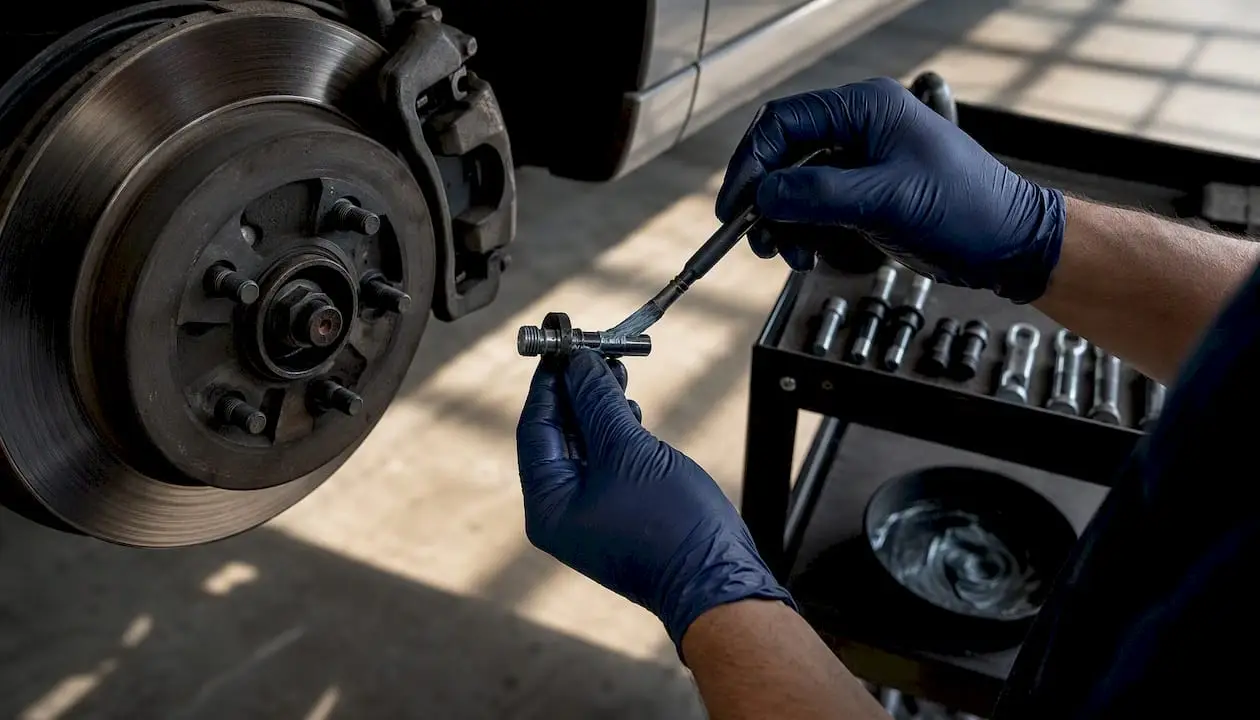
From there, the workflow is methodical. A quick road test confirms the sound pattern. With the wheel off, the technician measures pad thickness directly, checks rotor surface condition and runout, and inspects caliper slide pin movement. Pads that are above the wear threshold but glazed may be scuffed and reinstalled. Slide pins that are dry get cleaned and regreased with brake-specific compound. Rotors that are scored beyond the manufacturer’s minimum get replaced, not machined, because a rotor at minimum thickness has no margin left.
When replacement is the right call, Express Lube & Car Care uses quality parts backed by a 24-month/24,000-mile warranty. ASE-certified technicians handle every job, and same-day service means most drivers leave with the problem resolved, not scheduled for a follow-up. Uneven wear patterns that suggest a caliper or hardware issue get addressed at the same visit rather than deferred.
Get a brake inspection at Express Lube & Car Care today
Persistent brake noise deserves a professional set of eyes, and Express Lube & Car Care makes that easy. Walk in without an appointment for a same-day brake inspection at the Plano location, performed by ASE-certified technicians. Every brake job is backed by a 24-month/24,000-mile warranty, so you leave knowing the repair will hold.
Right now, Express Lube & Car Care is offering $30 off brake service for qualifying pad and rotor work. You can also browse current service specials or go straight to the brake repair service page to see what is covered and book your visit.
Sources
- What Causes Brake Squeal and How To Solve It | PowerStop Brakes
- Squeaky brakes: causes and solutions
- How to Fix Squeaky Brakes: Causes, DIY Fixes & When to Replace Pads
- Brake Squealing: 7 Causes and How to Stop It — Car Care Total
- Why Are My Brakes Squeaking? Causes & How to Fix It
FAQ
How do I get my brakes to stop squeaking?
Start by driving normally through several stops to clear surface rust. If the noise continues, inspect pad thickness, lubricate caliper slide pins with brake-specific grease, and check for debris between the pad and rotor. Persistent squealing after those steps usually means the pads need replacement.
Is it okay to drive on squeaking brakes?
A morning-only squeak that clears quickly is generally safe to drive on briefly. A squeal that happens on every stop, or any grinding sound, means you should have the brakes inspected before driving further, as pad wear may be at or past the safe threshold.
Can I spray WD-40 on my brakes to stop squeaking?
No. WD-40 on rotors or pad friction surfaces contaminates the pad material, damages rubber seals, and reduces braking effectiveness. Use only brake-specific cleaner on the rotor and brake-specific grease on hardware like slide pins and backing plates.
How much will it cost to fix squeaky brakes?
Brake pad replacement typically runs $150–$300 per axle, while rotor replacement adds $200–$400 per axle depending on the vehicle. Express Lube & Car Care currently offers $30 off qualifying brake service in Plano, which can reduce the total cost of a pad-and-rotor job.
Why are my new brakes still squeaking?
New pads and rotors often squeak during the bedding-in period as a friction transfer layer forms on the rotor surface. If the noise continues beyond a few hundred miles, the likely causes are improper installation, missing shims, or a pad-and-rotor compatibility issue that a technician should inspect.