

The battery stores the power that starts your engine. The alternator makes electricity while the engine runs and recharges the battery. If the car won’t crank or cranks slowly, the battery is the usual suspect. If the car starts, then dims, stalls or shows a battery light while you drive, the alternator is more likely. The two overlap enough that a quick test is the only sure answer.
This guide explains what each part does, which symptoms point where, what a starter problem looks like, and what you can safely check yourself before you call a shop.
TL;DR
- Won’t crank, or cranks slowly: the battery is the most common cause. A dead battery can also be a symptom of a weak alternator that never recharged it.
- Starts fine, then dies or dims while driving: suspect the alternator or the drive belt that turns it.
- Single click or a whirring noise with a healthy battery: the starter becomes a real possibility.
- A battery-shaped light on the dash points to the charging system as a whole, not only the battery.
- A load test and charging system check separates the three in minutes. A multimeter alone cannot.
Table of Contents
- What the battery and the alternator each do
- The quickest way to tell them apart
- Signs of a failing battery
- Signs of a failing alternator
- What the battery light really means
- Where the starter fits in
- Why a voltmeter reading is not the whole story
- What you can safely check before calling a shop
- How long each part lasts, and what shortens it
- Our perspective: test first, replace second
- Get a same-day charging system test in Plano
- FAQ
- Sources
What the battery and the alternator each do
Think of the battery as a fuel tank for electricity and the alternator as the pump that refills it. The battery supplies the burst of current that turns the starter and gets the engine running. It also keeps the clock, radio presets and computer memory alive when the car is off.
Once the engine is running, the alternator takes over. A belt spins it, and it powers the lights, ignition, fuel system, climate controls and infotainment while sending the surplus back to the battery. The battery then acts as a buffer, smoothing out demand.
That relationship explains why the two get confused. A failing alternator drains the battery until the battery can’t start the car. A worn battery can strain an alternator that is working fine. Either way, the driver sees the same thing: a car that won’t start.
The quickest way to tell them apart
Start with when the problem happens.
| What you notice | Most likely culprit | Why |
|---|---|---|
| Car won’t crank, dash lights are dim or dead | Battery | Not enough stored power to turn the engine |
| Slow, labored cranking | Battery (sometimes alternator) | Weak battery, or one that was never fully recharged |
| One loud click, then nothing, with bright dash lights | Starter or starter connection | The battery can power the lights but the starter isn’t turning |
| Car starts, then headlights dim or flicker while driving | Alternator | Output is not keeping up with demand |
| Car runs only with a jump and dies soon after | Alternator | The battery is not being recharged while the engine runs |
| Car jumps and keeps running, then won’t start next day | Battery | It can’t hold a charge |
| Battery light on while driving | Charging system | Alternator, belt, wiring or battery |
The jump-start behavior is one of the most useful clues. If the engine dies shortly after the cables come off, the alternator probably isn’t sustaining the electrical load. If it keeps running normally but struggles to start again later, the battery is the likelier problem. Treat this as a clue, not a verdict. A badly worn battery can also cause odd behavior in a car with a marginal alternator.
Signs of a failing battery
Batteries usually give some warning before they quit. Consumer Reports notes that most batteries last about two to four years in hot climates and four to six in cooler ones, so a battery that is several years old in North Texas deserves attention even when it still starts the car.
Watch for:
- Slow cranking. The engine turns over more slowly than it used to, especially on the first start of the day.
- Dim lights with the engine off. Interior lights or headlights look weak before you start.
- A dash warning light. The battery light or a general warning light can appear.
- Corrosion on the terminals. A white or bluish crust on the posts can interfere with the connection.
- A swollen or leaking case. This is a sign of damage. Do not keep using it.
- Repeated dead batteries. If a replacement or recharged battery dies again, something else may be draining it or not charging it.
Many late-model cars also drain a battery while parked, because modules and alarms stay awake. Consumer Reports explains that a regularly driven car lets the alternator replenish what is lost, but a car left parked for a while can go flat. If you travel often or leave a vehicle sitting, a battery maintainer helps. We also have a guide to parasitic battery drain if the battery dies overnight for no obvious reason.
Signs of a failing alternator
Alternators tend to fail more gradually than a battery dies, and the symptoms show up while the engine is running.
- Headlights that dim at idle and brighten when you rev. This is a classic pattern.
- A battery or charging warning light that comes on or flickers while you drive.
- Electrical oddities. Power windows slow down, the radio cuts out, gauges act strangely.
- Whining or growling from the engine bay. This can indicate worn alternator bearings. It can also come from other belt-driven parts, so the sound alone doesn’t prove which one.
- A burning smell. An overheating alternator or a slipping belt can produce one. Pull over safely if you smell something burning.
- Stalling. Once the battery has run down, the engine can quit, sometimes without much warning.
Our alternator diagnostic guide walks through these signs in more detail.
What the battery light really means
The red battery-shaped light is not a battery gauge. It indicates that the charging system voltage is outside the expected range. That can be a weak alternator, a loose or broken serpentine belt, a bad connection, or a battery that has failed internally.
If it comes on while you are driving, don’t assume you can finish the trip. With a charging problem, the car is running on whatever charge is left in the battery, and that can run out within a short time, especially at night with the headlights, wipers and A/C on. Turn off non-essential accessories, and head to a safe place to stop or to a shop. If the steering gets heavy, the belt may have come off, and you should stop right away. We cover the scenario in detail in our article on the battery light coming on while driving.
A light that flickers is often an early warning, not a false alarm. It can mean the alternator’s output is intermittent or a connection is loose. Get it checked before it turns into a no-start.
Where the starter fits in
People searching for alternator vs battery often have a third suspect without knowing it. The starter is the motor that physically turns the engine over when you turn the key or press the button. It gets its power from the battery.
A bad starter often looks like this:
- You hear a single click, or rapid clicking, but the dash lights stay bright.
- You hear the starter spin with a whirring or grinding sound, but the engine doesn’t turn.
- The car starts some days and not others, with no change in battery condition.
- A jump-start doesn’t help at all.
A bad battery usually looks different: dim or dead dash lights, rapid clicking with fading lights, or slow cranking that gets worse with each attempt. A jump-start typically helps a weak battery but not a failed starter.
Because the starter, battery and alternator are all part of the same system, we test all three together when a car comes in with a no-start complaint. We also check the cables and grounds that connect them, since a corroded or loose connection can mimic any of the three failures.
Why a voltmeter reading is not the whole story
If you own a multimeter, you can get a snapshot. Many guides, including our own alternator charging voltage guide, describe a healthy system as showing roughly 12.6 volts at the battery with the engine off, and a higher reading, commonly in the low-to-mid 14 volt range, with the engine running. A running reading that stays near battery voltage, or sits well below the expected range, suggests the alternator isn’t charging properly.
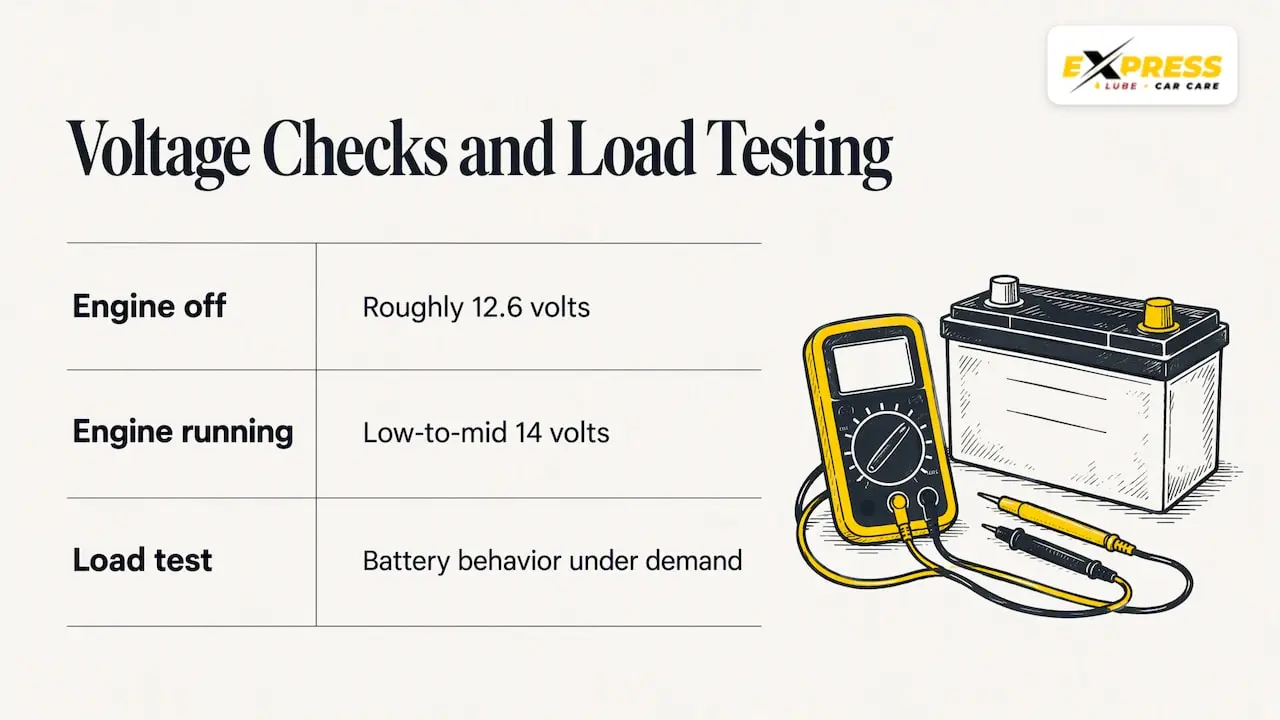
The catch is that voltage doesn’t tell you capacity. A battery can show a decent resting voltage and still collapse the moment the starter draws heavy current. That is why shops use a load test and a charging system analyzer, which measure how the battery behaves under demand and how the alternator performs with accessories on. If you’ve ever had a battery that read fine and then left you stranded, this is the reason.
There is a broader point here about recording measurements properly. A baseline reading from when a vehicle was healthy makes later diagnosis far more reliable, and this guide on capturing a reliable baseline measurement explains why comparing readings over time beats a single number. It is written for professional garages in Dutch, but the principle applies to any shop that keeps records on your vehicle.
What you can safely check before calling a shop
No tools are needed for the first few steps.
- Look at the dash when you turn the key. Bright lights and a single click lean toward the starter. Dim or dead lights lean toward the battery.
- Try the headlights. Dim headlights before starting point to a weak battery.
- Inspect the terminals. Look for heavy corrosion or loose clamps. Don’t touch the terminals with metal tools, and keep sparks and flames away from the battery.
- Check the belt by sight. A cracked, glazed or missing serpentine belt can stop the alternator from turning.
- Note the pattern. Did it fail on a cold start, after a long drive, after sitting for a week? That history helps a technician.
If you try a jump-start, follow the sequence in your owner’s manual. Some modern cars have specific jump points, and connecting cables incorrectly can damage electronics. If the car needs a second jump within a day or two, stop repeating the fix and get it tested.
Don’t keep driving on a charging warning to see how far you get. A car that stalls in traffic or on a highway is a safety problem, not just an inconvenience.
How long each part lasts, and what shortens it
Batteries are the wear item here. Alternators generally last longer, but they have no fixed expiration date. Both depend on how you drive and the climate.
A few things shorten battery life:
- Heat. Under-hood temperatures in a Texas summer speed up internal wear. The Consumer Reports guidance on making a battery last longer covers the habits that help.
- Short trips. The alternator needs time to replace the energy used to start the engine.
- Heavy accessory use. Extra lighting, audio gear or charging equipment adds load.
- Vibration and loose hold-downs. A battery that isn’t secured wears faster.
- Long periods parked. See the maintainer tip above.
An alternator may fail earlier if it runs with a weak battery for a long period, since it works harder to keep up. Replacing a dying battery promptly can protect the alternator. Our guides on how long car batteries last and battery maintenance go into more depth. If you aren’t sure which battery type suits your car, the AGM versus flooded battery guide helps.
Our perspective: test first, replace second
The expensive mistake in this area is replacing a part because it matched a symptom. We see cars where a new battery was installed and died again because the alternator wasn’t charging, and cars where a new alternator went in when the real problem was a worn battery or a corroded cable.
So our approach is simple. We test the battery, the charging output, the starter draw and the connections before recommending anything. When a vehicle comes in, our technicians can document what they find with a digital vehicle inspection that includes photos and notes, so you see the same thing we see and decide with the facts in front of you. If the answer is that your battery is fine, we’ll tell you.
We also encourage drivers to have the charging system checked as part of regular maintenance, especially once a vehicle is a few years old, because a planned replacement on your schedule beats a tow from a parking lot. Intervals and needs vary by vehicle, so your owner’s manual remains the baseline.
— Express Lube & Car Care
Get a same-day charging system test in Plano
If you’re stuck between a battery, an alternator and a starter, we can test all three. Our shop works on a no-appointment basis, and most services are completed the same day. Battery, alternator and starter service is part of what we do, alongside electrical and other repairs, and our ASE-certified technicians can explain the results in plain terms.
Qualifying repairs carry our 24-month/24,000-mile limited warranty, whichever comes first. Eligibility, limitations and exclusions apply, so ask us what covers your specific repair before you approve work. If you’d rather talk first, contact us through our site and we’ll point you the right way.
FAQ
Can a bad alternator kill a new battery?
Yes. If the alternator isn’t recharging, the battery keeps running down and can be damaged by repeated deep discharge. That is why a new battery should come with a charging system test. If the battery dies again soon after replacement, the charging system is the first place to look.
Can I drive with the battery light on?
It is not a good idea. The light signals a charging problem, and the car may be running on stored battery power that can run out without much warning. If it comes on, reduce electrical loads and get to a safe place or a shop as soon as you can. If you smell burning or the steering suddenly feels heavy, stop right away.
How long does a bad alternator take to drain a battery?
There’s no single answer. It depends on the battery’s condition, how much equipment is running and how far the alternator has failed. Nighttime driving with the lights, wipers and A/C on can drain it faster than a short daytime trip, so don’t count on a set number of miles.
How can I tell if it’s the starter instead?
A starter problem usually shows bright dash lights with a single click or a whirring sound, and a jump-start doesn’t change anything. A battery problem usually shows dim lights and slow or rapid-clicking cranking, and a jump-start tends to help. A technician can confirm with a quick test.
Does a jump-start prove which part is bad?
It gives a clue, not proof. A car that dies soon after the cables come off points toward the alternator, while one that keeps running points toward the battery. Because a worn battery and a weak alternator can both be involved, a proper test is the reliable way to know.
Sources
- Car Batteries: Which Ones Do Best? (Consumer Reports)
- How a Car Battery Charger Can Prevent a Dead Battery (Consumer Reports)
- How to Make Your Car Battery Last Longer (Consumer Reports)