

The most common catalytic converter symptoms are a check engine light (often with a P0420 code), sluggish acceleration, worse fuel economy, a rotten-egg smell from the exhaust, and a rattle under the car. None of these proves the converter itself is bad. Many of them point to a problem upstream, such as a misfire, a tired oxygen sensor or a fuel issue, that damages the converter over time. This guide explains what each sign means, what else can cause it, what a repair typically costs, and when to stop driving and have the car looked at.
TL;DR
- The most reliable warning is the check engine light, often with code P0420 (catalyst system efficiency below threshold).
- Lost power, poor fuel economy, a sulfur smell and a rattling noise from underneath are the other classic signs.
- A converter usually fails because of something else: misfires, bad O2 sensors or fuel problems. Fix the cause, or the new converter can fail early.
- A converter that is clogged or melted cannot be cleaned. It has to be confirmed by testing, then replaced.
- A flashing check engine light means a serious misfire. Slow down and get the car checked right away.
Table of Contents
- What a catalytic converter does
- The main catalytic converter symptoms
- Does a bad catalytic converter make the car shake or smell like gas?
- Why catalytic converters fail
- When to stop driving
- How a converter problem is diagnosed
- Can you unclog a catalytic converter?
- What does catalytic converter replacement cost?
- Replacing the converter is a last resort
- Emissions testing in Plano and Collin County
- Our perspective: diagnose first, replace last
- Get the warning light checked in Plano
- Protecting your converter
- FAQ
- Sources
What a catalytic converter does
The catalytic converter sits in your exhaust system between the engine and the muffler. Inside is a ceramic honeycomb coated with precious metals. It converts the most harmful gases the engine produces into less harmful ones before they leave the tailpipe.
Because it works at very high temperatures and every exhaust gas passes through it, it is sensitive to whatever the engine sends its way: unburned fuel, oil, coolant or heavy carbon. That is why converter trouble so often starts somewhere else.
Your car’s computer watches it with an upstream and a downstream oxygen sensor. When the downstream readings start to look too much like the upstream ones, the computer decides the converter is no longer cleaning well enough and turns on the check engine light. The EPA explains that on-board diagnostics can detect a malfunction or deterioration of sensors and components, usually well before the driver notices a drop in performance.
The main catalytic converter symptoms
1. Check engine light and a P0420 code
The check engine light is the primary indicator. The code most often tied to the converter is P0420, which means the catalyst system is operating below its efficiency threshold, as the EPA’s on-board diagnostics fact sheet describes the warning lamp. Some vehicles with two exhaust banks may set a similar code for the second bank.
A P0420 code is a starting point, not a verdict. A failing downstream oxygen sensor, an exhaust leak or an engine running slightly rich can all produce it. If you want to know how those sensors fail, our guide to bad O2 sensor symptoms covers it, and our overview of what causes a check engine light lists the other common triggers.
2. Sluggish acceleration and loss of power
When the honeycomb is blocked, exhaust cannot leave the engine freely. The engine struggles to breathe, so the car feels flat when you merge onto the George Bush Turnpike or climb an on-ramp. Drivers often describe it as the car running out of breath at highway speed, or struggling more the longer they hold the throttle.
In a restricted converter this tends to get worse gradually, then suddenly. In severe cases the engine may barely rev, or stall.
3. Worse fuel economy
A restricted exhaust makes the engine work harder for the same speed, and a failing engine-management problem behind the converter can add more fuel to the mix. If you are filling up more often with no change in your commute, that is worth noting. It is a weak clue on its own, because tires, a dirty air filter, spark plugs and a clogged fuel filter can do the same thing. Our article on signs of a clogged fuel filter is a good cross-check.
4. Rotten-egg or sulfur smell
Gasoline contains a little sulfur. A healthy converter processes it. When the converter is overworked, overheated or the engine is running rich, the exhaust can smell like rotten eggs. A strong smell that does not go away after the engine warms up deserves attention.
5. Rattling from under the car
Inside the converter, the ceramic core can break apart after overheating or physical impact. Loose pieces rattle, especially at idle or on a cold start. A rattle can also be a loose heat shield, which is a much cheaper fix, so have someone look underneath before assuming the worst.
6. Dark exhaust or a hot floorboard
Black exhaust usually means excess fuel. A floorboard that feels unusually hot after a drive can mean the converter is running too hot because of a restricted flow or unburned fuel igniting inside it. Both are reasons to get the car checked soon.
7. Failed emissions test
Sometimes the first sign is a failed emissions test. More on that below.
Does a bad catalytic converter make the car shake or smell like gas?
It is a common question, and the honest answer is: not directly. A converter problem by itself rarely shakes the car or produces a raw gasoline smell. As the EPA’s on-board diagnostics material notes, those symptoms usually come from the root causes of converter failure, like engine misfires or fuel-system issues.
If your car shakes, hesitates or smells like fuel, the misfire or fuel problem is the thing to diagnose. It is also the thing that can destroy the converter if you wait.
Why catalytic converters fail
Converters rarely wear out on their own in a short time. The usual causes are:
- Engine misfires. Bad spark plugs, worn ignition components or a leaking injector send unburned fuel into the exhaust, where it burns inside the converter and overheats it.
- Faulty oxygen sensors. If the sensors feed the computer bad data, the air-fuel mixture drifts and the converter takes the damage.
- Oil or coolant entering the exhaust. Worn piston rings, valve seals or a leaking head gasket can coat the catalyst and poison it.
- Physical damage. Road debris or a hard impact can crack the core.
- Age and mileage. Over many years the catalyst coating loses effectiveness.
If the car is due for a tune-up, that matters here too. Our list of signs your car needs a tune-up shows what to look for before a misfire starts costing you a converter.
When to stop driving
A flashing check engine light is not the same as a steady one. Flashing signals a severe misfire, and the EPA material warns it can rapidly damage the converter. Reduce speed right away and have the car diagnosed rather than driving on for days.
Stop and call a shop if you notice any of these:
- A flashing check engine light
- A strong sulfur smell together with a sharp loss of power
- The engine stalling or barely accelerating
- Visible heat or smoke from underneath the car
A restricted exhaust can leave you without power in traffic, and an overheated converter under the car is a fire risk near dry grass or debris. If any of this happens, pull over safely and get the vehicle inspected by a professional.
How a converter problem is diagnosed
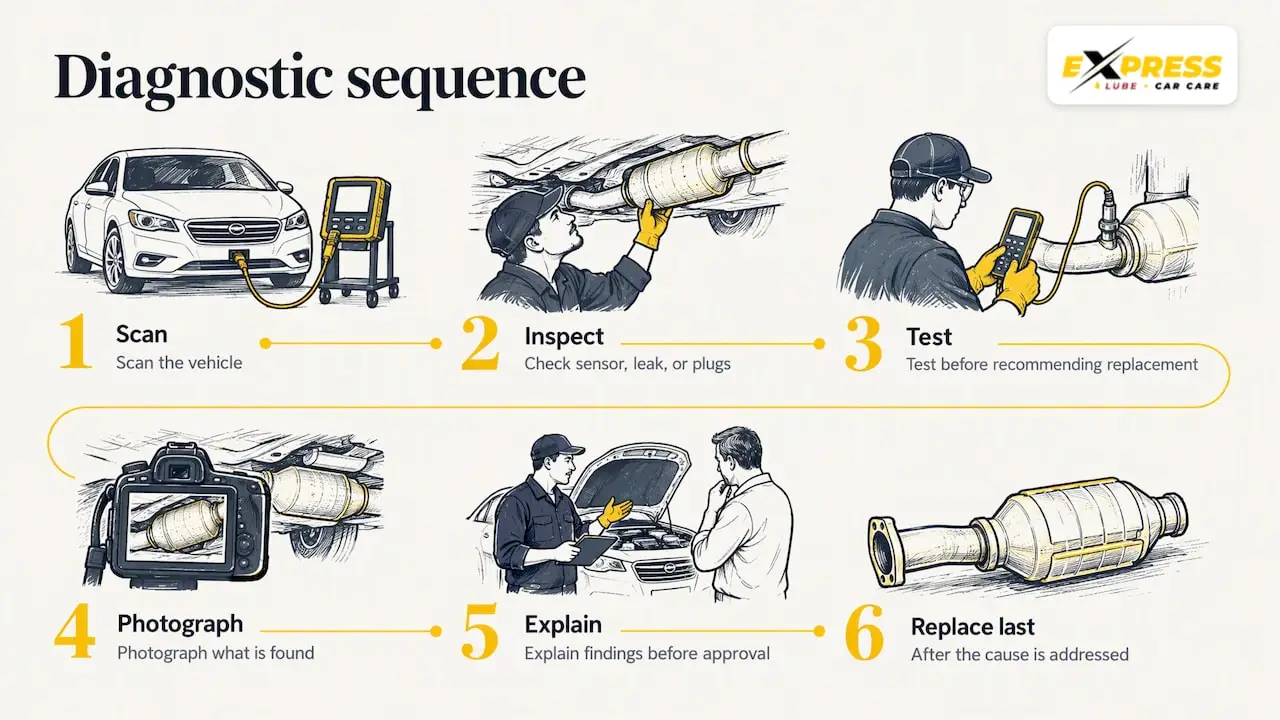
Good diagnosis separates a failed converter from a bad sensor or an upstream fault. The sequence typically looks like this:
- Read the codes. A scan tool pulls stored and pending codes, including any misfire codes alongside P0420.
- Check live sensor data. The upstream and downstream oxygen sensors are compared while the engine runs. A converter that works makes the downstream signal steady. A failing one lets it mirror the upstream sensor.
- Inspect for leaks and misfires. An exhaust leak near a sensor can fool the computer. Spark plugs, coils and fuel trim are checked.
- Test for restriction. If the car has lost power, a back-pressure test can check for a clog, while a code-related complaint starts with what the code points to.
- Look underneath. Physical damage, rattles, discoloration and heat damage are visible on the lift.
At our shop, this is where a digital vehicle inspection helps. You get photos and technician notes of what was found, so you can see the reason behind any recommendation instead of taking it on faith.
Can you unclog a catalytic converter?
Not really. Additives and “cleaner” products may be marketed for this, but once the substrate is physically blocked, melted or poisoned by contaminants, it cannot be restored. What can sometimes be fixed is a case where the converter is fine and a sensor is reporting wrong data. That is why diagnosis comes first.
If the converter is truly done, the cause still has to be found. The EPA’s guidance on correcting emission problems explains that high emissions signal an engine not performing as designed, and acting on the warning early can mean fixing smaller parts like spark plugs or oxygen sensors before the converter is lost.
What does catalytic converter replacement cost?
Expect a wide range. RepairPal’s estimator reports that, as of September 2026, the average runs roughly $2,177 to $2,506, with some common trucks under $1,000 and certain passenger vehicles above $4,000. The same page lists add-ons that often show up on the bill:
| Possible extra | Typical range (RepairPal) |
|---|---|
| Diagnostic fee | $50 to $150 |
| Hardware and gaskets | $20 to $100 |
| O2 sensor replacement | $150 to $300 each |
These are national figures and do not include taxes or a specific shop’s labor rate. Your quote depends on your vehicle, the part used and the labor time. Ask for a line-item written estimate so you can see parts, labor, sensors and gaskets separately.
Replacing the converter is a last resort
Replacing the converter without finding why it failed is a common and expensive mistake. If a misfire or a bad oxygen sensor killed the first one, it can kill the new one too. A careful shop confirms the converter has actually failed, repairs the root cause, and only then replaces the converter.
It is also a legal matter. Under federal law, converters may not be removed and replaced with replacement pipes, and any work in that part of the exhaust has to keep a proper converter in place. Anything that deletes or bypasses the converter is not an option, and it can also keep the vehicle from passing emissions testing.
Emissions testing in Plano and Collin County
Collin County is one of the Texas counties that requires an emissions inspection. According to the TxDMV FAQs, vehicles in Collin and the other listed counties must pass it as part of registration, while safety inspections apply to commercial vehicles regardless of county. Collin County’s own new-resident registration page also lists the emissions inspection as a step before you register a vehicle.
If a failing converter causes the failure, the vehicle has to be repaired and retested before registration can be completed. Our pages on Texas state inspection and how to pass emissions walk through what applies to your vehicle. Requirements depend on the vehicle’s age, type and use, so confirm yours before you go.
A tip: if the check engine light is on, fix the cause before the test. A lit warning lamp is a problem on its own, whatever caused it.
Our perspective: diagnose first, replace last
We see the same pattern often. A driver arrives with a P0420 code and a quote, from somewhere else, for a converter. Sometimes it is the right call. Just as often, the first thing to confirm is whether the code is real: a downstream sensor, an exhaust leak or an old set of spark plugs.
We approach it in order. Scan, inspect, test, photograph what we find, and explain it in plain language before anyone approves a dollar. Replacement comes after the cause is addressed. Our technicians are ASE-certified, and most services are completed the same day without an appointment, which matters when a car is your commute or your family’s schedule.
If an exhaust-related repair is covered, our 24-month/24,000-mile limited warranty on qualifying repairs (whichever comes first) may apply. Eligibility, limitations and exclusions apply, and not every repair or part is covered, so ask us about the terms for your specific job.
You can also read about our exhaust and muffler repair and check engine light guide for more on what we look at.
— Express Lube & Car Care
Get the warning light checked in Plano
If your car is showing any of these symptoms, bring it in. We will read the codes, inspect the exhaust and sensors, and show you what we find in a digital inspection with photos and technician notes. No appointment is needed. See our full list of services or contact Express Lube & Car Care to schedule service. If a repair estimate is a concern, we also have an auto repair financing page for details.
Protecting your converter
You cannot make a converter last forever, but you can avoid what kills it:
- Act on the check engine light promptly, especially a flashing one.
- Replace spark plugs and ignition parts on the schedule in your owner’s manual. Intervals vary by vehicle.
- Fix oil leaks, coolant leaks and burning oil early.
- Keep up with oil changes and fuel-system maintenance.
- Avoid driving over high debris or curbs that can strike the exhaust.
- Get unusual noises and smells inspected rather than waiting.
For a broader checkup, our vehicle safety inspection checklist covers other items worth reviewing at the same visit.
FAQ
What are the first signs of a bad catalytic converter?
Usually the check engine light, often with P0420, comes first, followed by reduced power, worse fuel economy or a sulfur smell. A rattle from underneath is another early clue. Because other faults can cause the same signs, a diagnosis is needed to confirm.
Can I drive with a bad catalytic converter?
For a short time and with a steady light, many cars still run, but it is not a good idea to wait. A restricted converter can cut power and raise exhaust heat, and an unresolved cause can do more damage. If the light is flashing, the engine stalls or you smell strong sulfur, stop driving and get it inspected.
How much does it cost to fix a catalytic converter?
RepairPal’s September 2026 figures put the average at about $2,177 to $2,506, with a range from under $1,000 to over $4,000 depending on the vehicle. Diagnostic fees, gaskets and oxygen sensors can add to that. Ask for a line-item written estimate.
What will unclog a catalytic converter?
Nothing reliably will. Once the converter is blocked, melted or contaminated, it cannot be cleaned or restored, and it needs to be replaced after the cause is fixed. Sometimes the real problem is a faulty sensor or a misfire, which is why testing comes first.
Will a bad converter fail an emissions test?
It can. In Collin County, a passing emissions inspection is part of vehicle registration, and the test checks that emission controls work properly. A failed vehicle must be repaired and retested.
Sources
- EPA: Frequently Asked Questions About On-Board Diagnostics
- EPA: Next Steps, Correcting Your Vehicle’s Emission Problems
- EPA: Exhaust system repair and converter replacement pipes
- RepairPal: Catalytic Converter Replacement Cost Estimate
- TxDMV: Frequently Asked Questions
- Collin County Tax Assessor: New Resident Registration