

Local oil change service options are defined as the range of professional fluid replacement and maintenance services available at quick-lube chains, independent mechanics, and dealerships, with or without a prior appointment. Understanding these options helps you protect your engine, control costs, and fit service into a busy schedule. Providers like Jiffy Lube, Express Lube & Car Care, and dealership service centers each offer distinct trade-offs in speed, price, and thoroughness. Routine oil changes extend engine life and reduce long-term repair costs. Knowing which option fits your car and your calendar is the first step toward smarter vehicle maintenance.
What are the main types of local oil change services?
Three oil types define most local oil change service options: conventional, synthetic blend, and full synthetic. Each serves a different vehicle profile and budget.
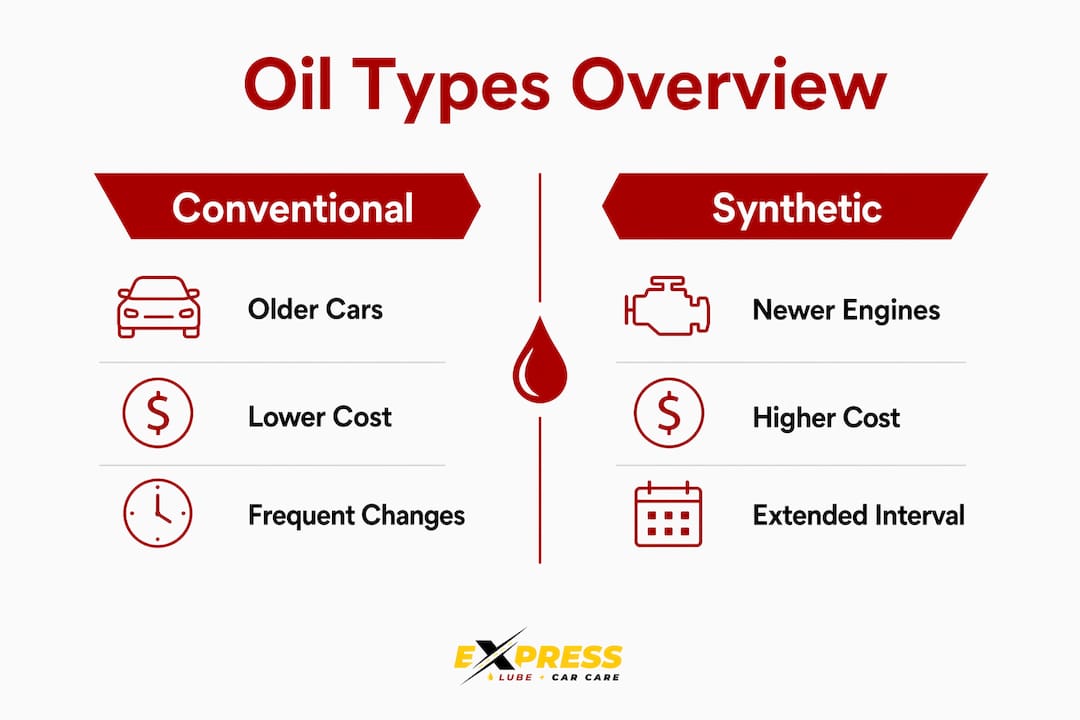
Conventional oil suits older vehicles or those with lower mileage. It costs the least but requires more frequent changes, typically every 3,000–5,000 miles. Synthetic blend oil mixes conventional and synthetic base stocks, offering better heat resistance at a moderate price point. It works well for trucks, SUVs, and vehicles under moderate stress. Full synthetic oil delivers the strongest engine protection. Full synthetic oil changes cost more upfront but allow longer service intervals, often 7,500–10,000 miles or more, making them cost-effective over time. Newer vehicles and high-performance engines almost always require full synthetic.

| Oil Type | Best For | Typical Interval | Relative Cost |
|---|---|---|---|
| Conventional | Older or low-mileage vehicles | 3,000–5,000 miles | Lowest |
| Synthetic Blend | Trucks, SUVs, moderate use | 5,000–7,500 miles | Moderate |
| Full Synthetic | New, high-performance, or turbocharged engines | 7,500–10,000+ miles | Highest |
| High-Mileage Synthetic | Vehicles over 75,000 miles | 5,000–7,500 miles | Moderate to high |
Beyond oil type, the service location matters. Quick-lube chains prioritize speed. Independent local mechanics often provide more personalized attention and flexible pricing. Dealership service centers use manufacturer-approved products but typically carry higher labor rates and longer wait times.
Pro Tip: Check your owner’s manual before walking into any shop. The manual specifies the exact oil viscosity and type your engine requires. A shop that ignores that spec is not serving your vehicle correctly.
Quality shops also include supplemental services with every oil change: filter replacement, drain plug inspection, and a visual check of accessible components. These extras separate a thorough provider from a bare-bones one.
How do pricing and wait times compare among local providers?
Oil change pricing varies based on oil type, vehicle model, shop overhead, and the additional services bundled into the visit. Understanding these factors helps you avoid surprises at the register.
Pricing factors include the oil grade selected, the number of quarts your engine holds, the filter type, and any shop fees. Dealership labor rates can start around $14.95 for basic service but climb quickly with added fees and premium oil requirements. Quick-lube chains typically undercut dealerships on price while offering faster turnaround. Independent shops often fall in the middle, with more flexibility on both price and service scope.
Wait times follow a similar pattern. Quick lube chains promise 15 minutes or less for a standard oil change. That speed is the core value proposition of the quick-lube model. Dealerships, by contrast, may require a scheduled appointment and a wait of 45 minutes to over an hour, depending on shop volume. Independent mechanics vary widely, but many offer walk-in availability with wait times in the 20–40 minute range.
Walk-in oil change services give car owners the flexibility to stop in without planning ahead. That convenience matters most for drivers with unpredictable schedules or those who notice a low oil warning light mid-week.
Here are the key factors that affect your total cost and time at any local provider:
- Oil type selected: Full synthetic costs more than conventional, but the longer interval offsets the price difference over a year.
- Vehicle size: Trucks and SUVs hold more oil, which raises the base cost regardless of provider.
- Add-on services: Tire rotations, cabin filter replacements, and fluid top-offs add time and cost but often deliver real value.
- Shop location and overhead: Urban shops in high-rent areas charge more than suburban or standalone facilities.
- Appointment vs. walk-in: Walk-in service is faster at quick-lube chains but may involve a short queue during peak hours.
Pro Tip: Visit quick-lube locations on weekday mornings. Traffic is lowest between 8 a.m. and 10 a.m., and you are far less likely to wait behind multiple vehicles.
What inspections come with a quality oil change?
A quality oil change acts as a health checkup for your vehicle, not just a fluid swap. Expert shops document vehicle condition and perform multi-point inspections during every service visit. That distinction separates a thorough provider from one that simply drains and refills.
Think of a professional oil change bay the way you would a commercial kitchen. The right tools, the right process, and the right checks are all non-negotiable. Skipping any step creates risk downstream.
A comprehensive oil change service at a reputable shop typically includes the following checks:
- Engine oil level and condition verified after the new oil is added.
- Oil filter replacement with a filter rated for the oil type installed.
- Drain plug inspection to confirm the plug and gasket seal correctly after reinstallation.
- Tire pressure check on all four tires, including the spare when accessible.
- Fluid level inspection covering coolant, brake fluid, power steering fluid, and windshield washer fluid.
- Visual belt and hose inspection to flag cracking, fraying, or leaks before they become failures.
- Battery terminal check to identify corrosion that can cause starting problems.
- Air filter visual inspection to determine whether replacement is due.
Some providers include extras like tire pressure adjustment, fluid top-offs, and battery tests as standard parts of the service package. These additions add genuine value and can catch problems that would otherwise go unnoticed until a breakdown occurs.
“A quality oil change is not just about the oil. It is about understanding the current condition of the vehicle and identifying anything that needs attention before it becomes a safety issue.” — How to Choose the Right Oil Change Services
ASE-certified technicians understand the differences between oil types and know how to read the signs of wear during an inspection. Certification is a reliable indicator that the person servicing your vehicle has met a recognized industry standard.
How do you choose the best local oil change option?
Choosing the best local oil change comes down to five practical criteria: technician certification, oil quality, service transparency, convenience, and the scope of the inspection performed.
Start with your vehicle’s age and mileage. Vehicles over 75,000 miles benefit from high-mileage synthetic blends that contain seal conditioners to reduce leaks. Newer vehicles under warranty often require full synthetic to maintain coverage. Matching the oil type to the vehicle is not optional. It directly affects engine wear and warranty compliance.
Transparent pricing is a reliable sign of a trustworthy shop. Reputable providers explain the cost difference between oil grades and do not pressure you into upgrades you do not need. If a shop cannot clearly explain why a service costs what it does, that is a signal worth noting.
Use this checklist when evaluating any local provider:
- Does the shop employ ASE-certified technicians?
- Does the provider offer walk-in service without requiring an appointment?
- Does the service include a multi-point inspection, not just an oil and filter swap?
- Does the shop clearly post or communicate pricing before the service begins?
- Does the provider use name-brand oil products and document what was installed?
- Does the shop offer service for your specific vehicle type, including trucks, SUVs, or European models?
No-appointment availability is a genuine differentiator. Busy drivers cannot always plan a service visit days in advance. Shops that accommodate walk-ins without sacrificing quality give you control over your schedule. Express Lube & Car Care is built around exactly that model, offering certified technicians and thorough service without requiring you to book ahead.
What a full-service oil change includes goes well beyond the oil itself. Understanding that scope helps you ask the right questions and recognize when a provider is cutting corners.
Key takeaways
Choosing the right local oil change service protects your engine, controls costs, and fits your schedule when you know what each option actually delivers.
| Point | Details |
|---|---|
| Oil type determines cost and interval | Full synthetic costs more but lasts longer; match the oil grade to your owner’s manual spec. |
| Quick-lube chains are fastest | Providers like Jiffy Lube target 15-minute turnarounds; walk-in availability removes scheduling friction. |
| Inspections separate good shops from basic ones | Quality providers check belts, hoses, fluids, tires, and battery during every oil change visit. |
| Pricing varies by oil type and vehicle size | Larger engines and premium oil grades raise the base cost; transparent shops explain every line item. |
| Certification signals quality | ASE-certified technicians understand oil specifications and can identify wear issues during service. |
What experience has taught us about local oil changes
After servicing thousands of vehicles at Express Lube & Car Care, the pattern is clear: most engine problems we see during oil changes were preventable. A cracked belt, low coolant, or a slow oil leak does not announce itself. It shows up during an inspection, or it shows up as a breakdown on the highway. Those are very different outcomes.
The conventional wisdom says an oil change is a commodity. Find the cheapest price, get in and out, repeat. We disagree with that framing. Speed matters, and we deliver it. But speed without thoroughness is just a missed opportunity to protect a vehicle that costs tens of thousands of dollars. A 15-minute service that includes a real multi-point inspection is not a contradiction. It is the standard we hold ourselves to.
We have also seen the damage caused by mismatched oil. A driver brings in a newer turbocharged engine and asks for conventional oil because it is cheaper. The engine is designed for full synthetic. Conventional oil breaks down faster under the heat a turbo generates, and the wear accumulates quietly until it does not. That conversation about oil type is not upselling. It is the job.
The drivers who get the most from their vehicles treat the oil change as a check-in, not a chore. They ask what was found. They look at the inspection sheet. They ask whether the filter housing showed any sludge. That level of engagement, combined with a shop that actually performs those checks, is what keeps engines running well past 150,000 miles.
— Express Lube & Car Care
Fast, thorough oil changes at express lube & car care plano
Express Lube & Car Care in Plano delivers no-appointment-needed oil changes performed by ASE-certified technicians, with every service including a multi-point inspection. Whether your vehicle needs conventional, synthetic blend, or full synthetic oil, the team matches the right product to your engine and explains the reasoning clearly.
Current oil change service specials are available online, covering all major oil types with transparent pricing and no hidden fees. Military members and healthcare providers receive special discounts as part of Express Lube & Car Care’s commitment to the community. Walk in any time during business hours and drive out with a serviced vehicle and a completed inspection report. Check the current oil change offers and see which service fits your vehicle today.
FAQ
What are the main local oil change service options?
The three primary options are conventional, synthetic blend, and full synthetic oil changes, available at quick-lube chains, independent mechanics, and dealerships. Each differs in cost, service interval, and engine protection level.
How long does a local oil change take without an appointment?
Quick-lube chains target 15 minutes or less for a standard oil change. Independent shops and dealerships typically take longer, ranging from 20 minutes to over an hour depending on volume and service scope.
What should a quality oil change include beyond the oil itself?
A thorough oil change includes filter replacement, drain plug inspection, tire pressure check, fluid level review, and a visual inspection of belts, hoses, and the battery. High-quality service providers document vehicle condition during every visit.
How do i know which oil type my car needs?
Your owner’s manual specifies the required oil viscosity and type. Newer and turbocharged engines typically require full synthetic, while older or standard engines may accept conventional or synthetic blend oil.
Is a walk-in oil change as reliable as a scheduled appointment?
Walk-in oil change quality depends on the shop, not the scheduling method. Providers that employ certified technicians and follow a consistent inspection process deliver the same quality whether you book ahead or walk in.