

A failing oxygen sensor usually shows up as a lit check engine light, worse fuel economy, a rough idle, hesitation when you accelerate, or a failed emissions test. No single symptom proves the sensor is the problem, though. The same signs can come from a vacuum leak, a misfire or a clogged injector, so the right move is a proper diagnosis before any part is replaced.
This guide walks through each symptom, explains what the sensor does, shows how to tell a sensor problem from a catalytic converter problem, and covers what to do when a code keeps coming back.
TL;DR
- The most common bad oxygen sensor symptoms are a check engine light, lower gas mileage, rough idle, hesitation, misfires and a failed emissions test.
- A trouble code alone does not confirm a failed sensor. The sensor may be reporting a real problem that starts somewhere else.
- A worn sensor left in place can hurt catalytic converter life, which is a much costlier repair.
- Replacing a sensor without fixing the underlying cause is the main reason codes return.
- Maintenance intervals and repair needs vary by vehicle, so check your owner’s manual and have the car inspected if symptoms appear.
Table of Contents
- What an oxygen sensor does
- The most common oxygen sensor symptoms
- Quick reference: symptom and what else it could be
- Why a code alone does not prove the sensor failed
- Oxygen sensor or catalytic converter?
- Can you keep driving with a bad oxygen sensor?
- What causes an oxygen sensor to fail
- Can you clean an oxygen sensor?
- Why the code comes back after replacement
- What does replacement cost?
- Our perspective
- Get the symptoms checked in Plano
- A simple plan if you suspect a bad sensor
- FAQ
- Sources
What an oxygen sensor does
Your engine computer needs to keep the air-fuel mixture in a narrow range. Oxygen sensors sit in the exhaust and measure how much unburned oxygen is leaving the engine. The computer reads that signal and trims fuel up or down, many times per second.
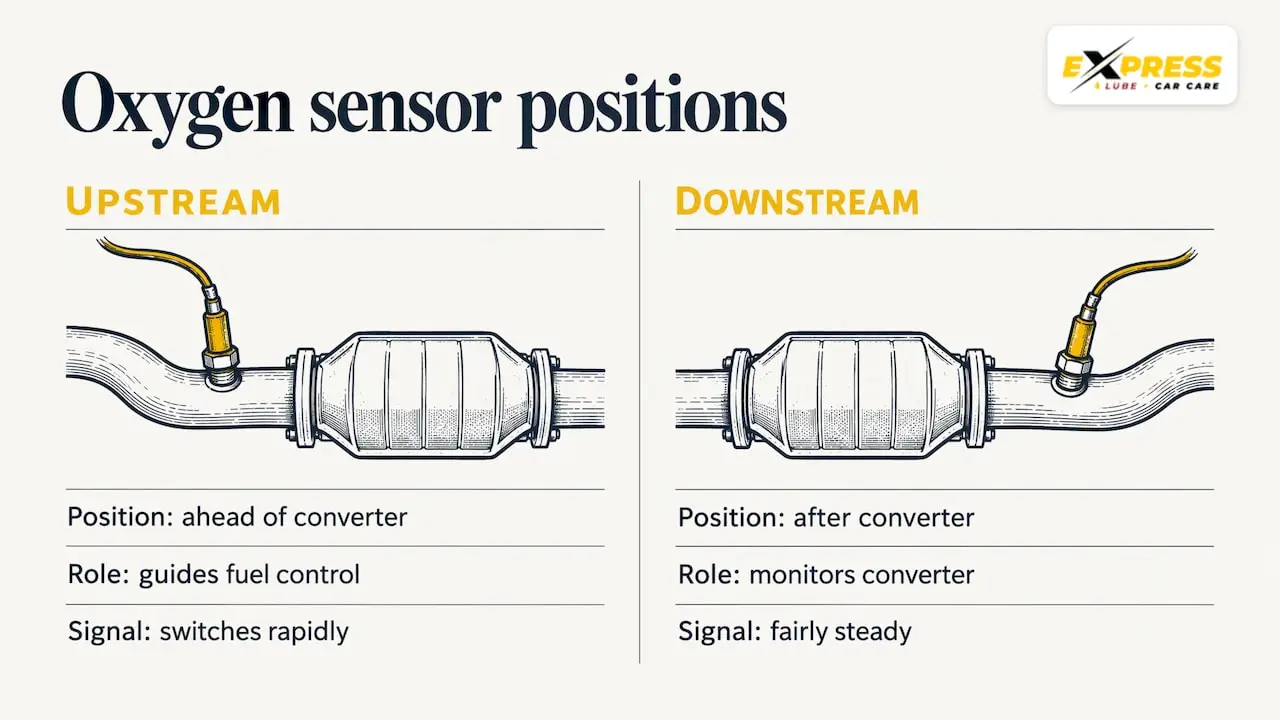
Most modern vehicles have at least two kinds of sensor positions. Sensors ahead of the catalytic converter (upstream) guide fuel control. Sensors after it (downstream) help the computer judge whether the converter is doing its job. According to Walker Exhaust’s diagnostic guidance, the front sensor signal should switch rapidly, while the rear signal should be fairly steady.
Think of the sensor like a thermometer in an oven. If the reading is wrong, the cook keeps adjusting the wrong way, and everything that comes out is a little off. That is why a slow or contaminated sensor affects so many things at once.
The most common oxygen sensor symptoms
A Walker Products training guide lists decreased fuel efficiency, rough idle, misfire and hesitation during acceleration among the signs, and stresses that none of them identifies a bad sensor by itself. Keep that in mind as you read the list below.
Check engine light
This is the most frequent first sign. The computer watches sensor response and heater circuits, and it sets a code when readings fall outside expected limits. The light can mean many things, so the code is a starting point rather than a verdict. Our guide to reading check engine codes explains how the codes are organized.
Lower fuel economy
When the sensor reports the wrong mixture, the computer may add more fuel than the engine needs. You notice it as more frequent fill-ups with no change in how or where you drive. Track a few tanks before deciding, since cold weather, tire pressure and heavy A/C use also move the number.
Rough idle, hesitation and misfires
A sluggish sensor can leave the mixture too rich or too lean, which makes the engine stumble at a stoplight or hesitate when you press the pedal. These symptoms overlap heavily with worn spark plugs, so it helps to compare against the signs of bad spark plugs. If the engine is also dropping toward stalling speed, see our page on engine stalling at idle.
Failed emissions test
Because the sensor controls the mixture, a bad one can push emissions out of range. Texas runs emissions testing in certain counties as part of the annual inspection process for gasoline vehicles in those areas, and ordinary noncommercial passenger vehicles do not otherwise need a yearly safety inspection. Check the Texas Department of Public Safety and Department of Motor Vehicles pages for your vehicle’s current requirements.
Black smoke, odd sounds and strong odors
HowStuffWorks adds black exhaust smoke, pinging or knocking sounds, and strong gasoline or sulfur smells to the list. Smells in particular have many possible sources, and the same principle applies as with cabin odors: you need to diagnose the source of car odors before treating them. A rotten-egg smell from the tailpipe is worth having checked promptly, since it can point to a fuel mixture or converter issue.
Quick reference: symptom and what else it could be
| Symptom | Possible oxygen sensor link | Other common causes |
|---|---|---|
| Check engine light | Slow response, heater circuit fault | Loose gas cap, misfire, MAF sensor, evap leak |
| Poor fuel economy | Wrong mixture reading | Tires, dirty air filter, brakes dragging, driving habits |
| Rough idle | Rich or lean mixture | Spark plugs, vacuum leak, fuel injectors |
| Hesitation | Delayed fuel correction | Clogged fuel filter, airflow sensor, ignition parts |
| Failed emissions test | Excess hydrocarbons or NOx | Worn converter, misfire, exhaust leak |
| Rotten-egg smell | Rich mixture | Failing catalytic converter |
If two or three of these appear together, a sensor becomes a more likely suspect, but only testing confirms it. Airflow problems can look nearly identical, which is why we also publish mass airflow sensor symptoms and a guide to a clogged fuel filter.
Why a code alone does not prove the sensor failed
This is the part that saves drivers the most money. Walker’s guide states that an OBD-II code does not prove the sensor has failed, because the sensor may be correctly reporting a lean or rich condition caused elsewhere. A vacuum leak, for example, lets extra air into the engine. The sensor sees the extra oxygen and reports it accurately. Replace the sensor and the code returns, because the sensor was never the problem.
A proper diagnosis combines three things:
- The code and its freeze-frame data, which show the conditions when the fault was recorded.
- Your symptoms, including when they happen (cold start, highway, under load).
- Physical and electrical inspection, including wiring, connectors, exhaust leaks and live sensor readings.
Bosch’s sensor guidance adds that a slow sensor may need oscilloscope testing rather than a simple code scan. A code reader tells you that something is wrong. Watching the signal tells you what the sensor is actually doing.
Oxygen sensor or catalytic converter?
These two parts are often confused because they sit in the same exhaust path and share trouble codes. The sensor measures. The converter cleans the exhaust. When the sensors disagree with each other, the computer may set a catalyst efficiency code such as P0420.
The U.S. Environmental Protection Agency has advised that emissions problems can originate in the oxygen sensors, the converter, fuel injectors or other controls, and that replacing the converter should generally be a last resort unless it is missing or tampered with. That guidance dates from 1997, but the logic still holds for diagnosis today.
Vehicle Service Pros reported in August 2025 that P0420 or P0430 does not automatically mean a failed converter. Active sensor, fuel-trim, misfire or exhaust-leak problems can cause or distort the catalyst test, and the test only gives reliable results under normal operating conditions with no relevant active faults.
Here is a practical way to separate the two:
- Sensor first: If sensor heater codes, slow response or fuel-trim faults are present, address those before judging the converter.
- Converter more likely: If the sensors test good, the engine runs cleanly and the rear sensor mirrors the front, a worn converter becomes more plausible. Symptoms such as reduced power, a rattle from underneath or a sulfur smell are covered in our catalytic converter symptoms guide, and our P0420 code explainer covers next steps for that specific code.
A useful rule: verify the sensors before replacing the converter. The converter is usually the more expensive part, and an unresolved sensor or mixture problem can damage a new one.
Can you keep driving with a bad oxygen sensor?
Often the car will still run, which tempts people to wait. The risk is gradual. Bosch notes that slow deterioration of a sensor reduces converter efficiency and can eventually contribute to premature converter failure. You are also likely paying for wasted fuel in the meantime.
Treat the situation by how the car behaves:
- Steady check engine light, car drives normally: schedule an inspection within a reasonable time rather than ignoring it for months.
- Flashing check engine light, strong misfire, or shaking: reduce speed and have the vehicle looked at right away. A flashing light signals a misfire severe enough to damage the converter.
- Stalling, loss of power in traffic, or strong fuel smell: these are safety concerns. Stop in a safe place and get professional help.
We do not recommend waiting to see whether symptoms clear on their own, since a faulty sensor does not repair itself.
What causes an oxygen sensor to fail
Sensors live in a harsh spot, exposed to exhaust heat and byproducts every mile. Common causes include:
- Age and mileage. An industry reference notes that older unheated sensors were often replaced every 30,000 to 50,000 miles, and heated sensors on OBD-II vehicles were recommended for replacement after 100,000 miles, according to the Walker training guide. Your manufacturer’s schedule is the one to follow.
- Contamination. Substances such as silicone, lead, sulfur, oil ash or coolant can coat the sensing element. Oil burning past worn rings and a leaking head gasket are two typical sources.
- Electrical faults. Damaged wiring, corroded connectors or a failed internal heater can all trigger sensor codes even when the sensing element itself is fine.
- Engine problems upstream. A chronic misfire or a rich-running engine can foul a sensor over time, so the sensor becomes a victim rather than the cause.
Can you clean an oxygen sensor?
Cleaning is not a dependable fix. If a sensor is coated or slow because of age, there is no cleaning step that restores it reliably, and spray cleaners can damage the sensing element. If it was temporarily sooted because of a rich condition, correcting that condition is the real repair. In practice, a sensor that has set a fault and shows poor response is replaced with the correct part for your vehicle, and the cause of any contamination is addressed at the same time.
Why the code comes back after replacement
There are a few usual reasons:
- The sensor was reporting accurately. Walker’s guide notes that a code may return if the sensor was replaced without fixing a cause such as a vacuum leak or a faulty fuel injector.
- The wrong sensor or a wrong position was replaced. Vehicles with several sensors need the code to be matched to the right bank and position.
- Wiring or connector damage was not found because only the part was swapped.
- A monitor has not finished. Some tests only run under specific driving conditions, so a code can take a few drive cycles to clear or reappear.
This is why we prefer to test first, repair the cause, then replace the sensor if it is truly at fault.
What does replacement cost?
Cost depends on the vehicle, which sensor position is affected, whether the part is a direct-fit or universal type, and how hard the sensor is to reach. Some sensors are seized in the exhaust and take extra time to remove. Diagnosis time and any related repairs, such as a vacuum leak or a spark plug service, are separate from the sensor itself. We do not publish a flat price for this service, so the reliable way to get a number is a diagnosis and written estimate for your specific vehicle.
Our perspective
Most of the oxygen sensor jobs we see begin with a driver who has already been told the answer by a code reader. We respect that instinct, but we think the code is the beginning of the work, not the end of it.
A sensor is only a messenger. When the message is “too lean” or “too rich,” the useful question is why. That is where a digital vehicle inspection with photos and technician notes earns its keep: you can see what the technician saw, and the reasoning behind the recommendation is written down.
Because we are a no-appointment shop, you can bring the car in when the light comes on instead of waiting for a slot. Catching a sensor problem early is the simplest way to avoid pushing the issue downstream to the converter.
Where a repair qualifies, our work is backed by a 24-month/24,000-mile limited warranty, whichever comes first. Eligibility, limitations and exclusions apply, and not every repair is covered, so we explain the terms before you decide.
Express Lube & Car Care
Get the symptoms checked in Plano
If your check engine light is on or the car is idling rough, our ASE-certified technicians can scan the codes, inspect the sensors and wiring, and look for the cause behind them. We handle check engine light and diagnostics along with related engine, fuel and exhaust work, and fleet customers can use the same service for vehicles that cannot afford downtime.
Stop by without an appointment, or see the full list of services to find the repair you need. If you want a closer look at engine concerns, our engine repair page explains how we approach diagnostics.
A simple plan if you suspect a bad sensor
- Note the symptoms. Write down when they occur and whether the light is steady or flashing.
- Check the easy items. Make sure the gas cap is tight, and note recent fuel fill-ups or repairs.
- Get the codes read and the data reviewed. Ask for live data, not just the code number.
- Fix the cause first. Address vacuum leaks, misfires or fuel problems that the sensor is reacting to.
- Replace the sensor only when testing supports it. Use the correct part for your engine and position.
- Confirm the repair. Drive through the needed cycles and verify the light stays off. If your car is due for an emissions test, make sure the monitors have completed.
If the car also needs routine care, a tune-up check at the same visit can catch worn plugs that mimic sensor trouble. Our educational guide on bad O2 sensor symptoms goes into more detail on the sensor itself.
FAQ
What are the first signs of a bad oxygen sensor?
The earliest signs are usually a check engine light and a gradual drop in fuel economy. Some drivers also notice a slightly rough idle or hesitation. Because these overlap with other problems, a scan and inspection are needed to confirm the cause.
Can I drive with a bad oxygen sensor?
Usually the car will run, but it is not a good idea to wait. A sluggish sensor can waste fuel and, over time, contribute to catalytic converter damage. If the light is flashing or the engine is misfiring badly, have it checked right away.
Is it the oxygen sensor or the catalytic converter?
It can be either, and sometimes the sensor is causing a converter code. Sensors should be tested first, since problems with them, fuel trim or misfires can trigger converter-related codes like P0420. A technician compares front and rear sensor readings to decide.
Why did my O2 sensor code return after replacement?
The most common reason is an underlying issue the sensor was reporting correctly, such as a vacuum leak or a faulty injector. Wiring problems or choosing the wrong sensor position can also be responsible. Fixing the cause is what keeps the code from returning.
How often should oxygen sensors be replaced?
It depends on the vehicle and the sensor type. Older unheated sensors were often replaced every 30,000 to 50,000 miles, while heated sensors on newer vehicles were commonly recommended after 100,000 miles. Follow your owner’s manual and have the sensors tested if symptoms appear sooner.
Sources
- OXYGEN SENSOR TRAINING GUIDE, Walker Products
- Diagnosing Catalytic Converter Problems, Walker Exhaust
- Understanding the Symptoms of a Bad Oxygen Sensor, HowStuffWorks
- Next Steps: Correcting Your Vehicle’s Emission Problems, U.S. EPA
- Cracking the code on catalyst efficiency, Vehicle Service Pros
- Oxygen Sensors Bosch Recommended Check/Replace Intervals