

A valve cover gasket leak means the seal on top of your engine is letting oil seep out. It is one of the more common oil leaks, and a minor one is usually not an emergency. Still, it will not fix itself, and oil that reaches hot engine parts can create a burning smell, a mess and sometimes bigger problems. Below we explain how to recognize the leak, what causes it, how long you can keep driving, and what a proper repair looks like.
TL;DR
- A valve cover gasket seals the joint between the valve cover and the cylinder head, so oil stays inside the top of the engine (J.D. Power).
- The usual signs are oil residue around the valve cover, a burning oil smell, and a falling oil level on the dipstick.
- A slow, stable seep can often be monitored for a short time. Puddles or a steadily dropping oil level mean you should stop driving and have the car inspected.
- Age, heat and over-tightened bolts are the common causes, and the repair cost depends on your engine layout. Intervals and repair needs vary by vehicle.
Table of Contents
- What the valve cover gasket does
- Signs of a valve cover gasket leak
- How to tell it from other oil leaks
- Why valve cover gaskets leak
- Driving with a valve cover gasket leak
- What a valve cover gasket repair involves
- What a valve cover gasket repair costs
- Why a professional inspection is worth it
- Get a leak looked at in Plano
- FAQ
- Sources
What the valve cover gasket does
The valve cover sits on top of the cylinder head and protects the valvetrain, the moving parts that open and close the engine’s valves. Between the cover and the head sits the gasket. Its job is simple: keep engine oil inside the top of the engine while the cover stays bolted down. J.D. Power’s guide describes the gasket as the seal for exactly that joint (J.D. Power).
Think of it like the lid seal on a pressure cooker. The lid can be perfectly good, but once the rubber ring hardens or shrinks, steam finds its way out. Valve cover gaskets live in a hot, vibrating environment, so over time they harden, shrink or crack. V-type and horizontally opposed engines have two valve covers, which means two gaskets that can leak.
Signs of a valve cover gasket leak
Not every leak looks the same, but most owners notice one or more of these:
- Oil residue around the edge of the valve cover. Fresh oil looks wet and shiny. Older leakage collects dirt and turns into a caked coating (CarParts.com).
- A burning oil smell. When leaked oil lands on a hot exhaust manifold or another hot component, you may smell it or see light smoke from the engine bay (CarParts.com). Car Talk’s Ray Magliozzi notes that a drop or two on a hot exhaust is enough to produce a strong smell that can drift into the cabin (Car Talk).
- Low oil on the dipstick. A leak that keeps going will show up as oil you have to top off between changes.
- Oil pooling or dripping under the engine. PartCatalog lists drips onto engine components below and oil beneath the engine among the common signs (PartCatalog).
- Rough idle or misfires. On many engines, the spark plugs sit in tubes inside the valve cover. If oil gets into those wells, it can foul plugs or ignition coils and cause misfires and a check engine light (TheCarBuzz).
On some turbocharged engines, a leaking gasket can also let extra air into the crankcase ventilation system. TheCarBuzz describes this as a vacuum leak that can bring a hissing noise and a loss of power (TheCarBuzz). If you see a misfire together with oil near the spark plugs, our guide to the signs of bad spark plugs can help you sort out what you are seeing.
How to tell it from other oil leaks
Oil rarely stays where it starts. It runs down the side of the engine, gets blown back by airflow, and ends up on the oil pan or a lower seal. That is why many people assume the oil pan is leaking when the actual source is the valve cover above it. Mobil’s guidance points out that oil can leak only while the engine runs and can travel downward, so the visible wet spot may sit well below the real leak (Mobil).
A sensible order of checks:
- Look from the top first. Inspect the whole perimeter of the valve cover and follow any oil trail downward rather than starting at the puddle.
- Clean the area. With the engine fully cool, wipe away old oil so a fresh leak is easy to spot. A clean engine bay and safe cleaning steps make it much easier to see where new oil is actually coming from.
- Run the engine and watch. Check again after a short drive. CarParts.com recommends this clean, run and follow-the-trail approach to separate a valve cover leak from an oil filter housing or oil pan leak (CarParts.com).
- Check the oil level. A dipstick reading tells you how fast the engine is losing oil, which matters more than how messy it looks.
If the trail is unclear, a technician can raise the vehicle and inspect it from above and below. We also have a broader walkthrough in Engine Oil Leaks? A Plano Driver’s Diagnosis & Repair Guide and a quick set of oil leak symptoms and safe checks.
Why valve cover gaskets leak
Most leaks come down to a few causes:
- Heat cycles and age. Repeated exposure to high temperatures, pressure, vibration and hot fluids makes gaskets lose their elasticity and eventually leak (Fel-Pro). Rubber and cork-type materials can shrink, harden or crack with time.
- A warped or deformed cover. Fel-Pro notes that a valve cover can warp over time or deform from excessive fastener torque, which keeps the gasket from sealing properly (Fel-Pro).
- Overtightened bolts. More torque is not better. Overtightening can distort the cover and gasket and make the leak worse (Fel-Pro). This is why professional shops use a torque wrench and follow the manufacturer’s tightening sequence.
- Poor installation on a previous repair. Reused gaskets, sealant in the wrong place or dirty mating surfaces can all lead to a repeat leak.
Higher mileage also raises a question: is it the gasket, or something deeper? Ray Magliozzi cautions that on higher-mileage engines, an oil leak is more likely to be something more serious, such as a cylinder head gasket (Car Talk). That is one more reason to confirm the source before you buy parts or approve work. If your engine seems to be using more oil overall, see what causes oil consumption to increase.
Driving with a valve cover gasket leak
The honest answer is: it depends on how fast the oil is leaving. PartCatalog states that a leaking valve cover gasket is not an immediate threat to steering, braking or electrical systems, so the car generally remains drivable (PartCatalog). For a minor seep, CarParts.com says short drives are usually fine as long as you check the oil often and top it off (CarParts.com).
That changes quickly when the leak gets worse:
| What you see | What it suggests | What to do |
|---|---|---|
| Damp film or light residue on the valve cover, oil level steady | Minor seep | Check the dipstick every few days and book an inspection soon |
| Burning smell after driving, oil level slowly dropping | Oil reaching hot surfaces | Schedule service promptly and keep the oil topped off |
| Visible puddles within hours or a steady drop in oil level | Fast leak | Stop driving and have the vehicle inspected right away |
| Misfire, flashing check engine light, smoke from the engine bay | Oil on ignition parts or hot components | Do not keep driving. Have it inspected by a qualified technician |
PartCatalog’s guidance matches the table: if the leak is minor and the level is stable, repair can often wait a few weeks while you schedule service, but a noticeably fast leak calls for professional attention immediately (PartCatalog).
Two practical points. First, a leak that looks small at idle can be larger on the road. Mobil explains that valvetrain motion throws more oil around at higher engine speeds, so the leak can be minimal at idle and substantial while driving (Mobil). Second, never let the oil level fall below the minimum mark. If you are unsure how low is too low, see our explanation of what causes low oil pressure in an engine.
If you see flames or heavy smoke, pull over safely, shut the engine off and call for help. Oil on a hot exhaust is a fire risk, which TheCarBuzz lists among its warning signs (TheCarBuzz).
What a valve cover gasket repair involves
The part itself is simple. The work around it is where experience counts. According to J.D. Power, the job generally goes like this: let the engine cool, remove the bolts and the valve cover, take off the old gasket by hand or with a plastic tool rather than metal, apply silicone only if the manufacturer recommends it, then reinstall the cover with a new gasket and tighten the bolts to the specified torque (J.D. Power). The same guide says to leave the job to a professional if you are not familiar with engine work.
In practice, a good repair also includes:
- Cleaning both mating surfaces so no old gasket material or oil film remains.
- Inspecting the valve cover for warping or cracks, and replacing it if the sealing surface is not flat.
- Checking the spark plug tube seals and plugs on engines where oil has entered the plug wells.
- Torqueing bolts in sequence to the manufacturer’s specification.
- Rechecking for leaks after the engine has reached operating temperature.
Access varies a lot. On some four-cylinder engines the cover is right on top. On others, the intake manifold, wiring or coils have to come off first, and on engines with a cover on each side, you may be doing the work twice. That is why the time involved differs from car to car.
What a valve cover gasket repair costs
We do not publish a flat price for this repair, because the right number depends on your engine, how much has to be removed to reach the cover, and whether plugs, coils or the cover itself need replacing. For a general idea, one published U.S. estimate puts a quality gasket at about $15 to $50, with shop labor around $150 to $400 for most four-cylinder or V6 engines, and more for V8s with tight engine bays (Wheels Greed). Treat that as a rough range, not a quote. A technician looking at your actual vehicle can give you a real number.
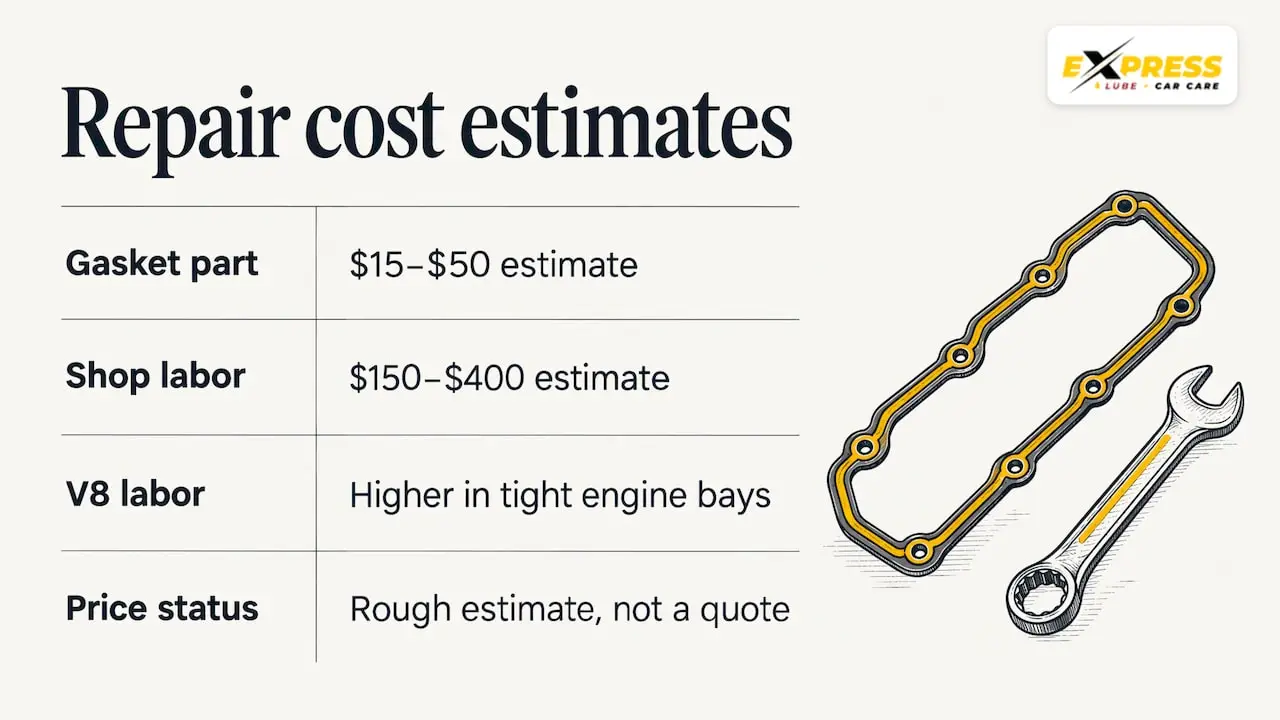
Waiting can add to the bill. The same source notes that driving on misfires from oil-fouled plugs can damage the catalytic converter (Wheels Greed). A modest gasket job costs far less than an exhaust repair that follows from ignoring one.
Why a professional inspection is worth it
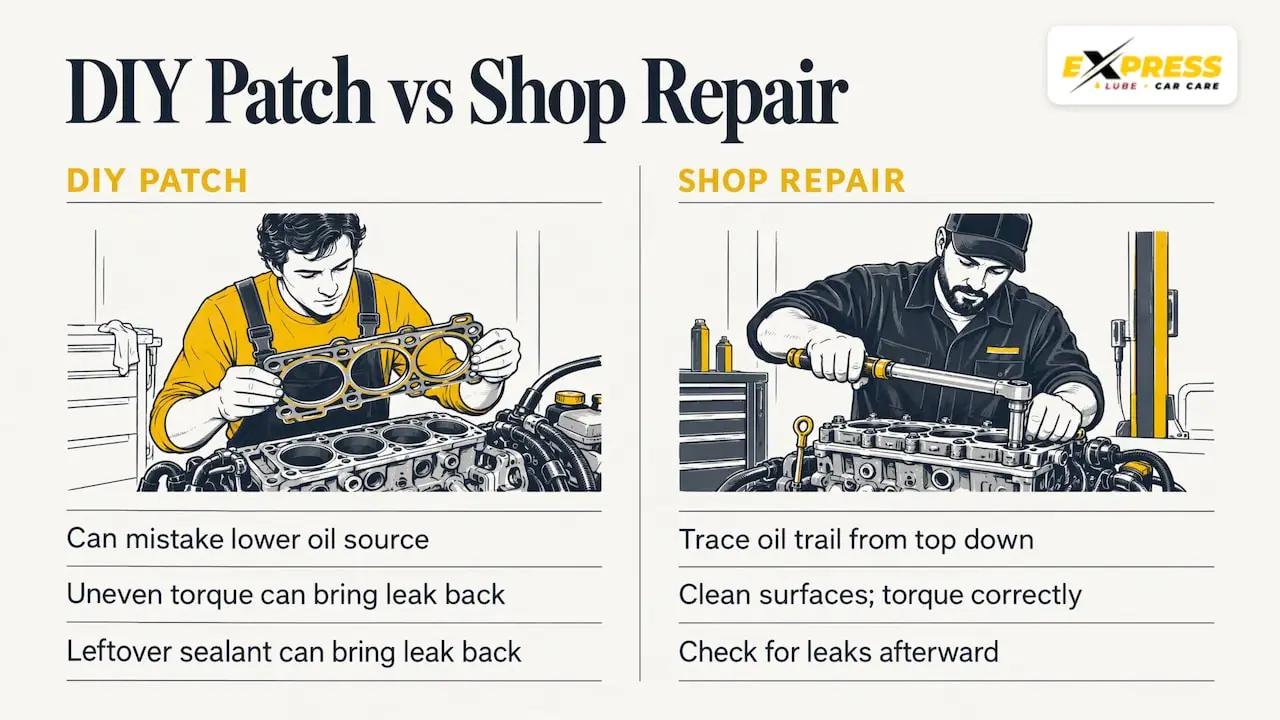
Two things tend to go wrong when the leak is treated as a quick DIY patch. The first is a misdiagnosis: the oil you see is really coming from a lower seal, a filter housing or the oil pan, and the new gasket changes nothing. The second is a poor reseal, where uneven bolt torque or leftover sealant brings the leak right back.
A shop with the right tools avoids both. It is a bit like a commercial kitchen compared with a home one: the same dish, but the equipment and process make the result repeatable. A lift to see the engine from above and below, a torque wrench, clean mating surfaces and a leak check afterward are what turn a gasket swap into a lasting repair.
Our perspective: find the real source first
At the shop, the most common mistake we see with oil leaks is chasing the wettest spot instead of the highest one. Oil from a valve cover will coat everything beneath it, and by the time it reaches the pan, it looks like a different problem.
That is why we start with inspection rather than assumptions. Our ASE-certified technicians trace the oil trail from the top down, and our digital vehicle inspections give you photos and technician notes, so you can see what we see before you decide on anything.
We also believe the repair should be done once. Clean surfaces, correct torque and a check for related issues, such as oil near the spark plugs, are part of a job done properly. Qualifying repairs are backed by our 24-month/24,000-mile limited warranty, whichever comes first. Eligibility, limitations and exclusions apply.
Express Lube & Car Care
Get a leak looked at in Plano
If you have noticed oil residue, a burning smell or a dropping dipstick reading, we can find where the oil is really coming from. Express Lube & Car Care offers same-day service for most jobs and does not require an appointment, so you can bring the car in when it suits you. Our engine repair services cover diagnostics and repairs, and we can pair the visit with an oil change if your oil is due.
Qualifying repairs carry our 24-month/24,000-mile limited warranty, whichever comes first, and eligibility, limitations and exclusions apply. You can read the details on our auto repair warranty page. To see everything we handle, browse our full list of services, or stop by and talk with a technician. If you also want to know when your next oil service is due, our guide on the signs your car needs an oil change is a good place to start. Maintenance intervals vary by vehicle, so always check your owner’s manual too.
FAQ
Can I drive with a valve cover gasket leak?
Often, yes, for a short time, if the leak is minor and your oil level stays steady. Check the dipstick every few days and top off as needed. If you see puddles, a steady drop in oil level, heavy smoke or misfires, stop driving and have the vehicle inspected right away.
How long can I wait before fixing a leaking valve cover gasket?
PartCatalog suggests that a stable, minor leak can often wait a few weeks while you schedule service, as long as you monitor the oil (PartCatalog). Every engine is different, so a technician’s inspection gives a better answer for your vehicle than any general timeline.
How do I know it is the valve cover and not the oil pan?
Oil travels downward, so start at the top of the engine and follow the trail. Cleaning the area and checking again after a short run helps separate a valve cover leak from an oil filter housing or oil pan leak. If the trail is unclear, we can inspect it on a lift.
Is a valve cover gasket leak expensive to fix?
The gasket is an inexpensive part, and most of the cost is labor, which varies with how much sits on top of the cover. One published estimate for most four-cylinder and V6 engines is about $150 to $400 in labor (Wheels Greed). We would need to inspect your vehicle to give you an accurate figure.
Can a leaking valve cover gasket cause a misfire?
Yes. If oil collects in the spark plug wells, it can foul plugs or coils and cause rough idle, misfires and a check engine light (TheCarBuzz). Have it checked promptly, since continued misfires can stress the exhaust system.
Sources
- J.D. Power: What Is A Valve Cover Gasket?
- CarParts.com: Valve Cover Gasket Leak Symptoms
- Car Talk: His Subaru Forester Is Burning the Midnight Oil
- PartCatalog: Engine Valve Cover Gasket Leak: Symptoms & Fixes
- TheCarBuzz: Symptoms of a Valve Cover Gasket Leak
- Mobil: How to replace a valve cover gasket
- Fel-Pro: Causes of Oil Leaks
- Wheels Greed: Valve Cover Gasket Explained