

A P0420 code means your vehicle’s computer has decided the catalytic converter on Bank 1 is not cleaning exhaust as efficiently as it should. The full wording is “catalyst system efficiency below threshold (Bank 1),” and Edmunds describes it as the onboard diagnostic system detecting catalyst efficiency under the required level on the side of the engine that holds cylinder No. 1. The converter is the most common culprit, but it is not the only one, and replacing it without testing is how drivers end up paying twice.
This guide explains what the code actually measures, what else can trigger it, whether you can keep driving, and how a careful shop confirms the cause before recommending parts.
TL;DR
- P0420 is a generic emissions code: the catalyst on Bank 1 is not performing at the level the computer expects.
- A failing catalytic converter is the most common cause, but exhaust leaks, misfires, a faulty oxygen sensor or fuel-control problems can set the same code.
- The car often drives normally, but you should not ignore it. Underlying problems such as misfires can damage the converter further, and the code can cause an emissions test failure.
- Diagnosis should come before parts. Ask for the stored data and the test results behind any converter recommendation.
- Repair cost depends heavily on the cause and the vehicle, so get a diagnosis first, then an estimate.
Table of Contents
- What the P0420 code means
- What causes a P0420 code
- Can you drive with a P0420 code?
- Symptoms that go with P0420
- How a P0420 code should be diagnosed
- Why clearing the code is not a fix
- What fixing P0420 can involve
- P0420 and emissions testing
- Our perspective at Express Lube & Car Care
- Get a P0420 code checked in Plano
- FAQ
- Sources
What the P0420 code means
Your engine has oxygen sensors in the exhaust. One sits before the catalytic converter (upstream) and one sits after it (downstream). A healthy converter stores and releases oxygen as it converts harmful gases, so the downstream sensor reads a steadier signal than the upstream one.
Ford’s OBD-II documentation explains the logic: the catalyst monitor compares the switching of the front and rear oxygen sensors. As the converter loses its oxygen-storage ability, the rear sensor starts to switch more like the front one. When the computer sees that similarity, it sets P0420.
Two details in the code name matter:
- Catalyst efficiency below threshold. The computer is not measuring the converter directly. It is inferring performance from sensor behavior. That is why a sensor, a leak or a fuel problem can fool it.
- Bank 1. This is the side of the engine with cylinder No. 1. Ford’s documentation notes that P0430 is the matching code for Bank 2. Four-cylinder engines and many inline engines have only one bank, so you will only see P0420. V6 and V8 engines have two.
P0420 is a generic code, so the definition is the same across makes. What differs is how each manufacturer runs the test and what typically causes the failure on that model.
What causes a P0420 code
KBB lists a faulty catalytic converter as the most common cause. It also lists other possibilities: exhaust manifold or pipe damage or leaks, engine misfires, oil-contaminated catalysts, coolant temperature sensor problems, oxygen sensor or wiring faults, leaking fuel injectors, high fuel pressure and incorrect fuel.
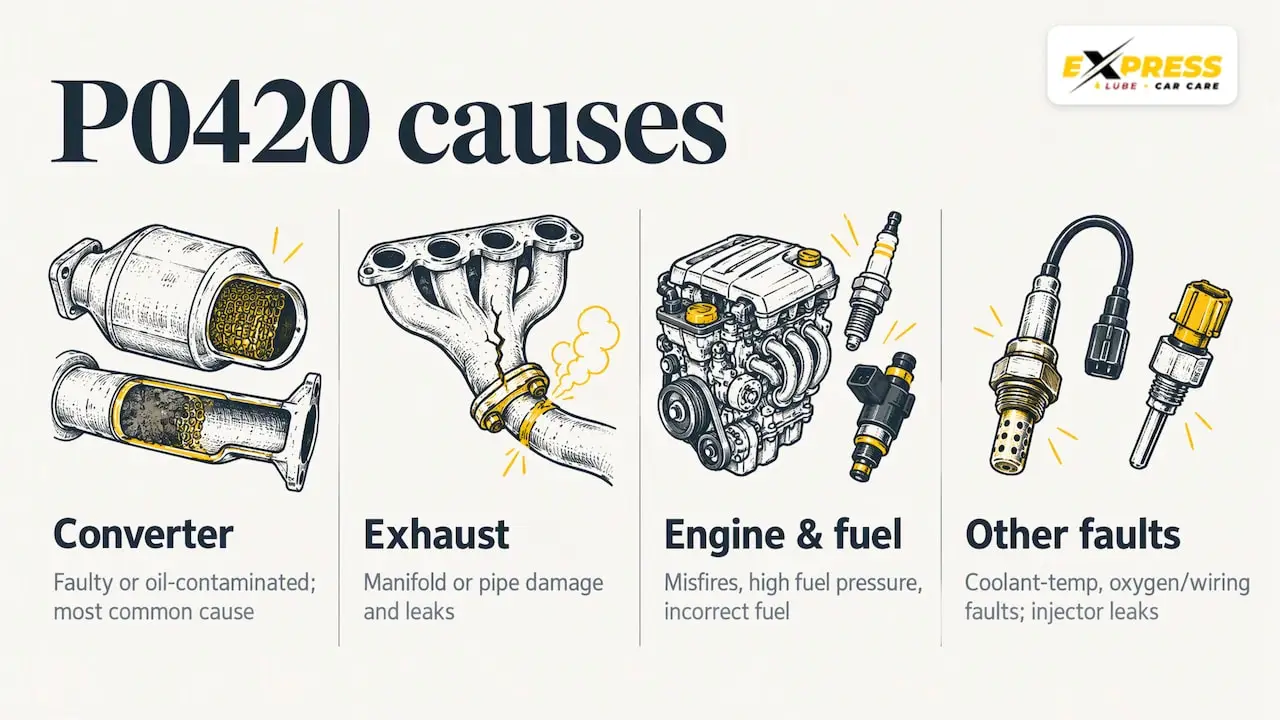
That list is useful because it shows the pattern. The converter is often the victim, not the original problem. Vehicle Service Pros points to several ways a converter fails: structural damage, exhaust leaks, thermal shock, oil or antifreeze contamination, additives or improper sealants, and overheating caused by misfires or incorrect fuel control.
Causes that live in the converter itself
- Age and wear. The precious-metal coating that does the work degrades over years and miles.
- Contamination. Burning oil or leaking coolant can coat the catalyst and reduce its ability to react.
- Overheating. Unburned fuel from a misfire reaches the converter and burns there, which can melt or damage the internal substrate.
- Physical damage. Road impact or a cracked substrate can cause rattling and loss of function.
Causes outside the converter
- Exhaust leaks. A leak ahead of the converter, or between the upstream and downstream sensors, can let in outside air. Vehicle Service Pros explains that a leak between the sensors can introduce false oxygen readings and trigger P0420.
- Oxygen sensor problems. A slow or biased downstream sensor can make a good converter look bad. Our guide to bad O2 sensor symptoms covers what to watch for.
- Misfires. Worn plugs or ignition parts push unburned fuel into the exhaust. See the signs of bad spark plugs if the engine runs rough.
- Fuel-control faults. A rich or lean condition changes what the converter has to handle and what the sensors report.
- Engine temperature sensor issues. If the computer misreads engine temperature, fuel control and monitor timing can be off.
Can you drive with a P0420 code?
Usually yes, for a short time. P0420 on its own is an emissions-system fault, not a sign the engine is about to fail. Edmunds notes that it commonly brings on the check-engine light and may appear with no obvious drivability symptoms, although reduced performance, lower fuel economy, an unusual exhaust odor or a failed emissions test can also occur.
There are exceptions where you should stop and have the car looked at promptly:
- The check-engine light is flashing. A flashing light generally signals an active misfire. Unburned fuel can overheat and damage the converter quickly.
- The engine is running rough, stalling or losing power.
- You smell rotten eggs or burning. A sulfur-like smell can accompany a failing converter, and a burning smell from under the car should be inspected right away.
- The engine is overheating. Cooling problems need immediate attention. Our guide on what to do when the overheating warning appears walks through it.
If none of those apply, plan the diagnosis within days or weeks, not months. Waiting is how a simple exhaust leak or a bad sensor turns into a damaged converter, which is the most expensive part of this system. If you are unsure whether the car is safe to drive, have a professional look at it before you take a long trip.
Symptoms that go with P0420
Some drivers notice nothing but the dashboard light. Others report:
- Slightly lower fuel economy
- A sulfur or rotten-egg odor from the exhaust
- Sluggish acceleration, especially going uphill or when carrying a load
- A rattling sound from under the car, which can point to broken internal converter material
- A failed emissions test
If you also see a warm, sweet smell or the temperature gauge climbing, the cause may be coolant entering the exhaust or an unrelated cooling issue, and that needs to be addressed first. Our overview of catalytic converter symptoms gives a fuller list.
How a P0420 code should be diagnosed
The code tells you where the computer saw a problem, not which part is broken. A good diagnosis works from the cheapest and most likely causes toward the converter, and it confirms with data. Vehicle Service Pros recommends starting with repair history and the customer’s symptoms, then scanning all codes, saving freeze-frame and Mode $06 data, checking the computer’s software calibration, road-testing, and consulting the vehicle’s service information.
Here is how that plays out in practice.
- Read every code, not just P0420. Misfire codes, fuel-trim codes or sensor codes found alongside P0420 usually point to the real cause. Fix those first.
- Look at freeze-frame data. It records engine conditions when the code set, which helps you reproduce the problem.
- Inspect the exhaust for leaks. Check the manifold, flex pipe, gaskets and flanges. Leaks near the sensors can change readings enough to set the code.
- Review fuel trims and misfire counts. If the engine is running rich or lean, the converter result is unreliable until that is corrected.
- Check the oxygen sensor signals. Compare the upstream and downstream waveforms on a scan tool. A healthy converter shows a calm downstream signal.
- Check for oil burning or coolant loss. Contamination can destroy a converter again soon after replacement if the source remains.
- Test the converter. One method is temperature comparison. ANSED states that on a warmed vehicle, a working converter should show at least a 150°F (65°C) higher temperature at the rear weld ring than at the front after fast idle. The same source says converter testing is only meaningful once exhaust leaks and fuel-control faults have been ruled out.
The code only sets when the monitor runs, and Ford notes that the monitor needs enable conditions such as a warmed engine, closed-loop fuel control, suitable engine load and intake temperature, and certain vehicle-speed conditions. That is why a code can clear itself and return days later, and why a shop may need a proper road test to verify a repair.
A structured approach matters more than any single tool. For a look at how a documented, step-by-step diagnostic process runs from complaint to verification, this step-by-step diagnostic process is a good outline of the logic.
Why clearing the code is not a fix
A cheap code reader will let you reset the light. The light will usually come back once the monitor runs again, and clearing the code also resets the vehicle’s readiness monitors. If you have an emissions test coming, a car that has just been cleared can be turned away as not ready, because the monitors need time and drive cycles to complete.
The same applies to fuel additives and “converter cleaners.” They are sold as quick fixes, but they do not address leaks, misfires, oil consumption or a worn-out catalyst, and some additives can themselves harm a converter. Diagnose first.
What fixing P0420 can involve
The repair follows the cause. In rough order from simplest to most involved:
| Cause found | Typical repair |
|---|---|
| Exhaust leak near the sensors | Replace a gasket, flex pipe or damaged section |
| Faulty downstream oxygen sensor | Replace the sensor and verify with live data |
| Misfire from worn ignition parts | Spark plugs, coils or related ignition repair |
| Rich or lean fuel condition | Repair the fuel-control fault, such as injectors or sensors |
| Oil or coolant contamination | Fix the engine leak or consumption, then address the converter |
| Failed catalytic converter | Replace the converter, after the root cause is corrected |
If your plugs are due, our list of signs your car needs a tune-up can help you judge. A clogged fuel filter can also affect fuel delivery, covered in signs of a clogged fuel filter.
What does it cost?
There is no single number. Estimates you find online range from under a couple of hundred dollars for a sensor or small exhaust repair to well over a thousand for a converter, and the spread comes from vehicle make, converter type (direct-fit versus universal versus original equipment), labor rates and what else is wrong. Treat any quote you get from a website as a rough guide only. A shop should give you an estimate after diagnosis, with the cause identified and the parts and labor itemized. Ask what test confirmed the converter before you approve replacement.
P0420 and emissions testing
A P0420 code means the emissions control system is flagged as not working properly, and an active code can cause an emissions inspection to fail. New Jersey’s motor vehicle agency, for example, explains that its OBD inspection reviews emissions-control information and describes P0420 as a catalytic converter failing to reduce emissions. Rules differ by state.
In Texas, emissions testing applies in designated counties, and the requirements depend on the vehicle’s age and type. Do not assume an ordinary noncommercial passenger car needs an annual safety inspection. Check the state’s official vehicle inspection information for your county and vehicle, and if your car shows P0420, get it diagnosed before your registration renewal and test are due so you have time to repair and complete the drive cycles.
Our perspective at Express Lube & Car Care
We see P0420 often enough to know the most common mistake: a code gets read, a converter gets quoted, and nobody checks why the converter failed or even whether it did. A converter is one of the more expensive single parts on a car, and a new one will not last if an oil-burning engine, a misfire or an exhaust leak is still there.
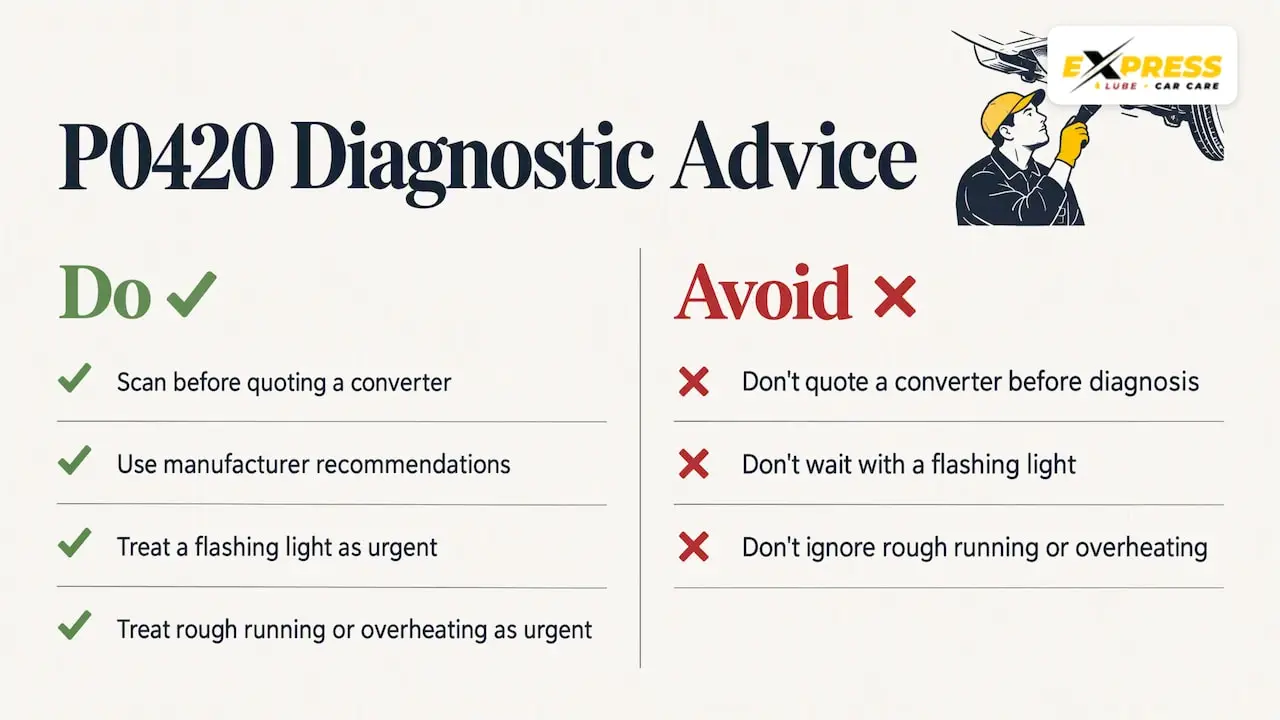
So our approach is to treat the code as the starting point. We scan the system, look at the data, inspect the exhaust and the ignition and fuel side, and find out what changed. Our digital vehicle inspections include photos and technician notes, so you can see what we saw, not just a total at the bottom. If the cause turns out to be a sensor or a leak, you pay for that repair, not a converter you did not need. If the converter really is finished, we will tell you why we think so and what else needs attention so the new part has a fair chance.
We also encourage drivers not to wait. A steady check-engine light with a P0420 code is usually not an emergency, but a flashing light, rough running or any overheating is. Maintenance intervals and repair needs vary by vehicle, so we work from the manufacturer’s recommendations and the condition of your car, not a generic list.
— Express Lube & Car Care
Get a P0420 code checked in Plano
If your check-engine light is on, our technicians can scan the codes and work through the causes in the order above. We offer check engine light and diagnostics along with exhaust, ignition, fuel system and engine repair, and we take walk-ins without an appointment. Many repairs qualify for our 24-month/24,000-mile limited warranty, whichever comes first, and qualifying suspension repairs are covered by our Lifetime Suspension Warranty. Eligibility, limitations and exclusions apply, so ask us what applies to your repair. Not sure where to start? Visit Express Lube & Car Care and tell us what the light is doing.
For related background, read what causes a check engine light.
FAQ
What does P0420 bank 1 mean?
It means the catalyst system efficiency on Bank 1 is below the level the computer expects. Bank 1 is the side of the engine containing cylinder No. 1. Engines with only one bank always use Bank 1, and V-type engines may also show P0430 for Bank 2.
What is the most common cause of a P0420 code?
A worn-out or damaged catalytic converter is the most common cause. But exhaust leaks, misfires, faulty oxygen sensors and fuel-control problems can set the same code, so those should be ruled out before you replace the converter.
Can I drive with a P0420 code?
Usually you can for a short period, since the car often runs normally. Get it diagnosed soon, though, because the underlying cause can get worse. If the check-engine light flashes, the engine runs rough or it overheats, stop driving and have it inspected right away.
Will a P0420 code fail an emissions test?
It can. An active emissions-system code generally prevents a pass where OBD testing is required. If your county requires an emissions test, have the cause repaired and the monitors completed before your test.
Can a bad oxygen sensor cause P0420?
Yes. A slow or inaccurate downstream oxygen sensor can make a healthy converter look inefficient. That is why sensor data and exhaust leak checks come before any converter replacement.
Sources
- Edmunds: P0420 Catalyst System Efficiency Below Threshold (Bank 1)
- Ford On Board Diagnostics II documentation
- KBB: P0420 Catalyst System Low Efficiency
- Vehicle Service Pros: Who killed the cat? Examining the root cause of P0420 and P0430 failures
- ANSED: Catalytic Converter and Exhaust System Codes P0420 to P0439
- New Jersey MVC: Owner education brochure on OBD inspections