

The question of "how long should brake pads last" is one of the most common inquiries vehicle owners have. The honest, expert answer is that it varies significantly. While a general guideline is between 30,000 and 70,000 miles, this wide range indicates that multiple factors are at play.
Consider this range a foundational estimate, not a strict rule for replacement.
Setting the Baseline for Brake Pad Lifespan
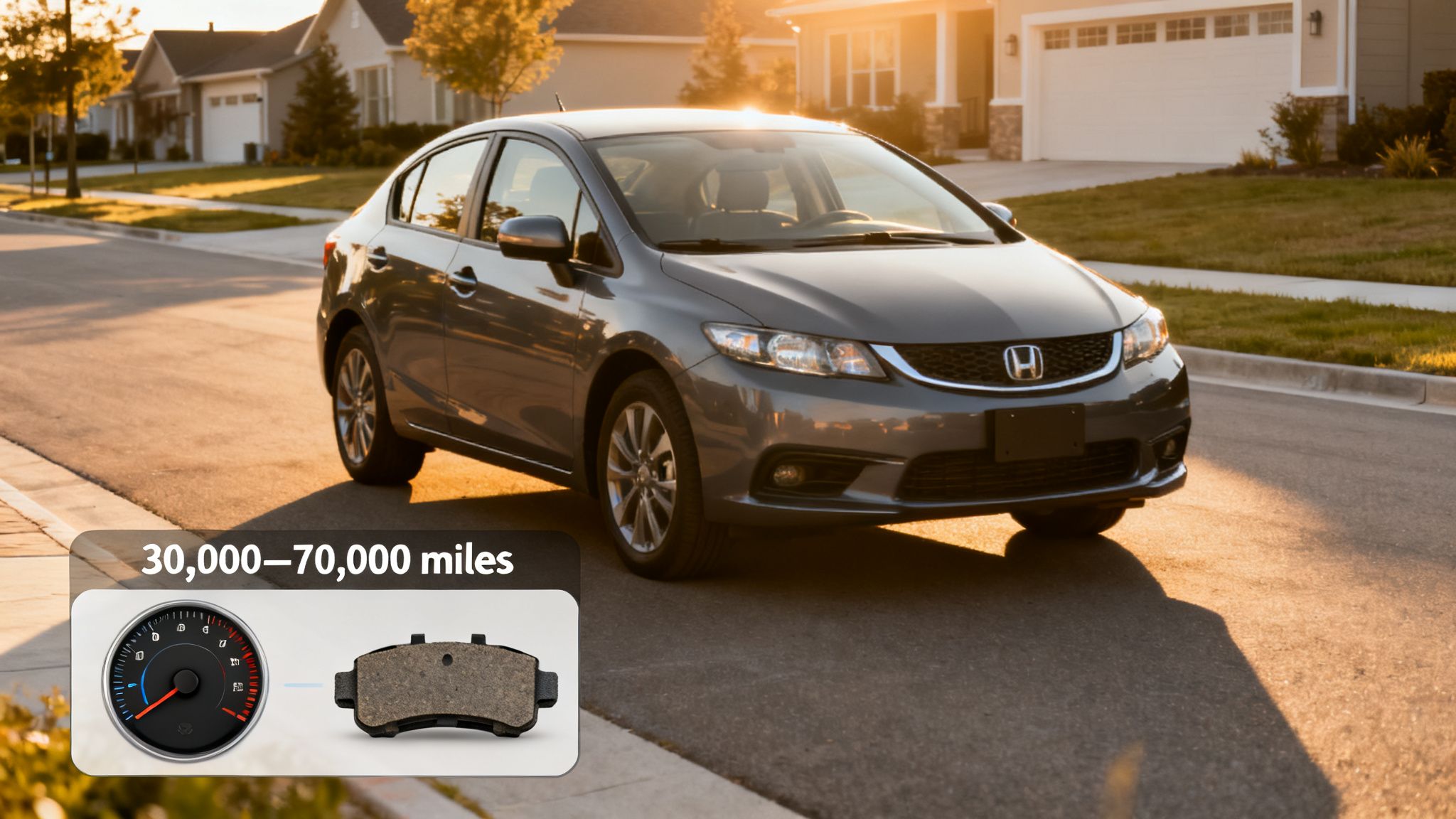
Before we delve into the variables that can shorten or extend the life of your brake pads, it's useful to establish a baseline. For the average driver, a replacement interval around the 50,000-mile mark is a common occurrence.
However, the type of vehicle you operate immediately influences this average. It's a matter of physics: a heavier vehicle possesses more kinetic energy and requires significantly more force to decelerate. This increased workload accelerates the wear on brake pad friction material.
Average Brake Pad Lifespan by Vehicle Type
A compact car does not subject its braking system to the same stresses as a full-size pickup truck towing a trailer. This disparity is directly reflected in the durability of the brake pads.
Whether you are commuting on the Dallas North Tollway or navigating local Plano streets, your vehicle's class is a primary determinant of brake wear. To provide clarity, we have compiled the following reference table.
Average Brake Pad Lifespan by Vehicle Type
This table offers an estimated mileage range for brake pads based on common vehicle classifications.
| Vehicle Type | Average Lifespan (Miles) |
|---|---|
| Compact Car | 60,000 – 70,000 |
| Sedan | 50,000 – 65,000 |
| SUV | 40,000 – 55,000 |
| Pickup Truck | 35,000 – 50,000 |
As illustrated, there is an inverse correlation between vehicle weight and brake pad lifespan. For a deeper analysis of this relationship, you can discover more insights on how vehicle weight impacts brake wear from our colleagues at Kwik Kar Spring Valley.
Why This Average Matters
Understanding these baseline figures empowers you to be proactive about vehicle maintenance. If you own an SUV and your odometer is approaching 40,000 miles, it is prudent to become more attentive to your vehicle's braking performance. This doesn't necessitate an immediate replacement, but it serves as a timely reminder to schedule a professional inspection.
Remember, these figures are just averages. The real lifespan of your brake pads depends heavily on your unique driving habits, the types of roads you travel on, and the material of the pads themselves.
Ultimately, these numbers are a helpful guidepost. They provide a foundational answer to "how long should brake pads last," but the complete picture is formed by the unique conditions of your vehicle's daily operation. We will explore those factors next.
What Determines How Long Your Brakes Last?
Mileage provides only a partial understanding of brake pad longevity. While average lifespan is a useful starting point, the definitive answer to "how long should my brake pads last?" lies in the specifics of how and where you drive.
To illustrate, consider an analogy: brake pads are like the soles of running shoes. An individual who jogs on a smooth, flat track will experience far less wear on their shoes than a sprinter who trains daily on abrasive asphalt. The same principle applies to your vehicle's brakes.
Your Personal Driving Profile
Your daily driving habits are the single most significant factor influencing brake pad wear. Are you an aggressive or a conservative driver?
- Aggressive Braking: Applying the brakes forcefully at the last moment generates immense heat and friction. This is the most rapid way to degrade brake pads and can lead to rotor damage over time.
- Tailgating: Following the vehicle ahead too closely necessitates constant, reactive braking, which is often more forceful than necessary.
- Gentle and Gradual Braking: This is the most efficient method. By anticipating stops and allowing the vehicle to coast, you can apply gentle, steady pressure. This technique minimizes heat generation and significantly extends the service life of your brake pads.
The core concept is straightforward: the more friction you generate, the faster your brake pads will wear. Smooth, predictive driving is not only a safer practice but also more economical from a maintenance perspective.
The Impact of Your Driving Environment
The environment in which you operate your vehicle is nearly as crucial as your driving style. Your daily commute presents a unique set of demands on your braking system.
A motorist who primarily travels on open highways will use their brakes far less frequently than someone navigating dense urban traffic. This environmental difference is a key reason for the wide variance in mileage estimates.
- City Commuting: Stop-and-go traffic is the ultimate test of brake pad endurance. Driving through downtown Plano or congested shopping areas means the brakes are in constant use, leading to accelerated wear.
- Highway Driving: Cruising at a consistent speed on highways like the President George Bush Turnpike requires minimal brake application. Vehicles used predominantly for highway travel often see brake pad life extend well beyond the average.
- Hilly or Mountainous Terrain: Descending steep grades requires prolonged brake application to control vehicle speed. This sustained friction generates substantial heat, which can wear out pads prematurely.
Vehicle Load and Towing
Finally, the total weight of your vehicle plays a critical role. Every additional pound of mass requires more braking force to bring the vehicle to a halt.
A vehicle loaded with passengers, heavy cargo, or towing a trailer places a much higher demand on its braking system. This is why pickup trucks and large SUVs often require brake service sooner, even with conservative driving habits. The sheer mass they must decelerate puts continuous, heavy strain on all braking components.
The global impact is massive. Over a typical vehicle lifespan of about 150,000 miles, cars may require around 56 brake pads and 10 discs, consuming significant resources. You can read the full research about these lifecycle findings to understand the scale.
By considering your driving style, environment, and vehicle load, you can move beyond generic estimates and get a much clearer picture of how long your specific brake pads should last.
Choosing Your Best Brake Pad Material
Similar to selecting appropriate tires for Texas weather conditions, choosing the correct brake pad material is a critical decision. It directly influences not only the lifespan of the pads but also the vehicle's braking characteristics. The material composition is a core component that defines your braking system's performance.
For most drivers in the Plano area, the choice typically narrows to two primary types: ceramic and semi-metallic. Each possesses distinct advantages and disadvantages, making one more suitable for a quiet family sedan and the other the superior choice for a heavy-duty truck. Let's analyze the differences to inform your decision.
H3 Ceramic Brake Pads: The Quiet Performer
Ceramic brake pads are engineered for a smooth, quiet, and low-maintenance driving experience. They generate minimal noise and produce significantly less brake dust compared to other types. For the vehicle owner, this translates to cleaner wheels and consistently quiet, smooth braking performance.
Their primary advantage is longevity. Ceramic pads are renowned for their durability, often exceeding 60,000 miles of service life—more than 50% longer than many semi-metallic counterparts. Recent data indicates that ceramics have a 23% advantage in stop-and-go traffic, a common scenario in suburban Texas. They offer superior heat resistance and can reduce wear by up to 30%, making them an excellent long-term value for daily commuters. You can discover more insights about 2025 brake pad data to see the full comparison.
H3 Semi-Metallic Brake Pads: The Heavy-Duty Workhorse
In contrast to the refined performance of ceramic pads, semi-metallic pads are the robust workhorses of the braking world. Composed of a mixture of metal fibers such as steel, copper, and iron, they are designed for superior stopping power, especially under high-stress conditions.
Their main benefit lies in thermal conductivity. The metal content efficiently dissipates heat, which helps prevent "brake fade"—a reduction in stopping power caused by overheating. This makes them the standard choice for trucks, SUVs, and performance vehicles that require maximum, reliable braking force. However, this performance comes with trade-offs: they tend to be noisier and produce a greater amount of dark-colored brake dust.
This decision tree helps visualize how things like your driving style, the roads you're on, and your vehicle's weight all play a part in brake pad life.
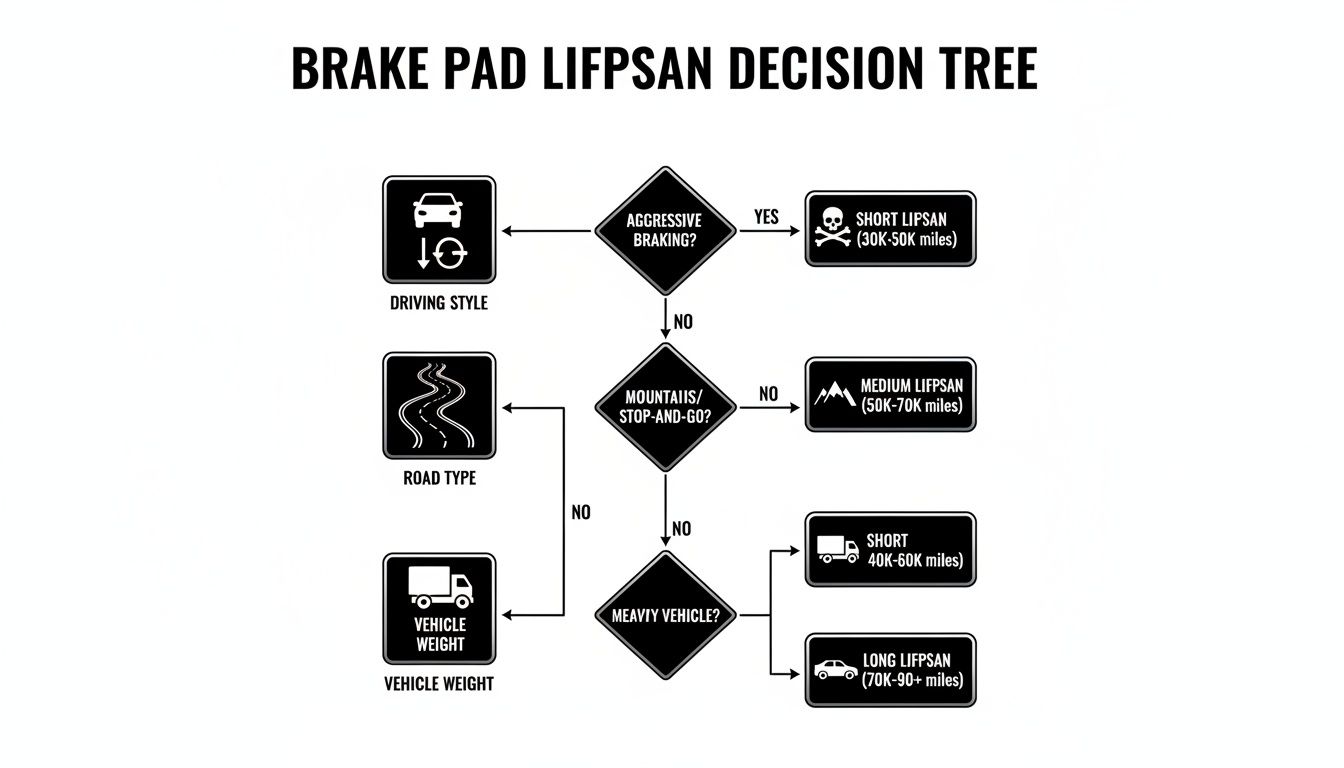
It’s a great reminder that aggressive driving and heavy loads will chew through your brake pads faster, no matter which material you choose.
H3 Making the Right Choice for Your Vehicle
The ideal choice depends on your specific priorities and vehicle application. There is no single "best" option—only the material that is best suited for your vehicle and your driving patterns. To simplify the decision, here is a direct comparison of the two most prevalent brake pad types.
H3 Ceramic vs Semi-Metallic Brake Pad Comparison
| Feature | Ceramic Brake Pads | Semi-Metallic Brake Pads |
|---|---|---|
| Lifespan | Excellent (Longest lasting) | Good (Durable but shorter than ceramic) |
| Stopping Power | Good (Consistent and reliable for daily driving) | Excellent (Superior performance under heavy loads) |
| Noise Level | Very Quiet (Minimal noise during braking) | Moderate to Loud (Can be noisy, especially when cold) |
| Brake Dust | Very Low (Keeps wheels much cleaner) | High (Produces noticeable dark dust) |
| Cost | Higher (More expensive upfront) | Lower (More budget-friendly initially) |
Ultimately, the decision is clear. If your priorities are a quiet ride, clean wheels, and maximum longevity for daily commuting, ceramic pads are the logical choice. However, if your application demands maximum stopping power for towing, hauling, or high-performance driving, the superior thermal characteristics of semi-metallic pads make them the safer, more effective option.
By matching the right brake pad to your vehicle, you ensure you're getting optimal safety and the most value out of every mile.
Warning Signs Your Brake Pads Need Replacing
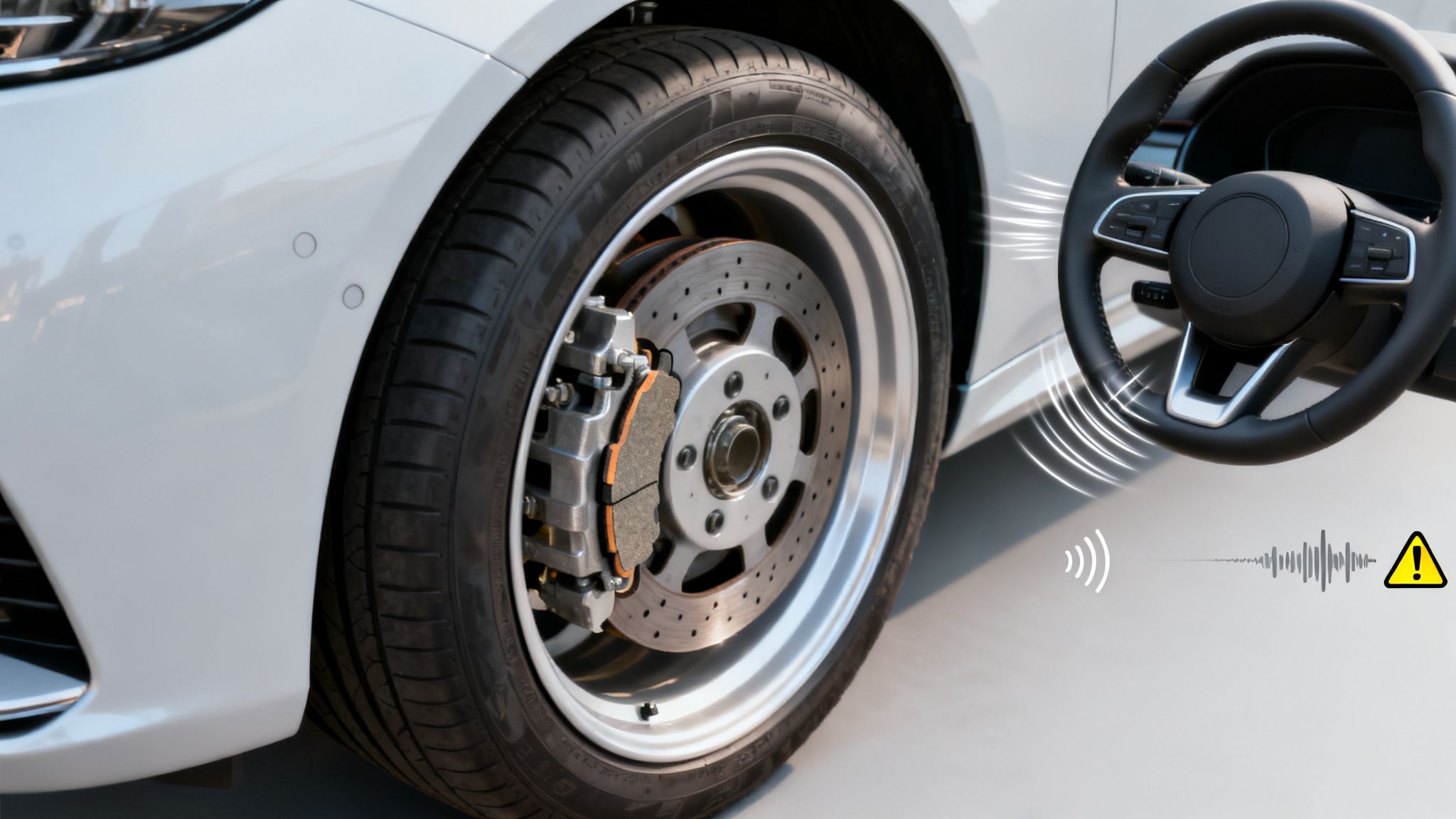
While mileage estimates provide a useful framework, your vehicle is equipped with its own systems for indicating when brake service is required. It communicates through distinct auditory, tactile, and visual cues that serve as an early warning system.
Recognizing these signs is critical not only for safety but also for preventing minor wear from escalating into major, costly repairs. You can think of it as your vehicle communicating its needs—you simply need to understand the language.
The High-Pitched Squeal: A Gentle Nudge
One of the earliest and most common indicators of wear is a high-frequency squeal or screeching sound during brake application. This is not a sign of catastrophic failure; it is an intentional, engineered safety feature.
Most brake pads are manufactured with a small metal tab known as a wear indicator. As the friction material of the brake pad wears down, this tab makes contact with the brake rotor, creating the distinct, high-pitched noise. Its purpose is to alert you to the need for an inspection well before the braking system's performance is compromised.
This squeal is your car’s polite way of saying, “Hey, it's time to schedule a brake inspection soon.” If you ignore it, you’re just asking for bigger headaches down the road.
The Vibration or Pulsing Sensation: A Sign of Uneven Wear
If you feel a shuddering or pulsing sensation through the steering wheel or brake pedal during deceleration, this is often a symptom of an issue with the brake rotors, not just the pads.
This phenomenon is typically caused by "warped" rotors, a condition resulting from excessive heat generated during heavy or prolonged braking. This intense heat can cause the rotor's surface to become uneven. When the brake pads clamp down on this inconsistent surface, it creates the shuddering feeling. Even if the pads have remaining life, this is a clear indication that your braking system requires immediate professional attention to restore smooth, safe operation.
The Deep Grinding Noise: An Urgent Alert
If the initial squeal is ignored for an extended period, it will progress to a much more severe sound: a harsh, metallic grinding or growling noise. This is a critical warning that signifies an urgent safety issue.
A grinding noise indicates that the friction material on the brake pads has been completely worn away. The sound you are hearing is metal-on-metal contact: the brake pad's steel backing plate is grinding directly against the brake rotor.
This situation is hazardous for two primary reasons:
- Severely Reduced Stopping Power: Without the friction material, your vehicle's ability to decelerate is drastically reduced.
- Expensive Rotor Damage: The metal-on-metal contact will quickly score and destroy your rotors, transforming a routine brake pad replacement into a much more complex and expensive repair.
If you hear grinding, cease driving the vehicle and arrange for immediate brake service. This is not a recommendation; it is a critical safety directive.
Other Key Indicators to Watch For
Beyond these primary auditory and tactile warnings, several other clues can indicate that your brakes are nearing the end of their service life. For a more detailed look, check out our guide on the signs you need new brakes.
Be observant for these additional signs:
- Longer Stopping Distances: If you perceive that your vehicle requires more distance to come to a complete stop, your pads are likely worn and have reduced effectiveness.
- Brake Warning Light: Most modern vehicles are equipped with a dashboard warning light for the braking system. If this light illuminates, do not ignore it.
- Visible Thinness: A quick visual inspection can sometimes be informative. Look through the wheel spokes at the brake pad pressed against the rotor. If the friction material appears to be less than a quarter-inch (about 6mm) thick, it is time to schedule a professional inspection.
How to Make Your Brakes Last Longer
While brake pads are consumable components designed for eventual replacement, your driving techniques can have a profound impact on their rate of wear. By implementing a few simple adjustments to your driving style, you can extend their lifespan by thousands of miles, saving money and enhancing safety.
Think of brake pad material like tire tread. Every aggressive, sudden stop abrades the material more rapidly. Conversely, smooth and gentle driving habits preserve it for a much longer duration.
Adopt Defensive Driving Habits
The single most effective strategy for preserving your brakes is to practice defensive driving. This involves scanning the road far ahead, anticipating the actions of other drivers, and maintaining a safe following distance.
When you allow ample space between your vehicle and the one ahead, you create more time to decelerate gradually rather than braking abruptly. This simple habit dramatically reduces the friction and heat that cause pad wear. You will find yourself responding smoothly to the overall flow of traffic instead of simply reacting to the vehicle immediately in front of you.
Coasting Is Your Brakes' Best Friend
One of the most effective and underutilized techniques for brake preservation is coasting. Instead of maintaining acceleration until the last possible moment before a stop, lift your foot from the accelerator and allow the vehicle's momentum to decrease naturally.
This practice, often referred to as engine braking, utilizes the engine's natural compression to slow the vehicle without engaging the brake pedal. It is a subtle change that yields significant long-term benefits, particularly in the stop-and-go traffic conditions common in Plano.
Every second you spend coasting is a second you aren’t actively wearing down your brake pads. By anticipating stops and letting your car’s momentum do the work, you give your entire braking system a much-needed break.
Lighten Your Vehicle's Load
A vehicle's mass has a direct correlation with the amount of work its brakes must perform. Every extra pound of cargo requires additional braking force to bring the vehicle to a stop.
Periodically, take time to remove unnecessary heavy items from your trunk or cargo area. Eliminating old sports equipment, heavy toolboxes, or other non-essential items can make a tangible difference. While it may seem minor, reducing the vehicle's overall weight lessens the strain on the brake pads over thousands of miles.
Proactive Maintenance for Long-Term Health
Finally, proper driving habits are only one part of the equation. Regular, professional maintenance ensures that the entire braking system functions optimally, which promotes even wear and maximizes the life of the pads. A crucial element of this is maintaining the integrity of your brake fluid. You can learn more about how often you should get a brake fluid flush in our detailed guide.
Routine inspections by a qualified technician can identify minor issues, such as sticking calipers or worn hardware, before they lead to premature or uneven pad wear. A properly lubricated and adjusted system operates more efficiently. Combining intelligent driving with regular maintenance is the definitive strategy for maximizing the service life of your brake pads.
Your Guide to Local Brake Service in Plano
Understanding how long brake pads should last is valuable knowledge, but the subsequent step—selecting a competent service center—is equally critical. Your vehicle's braking system is arguably its most important safety feature, making expert service non-negotiable.
When evaluating auto repair facilities in Plano, several key attributes distinguish a superior shop. The goal is not merely to have the work completed, but to have absolute confidence in the safety and reliability of your vehicle.
What to Look for in a Quality Brake Shop
A reputable auto shop will always prioritize your safety, utilizing high-quality components and extensive technical expertise to ensure the job is performed correctly the first time. Here are the criteria you should look for:
- ASE-Certified Technicians: This certification is the industry's gold standard for automotive service excellence. It signifies that the mechanics have passed rigorous testing and are committed to maintaining a high level of technical proficiency.
- Use of Premium Parts: The quality of the brake pads and rotors significantly impacts performance and longevity. A top-tier shop will use parts that meet or exceed original equipment manufacturer (OEM) specifications.
- A Customer-Focused Approach: You should feel informed, not pressured. A good service advisor will explain the necessary repairs in clear, understandable terms, answer your questions thoroughly, and provide honest recommendations without resorting to technical jargon.
When it comes to your braking system, your safety depends entirely on the skill of your mechanic and the quality of the parts they use. Settling for less is never an option.
The Express Lube Plano Advantage
For drivers in our community, we understand that expert care must be paired with practical convenience. Your schedule is busy, and we have structured our service model to accommodate that reality. At Express Lube & Car Care, we offer no-appointment services, allowing you to visit at a time that works best for you.
We also believe that high-quality maintenance should be accessible. That is why we provide valuable discounts and coupons to make essential services more affordable. This approach transforms a necessary task into a simple, efficient process.
To understand the full scope of a professional brake job, please review our detailed guide on what a complete brake service includes.
Your Top Brake Pad Questions, Answered
Brake system maintenance can seem complex, so we aim to provide clarity. Here are answers to the most frequent questions we receive from drivers in Plano, designed to help you understand what to expect and ensure your vehicle remains safe.
How Often Should I Have My Brakes Checked?
As a general rule, it is advisable to have your brakes professionally inspected at least once a year or approximately every 12,000 miles. This routine check allows a technician to identify and address wear and tear long before it escalates into a more significant and costly problem.
However, if your driving consists primarily of stop-and-go traffic or if you regularly tow a trailer, a more frequent inspection schedule is prudent. For vehicles under heavy use, an inspection every six months (often coinciding with an oil change) is a smart investment in your safety.
Do Front and Back Brakes Wear Out at the Same Speed?
No, they do not wear at the same rate. During braking, the vehicle's forward momentum causes a weight transfer to the front axle. As a result, the front brakes are responsible for the majority of the braking force—up to 70% of the total stopping work.
Consequently, it is entirely normal for front brake pads to require replacement twice as often as the rear brake pads. This differential wear is an expected outcome of modern braking system design.
What Happens if I Wait Too Long to Replace My Pads?
Postponing brake replacement is both dangerous and financially unwise. Once the friction material is completely worn away, the pad's metal backing plate will make direct contact with the metal brake rotor. This results in a loud grinding noise and a severe reduction in braking effectiveness.
Beyond the immediate safety risk, this metal-on-metal contact will rapidly damage the rotors, often beyond repair. A routine brake pad replacement can quickly become a more extensive and expensive service that includes new rotors and additional labor costs.
Can I Just Replace the Pads on One Wheel?
Absolutely not. Brake pads must always be replaced in pairs on the same axle—either both front wheels or both rear wheels simultaneously. It is unsafe and improper to replace the pads on only one side.
Replacing only one side creates a dangerous braking imbalance. The wheel with the new, more effective pad would grip more aggressively, causing the vehicle to pull sharply to that side during braking and potentially leading to a loss of control. For safe, stable, and predictable braking, service is always performed as a complete axle set.
When you need professional, honest advice on your brakes, the ASE-certified team at Express Lube & Car Care is here to help. Drive over for a no-appointment inspection and let us keep you safe on the road. Learn more about our complete auto care services here.