
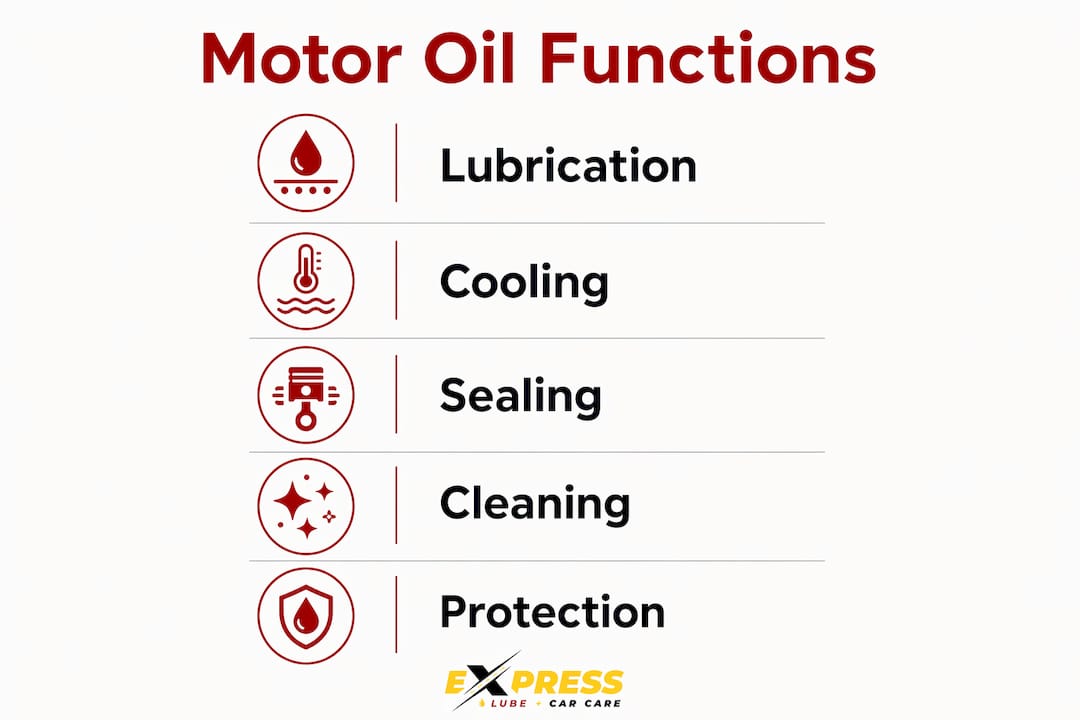
Motor oil is defined as the primary lubricant responsible for reducing friction, controlling heat, and protecting every moving part inside your engine. The role of motor oil in engine lubrication goes far beyond a simple fluid swap. It simultaneously lubricates, cools, cleans, seals, and prevents corrosion, all at once, every time your engine runs. API (American Petroleum Institute) specifications set the quality benchmarks that every bottle of motor oil must meet before it reaches your vehicle. At Express Lube & Car Care, certified technicians apply those standards on every oil change, ensuring your engine gets the protection it was engineered to receive.
What functions does motor oil perform in engine lubrication?
Motor oil performs five simultaneous functions that keep your engine alive: lubrication, cooling, sealing, cleaning, and corrosion prevention. Each one is critical. Fail any single function and engine damage follows.
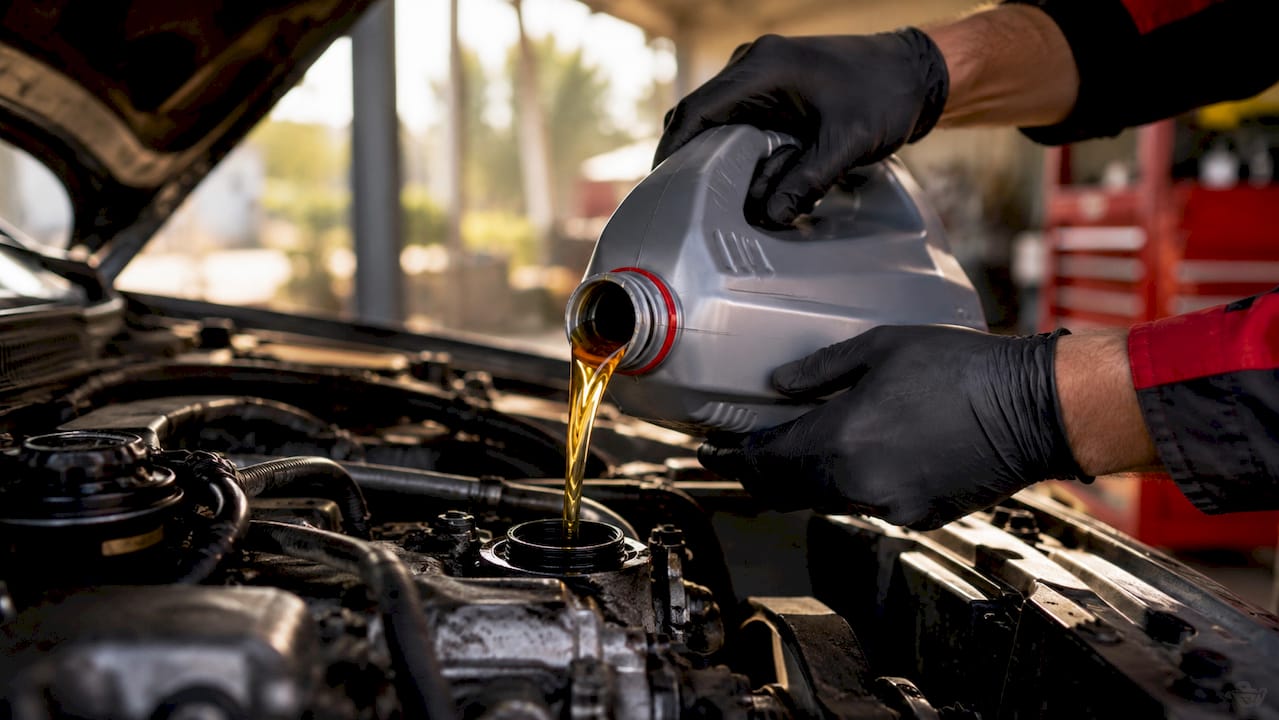
| Function | What it does | Why it matters |
|---|---|---|
| Lubrication | Creates a film between metal surfaces | Reduces metal-to-metal wear by up to 10,000 times |
| Cooling | Carries heat away from combustion zones | Manages up to 40% of engine heat not handled by coolant |
| Sealing | Fills gaps between piston rings and cylinder walls | Improves compression and reduces blow-by gases |
| Cleaning | Suspends soot, carbon, and particulates | Prevents sludge buildup in oil galleries and passages |
| Corrosion prevention | Neutralizes combustion acids | Protects metal surfaces from chemical degradation |
The lubrication function alone is staggering. A properly oiled engine reduces wear between surfaces by a factor that no mechanical fix can replicate. The cooling function is equally underappreciated. Your coolant handles the bulk of engine heat, but oil reaches areas coolant never touches, including crankshaft bearings, camshaft lobes, and piston skirts.
The cleaning function works because oil holds contaminants in suspension until the filter traps them or the oil is drained. When oil ages and loses this capacity, those particles settle into galleries and form sludge. Sludge restricts flow, starves components, and accelerates wear in a cycle that compounds quickly.
How is motor oil formulated, and why do additives matter?
Finished motor oil contains 70–99% base oil with up to 25% additives by volume. The base oil provides the foundational film. The additives do the specialized work that base oil alone cannot accomplish.
The most important additive categories include:
- Detergents: Keep combustion residue from bonding to metal surfaces
- Dispersants: Hold soot and carbon particles in suspension so they reach the filter
- Anti-wear agents (ZDDP): Form a sacrificial protective layer on high-load surfaces like camshaft lobes and lifters
- Viscosity modifiers: Keep oil flowing correctly across a wide temperature range
- Corrosion inhibitors: Neutralize acids produced during combustion
- Antioxidants: Slow oil oxidation and extend service life
The ZDDP (zinc dialkyldithiophosphate) additive deserves special attention. Classic vehicles with flat-tappet camshafts require higher zinc concentrations than modern low-emission oils typically provide. Running a modern low-zinc formulation in a vintage engine accelerates camshaft wear at a rate that surprises even experienced mechanics. This is not a minor compatibility issue. It is the difference between an engine that lasts decades and one that needs a rebuild.
Modern additive packages also address thermal stability. High engine temperatures cause base oil molecules to break down and oxidize. Without antioxidant additives, that breakdown accelerates, thickening the oil and reducing its ability to flow through narrow galleries.
Pro Tip: If you own a vehicle built before 1990 or one with a performance flat-tappet camshaft, ask your service provider specifically about ZDDP content before selecting an oil. Not all oils labeled “classic” or “vintage” contain adequate zinc levels.
How does the lubrication system circulate and protect engine components?
The oil pump is the heart of the lubrication system. It draws oil from the sump and pushes it through a network of drilled passages called oil galleries, delivering it to bearings, camshafts, valve train components, and piston cooling jets. The pump runs continuously whenever the engine runs.
Oil forms what engineers call a hydrodynamic film on moving surfaces. This film physically separates metal parts so they never touch directly. Think of it like a thin, pressurized cushion between two surfaces moving at high speed. The moment that film breaks down, metal contacts metal, and wear begins immediately.
The consequences of interrupted oil flow are severe:
- Bearing failure: Main and rod bearings depend entirely on oil pressure. Without it, they seize within seconds.
- Camshaft damage: Lobes and followers run under extreme contact pressure. Oil starvation causes scoring and pitting that cannot be reversed.
- Piston scuffing: Pistons expand with heat. Oil keeps clearances manageable. Without it, pistons seize against cylinder walls.
- Thermal runaway: Oil carries heat from combustion zones coolant cannot reach. Without that transfer, localized temperatures spike and warp metal.
Cold starts represent the most critical wear period in any engine’s life. Oil takes several seconds to circulate fully after startup, leaving some surfaces temporarily unprotected. Using the correct viscosity grade minimizes that window. A 0W-20 oil flows to critical surfaces faster at low temperatures than a 10W-40 would, which is exactly why manufacturers specify grades rather than leaving the choice to guesswork.
Pro Tip: Let your engine idle for 30 seconds before driving hard, especially in cold weather. This gives the oil pump time to build full pressure and coat all surfaces before load is applied.
What are the risks and consequences of poor engine lubrication?
Poor lubrication is the leading cause of premature engine failure. The damage mechanisms are well understood and entirely preventable.
- Increased friction and heat: Degraded oil loses its film strength. Metal surfaces generate more friction, which generates more heat, which degrades the oil faster. The cycle accelerates.
- Sludge formation: Old oil that can no longer suspend contaminants deposits them as sludge. Sludge blocks oil galleries, restricts flow to bearings, and can trigger oil pressure warnings.
- Acid corrosion: Combustion produces acids. Fresh oil neutralizes them. Aged oil cannot. Those acids attack bearing surfaces, cylinder walls, and valve train components.
- Catastrophic seizure: Engine seizure from zero oil pressure occurs within 30–45 seconds at idle. Bearings weld to journals. The result is total engine failure with no recovery short of a full rebuild or replacement.
- Viscosity mismatch: Using the wrong viscosity grade increases internal resistance, reduces fuel economy, and leaves critical surfaces under-protected at startup or high temperatures.
The repair costs that follow lubrication neglect are not modest. A bearing replacement runs into hundreds of dollars. A full engine rebuild or replacement can reach several thousand. The cost of a regular oil change is a fraction of either outcome.
Even a vehicle that sits unused accumulates damage. Moisture and combustion acids build up in oil over time, even without driving. A car parked for six months with old oil develops internal corrosion that a fresh oil change could have prevented entirely.
How should you select and maintain motor oil for your engine?
Selecting the right motor oil starts with your owner’s manual. The manufacturer specifies a viscosity grade and API service category based on your engine’s design, tolerances, and operating temperatures. That specification is not a suggestion.
The three main oil types differ in base stock quality and performance range:
- Conventional oil: Refined from crude oil. Suitable for older engines with simple designs and moderate operating demands.
- Synthetic blend: Mixes conventional and fully synthetic base stocks. Offers better protection at temperature extremes than conventional oil at a moderate price point.
- Full synthetic: Engineered base stocks with premium additive packages. Provides the best film strength, thermal stability, and cold-flow performance. Recommended for turbocharged engines, high-performance vehicles, and extreme climates.
Oil change intervals vary based on driving conditions, not just mileage. Short trips, heavy traffic, towing, and extreme temperatures all degrade oil faster than highway driving does. Mileage-based schedules often fail to reflect real-world degradation caused by short trips, heavy idling, and climate stress. Condition-based monitoring, using embedded oil quality sensors, offers a more accurate picture of when service is actually needed.
Checking your oil at home takes two minutes. Pull the dipstick, wipe it clean, reinsert it fully, and pull it again. The oil level should sit between the two marks. The color tells you something too. Fresh oil is amber. Dark brown oil is normal wear. Black, gritty oil means the oil is overdue for a change. Milky or foamy oil signals coolant contamination, which requires immediate professional attention.
Pro Tip: Check your oil level every time you fill your gas tank. Catching a slow leak or consumption issue early costs nothing. Catching it after the engine seizes costs everything.
For drivers who want the benefits of high mileage oil protection, switching to a high-mileage formula after 75,000 miles adds seal conditioners and extra detergents that address the wear patterns common in older engines.
Key Takeaways
Motor oil performs five simultaneous functions that no single alternative can replicate, making regular, correctly specified oil changes the most cost-effective engine protection available.
| Point | Details |
|---|---|
| Five critical functions | Motor oil lubricates, cools, seals, cleans, and prevents corrosion all at once. |
| Additives are not optional | ZDDP, detergents, and viscosity modifiers target specific wear and contamination challenges your base oil cannot handle alone. |
| Cold starts cause the most wear | Oil takes seconds to circulate at startup, making correct viscosity grade critical for protecting surfaces during that window. |
| Neglect leads to rapid failure | Engine seizure from lost oil pressure occurs within 30–45 seconds, making delayed maintenance a high-stakes risk. |
| Mileage alone is not enough | Driving conditions, climate, and oil age all determine when a change is needed, not just the odometer reading. |
What we have learned from years of oil changes at Express Lube & Car Care
The most common mistake we see is not skipping oil changes entirely. It is waiting too long because the car “seems fine.” Engines are remarkably tolerant of abuse right up until they are not. By the time a driver notices a noise, a warning light, or a performance drop, the damage is already done. Bearings do not announce their failure in advance.
What we have also observed is that drivers who understand what motor oil actually does treat maintenance differently. They stop seeing an oil change as an inconvenience and start seeing it as the single most effective thing they can do for their engine’s lifespan. That shift in perspective is worth more than any specific product recommendation.
The oil selection question comes up constantly. Our honest answer is always the same: follow your manufacturer’s specification first, then consider your driving conditions. A driver doing mostly short city trips in Texas heat needs to think about oil degradation differently than someone doing long highway miles in a mild climate. The signs your oil needs changing are real and readable if you know what to look for.
We also see the vintage engine problem regularly. Owners of classic cars often use whatever oil is on the shelf without realizing that modern low-zinc formulations can destroy a flat-tappet camshaft in a single season. That is an expensive and entirely avoidable lesson. Working with a service provider who asks the right questions before recommending an oil is not a luxury. It is basic due diligence.
— Express Lube & Car Care
Professional oil change service at Express Lube & Car Care
Your engine depends on the right oil, applied correctly, at the right interval. Express Lube & Car Care makes that easy with no-appointment-needed service, certified technicians, and oil change packages built around your vehicle’s actual specifications.
Check the current oil change service specials and see which package fits your vehicle and driving habits. Express Lube & Car Care serves drivers in Plano, TX, with fast turnaround, quality-grade oils, and a genuine commitment to getting the job done right. Military and healthcare providers receive special discounts as a thank-you for their service. If your engine needs more than an oil change, the engine diagnostics and repair team is ready to assess and address any underlying issues before they become costly failures.
FAQ
What does motor oil actually do for my engine?
Motor oil lubricates, cools, seals, cleans, and prevents corrosion simultaneously. It reduces metal-to-metal wear by up to 10,000 times and carries away up to 40% of engine heat not managed by coolant.
How often should I change my motor oil?
Follow your manufacturer’s recommended interval, but adjust for driving conditions. Short trips, heavy idling, towing, and extreme temperatures degrade oil faster than mileage alone reflects.
Does it matter which viscosity grade I use?
Yes. Using the wrong viscosity grade increases internal engine resistance, reduces fuel economy, and leaves critical surfaces under-protected. Always use the grade specified in your owner’s manual.
Can old oil damage my engine even if I don’t drive much?
Yes. Moisture and combustion acids accumulate in oil over time regardless of mileage. A vehicle parked for months with old oil develops internal corrosion that a timely oil change would have prevented.
What is the difference between conventional and full synthetic oil?
Conventional oil is refined from crude oil and suits older, lower-demand engines. Full synthetic uses engineered base stocks with premium additives, offering superior film strength, thermal stability, and cold-flow performance for modern, turbocharged, or high-performance engines.