

The right brake fluid is the grade your vehicle’s manufacturer specifies, and that is printed on the reservoir cap or in the owner’s manual. DOT 4 has higher minimum boiling points than DOT 3, so it holds up better under heat and as moisture builds up. That does not make it a free upgrade for every car, and it does not make DOT 3 a lesser choice in a car designed for it. This guide explains the real differences, what happens when the two are mixed, where DOT 5.1 fits, and how to settle the question for your own vehicle.
If you also searched for drilled vs slotted rotors, you will find a short answer near the end, because both choices come down to the same thing: matching the part to how you drive.
TL;DR
- DOT 3 and DOT 4 are both glycol-based brake fluids. DOT 4 has higher minimum dry and wet boiling points.
- Use the grade your vehicle manufacturer specifies. It is on the reservoir cap and in the owner’s manual.
- Brake fluid absorbs moisture over time, so the interval for changing it matters as much as the grade.
- DOT 5.1 is a different grade again, and a silicone-based DOT 5 is not interchangeable with either.
- Drilled and slotted rotors are both valid. Neither is better for every driver.
Table of Contents
- What the DOT numbers mean
- DOT 3 vs DOT 4: the differences that matter
- Why the wet boiling point is the one to watch
- Which brake fluid should you use?
- Can you use DOT 4 instead of DOT 3?
- Can you use DOT 3 where DOT 4 is required?
- What happens if you mix DOT 3 and DOT 4?
- Where DOT 5.1 and DOT 5 fit
- How often should brake fluid be replaced?
- Putting it to work: what a brake fluid service looks like
- Brake service in Plano without the wait
- Drilled vs slotted rotors: a short answer
- Fleet vehicles and brake fluid
- FAQ
- Sources
What the DOT numbers mean
“DOT” stands for the U.S. Department of Transportation. Its Federal Motor Vehicle Safety Standard No. 116 sets the minimum performance for each brake fluid grade sold in the country, including boiling point and viscosity (how easily the fluid flows). The numbers 3, 4 and 5.1 are grades under that standard, and they are not a quality ranking where a bigger number always wins.
Brake fluid does one job: it carries the force from your foot at the pedal to the brakes at each wheel. Liquids do not compress, so the force arrives right away. Gas does compress. If fluid near a hot caliper boils, vapor bubbles form and the pedal can feel soft or sink toward the floor. That is why boiling point is the number that matters most.
DOT 3 vs DOT 4: the differences that matter
The federal standard sets two boiling point minimums for each grade. The dry figure applies to fresh fluid straight from a sealed container. The wet figure applies to fluid that has absorbed a set amount of water, which is closer to what is in a car that has been on the road for a couple of years.
| DOT 3 | DOT 4 | |
|---|---|---|
| Minimum dry boiling point | 401°F (205°C) | 446°F (230°C) |
| Minimum wet boiling point | 284°F (140°C) | 311°F (155°C) |
| Base | Glycol ether | Glycol ether with borate ester |
| Viscosity limits | Set separately for each grade | Set separately for each grade |
The boiling point minimums come from 49 CFR 571.116, the federal brake fluid standard. The standard also sets different viscosity limits for each grade.
Three practical points follow from the table.
DOT 4 has more thermal headroom. The wet figure is 27°F higher. In a vehicle that tows, carries heavy loads, or drives long downhill grades, that margin is worth having, provided the manufacturer allows the grade.
Both grades absorb water. Glycol-based fluids are hygroscopic, meaning they pull moisture from the air through hoses and seals over time. Neither grade avoids this. You will sometimes read that DOT 4 “goes bad faster” than DOT 3. The safer way to put it is that every glycol-based fluid loses boiling point as it takes on water, and the interval for replacing it should follow the manufacturer’s schedule, not the grade number.
Viscosity is part of the design. Modern anti-lock braking (ABS) and stability control systems make fast, small pressure changes. Some vehicles are designed around fluids with specific flow characteristics in cold weather. That is another reason to follow the spec for your vehicle and not swap grades on a guess.
Why the wet boiling point is the one to watch
A new bottle never stays new inside a car. Moisture enters through microscopic pores in the rubber brake hoses and at the reservoir cap each time it is opened. As the water content rises, the boiling point falls toward the wet figure and, if the fluid is neglected, below it.
The federal standard makes the point itself. Brake fluid containers must carry a warning to keep the fluid clean and dry, because contamination with dirt, water, petroleum products or other materials may result in brake failure or costly repairs. That language is in the same federal standard that sets the boiling points.
For Texas drivers, the real-world picture is stop-and-go commuting, summer heat under the hood and the occasional long highway run with a loaded SUV or truck. Those conditions load the brakes with heat. They also make the age of the fluid a bigger deal than the debate over which grade is “best.” Fresh DOT 3 in a car designed for it will outperform old, wet DOT 4.
Which brake fluid should you use?
Work through these in order.
- Read the reservoir cap. Most vehicles print the required grade right on it, for example “DOT 3” or “DOT 4.”
- Check the owner’s manual. It lists the specification and, usually, the service interval.
- Follow the label on the fluid container. Federal rules require the container to tell you to follow the vehicle manufacturer’s recommendations when adding fluid.
- If the cap is unreadable or the manual is missing, have a technician look up the specification for your exact year, make and model.
Many European vehicles specify DOT 4 or a related low-viscosity version, and many domestic trucks and SUVs call for DOT 3 or DOT 4. Those are patterns, not rules. Specifications vary by model and even by trim, so treat the manual as the final word on your vehicle.
If you want to see where the fluid sits and what it should look like, our guide on how to check your brake fluid walks through the reservoir and what a low level can mean.
Can you use DOT 4 instead of DOT 3?
In most cases where the manufacturer lists DOT 3, DOT 4 is also acceptable, because both are glycol-based and the higher-spec fluid meets or exceeds the lower one’s boiling point minimums. Even so, the manufacturer’s listed grade is the one the braking system was engineered and tested with. If your manual says DOT 3 only, stay with DOT 3. If it says “DOT 3 or DOT 4,” either is fine, and DOT 4 gives you more heat margin.
Can you use DOT 3 where DOT 4 is required?
This is the direction to avoid. DOT 3 has lower minimum boiling points, and a system specified for DOT 4 may rely on that higher margin. A system that needs DOT 4 should get DOT 4. The same goes for motorcycles: use what the motorcycle manufacturer specifies, because the brake design and heat load differ from a car’s.
What happens if you mix DOT 3 and DOT 4?
Because both are glycol-based, a small top-off of one into the other does not usually cause an immediate chemical problem. The catch is performance. The mixture will not perform better than the lower grade, so you lose the benefit of paying for DOT 4. If the car calls for DOT 4 and has been topped off with DOT 3, the clean fix is a fluid exchange to bring the whole system back to the specified grade.
A need to top off frequently is also a warning sign in itself. Brake fluid should not disappear. A falling level can mean worn pads (the fluid level drops naturally as pads thin) or a leak. Either needs a look from a professional soon. Our article on spotting a dangerous brake fluid leak explains the signs, such as a soft pedal or fluid spots under the car.
Where DOT 5.1 and DOT 5 fit
DOT 5.1 is a glycol-based grade, labeled in the federal standard as “DOT 5.1 NON-SILICONE BASE.” It is built to higher boiling point minimums than DOT 4, and it is used in some performance and heavy-duty applications. Because it is non-silicone, it is generally compatible with DOT 3 and DOT 4 systems, but that does not mean you should switch to it on your own. Use it only when your vehicle manufacturer lists it.
DOT 5, by contrast, is silicone-based. It behaves differently from the glycol grades and should never be mixed with them. Unless your vehicle was built to run on it, it does not belong in the reservoir.
A simple way to remember it: DOT 3, 4 and 5.1 form one glycol family with rising heat margins. DOT 5 is a separate family.
How often should brake fluid be replaced?
The answer depends on your vehicle. Manufacturers publish intervals in the owner’s manual, and they differ widely: some call for replacement every two years, others by mileage, and some by condition. Whatever the grade, the water content keeps climbing with time and with the humid, hot conditions the fluid lives in.
Two of our guides go deeper on timing. Brake fluid change intervals covers the two-to-three-year rule of thumb against testing, and how often you need a brake fluid flush explains what a flush involves. If you are wondering whether you need one at all, is a brake flush necessary answers that directly.
Signs the fluid or the brake system needs attention include a spongy or low pedal, a brake warning light, dark or cloudy fluid in the reservoir, a burning smell after hard braking, or longer stopping distances. Any of these is a reason to have the brakes inspected promptly, not to wait for the next oil change.
Putting it to work: what a brake fluid service looks like
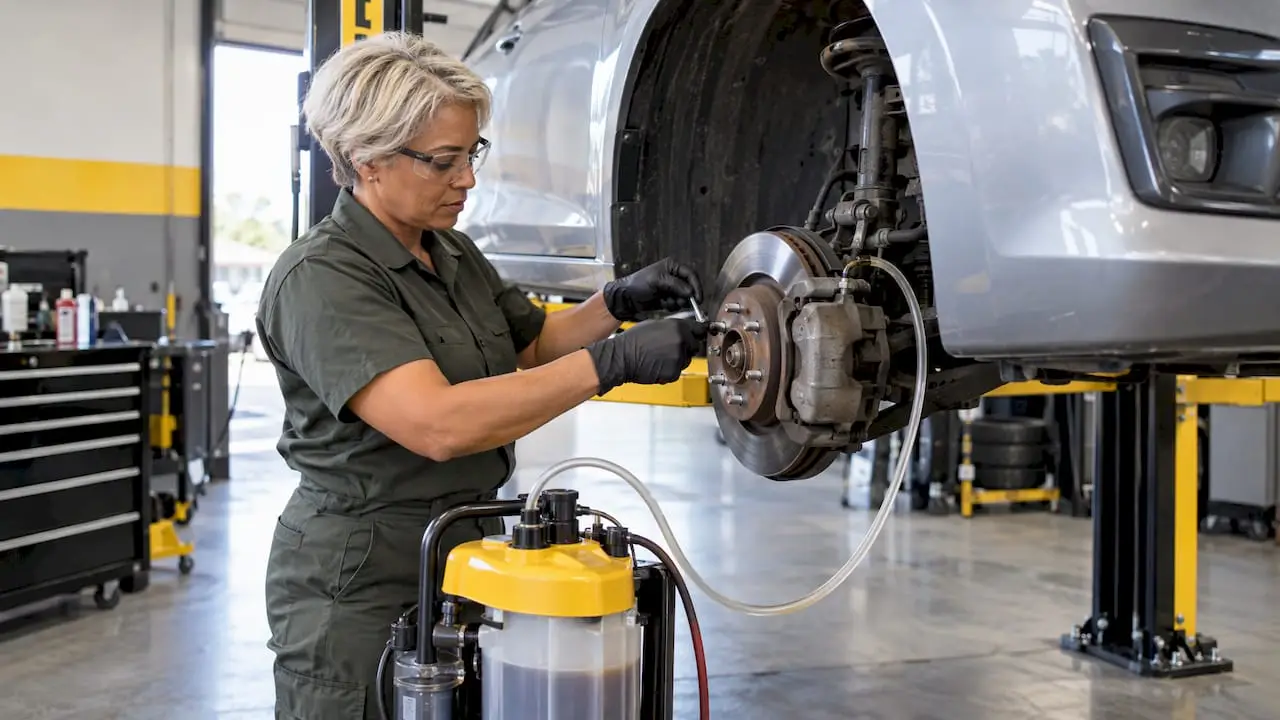
A correct brake fluid service is more than pouring in a new bottle. The technician confirms the specified grade for the vehicle, replaces the old fluid throughout the system, not only at the reservoir, and makes sure the system is free of trapped air so the pedal feels firm. The brake lines, hoses, calipers and pads can be looked at at the same visit. For a list of what is covered when brakes are inspected, see what brake service includes.
Brake service in Plano without the wait
At Express Lube & Car Care in Plano, brake repair and fluid exchange services are performed by ASE-certified technicians, and no appointment is needed. Most services are done the same day. Qualifying repairs are backed by a 24-month/24,000-mile limited warranty, whichever comes first, and qualifying suspension repairs carry a Lifetime Suspension Warranty. Eligibility, limitations and exclusions apply to both warranties, so ask us what covers your specific repair. Military and healthcare workers can ask about our discounts.
If your brake fluid is due, or you are not sure which grade your vehicle uses, stop by or look at our brake repair and fluid exchange services. You can also check the current brake coupon before you come in.
Drilled vs slotted rotors: a short answer
You may have landed here from a brake search after seeing both questions. Brake fluid and rotors are separate parts, but the logic is the same: pick what fits your driving.
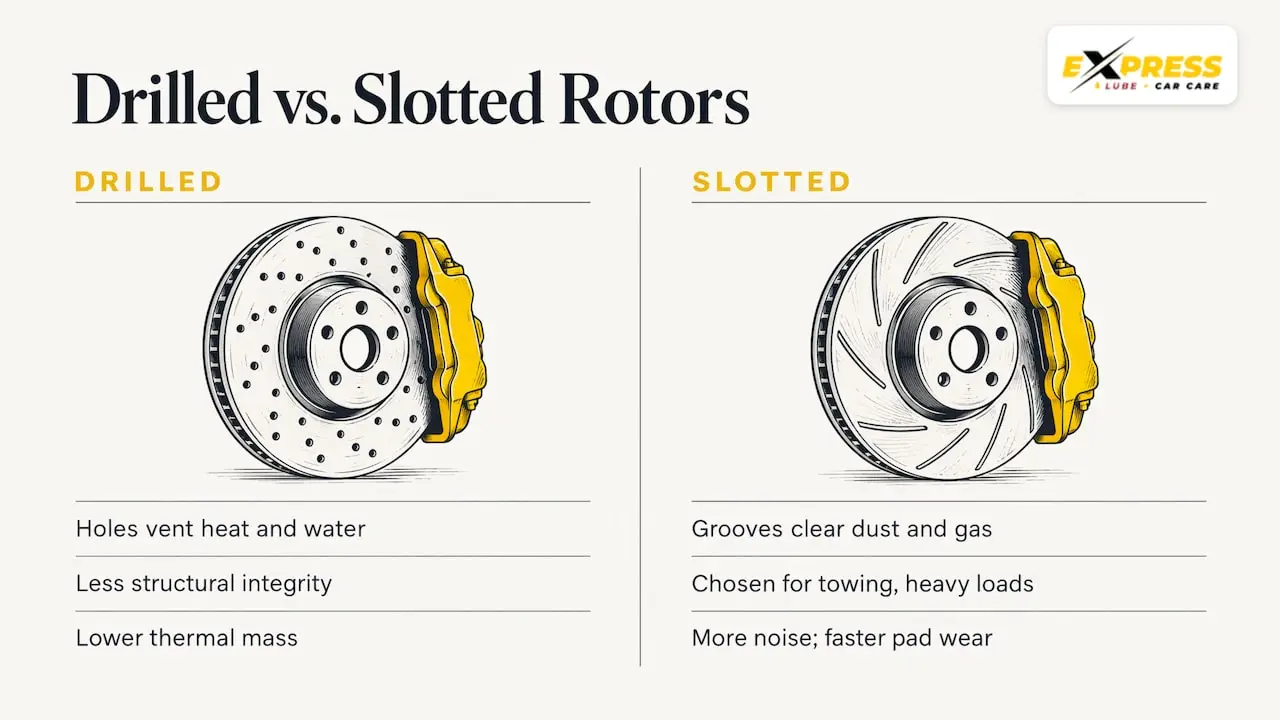
Drilled rotors have holes through the face. The holes help vent heat and water. The tradeoff is that holes remove metal. In an interview with Road & Track, a Brembo North America engineering manager said cross-drilling can help dissipate heat and water, but holes reduce a rotor’s structural integrity and thermal mass.
Slotted rotors have grooves cut across the face. They help clear dust and gas from between the pad and the rotor, and many drivers choose them for towing and heavy loads. They can add some noise and wear pads a little faster.
So are drilled rotors better? Not across the board. For ordinary commuting, school runs and highway driving, the rotors your vehicle came with are designed for that job. Drilled or slotted rotors make sense when your driving puts unusual demands on the brakes. If you are weighing it for a truck, SUV or performance car, tell the technician how you use the vehicle and what you tow, and they can recommend what fits. Rotor choice, like brake fluid grade, should be tied to your vehicle and how you use it.
Fleet vehicles and brake fluid
Fleet managers have a simple reason to care about the grade and the interval: a vehicle with brake fluid that is overdue is a vehicle waiting for a brake complaint. Fleets that run a mix of models will have a mix of specifications, so recording the required grade for each unit, along with its last fluid service, keeps the work consistent. Our fleet maintenance and repair service is set up for businesses with more than one vehicle.
Our perspective
Brake fluid is one of the quietest parts of a car. It does not make noise, it does not leak unless something is wrong, and most drivers never see it. That is exactly why it gets forgotten.
When customers ask us whether DOT 3 or DOT 4 is better, we steer the conversation to two better questions: what did the manufacturer design this system for, and how old is the fluid in it? The first sets the grade. The second sets the urgency.
We prefer to put the facts in front of you. Our digital vehicle inspections come with photos and technician notes, so you can see what we see before you decide on any brake or fluid work. We would rather you leave with a clear picture and a firm pedal than with a guess.
Because we work without appointments and handle most services the same day, a fluid exchange or brake inspection does not need to wait for a free weekend. Our technicians are ASE-certified, and qualifying repairs carry our 24-month/24,000-mile limited warranty, with eligibility, limitations and exclusions applying.
Express Lube & Car Care
FAQ
Is DOT 4 better than DOT 3?
DOT 4 has higher minimum dry and wet boiling points, so it offers more heat margin. Better only counts if your vehicle is designed for it. Use the grade your manufacturer specifies, and if the manual allows both, DOT 4 is a reasonable choice.
Which brake fluid should I use in my car?
Use the grade printed on the brake fluid reservoir cap or listed in your owner’s manual. If you cannot find it, a technician can look up the specification for your year, make and model. Do not guess, because the wrong fluid type can affect braking.
What happens if I mix DOT 3 and DOT 4?
Both are glycol-based, so a small amount of one in the other does not normally react badly. The mixture, however, performs like the lower grade. If the car needs DOT 4, have the system flushed and refilled with the specified fluid.
Can I use DOT 5.1 instead of DOT 4?
DOT 5.1 is a non-silicone, glycol-based grade with higher boiling point minimums, and it is generally compatible with DOT 3 and DOT 4 systems. Only use it if your vehicle manufacturer lists it. Never use silicone-based DOT 5 in a system built for the glycol grades.
How do I know if my brake fluid needs to be changed?
Check your owner’s manual for the interval, then look for a soft pedal, dark or cloudy fluid, or a brake warning light. A technician can also test the fluid’s condition. Because moisture builds up with age, replacement on the manufacturer’s schedule is the safest approach.
Sources
- eCFR: 49 CFR 571.116, Standard No. 116, Motor vehicle brake fluids
- eCFR: 49 CFR 571.116 (Jan. 7, 2025 version)
- Road & Track: Cross-Drilled Brake Rotors Aren’t Just Form Over Function