

The most common mass airflow (MAF) sensor symptoms are a check engine light, rough idle, hesitation or jerking when you accelerate, stalling, harder starting, worse fuel economy and, sometimes, black exhaust smoke. The sensor measures the air entering your engine so the computer can add the right amount of fuel. When its readings drift, every fueling decision after it drifts too.
None of these signs points only to the MAF sensor. A vacuum leak, a worn spark plug or a clogged filter can feel the same from the driver’s seat. This guide explains what a failing sensor feels like, why it often fails without a warning light, what else can look like it and how a proper diagnosis separates them.
TL;DR
- The usual signs are a check engine light, rough idle, hesitation, stalling, hard starting, poor mileage and occasionally black smoke.
- A dirty sensor can send readings that are wrong but still inside the allowed range, so there may be no light at all.
- Leaks in the intake, bad spark plugs and fuel problems can mimic a bad MAF sensor, so confirm before you replace parts.
- A steady check engine light needs attention soon. A flashing one means stop driving and get help.
- A technician with a scan tool can compare live airflow data with fuel trims and tell you whether the sensor is the problem.
Table of Contents
- What the mass airflow sensor does
- Eight mass airflow sensor symptoms to watch for
- Why there may be no warning light
- What else can look like a bad MAF sensor
- How a MAF sensor problem is diagnosed
- Can you drive with a bad MAF sensor?
- What happens if you unplug the MAF sensor?
- What causes a MAF sensor to go bad
- Our perspective: diagnose first, replace second
- When to get it checked in Plano
- How we can help
- FAQ
- Sources
What the mass airflow sensor does
The MAF sensor sits in the intake tube between the air filter box and the throttle body. Most designs use a thin heated wire or film. Air flowing past cools the element, and the sensor turns that cooling effect into an electrical signal. The engine computer reads the signal to work out how much air is coming in, then sets fuel delivery to match.
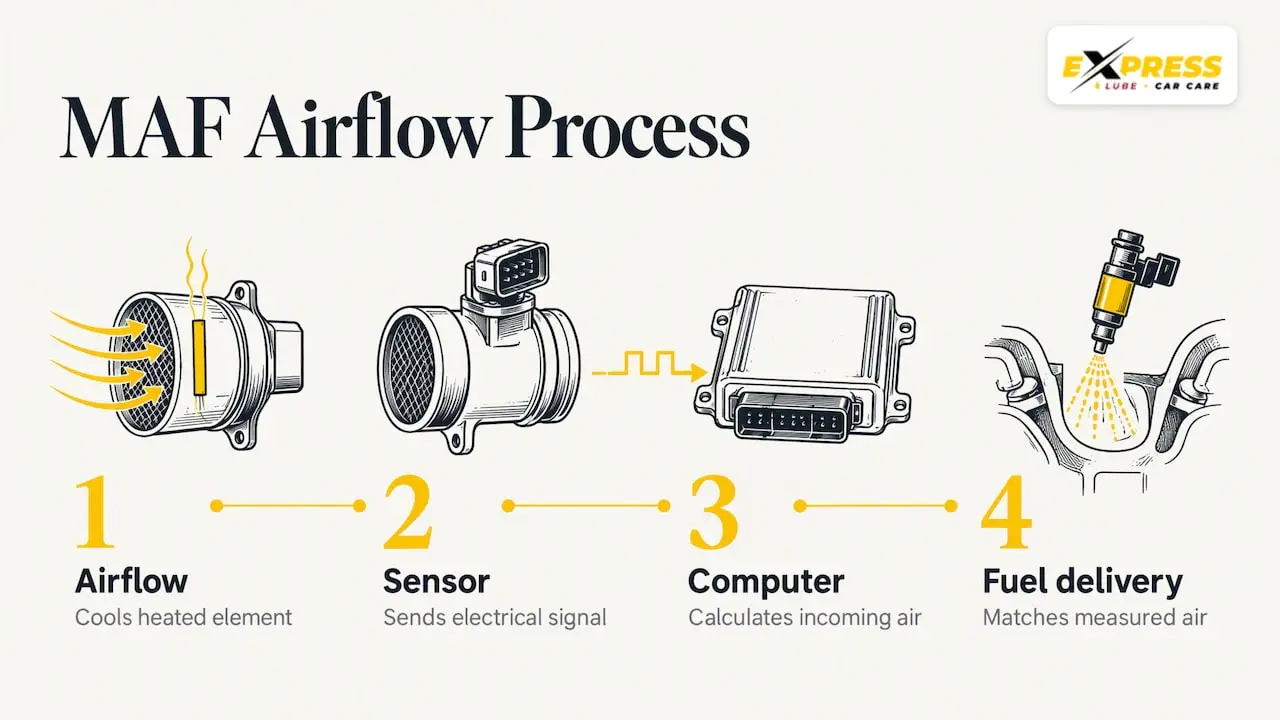
Think of a recipe where the cook has to guess the amount of flour. If the scale reads low, every batch comes out wrong, and it keeps coming out wrong the same way. That is why a sensor that is only slightly off can quietly hurt performance for months. As one diagnostic guide puts it, the MAF reading is the primary input for calculating how much fuel to inject.
Eight mass airflow sensor symptoms to watch for
1. A check engine light
A failing MAF sensor often sets a diagnostic trouble code. Codes in the P0100 to P0104 range are the typical ones, and lean conditions can also set P0171 and P0174. If you want to understand how those codes are read, our guide to reading check engine codes walks through it.
2. Rough or uneven idle
At idle the engine needs a very precise air and fuel balance. If the computer thinks less or more air is entering than really is, the idle may shake, hunt up and down or feel lumpy at a stoplight.
3. Stalling
The engine may die just after starting, or as you roll to a stop. If your car drops in RPM and cuts out at idle, see our article on engine stalling at idle for the other causes worth ruling out.
4. Hesitation or jerking under acceleration
You press the pedal and the car stumbles, lags or surges before it pulls. This is one of the most reported signs, because acceleration is when airflow changes fastest and a wrong reading shows up most.
5. Poor acceleration and weak power
If the sensor under-reports air, the computer delivers too little fuel and the engine feels flat. Contamination on the sensing element is a frequent cause. Oil from over-oiled performance air filters can bake onto the hot-wire element and insulate it from the airflow.
6. Worse fuel economy
When the engine runs rich, it burns more fuel than needed. When it runs lean, the computer often compensates in ways that still cost mileage. A slow, steady drop in miles per gallon with no other obvious cause is worth a diagnostic check.
7. Hard starting
An incorrect air reading at startup can leave the mixture off, so the engine cranks longer than it should before it catches.
8. Black smoke from the exhaust
In some cases a rich condition produces dark exhaust smoke. It is not the most common sign, but if you see it, do not wait for the next oil change to have it checked.
Why there may be no warning light
Many drivers expect the check engine light to come on first. With MAF sensors, that is not reliable. A dirty sensor can fail “in spec”: it sends readings that are wrong but still within the voltage range the computer accepts. In that case no code is set, and the engine can run lean or rich for thousands of miles. Drivers often describe the result as needing a tune-up.
This is also why the symptoms matter more than the dashboard. If the car hesitates, idles roughly or has lost mileage and the light is off, a scan-tool check can still find the problem. According to the same diagnostic guidance, watching live data is more effective than waiting for a code, because the computer keeps compensating with fuel trims until something else, such as a misfire, shows up.
What else can look like a bad MAF sensor
Before replacing a sensor, rule out the neighbors. Technicians stress that contamination and air leaks should be eliminated first, because the sensor is often fine and simply being overwhelmed by something else.
| Symptom | Could be the MAF sensor | Other common causes |
|---|---|---|
| Rough idle | Yes | Vacuum leak, worn spark plugs, dirty throttle body |
| Hesitation | Yes | Clogged fuel filter, ignition problems |
| Poor mileage | Yes | Failing oxygen sensor, low tire pressure, old plugs |
| Lean code (P0171, P0174) | Yes | Unmetered air leak after the sensor, weak fuel delivery |
| Stalling | Yes | Idle control problems, fuel delivery, electrical faults |
A few of these overlap with other pages we have written:
- Worn plugs cause misfires and hesitation. See signs of bad spark plugs.
- A restricted fuel filter starves the engine under load. See signs of a clogged fuel filter.
- A failing oxygen sensor can also hurt mileage and set codes. See bad O2 sensor symptoms.
- If several symptoms stack up, our list of signs your car needs a tune-up may help you sort them.
An intake leak deserves special mention. Air that enters after the MAF sensor is never measured, so the engine leans out and the computer’s fuel trims climb. Shops often use a smoke test to find these leaks. High positive fuel trims with no leak found are a strong sign of an under-reporting sensor, which is exactly why the leak check comes first.
How a MAF sensor problem is diagnosed
A code reader tells you a code number. It does not tell you why the code set. A proper diagnosis usually follows these steps:
- Scan for codes and freeze-frame data. This shows what the engine was doing when the fault was recorded.
- Look at live airflow data. The technician compares the sensor’s reading at idle and at higher RPM with what is expected for that engine.
- Check short-term and long-term fuel trims. Large, persistent corrections show the computer is fighting a wrong airflow number or a leak.
- Inspect the intake path. This includes the air filter housing, the tube between the sensor and throttle body, clamps, hoses and the sensor connector.
- Test for unmetered air. A smoke test or similar leak check finds the intake and vacuum leaks that mimic a bad sensor.
- Validate wiring and connections. Corroded pins or a loose plug can produce the same symptoms as a failed sensor.
Only after those steps does it make sense to clean or replace the sensor. That order can save you from buying a part you did not need. Each vehicle is different, so the right test values and the right repair depend on the make, model and engine.
Can you drive with a bad MAF sensor?
You can usually drive short distances, but it is not a good idea to keep going for weeks. A wrong air reading means the wrong amount of fuel, and long-term lean or rich running can wear spark plugs and stress the catalytic converter. Diagnostic experts note that proactive diagnosis avoids the higher costs of prolonged lean or rich running.
The type of light on your dash matters:
- Steady check engine light: the EPA explains that this means the vehicle needs service soon, not that you must stop at once. Schedule a diagnosis promptly, and avoid hard acceleration and towing in the meantime.
- Flashing check engine light: this signals a severe misfire that can damage the catalytic converter. Reduce speed, limit driving and get professional help right away. Our article on a flashing check engine light explains what to do.
- Stalling in traffic, loss of power on a highway ramp or a car that will not restart: this is a safety issue. Do not keep driving it, and have it towed or inspected.
If you want a broader picture of why the light comes on, read what causes a check engine light.
What happens if you unplug the MAF sensor?
Many drivers hear that unplugging the sensor is a quick test. Technicians do use it as a diagnostic step: if the engine runs better with it unplugged, that suggests the sensor was sending bad data. But it is a test, not a fix. On many vehicles the computer switches to a calculated airflow value based on throttle position and RPM, and the engine runs in open loop. That means poor fuel economy, higher emissions and possible catalytic converter damage if you drive that way for long.
If you try it yourself, turn the ignition off before you disconnect or reconnect any sensor. It also will not “reset” anything lasting. Clearing a code or disconnecting a battery only erases the stored fault, and the symptoms return if the cause is still there.
What causes a MAF sensor to go bad
- Dirt and oil film. Fine debris, or oil carried in from an over-oiled reusable air filter, coats the sensing element.
- A damaged or poorly fitted air filter. Unfiltered dust reaches the sensor.
- Intake leaks. Cracked tubes or loose clamps let unmeasured air in and confuse the fuel trims.
- Electrical faults. Corroded connectors, damaged wires or a weak ground distort the signal.
- Age and heat. Like any electronic part, a sensor can simply wear out.
A clean, correctly fitted air filter that is replaced on the schedule in your owner’s manual is the simplest protection. Intervals vary by vehicle and driving conditions, so follow the manufacturer’s recommendation.
Our perspective: diagnose first, replace second
We see the same pattern again and again. A driver comes in saying the car hesitates and the mileage has dropped, and wonders whether it needs a new sensor. Sometimes it does. Just as often the sensor is dirty, an intake hose has a crack or the spark plugs are overdue. Replacing the first part that fits the symptom is the surest way to pay twice.
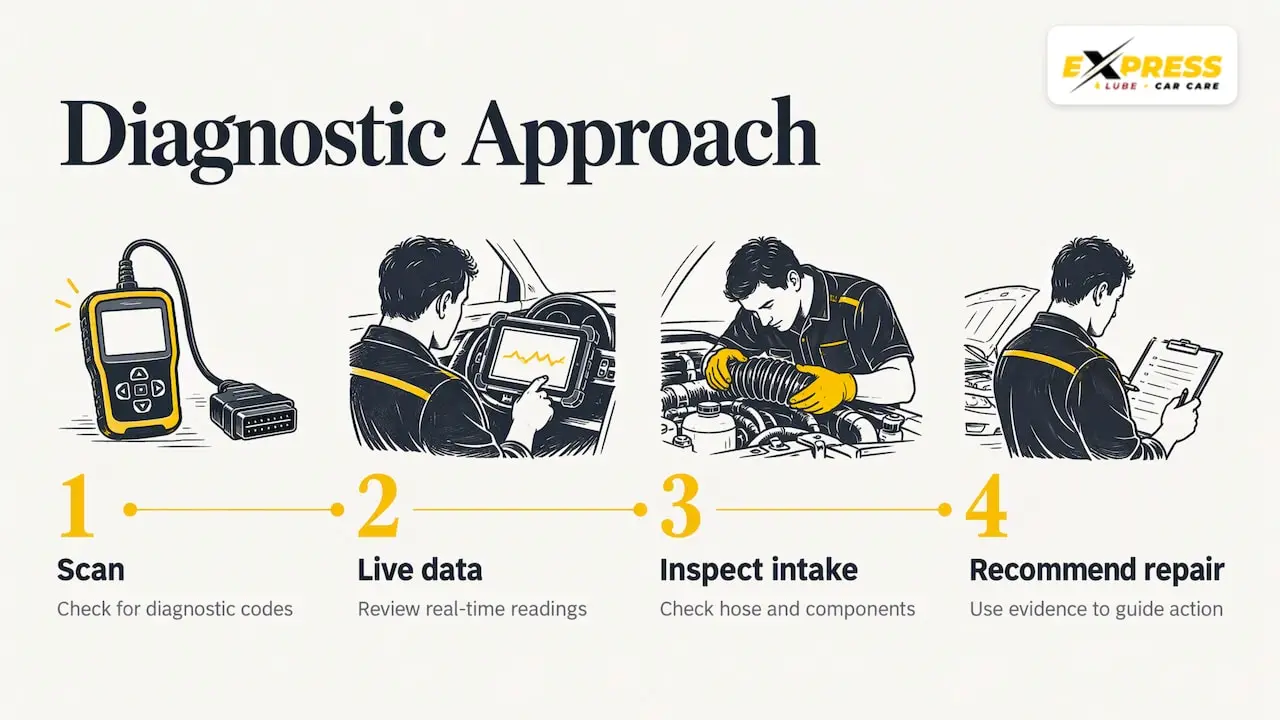
Our approach is to scan, look at live data, inspect the intake and then recommend only what the evidence supports. Our technicians are ASE-certified, and we provide digital vehicle inspections with photos and technician notes, so you can see what we saw rather than take our word for it. We do not promise that every symptom comes from one part, and we will tell you when a cheaper fix is the right one. If your vehicle has a safety concern, such as stalling in traffic, we will say so plainly.
We also know many readers cannot spare a day. Walk-ins are welcome, with no appointment needed, and most services are completed the same day.
— Express Lube & Car Care
When to get it checked in Plano
Book a diagnosis if you notice any of these:
- Hesitation, surging or jerking that repeats over several drives
- A steady check engine light together with rough running
- Idle that dips or hunts at stoplights
- A noticeable and lasting drop in mileage
- Black smoke, stalling or hard starting
Texas rules also give a practical reason not to wait. Since 2025, non-commercial vehicles no longer need a safety inspection before registration, but Collin County drivers still have to pass an emissions test. A lit check engine light with an unresolved fault can complicate that test, so it helps to sort out the cause beforehand. Check the current requirements for your own vehicle with the Texas DPS and your county before you go.
How we can help
At Express Lube & Car Care in Plano, a check engine light or drivability problem starts with a proper scan and inspection. Our check engine and diagnostic services cover codes, live data and intake checks, and if the cause turns out to be bigger, we also handle engine repair and auto electrical repair. We offer discounts for military and healthcare providers. Qualifying repairs carry a 24-month/24,000-mile limited warranty, whichever comes first, and eligibility, limitations and exclusions apply. Pricing depends on your vehicle and what the inspection finds, so we do not quote a fixed number here.
Stop by without an appointment, or contact us through the site to describe the symptoms you are noticing.
FAQ
What are the warning signs of a bad mass airflow sensor?
The common signs are a check engine light, rough idle, hesitation, stalling, hard starting and reduced fuel economy. Some cars also show black exhaust smoke. Because other faults can cause the same symptoms, a scan-tool diagnosis is the reliable way to confirm.
Can a dirty MAF sensor be cleaned instead of replaced?
Sometimes, if the problem is light contamination. Use only a cleaner made for MAF sensors and never touch the sensing element. Cleaning will not help if the sensor is electrically failed or if the real fault is a leak, so have the cause confirmed first.
Can I drive with a bad MAF sensor?
Short trips are usually possible, but extended driving can waste fuel, raise emissions and stress the catalytic converter. If the check engine light is flashing or the car stalls or loses power, stop driving and get professional help.
How do I reset a MAF sensor?
There is no true reset that fixes a failing sensor. Clearing codes only erases the stored fault, and the light returns if the problem remains. Diagnose the cause, then clean or replace the sensor if it is the culprit.
Does a bad MAF sensor always trigger a check engine light?
No. A contaminated sensor can send readings that are wrong yet still within the accepted range, so no code is stored. That is why symptoms like hesitation and poor mileage should be checked even when the dash is clear.
Sources
- How to Test a MAF Sensor, AutoDTCs
- 8 Symptoms of a Bad Mass Air Flow (MAF) Sensor, The Motor Guy
- Failure in Spec: What Happens When a Mass Airflow Sensor Lies, Vehicle Service Pros
- Environmental Fact Sheet: Frequently Asked Questions About On-Board Diagnostics, EPA
- What To Know About 2025 Texas Vehicle Safety Inspections In Collin County, Local Profile